
Opinion & Analysis
The Wedge Guy: Industry insight – Birth of an idea


A GolfWRX reader wrote me the other day to ask how I got into the design and specialization in wedges, so I thought I would share this story with you all. I hope you find it interesting.
As most of you know, I’ve been in the golf equipment industry for almost 40 years. I actually started out on the marketing side but evolved into a club designer as well, as my tinkerer personality and habits began to manifest. My marketing background actually serves my club design work, because all impactful product development springs from an awareness of a genuine consumer problem or opportunity, whether it’s a golf club or an iPod.
As for that tinkerer personality, I was the kid who always took my toys apart to see how they worked and then put them back together—hopefully, so that they would work again. That mechanical curiosity was nurtured by my patient father, who entertained all my questions as we took apart our fishing reels, shotguns, etc. to clean and maintain them.

When I became involved in the golf industry, I spent an inordinate amount of time in the back end of Ray Cook and Otey Crisman putters, Joe Powell Golf, and others, as I was completely fascinated with how and why golf clubs worked. You see, I don’t remember life before golf–another gift from my father. He and our local golf pro nurtured my commitment and curiosity about the golf swing and the game while mentoring me to become a scratch golfer.
Anyway, that curiosity and imagination led me to my first original putter design in the mid-1980s and then over a hundred more putter designs in the years following.
But it was a golf trip to Scotland in 1990 that triggered my interest in wedges. My brother and I had played the New Course at St. Andrews our first day there and the tight lies and firm turf proved challenging with my then-new “brand X” sand wedge.
As we were touring Auchterlonie’s Golf Shop the next morning, I saw a grinding wheel and an idea just came to me. I asked if I could come back with a wedge to grind on it some, to which they said OK.
So, I went back to the hotel and got my conventional sand wedge – this was long before all these diverse grind options were available. I don’t think wedges even had a bounce designation on them at the time.
Anyway, I proceeded to grind away on the trailing part of the sole until I had reduced the bounce by probably half. I wasn’t really measuring as much as eyeballing. Then–and why this idea hit me, I’m not sure–I proceeded to grind the leading 1/4 or so of the sole to create a very aggressive bounce in the range of 20-25 degrees. In fact, I ground almost all the way up to the first groove, making the wedge look very odd.

By this time, the wedge was butchered pretty good, as I was not a trained grinder by any stretch of the imagination. So, I then ground more off the bottom of the hosel and in the heel to make it as visually palatable as I could. By the time it got to looking reasonable, of course, I had compromised the head weight dramatically.
So, I bought or borrowed some lead tape from the shop and proceeded to pack the back of the wedge to bring it back up to D4-5, as I remember.
And the results were very gratifying. Hardpan to bunkers, soft lie to rough—this thing was odd-looking, but amazing. My brother and I took turns with my wedge the rest of the trip – from Carnoustie to The Old Course, Turnberry, and Troon. He even nicknamed it “Quasimodo,” after the character in The Hunchback of Notre Dame. We were both extremely excited about what I had created in the back of the shop in “The Old Grey Toon,” as St. Andrews is often called.
So, when I returned to the states, I bought several conventional sand wedges out of the bargain barrels and began to experiment–this time in a bit more sophisticated manner. I found a welder who would add material onto the soles and purchased a grinder so that I could try different grinds. Each time, I would take them out for testing by myself and by some very good players I knew. But I also had mid- to high-handicap players testing, and they were even more enthused than the scratch players and pros in my test group.
[NOTE: That’s when also began to realize there was a big difference in the wants and needs from wedges between the better players and those not so advanced]
And that was how “the Koehler Sole” was invented.
After three years of legal work, in 1994 I was awarded U.S. Patent #5,301,944 for incorporating two positive bounce angles into the sole of a club. And I have incorporated that feature into every wedge I’ve ever designed, from Merit Golf to EIDOLON to SCOR to Ben Hogan, and now for Edison Golf. It’s been called the “Dual Bounce Sole™” and the “V-Sole®”, but each iteration has been an improvement on the one before, and it has earned a pretty loyal following through those brands.
I should add that along this journey, I also began to dramatically increase the mass in the top half of the wedge as well.
But that’s another story I am happy to tell if you are interested.










This past Monday, I played in the U.S. Amateur local qualifier at Rock Creek Country Club in Portland, Oregon. A full tee sheet from 7:30 a.m. to 1:55 p.m., the top 11 scores would make it to the U.S. Amateur final qualifying.
I teed off at 10:48 a.m.. With the 7:30 am tee time, you can get a feel for the leaders’ pace, and they were off and running on the challenging setup at Rock Creek.
View this post on Instagram
Getting to the highlight of the round on the par five 17th, a drive up the left side and 212 yards left to the front hole location. I took out a 5-iron with plans of middle of the green. The ball ended up 8 feet left of the hole, pin high. A slight downhill putt dropped in for an eagle 3 on the 17th. With the cut line looking to be anywhere from -2 to even par. This was the boost I had been waiting for all day.
With making par from the trees on 18, it was time to wait for a potential playoff with a posted score of one under par 71.
Three hours later, it was playoff time. 8 players for 6 spots. I made par on the playoff hole, which was good enough to advance to the U.S. Amateur final qualifying in July. USGA qualifiers sure deliver on all of the emotions in golf!
Club Junkie
Building my 2026 gamer WITB: Ranking the contenders and new putter projects – Club Junkie Podcast

The annual What’s In The Bag build is underway, and on this episode of Club Junkie, Brian breaks down the clubs currently leading the race for a spot in his 2026 gamer setup. From drivers and fairway woods to irons, wedges, and shafts, he ranks the equipment that’s performing best and explains what’s separating the front runners from the rest of the field.
Brian also heads into the workshop to discuss several putter projects currently on the bench. From head options and shaft choices to build ideas and testing plans, he shares what he’s working on and which putters could become serious contenders for the bag this season.
If you’re a gear junkie who loves equipment testing, club building, and the never-ending pursuit of the perfect setup, this episode is for you.
Follow Club Junkie:
Instagram: @clubjunkiepod
TikTok: @clubjunkiepod
Threads: @clubjunkiepod
X: @ClubJunkiePod
Club Junkie
Tour Edge Exotics mini driver review + TaylorMade Spider ZT Max first look – Club Junkie

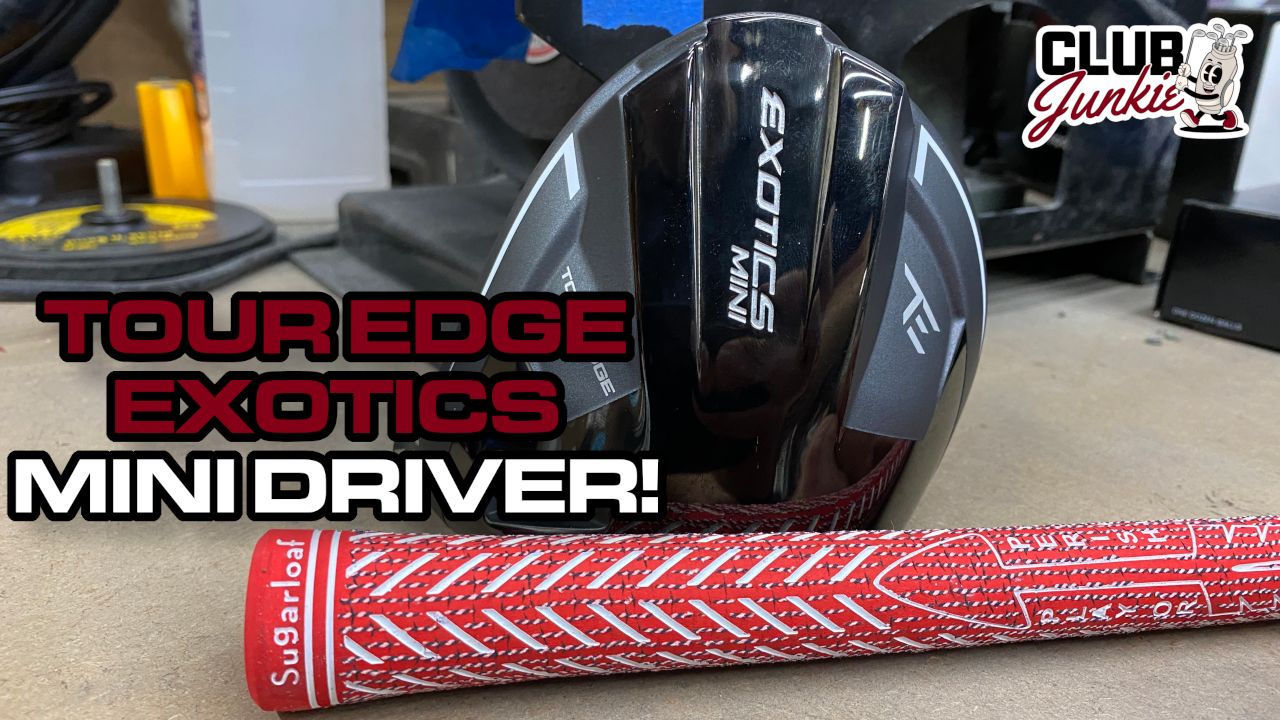
On this episode of Club Junkie, I put the new Tour Edge Exotics Mini Driver to the test and break down the performance, forgiveness, distance, and where it fits compared to a traditional driver or strong fairway wood. If you have been curious about adding a mini driver to the bag, this one is worth a look.
I also dive into the new TaylorMade Spider ZT Max putter that was recently spotted and discuss the growing zero torque putter trend. Plus, there is a closer look at the new Project X Titan Yellow shaft showing up on the PGA Tour and what makes it different from other profiles currently out there.

Justin Rose WITB 2026 (April): Full WITB breakdown with new McLaren irons

What’s the story behind Webb Simpson’s custom-stamped irons?

Memorial Tournament Tour Report: Rory McIlroy, Cameron Young switch up drivers, and more

Cadillac Championship Tour Report: Spieth’s sizable changes, McLaren Golf launches, and more

Russell Henley’s winning WITB: 2026 Charles Schwab Challenge

Kristoffer Reitan’s winning WITB: 2026 Truist Championship

Aaron Rai’s winning WITB: 2026 PGA Championship

J.T. Poston’s winning WITB: 2026 Memorial Tournament

Best irons 2026: Best irons overall, most forgiving irons, and more

Cameron Young’s winning WITB: 2026 Cadillac Championship


Bud Cauley WITB 2026 (June)
Bud Cauley had >14 clubs in his bag when photographed prior to the Memorial Tournament. Driver: Titleist GTS2 (8 degrees) Shaft: Fujikura...


Hannah Green WITB 2026 (June)
Driver: Titleist GTS3 (10 degrees, D4 SureFit setting) Shaft: Mitsubishi Chemical Diamana RB 53 S 3-wood: Titleist GT3 (15 degrees,...


Asterisk Talley WITB 2026 (June)
Driver: TaylorMade Qi4D (9 degrees) Shaft: Fujikura Ventus Blue 6 S 3-wood: TaylorMade Qi4D (16.5 degrees) Shaft: Fujikura Ventus Blue...


Brianna Do WITB 2026 (June)
Driver: Callaway Quantum Triple Diamond (9 degrees) Shaft: KBS PGW 3-wood: Callaway Elyte Titanium (15 degrees) Shaft: KBS PGW 5-wood:...
-
 Equipment6 days ago
Memorial Tournament Tour Report: Rory McIlroy, Cameron Young switch up drivers, and more
-
 News1 week ago
Russell Henley’s winning WITB: 2026 Charles Schwab Challenge
-
 Whats in the Bag3 days ago
J.T. Poston’s winning WITB: 2026 Memorial Tournament
-
 Equipment3 days ago
Best irons 2026: Best irons overall, most forgiving irons, and more
-

 Equipment1 week ago
Details on Jason Day’s latest prototype Avoda iron setup
-

 Equipment3 weeks ago
CJ Cup Byron Nelson Tour Report: Koepka and Kim’s newest putters finally get hot
-

 News2 weeks ago
Charles Schwab Challenge Tour Report: MacIntyre, Åberg and Spaun all switch putters, TaylorMade launches new Spider
-

 Equipment2 weeks ago
Details on J.J. Spaun’s surprise putter switch


Paul
Mar 25, 2021 at 5:15 pm
What ever became of Quasimodo?
Paul G.
Mar 24, 2021 at 12:18 pm
Just wanted to say how much I enjoyed reading this particular article. I’m a (Canadian) Mechanical Engineer who’s dove into club building on the side as a hobby. It’s always been a fantasy dream of mine to work as a design or manufacturing engineer in the golf industry and these articles by Terry always seem to give me that glimpse into that world from a professional point of view. Apart from being a good writer I find your passion for the game and process of it always comes through, so thanks for that and keep up the great content.
Also wanted to mention I recently cut down my stock length driver after reading a few of your articles. The first round out was really positive from an impact point – thanks for the tip there, feels like I’ll be smoking the sweet spot a lot more this summer.
Hope to keep seeing your articles every week, Terry.