
Opinion & Analysis
Sand Saves: How often should you actually get “up-and-down” from the bunker based on your handicap?


This is a follow-up to my recent article,“How often should you … get ‘Up-and-Down’ based on your handicap?” That article focused on short game shots around the green that were NOT sand shots. If you have not read it, please do as I will not be repeating all of the supporting points in this article.
The traditional “Sand Save” stat has long been the accepted measure of skill from greenside sand. The chart below shows average performance in this area for PGA Tour players and an array of handicap levels. It refers to sand shots around the green and within 50 yards of the hole.
How do you fit in?
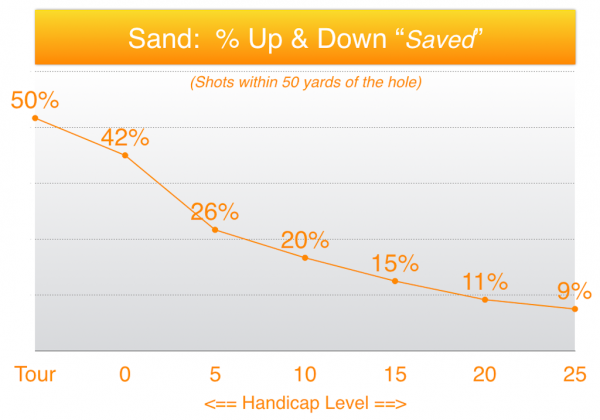
While sand saves, or “up and downs,” are nice, I do not believe them to be an appropriate or accurate measure of short game skill. Sand shots are quite a bit different than chipping or pitching, not only because they are a very different skill, but also because they tend to occupy a much smaller part of the overall game.
Non-sand short game shots generally range from a low of four or five shots per round at the top levels of the game, to as many as 15 shots at the other end. For perspective, the typical 15-19 handicap golfer averages about 10 non-sand short game shots per round. Shots from the sand are relatively rare, usually only 1 to 3 per round, and the 15-19 handicap golfer averages less than two.
Despite their reduced role, however, sand shots can have a meaningful impact on score. Why? It’s due to the difficulty of these shots and their high incidence of ERRORs, which I will discuss more below.
Again, I do NOT believe that “up and downs” are an appropriate or accurate measure of short game skill for two reasons:
- An up-and-down is actually the combination of two skills: Short Game and Putting.
- The stat totally ignores ERRORS, or shots that miss the green.
In my 30+ years of studying golf performance at all skill levels, I have found that FREQUENCY and SEVERITY of bad shots (errors) do so much more to influence a player’s scoring level than do all the good shots. I did not create my stat program to expose the errors in the game, but my early work and analysis revealed exactly how important they are, as well as their glaring omission from existing, traditional stats. Accordingly, I built the ability to capture data on the common errors in the game into ShotByShot.com.
The true measure of a player’s short game skill is their Strokes Gained in that facet. BUT, that is simply a number — a positive number is good, and a negative number is not so good. So how then to best display the skill that is associated with the Strokes Gained number? I believe the combination of the three stats below to be the correct way to display skill from the sand:
- Average putting distance when the green is successfully hit.
- Percent of shots hit to within 8 feet of the hole.
- Percent of errors, or shots that miss the putting surface.
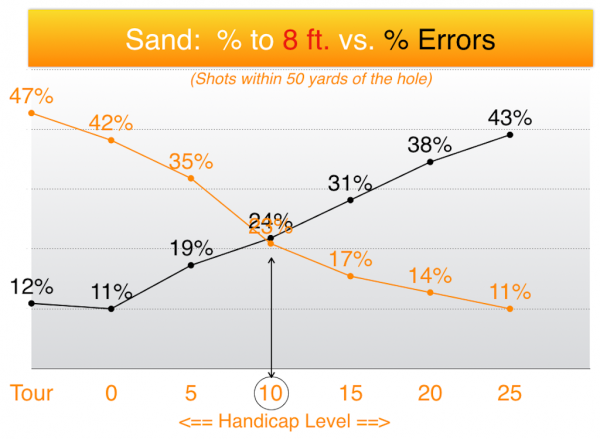
In the chart above, the orange line represents the percentage of shots that the various levels of handicap golfers hit to within 8 feet of the hole. Why 8 feet? Our data has told us that this distance represents a good shot, just as 5 feet does in Chipping and Pitching around the green. The black line represents shots that miss the green (errors). For example, if you are the average 15-handicap golfer, you should be getting about one of every six sand shots to within 8 feet. You’ll miss the green with about one in every three sand shots, however, so you’ll make twice as many errors as you make good shots.
Note that the two lines cross at about a 10 handicap. A 10 handicap is actually a better golfer than 90 percent of the people who play the game regularly. Yet for every sand shot that they successfully get to within 8 feet of the hole, they are also sculling or leaving one in the sand and missing the green altogether. Further, these errors can lead to even more difficult positions, large numbers and real frustration.
Finally, a fear of the greenside sand can dramatically impact confidence and ability to hit greens. If you are having difficulty from the sand, I suggest that you first consult with your pro about your sand wedge. Is it the right loft and bounce for your game and the condition of your course’s sand? Then work to gain confidence in getting OUT. Just focus on getting the ball on the green. Forget the about the “save” until you can practice enough to reliably play the array of sand shots required with confidence.
If you’d like to see how greenside errors are affecting your game, as well as where you stack up to golfers in your handicap level, you can register for a FREE TRIAL of my strokes-gained analysis at ShotbyShot.com










This past Monday, I played in the U.S. Amateur local qualifier at Rock Creek Country Club in Portland, Oregon. A full tee sheet from 7:30 a.m. to 1:55 p.m., the top 11 scores would make it to the U.S. Amateur final qualifying.
I teed off at 10:48 a.m.. With the 7:30 am tee time, you can get a feel for the leaders’ pace, and they were off and running on the challenging setup at Rock Creek.
View this post on Instagram
Getting to the highlight of the round on the par five 17th, a drive up the left side and 212 yards left to the front hole location. I took out a 5-iron with plans of middle of the green. The ball ended up 8 feet left of the hole, pin high. A slight downhill putt dropped in for an eagle 3 on the 17th. With the cut line looking to be anywhere from -2 to even par. This was the boost I had been waiting for all day.
With making par from the trees on 18, it was time to wait for a potential playoff with a posted score of one under par 71.
Three hours later, it was playoff time. 8 players for 6 spots. I made par on the playoff hole, which was good enough to advance to the U.S. Amateur final qualifying in July. USGA qualifiers sure deliver on all of the emotions in golf!
Club Junkie
Building my 2026 gamer WITB: Ranking the contenders and new putter projects – Club Junkie Podcast

The annual What’s In The Bag build is underway, and on this episode of Club Junkie, Brian breaks down the clubs currently leading the race for a spot in his 2026 gamer setup. From drivers and fairway woods to irons, wedges, and shafts, he ranks the equipment that’s performing best and explains what’s separating the front runners from the rest of the field.
Brian also heads into the workshop to discuss several putter projects currently on the bench. From head options and shaft choices to build ideas and testing plans, he shares what he’s working on and which putters could become serious contenders for the bag this season.
If you’re a gear junkie who loves equipment testing, club building, and the never-ending pursuit of the perfect setup, this episode is for you.
Follow Club Junkie:
Instagram: @clubjunkiepod
TikTok: @clubjunkiepod
Threads: @clubjunkiepod
X: @ClubJunkiePod
Club Junkie
Tour Edge Exotics mini driver review + TaylorMade Spider ZT Max first look – Club Junkie

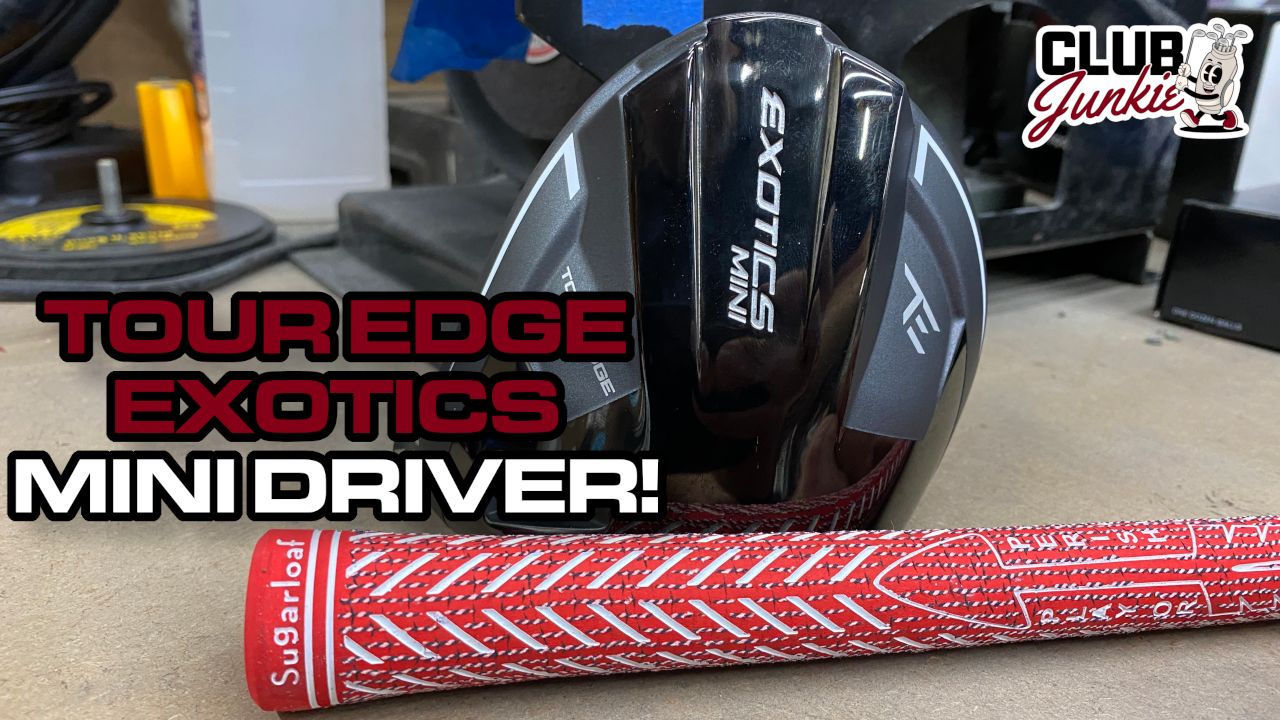
On this episode of Club Junkie, I put the new Tour Edge Exotics Mini Driver to the test and break down the performance, forgiveness, distance, and where it fits compared to a traditional driver or strong fairway wood. If you have been curious about adding a mini driver to the bag, this one is worth a look.
I also dive into the new TaylorMade Spider ZT Max putter that was recently spotted and discuss the growing zero torque putter trend. Plus, there is a closer look at the new Project X Titan Yellow shaft showing up on the PGA Tour and what makes it different from other profiles currently out there.

Justin Rose WITB 2026 (April): Full WITB breakdown with new McLaren irons

What’s the story behind Webb Simpson’s custom-stamped irons?

Memorial Tournament Tour Report: Rory McIlroy, Cameron Young switch up drivers, and more

Cadillac Championship Tour Report: Spieth’s sizable changes, McLaren Golf launches, and more

Russell Henley’s winning WITB: 2026 Charles Schwab Challenge

Kristoffer Reitan’s winning WITB: 2026 Truist Championship

J.T. Poston’s winning WITB: 2026 Memorial Tournament

Best irons 2026: Best irons overall, most forgiving irons, and more

Aaron Rai’s winning WITB: 2026 PGA Championship

Cameron Young’s winning WITB: 2026 Cadillac Championship


Bud Cauley WITB 2026 (June)
Bud Cauley had >14 clubs in his bag when photographed prior to the Memorial Tournament. Driver: Titleist GTS2 (8 degrees) Shaft: Fujikura...


Hannah Green WITB 2026 (June)
Driver: Titleist GTS3 (10 degrees, D4 SureFit setting) Shaft: Mitsubishi Chemical Diamana RB 53 S 3-wood: Titleist GT3 (15 degrees,...


Asterisk Talley WITB 2026 (June)
Driver: TaylorMade Qi4D (9 degrees) Shaft: Fujikura Ventus Blue 6 S 3-wood: TaylorMade Qi4D (16.5 degrees) Shaft: Fujikura Ventus Blue...


Brianna Do WITB 2026 (June)
Driver: Callaway Quantum Triple Diamond (9 degrees) Shaft: KBS PGW 3-wood: Callaway Elyte Titanium (15 degrees) Shaft: KBS PGW 5-wood:...
-
 Equipment6 days ago
Memorial Tournament Tour Report: Rory McIlroy, Cameron Young switch up drivers, and more
-
 News2 weeks ago
Russell Henley’s winning WITB: 2026 Charles Schwab Challenge
-
 Whats in the Bag4 days ago
J.T. Poston’s winning WITB: 2026 Memorial Tournament
-
 Equipment3 days ago
Best irons 2026: Best irons overall, most forgiving irons, and more
-

 Equipment1 week ago
Details on Jason Day’s latest prototype Avoda iron setup
-

 Equipment3 weeks ago
CJ Cup Byron Nelson Tour Report: Koepka and Kim’s newest putters finally get hot
-

 News2 weeks ago
Charles Schwab Challenge Tour Report: MacIntyre, Åberg and Spaun all switch putters, TaylorMade launches new Spider
-

 Equipment2 weeks ago
Details on J.J. Spaun’s surprise putter switch


Brad
Aug 3, 2018 at 5:01 am
The best thing to do on many of the bunkers around here is to take your putter or a 7 iron and just chip it out on the lowest side of the bunker, regardless of what direction that may be. Many of the bunkers are like wet concrete around here and the bunker technique used by most pros and taught by most coaching pros is entirely worthless and will only result in a skulled bunker shot 80% or more of the time. I would rather hit a flop shot over a bunker or over a 50 foot tall tree from a hard pan lie than have to get it out of most bunkers.
I would just love to see some of the best pros on tour get out of some of the kind of bunkers we have to play in sometime. There would be no end to the complaints from them I’m sure…
DaveyD
Aug 2, 2018 at 11:02 am
The charts above should be explained by the number of data points used to create the statistics. While the overall trends aren’t surprising and are most likely expected, these types of stats are kept for your players, but less likely to be kept as the handicap increases.
The last comment is in regard to putting, or rather the putting surface- in general. An assumption might be made that better golfers might play on better courses with better-maintained greens which could positively impact putting success.
DaveyD
Aug 2, 2018 at 11:03 am
The “your players” above should be “tour players”
Poot
Aug 2, 2018 at 2:04 am
You ain’t applying this to Links bunkers, that’s for sure. We saw what happened at Carnoustie last week, they were lucky just to get it out.
So, another meaningless “you’re an amateur and you suck” statistical analysis.
Paul
Aug 1, 2018 at 10:54 pm
Makes me feel better about my sand play!
I thought I was pretty average but I’m actually doing ok!
Tom54
Aug 1, 2018 at 2:21 pm
Kevin explains it well. Our bunkers at our course aren’t the greatest either. Depth of sand inconsistent. One shot you hit couple inches behind and it comes out great. Next bunker you’re in there’s no sand, the club bounces into the ball and over the green it goes. Lots of times our group plays move it out of footprints. Pros play off perfect lies why shouldn’t we?
Tee-Bone
Aug 1, 2018 at 1:58 pm
Strokes Gained on the PGA Tour are based on the averages of the field. Where are the averages from with your Strokes Gained programs?
Peter Sanders
Aug 2, 2018 at 9:09 am
Good Q! Our Strokes Gained model is based upon the average Scratch player. We calculate each players SG # vs. Scratch and then compare it to the average SG #’s in each facet for the player’s Target handicap range. It works!
Kevin
Aug 1, 2018 at 11:05 am
Sand save recovery stats are skewed as i’d guess the majority of amateurs aren’t playing courses where the greenside bunkers have several inches of sand and perfectly manicured like on tour. factor in that thousands of courses have little to no sand in some bunkers and the liklihood of a skull is much higher than a pga course. i always find it amusing when watching an instruction program on GC and they mention opening face and hitting 3 inches behind the ball. good luck when you come play in ohio and the bunker is hard packed. and its not goat tracks…a lot of really nice courses simply can’t afford to constantly replace/fill sand in their bunkers.
Mat
Aug 1, 2018 at 5:33 pm
Complete agreement. Sand, believe it or not, is expensive and getting rare. Traps are not worthy of a lot of practice outside of knowing your lie (your feet will tell you how far you sink in is how far behind the ball you enter) and getting out in one shot. If you’re a 10+, that’s the biggest challenge. Get out and two putt for bogey. Don’t take two to get out – that’s the card killer.
Pete McGill
Aug 2, 2018 at 2:08 am
True. My course has one hole with the only two bunkers. Players walk off with either 100% or zero in sand saves.