
Opinion & Analysis
The Wedge Guy: Mind the gap


One of the most important elements of optimizing your scoring range performance is to get consistent and reliable distance gapping in your prime scoring clubs. For this discussion, I’m referring to all your clubs of about 37-38 degrees of loft and higher.
The first challenge is to determine exactly which club in your set has that loft. If you have recently purchased a new set of irons, it could be very different from your last set. When I was a teenager in the 1960s, playing Hogan blade irons, that club would have had a “6” on the bottom. As iron technologies led to the constant strengthening of lofts, that migrated to a “7”, then to an “8”. But in many of the iron sets on the market today, that loft falls between the “8” and “9” irons.
The fact is, regardless of the number on the bottom of the club, when you get in range to hit shots with an iron of this loft or higher, you should consider yourself in prime scoring position. With those clubs, you should be hitting shots with a repeating, penetrating trajectory, reasonably consistent carry distance, and enough spin to hold the greens. And that’s where I see many of the modern irons being deficient.
As I explained in an earlier post, the “launch monitor wars” have inspired iron brands to create ever higher launching and lower spinning 6-irons and 7-irons. And with few exceptions, that thin face, low CG, higher launch, lower spinning design is then applied all the way through the set. But that doesn’t produce the shot trajectories, consistent distance and spin characteristics you want in your prime scoring clubs.
I guess that takes us to the recurring question of, “How many wedges should I carry?”
The correct answer is different for every golfer, of course, but it is always the same:
“Carry as many wedges as it takes to give you consistent and controllable distance differentials from that first scoring iron all the way down to your shortest ‘full swing’ wedge.”
I put “full swing” in quotes, because a full swing with a wedge should be throttled back to about 85 percent of what you consider a full swing with a 6- or 7-iron. That will give you more penetrating trajectory, more consistent impact, and therefore, more consistent distance and spin.
Back to the gapping question, there are two ways to arrive at what is best for you and your game. And you should be regularly re-visiting and evaluating your gapping as you get new irons or work on improving your technique.
If you have access to a quality launch monitor, you can work through the higher-loft end of your bag to get accurate and repeatable carry distances and spin rates for each of your prime scoring clubs. I highly recommend you do this outdoors with your regular game ball. You should be seeking 10- to 12-yard differentials in that range, so that you can reliably select the iron or wedge that will fly the desired distance without much swing manipulation.
The other method requires you to have access to a relatively level hole on the golf course or a vacant field that is large enough for the exercise. If on the golf course, set up in the middle of a par 5 or par-4 hole, and hit down the fairway, NOT to the green.
Start out by hitting a half-dozen shots with your 8-iron, then take your 9-iron and wedges and walk down to the short center of the pattern of balls. To determine that actual distance, you can take your laser range finder and shoot the distance back to your bag from that pattern, or you can step off the distance. Make a note of the distance.
Then hit shots back toward your starting point with your 9-iron and note the distance difference to the center of the pattern from your starting point. Repeat this back-and-forth process, making your notes until you have worked through all your wedges.
If you see gaps that are excessively smaller or larger than that ideal ten to twelve yards, you can adjust your loft gapping and/or shaft length slightly to open or close them to your goal.
The key to better scoring is, in prime conditions, to know your distances to the letter with all your high-loft clubs, whether they be wedges or short irons. And this exercise is well worth the investment of time.




This past Monday, I played in the U.S. Amateur local qualifier at Rock Creek Country Club in Portland, Oregon. A full tee sheet from 7:30 a.m. to 1:55 p.m., the top 11 scores would make it to the U.S. Amateur final qualifying.
I teed off at 10:48 a.m.. With the 7:30 am tee time, you can get a feel for the leaders’ pace, and they were off and running on the challenging setup at Rock Creek.
View this post on Instagram
Getting to the highlight of the round on the par five 17th, a drive up the left side and 212 yards left to the front hole location. I took out a 5-iron with plans of middle of the green. The ball ended up 8 feet left of the hole, pin high. A slight downhill putt dropped in for an eagle 3 on the 17th. With the cut line looking to be anywhere from -2 to even par. This was the boost I had been waiting for all day.
With making par from the trees on 18, it was time to wait for a potential playoff with a posted score of one under par 71.
Three hours later, it was playoff time. 8 players for 6 spots. I made par on the playoff hole, which was good enough to advance to the U.S. Amateur final qualifying in July. USGA qualifiers sure deliver on all of the emotions in golf!
Club Junkie
Building my 2026 gamer WITB: Ranking the contenders and new putter projects – Club Junkie Podcast

The annual What’s In The Bag build is underway, and on this episode of Club Junkie, Brian breaks down the clubs currently leading the race for a spot in his 2026 gamer setup. From drivers and fairway woods to irons, wedges, and shafts, he ranks the equipment that’s performing best and explains what’s separating the front runners from the rest of the field.
Brian also heads into the workshop to discuss several putter projects currently on the bench. From head options and shaft choices to build ideas and testing plans, he shares what he’s working on and which putters could become serious contenders for the bag this season.
If you’re a gear junkie who loves equipment testing, club building, and the never-ending pursuit of the perfect setup, this episode is for you.
Follow Club Junkie:
Instagram: @clubjunkiepod
TikTok: @clubjunkiepod
Threads: @clubjunkiepod
X: @ClubJunkiePod
Club Junkie
Tour Edge Exotics mini driver review + TaylorMade Spider ZT Max first look – Club Junkie

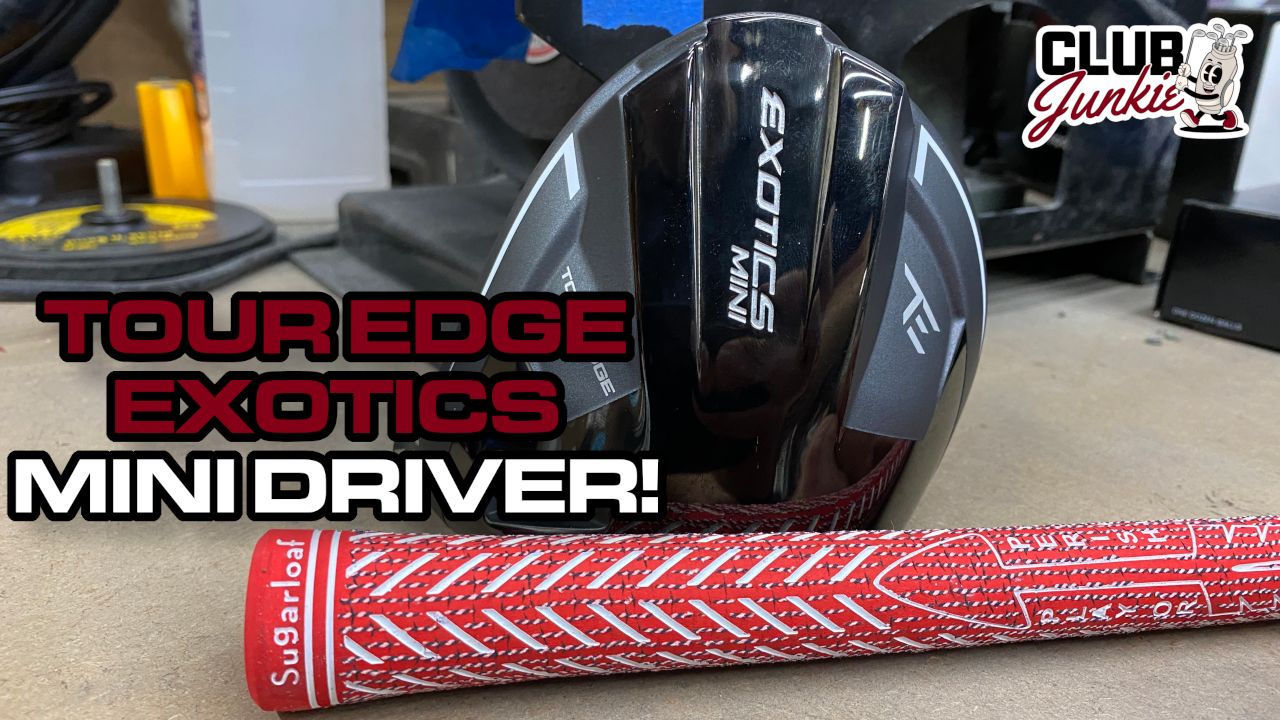
On this episode of Club Junkie, I put the new Tour Edge Exotics Mini Driver to the test and break down the performance, forgiveness, distance, and where it fits compared to a traditional driver or strong fairway wood. If you have been curious about adding a mini driver to the bag, this one is worth a look.
I also dive into the new TaylorMade Spider ZT Max putter that was recently spotted and discuss the growing zero torque putter trend. Plus, there is a closer look at the new Project X Titan Yellow shaft showing up on the PGA Tour and what makes it different from other profiles currently out there.

Justin Rose WITB 2026 (April): Full WITB breakdown with new McLaren irons

What’s the story behind Webb Simpson’s custom-stamped irons?

Memorial Tournament Tour Report: Rory McIlroy, Cameron Young switch up drivers, and more

Cadillac Championship Tour Report: Spieth’s sizable changes, McLaren Golf launches, and more

Russell Henley’s winning WITB: 2026 Charles Schwab Challenge

Kristoffer Reitan’s winning WITB: 2026 Truist Championship

Best irons 2026: Best irons overall, most forgiving irons, and more

J.T. Poston’s winning WITB: 2026 Memorial Tournament

Aaron Rai’s winning WITB: 2026 PGA Championship

Cameron Young’s winning WITB: 2026 Cadillac Championship


Ryan Palmer WITB 2026 (June)
Driver: Callaway Quantum Triple Diamond (9 degrees) Shaft: Project X HZRDUS Smoke Blue RDX 60 TX 3-wood: TaylorMade Qi10 (15 degrees) Shaft:...


Bud Cauley WITB 2026 (June)
Bud Cauley had >14 clubs in his bag when photographed prior to the Memorial Tournament. Driver: Titleist GTS2 (8 degrees) Shaft: Fujikura...


Hannah Green WITB 2026 (June)
Driver: Titleist GTS3 (10 degrees, D4 SureFit setting) Shaft: Mitsubishi Chemical Diamana RB 53 S 3-wood: Titleist GT3 (15 degrees,...


Asterisk Talley WITB 2026 (June)
Driver: TaylorMade Qi4D (9 degrees) Shaft: Fujikura Ventus Blue 6 S 3-wood: TaylorMade Qi4D (16.5 degrees) Shaft: Fujikura Ventus Blue...
-
 Equipment6 days ago
Memorial Tournament Tour Report: Rory McIlroy, Cameron Young switch up drivers, and more
-
 News2 weeks ago
Russell Henley’s winning WITB: 2026 Charles Schwab Challenge
-
 Equipment3 days ago
Best irons 2026: Best irons overall, most forgiving irons, and more
-
 Whats in the Bag4 days ago
J.T. Poston’s winning WITB: 2026 Memorial Tournament
-

 Equipment1 week ago
Details on Jason Day’s latest prototype Avoda iron setup
-

 Equipment3 weeks ago
CJ Cup Byron Nelson Tour Report: Koepka and Kim’s newest putters finally get hot
-

 News2 weeks ago
Charles Schwab Challenge Tour Report: MacIntyre, Åberg and Spaun all switch putters, TaylorMade launches new Spider
-

 Equipment2 weeks ago
Details on J.J. Spaun’s surprise putter switch


Pingback: The Wedge Guy: My top 5 practice tips – GolfWRX
Pingback: The Wedge Guy: Understanding iron designs, Part 2 – GolfWRX