
Opinion & Analysis
The difference between “ugly” and “unorthodox” golf swings


I’d like you pretend for a moment that you were asked to name the five ugliest golf swings by players who had won a major championship. Who would you select, and what criteria would you use to make that judgment? You might say you’re not sure, but you would have no difficulty identifying an ugly swing if you were to see one, right? The question is, what factors would move you toward that decision?
I struggled with this exact question when it was posed to me and others who were members of Golf Magazine’s “Top 100” panel at the time. In making my decision, I was concerned that I did not confuse UNORTHODOX with UGLY. The fact is that some of the greatest golfers throughout history have been considered to have had unorthodox swings.
- The word “unorthodox” is defined as that which is contrary to what is usual, traditional or generally accepted.
- The word “ugly” is defined as that which is unpleasant or repulsive in appearance.
In comparing the two definitions, they are clearly quite different. The word “unorthodox” suggests something that is different from the norm, while the word “ugly” relates to the appearance of an object regardless of its status. The problem with labeling any golf swing as unorthodox is that the definition of that condition varies with time. What was once considered to be unorthodox may later be considered perfectly acceptable, and we’ve seen this happen over and over again in golf instruction.
Case No. 1
It was considered unorthodox when Harry Vardon moved his thumbs toward the top of the shaft and placed the little finger of his right hand over his left forefinger knuckle. The standard grip in his era featured both thumbs to the sides of the shaft. The club was held more in the palms of both hands and with all ten fingers, rather than more diagonally through the palm as in Vardon’s Grip. As Vardon began to win, however, his competitors copied his grip. What once was considered unorthodox became orthodox.
Case No. 2
Hogan and Nicklaus were paired together in the final round of the 1957 U.S. Open at Cherry Hills. The dichotomy between their backswings couldn’t have been more evident. This was due to the way in which they utilized their right elbows in the backswing. Nicklaus allowed his right elbow to work up and away, pointing more outward at the top. Hogan’s right elbow was closer to his body and pointed more downward.
At the time, Hogan’s backswing was considered orthodox while Nicklaus’ swing was considered unorthodox. As Hogan faded from the winner’s circle and Nicklaus began to emerge, what was once thought to be unorthodox later came to be considered orthodox.
There are some swings that most observers would agree are both unorthodox and ugly. For example, most observers would say that Jim Furyk’s swing is not pretty — they might even go so far as to categorize it as ugly. This is despite the face that Furyk has had an outstanding career and has a U.S. Open victory to his credit. What is it that observers find so offense in his swing? The answer is the differential in planes between the backswing and the downswing, or what might be referred to as a “loop” in his swing.
In Furyk’s case, the club is taken well outside what might be considered the traditional backswing plane. Then it is looped well to the inside and back into position on the downswing. This is is a perfectly acceptable way to play golf, which is evidenced by the size of his bank account and the number of trophies on his mantle. As you might surmise, because of his golf swing, Furyk has not been asked to write any full-swing instruction books.
The problem is that, in the eyes of the observer, the combination of the two distinctly different planes gives a disjoined appearance to the swing. Does it follow then that the variance in the backswing and downswing is the primary factor in determining if a swing qualifies as being ugly? The problem with reaching that conclusion is that it doesn’t hold up to comparison with other players who employ a similar pattern… beginning with Freddy Couples. He begins his swing by lifting his arms well outside the traditional plane line. With a delayed turn of his torso, he then brings the club back into a more traditional plane at the top.
In the case of both Couples and Furyk, their backswings operate well outside the traditional plane line with both players “looping” the club back into position prior to impact. And yet Couples’ swing is universally admired, while Furyk’s swing is in some quarters ridiculed. This begs the question of why Couples’ “looping” swing motion is considered more acceptable than Furyk’s. The answer to that question is two-fold.
- Furyk’s loop is created ostensibly by a change in plane with the arms and the hands, giving the swing a frenetic appearance.
- Couples’ loop is created with a graceful turn of his body with the arms following in perfect harmony.
And so, when taking the swings of Couples and other “loopers” into consideration, it would seem that the dramatic change in plane between the backswing and the downswing in and of itself does not warrant the classification of ugly.
Author Footnote: A point worth considering as part of this discussion is that there have been other accomplished players throughout the history of the game whose backswings have operated on the same principles as Couples. This would include perennial Champion’s Tour winners Kenny Perry, and earlier Jay Haas, whose swings were generally admired despite their unorthodox approach to the backswing.
What does this all mean? First, while a loop in the golf swing may be unorthodox, is not necessary considered ugly provided that the club is routed into plane with the turn of the body rather than just the arms and the hands. Second, as stated earlier, the definition of unorthodox can and does change depending on the era. And third, an unorthodox swing is not necessarily ugly. The two classifications are very different.
As you evaluate golf swings, remember this adage; an unorthodox swing is not necessarily ugly, but an ugly swing is always unorthodox.




This past Monday, I played in the U.S. Amateur local qualifier at Rock Creek Country Club in Portland, Oregon. A full tee sheet from 7:30 a.m. to 1:55 p.m., the top 11 scores would make it to the U.S. Amateur final qualifying.
I teed off at 10:48 a.m.. With the 7:30 am tee time, you can get a feel for the leaders’ pace, and they were off and running on the challenging setup at Rock Creek.
View this post on Instagram
Getting to the highlight of the round on the par five 17th, a drive up the left side and 212 yards left to the front hole location. I took out a 5-iron with plans of middle of the green. The ball ended up 8 feet left of the hole, pin high. A slight downhill putt dropped in for an eagle 3 on the 17th. With the cut line looking to be anywhere from -2 to even par. This was the boost I had been waiting for all day.
With making par from the trees on 18, it was time to wait for a potential playoff with a posted score of one under par 71.
Three hours later, it was playoff time. 8 players for 6 spots. I made par on the playoff hole, which was good enough to advance to the U.S. Amateur final qualifying in July. USGA qualifiers sure deliver on all of the emotions in golf!
Club Junkie
Building my 2026 gamer WITB: Ranking the contenders and new putter projects – Club Junkie Podcast

The annual What’s In The Bag build is underway, and on this episode of Club Junkie, Brian breaks down the clubs currently leading the race for a spot in his 2026 gamer setup. From drivers and fairway woods to irons, wedges, and shafts, he ranks the equipment that’s performing best and explains what’s separating the front runners from the rest of the field.
Brian also heads into the workshop to discuss several putter projects currently on the bench. From head options and shaft choices to build ideas and testing plans, he shares what he’s working on and which putters could become serious contenders for the bag this season.
If you’re a gear junkie who loves equipment testing, club building, and the never-ending pursuit of the perfect setup, this episode is for you.
Follow Club Junkie:
Instagram: @clubjunkiepod
TikTok: @clubjunkiepod
Threads: @clubjunkiepod
X: @ClubJunkiePod
Club Junkie
Tour Edge Exotics mini driver review + TaylorMade Spider ZT Max first look – Club Junkie

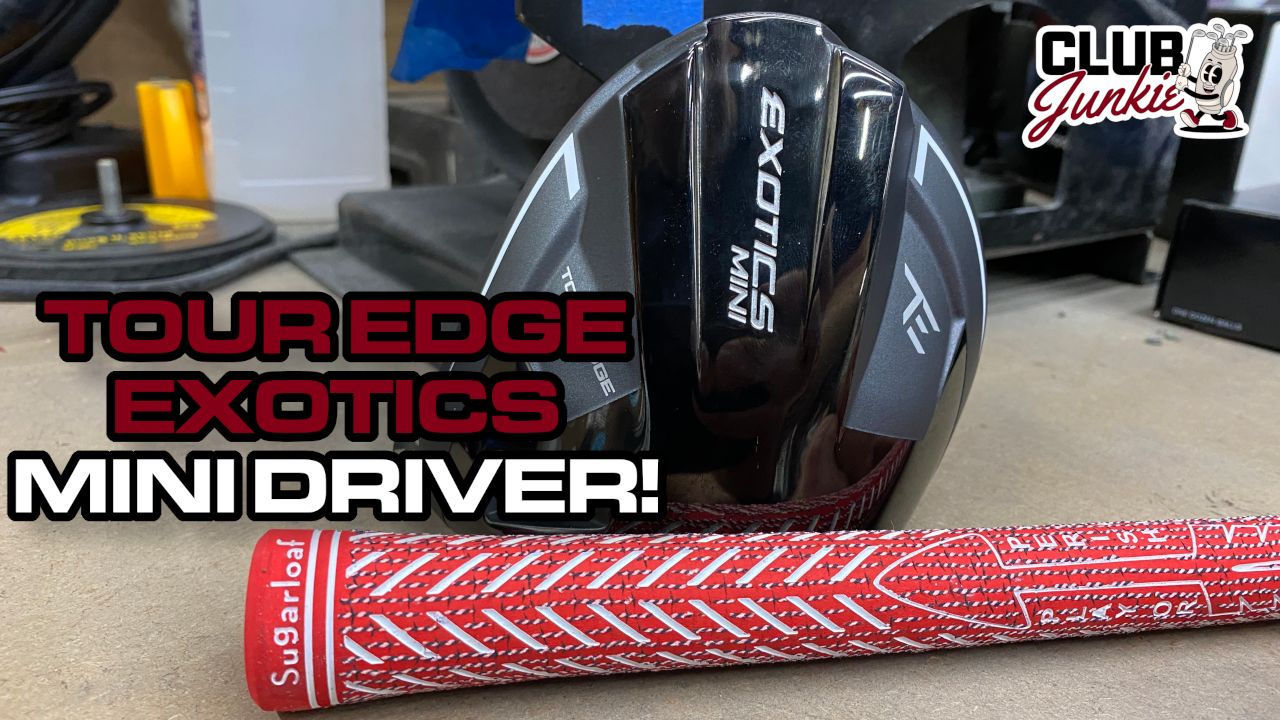
On this episode of Club Junkie, I put the new Tour Edge Exotics Mini Driver to the test and break down the performance, forgiveness, distance, and where it fits compared to a traditional driver or strong fairway wood. If you have been curious about adding a mini driver to the bag, this one is worth a look.
I also dive into the new TaylorMade Spider ZT Max putter that was recently spotted and discuss the growing zero torque putter trend. Plus, there is a closer look at the new Project X Titan Yellow shaft showing up on the PGA Tour and what makes it different from other profiles currently out there.

Justin Rose WITB 2026 (April): Full WITB breakdown with new McLaren irons

What’s the story behind Webb Simpson’s custom-stamped irons?

Memorial Tournament Tour Report: Rory McIlroy, Cameron Young switch up drivers, and more

Cadillac Championship Tour Report: Spieth’s sizable changes, McLaren Golf launches, and more

Russell Henley’s winning WITB: 2026 Charles Schwab Challenge

Kristoffer Reitan’s winning WITB: 2026 Truist Championship

Best irons 2026: Best irons overall, most forgiving irons, and more

J.T. Poston’s winning WITB: 2026 Memorial Tournament

Aaron Rai’s winning WITB: 2026 PGA Championship

Cameron Young’s winning WITB: 2026 Cadillac Championship


Bud Cauley WITB 2026 (June)
Bud Cauley had >14 clubs in his bag when photographed prior to the Memorial Tournament. Driver: Titleist GTS2 (8 degrees) Shaft: Fujikura...


Hannah Green WITB 2026 (June)
Driver: Titleist GTS3 (10 degrees, D4 SureFit setting) Shaft: Mitsubishi Chemical Diamana RB 53 S 3-wood: Titleist GT3 (15 degrees,...


Asterisk Talley WITB 2026 (June)
Driver: TaylorMade Qi4D (9 degrees) Shaft: Fujikura Ventus Blue 6 S 3-wood: TaylorMade Qi4D (16.5 degrees) Shaft: Fujikura Ventus Blue...

Brianna Do WITB 2026 (June)
Driver: Callaway Quantum Triple Diamond (9 degrees) Shaft: KBS PGW 3-wood: Callaway Elyte Titanium (15 degrees) Shaft: KBS PGW 5-wood:...
-
 Equipment6 days ago
Memorial Tournament Tour Report: Rory McIlroy, Cameron Young switch up drivers, and more
-
 News2 weeks ago
Russell Henley’s winning WITB: 2026 Charles Schwab Challenge
-
 Equipment3 days ago
Best irons 2026: Best irons overall, most forgiving irons, and more
-
 Whats in the Bag4 days ago
J.T. Poston’s winning WITB: 2026 Memorial Tournament
-

 Equipment1 week ago
Details on Jason Day’s latest prototype Avoda iron setup
-
 Equipment3 weeks ago
CJ Cup Byron Nelson Tour Report: Koepka and Kim’s newest putters finally get hot
-

 News2 weeks ago
Charles Schwab Challenge Tour Report: MacIntyre, Åberg and Spaun all switch putters, TaylorMade launches new Spider
-
 Equipment2 weeks ago
Details on J.J. Spaun’s surprise putter switch


Mat
Mar 25, 2018 at 2:33 am
What wins on Sunday sells on Monday – especially with lessons.
The ball doesn’t care how it’s propelled. The only thing you should be worried about is:
#1 – Is the impact dynamic repeatable?
#2 – Is the swing repeatable?
#3 – Is the swing going to cause physical issues if repeated?
The ball flight is always the best teacher. It never lies.
acew/7iron
Mar 24, 2018 at 11:49 am
My swing just forgets who it is every other round…I can go from 77 – 87 overnight
BIG STU
Mar 24, 2018 at 4:28 am
Exactly BD you get it– It is all about the position in the impact zone not how it gets there. I have said that about Furyk for years and no one listens
Chris
Mar 23, 2018 at 10:49 pm
Example no 1 is not terrible well thought out, a grip change can hardly be seen at adress, and not at all during the swing.
abba
Mar 23, 2018 at 3:12 pm
“ugly”… “unorthodox”… and the swing of 95% of all golfers worldwide… “abomination” 😮
Brandon
Mar 23, 2018 at 2:39 pm
Im proud to say I have a ugly swing but its repeatable and playable!
Brett Weir
Mar 23, 2018 at 11:56 am
The ball doesn’t care how ugly your swing is but it does care if it is hit solid and straight through impact.
BD
Mar 23, 2018 at 11:43 am
As Arnie used to say, “Swing your swing”. I would rather have an ugly swing and play well than have a good looking swing and play poor. The look of the swing is irrelevant. It is all about impact. Hence, Jim Furyk. If you freeze frame his impact zone, it looks like most PGA Tour Pros.
BIG STU
Mar 24, 2018 at 4:28 am
Exactly BD you get it– It is all about the position in the impact zone not how it gets there. I have said that about Furyk for years and no one listens
Tiemco
Mar 23, 2018 at 11:03 am
Tommy Gainey’s swing always looked terrible to me.
Bruce Ferguson
Mar 23, 2018 at 10:57 am
I always thought Moe Norman’s swing was rather ugly. That said, I envied his consistency. To each, his own . . .
Nack Jicklaus
Mar 23, 2018 at 10:49 am
My swing is both ugly and unorthodox.