
Opinion & Analysis
Even Jordan Spieth Has A Weakness!

As the founder of ShotByShot.com, a Strokes Gained analysis website, I have been studying Strokes Gained and the relevant performance statistics for PGA Tour players and amateurs for more than 30 years. In all that time, I have never seen a player that was good at every part of the game. I have made it my business to help players at every level identify their strengths and weaknesses, as improving the latter generally represents the quickest route to consistently lower scores.
This week, I looked at Spieth’s 2017 Tour data through the BMW Championship, and I compared it to the other top-5 players in the FedEx Cup race to the same point in time. The other players, which I’ll refer to this group as “Other-4,” are:
- No. 2: Justin Thomas
- No. 3: Dustin Johnson
- No. 4: Mark Leishman
- No. 5: Jon Rahm
Off the Tee, Driving Performance?
If there is one weakness in Spieth’s game, it’s his driving. I believe that his quest for more distance, following his loss to Jason Day in the 2015 PGA Championship, has injected a two-way miss off the tee, resulting in more severe driving errors. With the help of my genius programmer, I extracted the two types of driving errors from the ShotLink data that are most frequent on Tour:
- No Shot: A miss that requires an advancement shot to return to normal play. The average cost of this type of error in 2017 has been 74 percent of a stroke, or 0.74 strokes.
- Penalty: A miss that causes a player to incur a penalty. The average cost this year has been 1.38 strokes.
Note: There is a third type of driving error, Out of Bounds/Lost Ball. This most severe miss is relatively rare on Tour and neither Jordan or the Other-4 had one.
As you can see in the charts below, 2015 Spieth, 2017 Spieth and the 2017 Other-4 all had just about the same frequency of driving errors, but the Spieth’s 2017 errors were much more costly (my definition of “cost” is calculated based upon the score, relative to par, recorded on the driving-error hole). As we can see, while Spieth’s frequency of errors has not increased, the severity/cost has jumped significantly: +41 percent over his 2015 average and +55 percent over the Other-4.
Jordan Spieth 2015 vs. 2017 Driving Errors

*0.48/round is just under 1 driving error every 2 rounds.
Other-4 2017 vs. Jordan Spieth 2017 Driving Errors
 Approach Shots
This is clearly how Spieth separates himself from the rest and mitigates his less-than-stellar driving. Ranked No. 1 in this Strokes-Gained category, here are some of his impressive approach-shot numbers:
- Strokes Gained: 0.958/round, Rank No. 1
- Proximity to the Hole: 33-feet 8-inches, Ranked No. 8, Tour Average: 36-feet 4-inches
- Greens in Regulation: 70.35 percent, Ranked No. 3, Tour Average: 64.94 percent, Other-4: 67.7 percent
- Penalties Per Round: The Tour does not publish this, or any such negative numbers, but all players make them. Jordan: 0.18/round (1 every 6 rounds). Tour avg.: 0.2/round (1 every 5 rounds), Other-4: 0.15/round (1 every 7 rounds).
Short Game, Around the Green
This Tour stat includes every shot from within 30 yards of the edge of the green. Jordan is ranked No. 15. The short game is obviously one of Jordan’s strengths. We have all seen it, so I will not go into detail.
Putting
This is an extremely important skill in golf and approximately 40 percent of the game at any handicap level. Actually, it’s more than one skill; it’s two:
- The art of holing short putts.
- The precise distance control on the long putts.
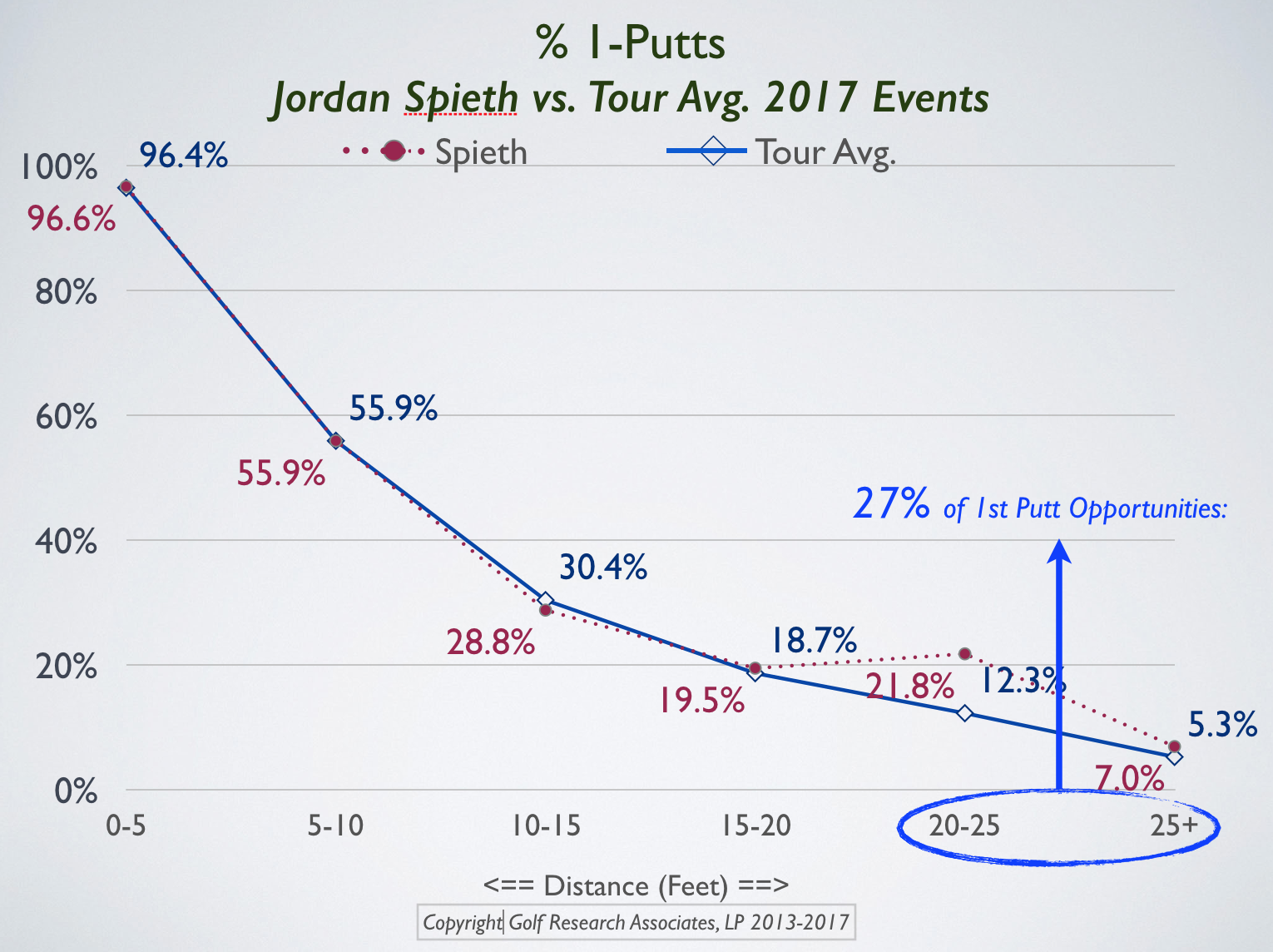
While putting is a very important part of Spieth’s success, when one looks under the hood, what Jordan does so well is not what we would think. It’s his long-range distance control that separates him from the rest. Further, Spieth’s 1-Putt numbers are VERY AVERAGE.
Note, in the chart below, at each distance up to 20 feet, Spieth is either right at or literally within 1-percentage point of the 2017 Tour average. This is not at all what we would expect from a No. 1 player.
 Again, below, Jordan’s 1-Putt percentages are below the Other-4 until he gets past 16 feet.
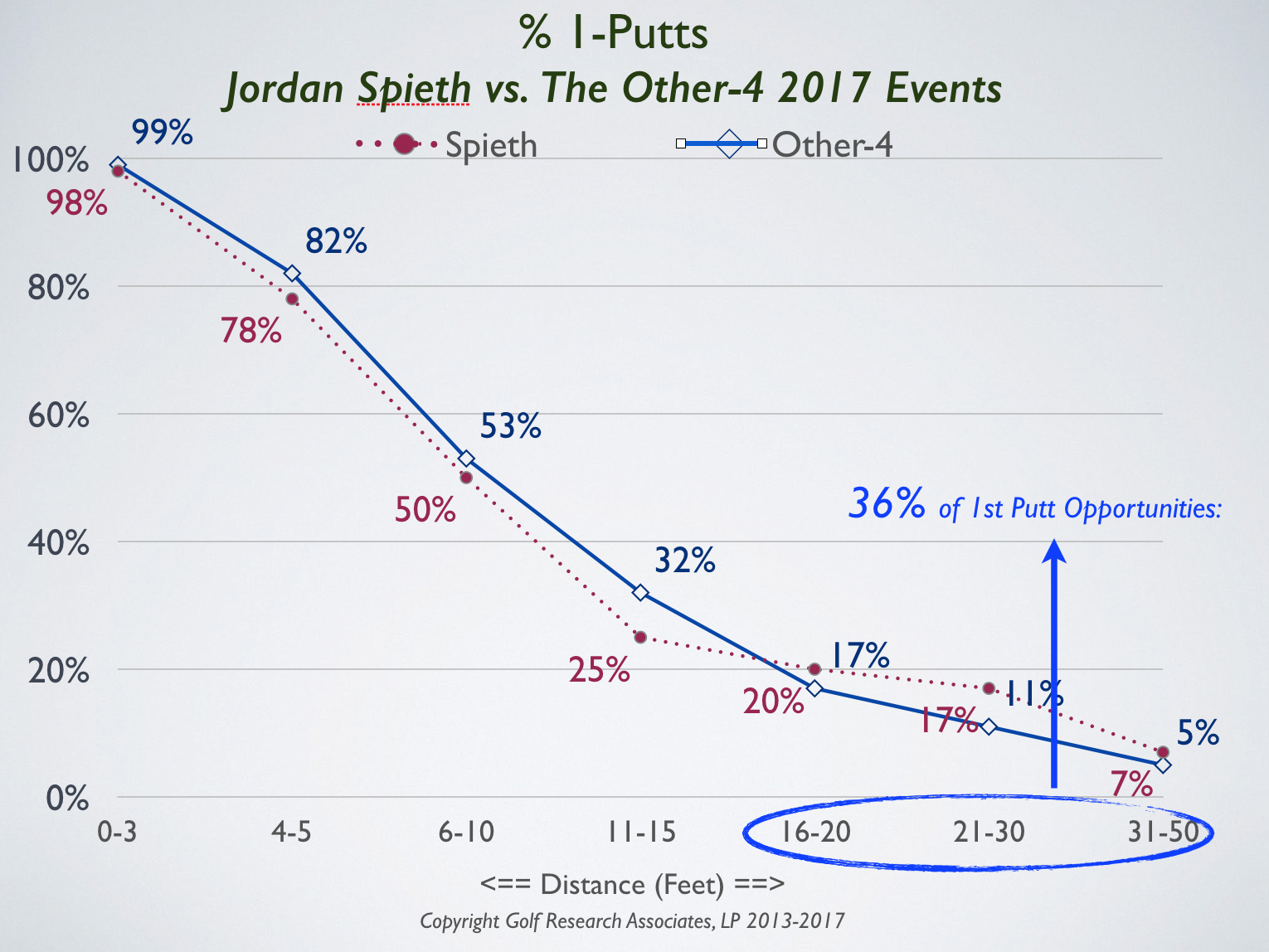 Spieth’s long-range excellence serves him well and in two ways:
No. 1: Fewer 3-Putts. Jordan is ranked 9th in 3-Putt Avoidance at 2.03 percent (a 3-Putt on only 2.3 percent of total greens). The Tour Average (3.16 percent) is 56 percent higher! This complements his approach-shot strength. By hitting 13+ greens each round with average proximity of 33.9 feet, Spieth is faced with a bundle of +20-foot opportunities.
No. 2: Fewer “Save” Putts. With fewer missed greens, Spieth is faced with fewer short-putting “save” opportunities, where he enjoys only average success.
Finally, a few points to support Jordan’s distance-control excellence. The numbers below are from a study that I performed for a Golf Digest article: Stats show why Spieth is a great putter (Masters issue 2016). I compared Spieth’s putting to a thorough, distance-control study that I had performed on the No. 1 Strokes-Gained putters for the prior five years (I’ll call them the FIVE #1’s below). Coincidently, it covered all putts from 20 feet and greater in the 2015 season and Spieth beat the averages of the FIVE #1’s in every key measurement.
- Average Leave Distance: Spieth was the only player under 2 feet at 1.97 feet. The FIVE #1’s averaged 2.31 feet.
- Percentage of 1-Putts: Spieth: 12 percent, FIVE #1’s: 7 percent
- Percentage of 3-Putts: Spieth: 5 percent, FIVE #1’s: 8 percent
- Percentage of Putts Holed or Past the Hole: Spieth: 69.3 percent, FIVE #1’s: 66 percent
What can we amateurs take away from all this?
No. 1: There are two important, but different, skills in putting. Understand and practice both. For more, see my GolfWRX article: Research shows golfers should spend more time practicing short putts?
No. 2: To improve as much as possible, golfers must determine the strengths and weakness of their game, because we all have them. Work to take advantage of your strengths while improving or mitigating your weaknesses.




This past Monday, I played in the U.S. Amateur local qualifier at Rock Creek Country Club in Portland, Oregon. A full tee sheet from 7:30 a.m. to 1:55 p.m., the top 11 scores would make it to the U.S. Amateur final qualifying.
I teed off at 10:48 a.m.. With the 7:30 am tee time, you can get a feel for the leaders’ pace, and they were off and running on the challenging setup at Rock Creek.
View this post on Instagram
Getting to the highlight of the round on the par five 17th, a drive up the left side and 212 yards left to the front hole location. I took out a 5-iron with plans of middle of the green. The ball ended up 8 feet left of the hole, pin high. A slight downhill putt dropped in for an eagle 3 on the 17th. With the cut line looking to be anywhere from -2 to even par. This was the boost I had been waiting for all day.
With making par from the trees on 18, it was time to wait for a potential playoff with a posted score of one under par 71.
Three hours later, it was playoff time. 8 players for 6 spots. I made par on the playoff hole, which was good enough to advance to the U.S. Amateur final qualifying in July. USGA qualifiers sure deliver on all of the emotions in golf!
Club Junkie
Building my 2026 gamer WITB: Ranking the contenders and new putter projects – Club Junkie Podcast

The annual What’s In The Bag build is underway, and on this episode of Club Junkie, Brian breaks down the clubs currently leading the race for a spot in his 2026 gamer setup. From drivers and fairway woods to irons, wedges, and shafts, he ranks the equipment that’s performing best and explains what’s separating the front runners from the rest of the field.
Brian also heads into the workshop to discuss several putter projects currently on the bench. From head options and shaft choices to build ideas and testing plans, he shares what he’s working on and which putters could become serious contenders for the bag this season.
If you’re a gear junkie who loves equipment testing, club building, and the never-ending pursuit of the perfect setup, this episode is for you.
Follow Club Junkie:
Instagram: @clubjunkiepod
TikTok: @clubjunkiepod
Threads: @clubjunkiepod
X: @ClubJunkiePod
Club Junkie
Tour Edge Exotics mini driver review + TaylorMade Spider ZT Max first look – Club Junkie

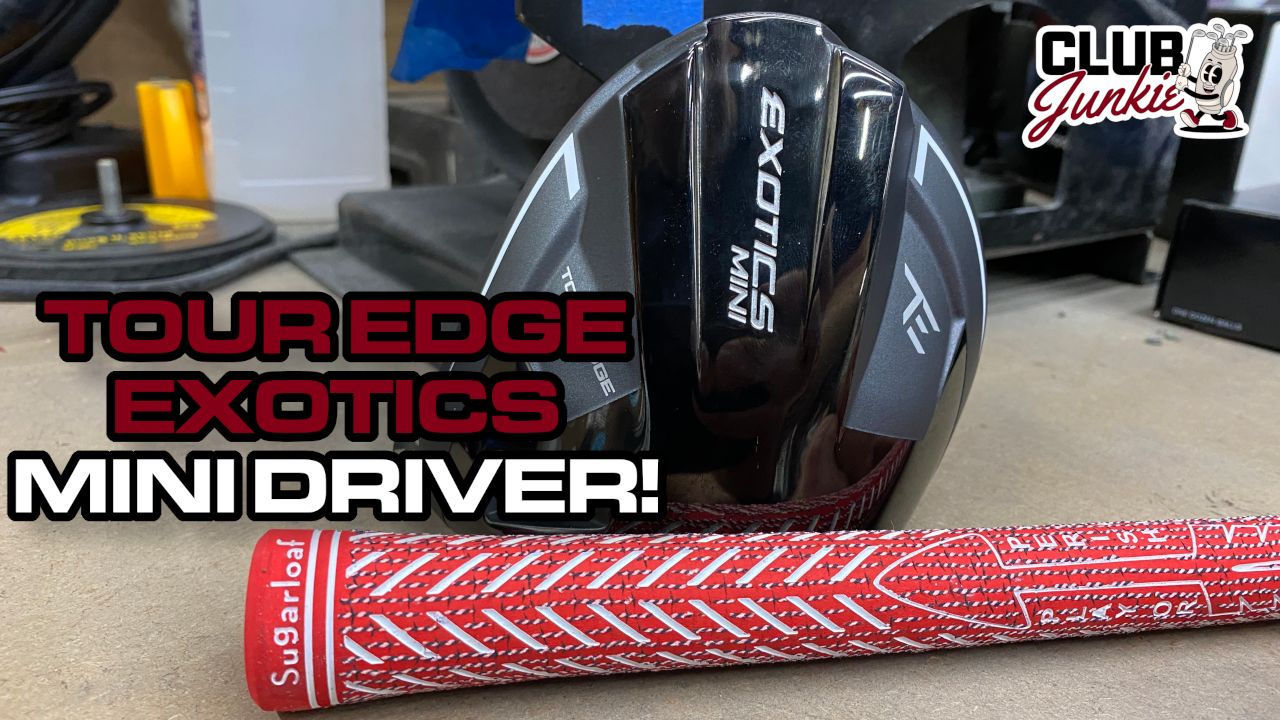
On this episode of Club Junkie, I put the new Tour Edge Exotics Mini Driver to the test and break down the performance, forgiveness, distance, and where it fits compared to a traditional driver or strong fairway wood. If you have been curious about adding a mini driver to the bag, this one is worth a look.
I also dive into the new TaylorMade Spider ZT Max putter that was recently spotted and discuss the growing zero torque putter trend. Plus, there is a closer look at the new Project X Titan Yellow shaft showing up on the PGA Tour and what makes it different from other profiles currently out there.

Justin Rose WITB 2026 (April): Full WITB breakdown with new McLaren irons

What’s the story behind Webb Simpson’s custom-stamped irons?

Memorial Tournament Tour Report: Rory McIlroy, Cameron Young switch up drivers, and more

Cadillac Championship Tour Report: Spieth’s sizable changes, McLaren Golf launches, and more

Russell Henley’s winning WITB: 2026 Charles Schwab Challenge

Kristoffer Reitan’s winning WITB: 2026 Truist Championship

Aaron Rai’s winning WITB: 2026 PGA Championship

Cameron Young’s winning WITB: 2026 Cadillac Championship

J.T. Poston’s winning WITB: 2026 Memorial Tournament

Best irons 2026: Best irons overall, most forgiving irons, and more


Bud Cauley WITB 2026 (June)
Bud Cauley had >14 clubs in his bag when photographed prior to the Memorial Tournament. Driver: Titleist GTS2 (8 degrees) Shaft: Fujikura...


Hannah Green WITB 2026 (June)
Driver: Titleist GTS3 (10 degrees, D4 SureFit setting) Shaft: Mitsubishi Chemical Diamana RB 53 S 3-wood: Titleist GT3 (15 degrees,...


Asterisk Talley WITB 2026 (June)
Driver: TaylorMade Qi4D (9 degrees) Shaft: Fujikura Ventus Blue 6 S 3-wood: TaylorMade Qi4D (16.5 degrees) Shaft: Fujikura Ventus Blue...


Brianna Do WITB 2026 (June)
Driver: Callaway Quantum Triple Diamond (9 degrees) Shaft: KBS PGW 3-wood: Callaway Elyte Titanium (15 degrees) Shaft: KBS PGW 5-wood:...
-
 Equipment6 days ago
Memorial Tournament Tour Report: Rory McIlroy, Cameron Young switch up drivers, and more
-
 News1 week ago
Russell Henley’s winning WITB: 2026 Charles Schwab Challenge
-
 Whats in the Bag3 days ago
J.T. Poston’s winning WITB: 2026 Memorial Tournament
-
 Equipment3 days ago
Best irons 2026: Best irons overall, most forgiving irons, and more
-

 Equipment1 week ago
Details on Jason Day’s latest prototype Avoda iron setup
-

 Equipment3 weeks ago
CJ Cup Byron Nelson Tour Report: Koepka and Kim’s newest putters finally get hot
-

 News2 weeks ago
Charles Schwab Challenge Tour Report: MacIntyre, Åberg and Spaun all switch putters, TaylorMade launches new Spider
-

 Equipment2 weeks ago
Details on J.J. Spaun’s surprise putter switch


Dtrain
Sep 23, 2017 at 11:44 pm
Also JS struggled with his putting early in the year. I’d like to see the poor rounds tossed out and compare JS to the other 4 at say their best 10 events relative to the field.
Ron
Sep 23, 2017 at 10:26 pm
Make you short putts, get close on the long putts. Brilliant insight.
Joe
Sep 22, 2017 at 7:35 am
“Note: There is a third type of driving error, Out of Bounds/Lost Ball.”
That’s another advantage PGA pros have. Their ball usually hits a spectator or grandstand a lot of the times before it gets into any real danger!! On top of that they got so many eyes on their ball that it’s easily findable. Where us hackers can only spend “X” amount of time looking for it to keep pace of play. Pace of play is irrelevant on the tour if you’re a big name 😛
Andrew
Sep 22, 2017 at 12:49 am
Good analysis. Unfortunately there isn’t a fleet of total stations and trackmans surveying and logging my every shot.
Irma
Sep 21, 2017 at 10:02 pm
We didn’t need all this analysis, it’s fairly bloody obvious he’s bad off the tee lol
Frankie
Sep 21, 2017 at 9:06 pm
“There is a third type of driving error, Out of Bounds/Lost Ball. This most severe miss is relatively rare on Tour and neither Jordan or the Other-4 had one.” That’s right, just disregard and ignore the fact that Jordan Spieth made a 9 on a par 5 this year by hitting back-to-back tee shots OB right…
Henry
Sep 21, 2017 at 11:52 pm
If that’s the only time he did that, I don’t think something that happened on .0006% of holes played should matter all that much. Do you?
Speedy
Sep 21, 2017 at 8:53 pm
Fake news.
X-out
Sep 21, 2017 at 3:39 pm
Golf statistics are only two dimensional; they lack real-time competitive game perspective.
IOW, they are misleading because they do not calculate what is happening on the golf course during play. Nobody can do that because the future is not predictable, particularly on a golf course in competition and the playing environment.
AC
Sep 22, 2017 at 11:43 am
How true.
Chris B
Sep 21, 2017 at 3:25 pm
It seems that the fairways hit percent category is now the least important one of all.
Mike
Sep 21, 2017 at 3:12 pm
How is the cost/error of the driving error calculated? Wouldn’t this cost be affected by the decision making/execution of subsequent shots in addition to the severity of the missed drive?
henry
Sep 22, 2017 at 3:31 pm
you cant calculate something based on a decision that he didnt make, and if whether an outside perspective thought the decision was the right one or not.