
Opinion & Analysis
Did Jason Day just have the best putting year of any Tour pro ever?

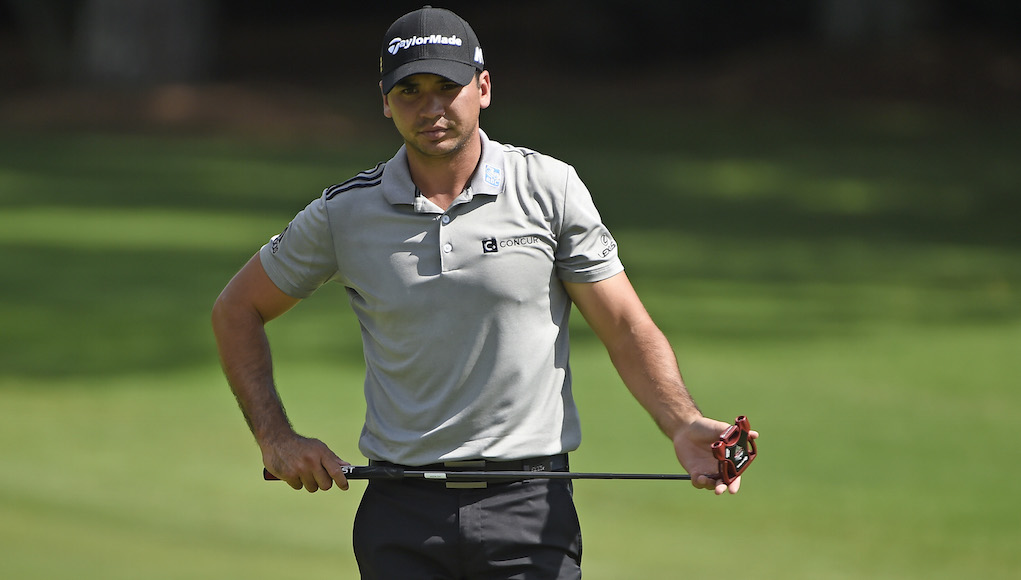
Jason Day was ranked No. 1 in Strokes-Gained Putting for the 2016 season. His average Strokes Gained on the field per round was an incredible 1.13 strokes (4.52 strokes per event). For context, this is the largest advantage recorded over the 13 years for which Strokes-Gained Putting is now available. This article explains how his performance was superior, and why I believe it is the best ALL TIME.
What is Strokes-Gained Putting?
The PGA Tour added its new Strokes-Gained Putting analysis in 2011. It was a revolutionary breakthrough in analysis, and a huge departure from the myopic, one-dimensional putting stats of yesteryear (number of putts per round and number of putts per GIR’s).
Simply stated, Strokes-Gained Putting places a numeric value on each putting opportunity based on distance from the hole. The result of the shot (or putt) is: [Start Value – Number of Putts to Hole Out]. The starting distance values on the PGA Tour are based upon the average performance on Tour since 2004 when ShotLink was implemented. My company, ShotByShot.com, uses start values that are based on the average performance of all of the “Scratch” rounds recorded in our system since 2003 (Scratch = 0 differential from Slope Adjusted Course Rating).
Start = 8 ft. Value = 1.50 (A Tour player will make this putt 50 percent of the time).
# Putts: 1; SG = 0.5 (1.5 – 1.0 = 0.5)
# Putts: 2; SG = 0-.5 (1.5 – 2.0 = -0.5)
Here’s an example of how Strokes-Gained Putting works. Let’s say a golfer has an 8-foot putt, which the stats say a player should make 50 percent of the time. The putt is given a value of 1.5. If the golfer makes it, he/she gains 0.5 strokes on the field. If the golfer misses it, he/she loses 0.5 strokes on the field.
There is a complete explanation of Strokes Gained and its history on my website: ShotByShot.com.
Back to J. Day
I have conducted a detailed study of the No. 1-ranked player each year since 2011. The results provide valuable perspective for the Tour players with whom I work. Because the Tour now produces this analysis as far back as ShotLink was collecting the data, I can now include players from 2004 forward.
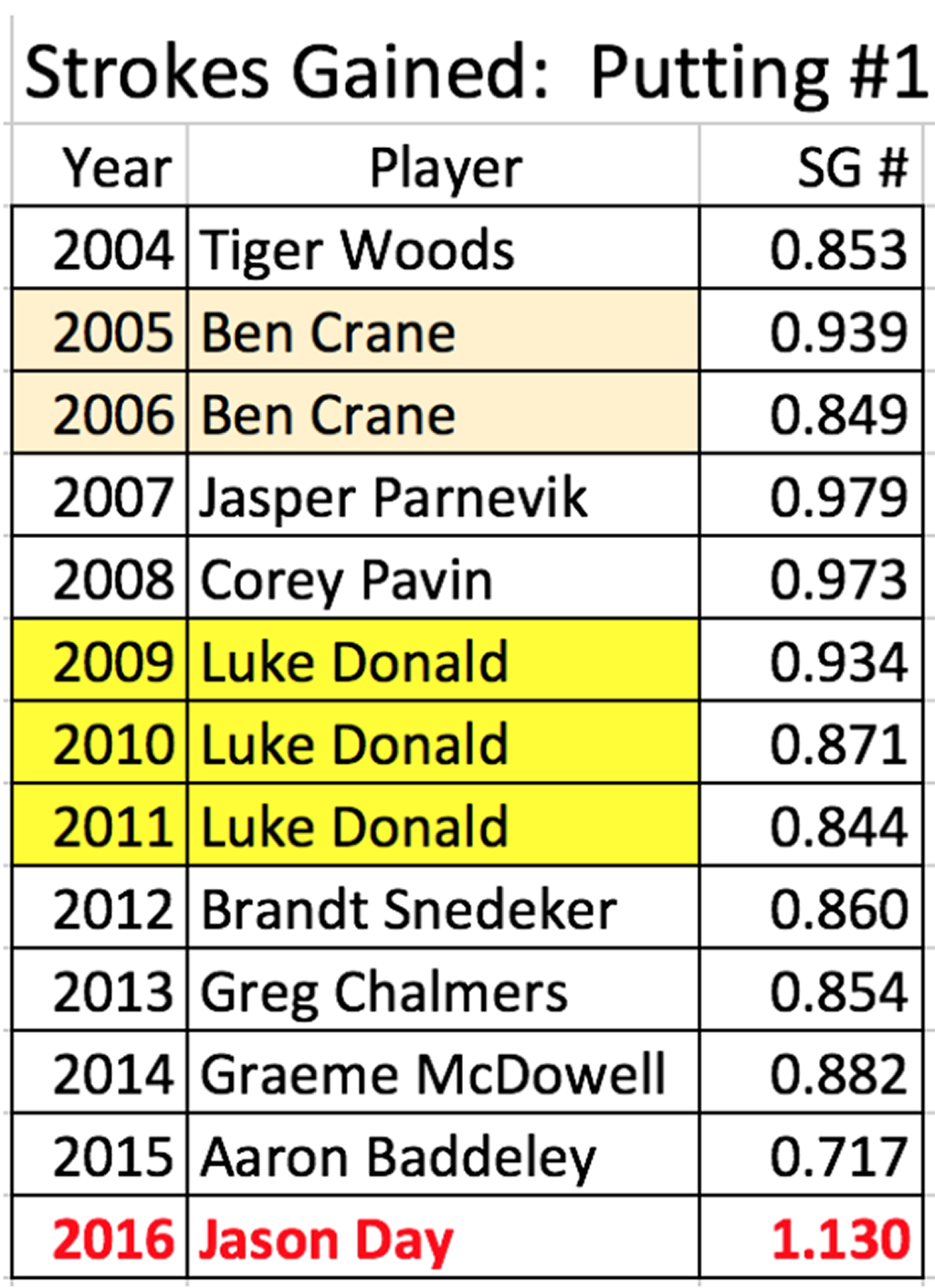
P.S. I found it worthy to note that Ben Crane was the best putter on Tour for two consecutive years and Luke Donald for THREE!
Jason Day vs. the No. 1s
I was immediately curious to see what Day did to overshadow all of the prior No. 1s. Could it be that he three-putted fewer times than the other 12? No! Day’s 2.4 percent rate of three-putts per holes played was actually the second highest among his No. 1 peers.
Side Note: For the benefit of the rest of us, the average 10-handicap’s three-putt avoidance is 8.5 percent, or almost three times that of the Tour’s 3.04 percent average.
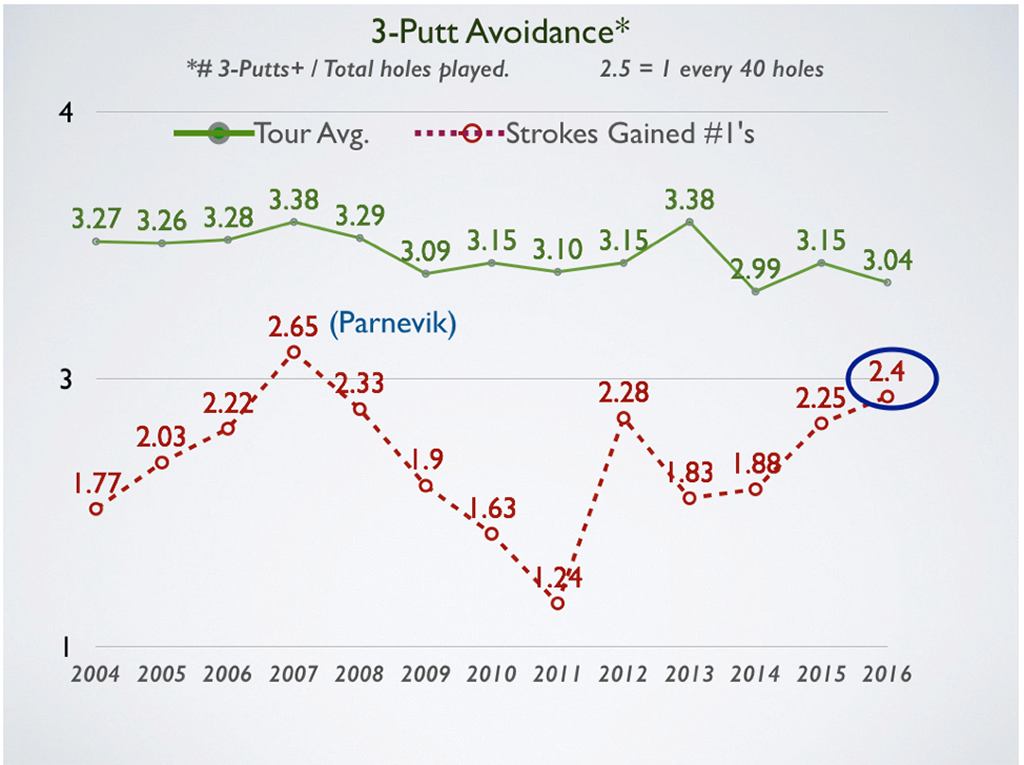
And no, Day also did not one-putt with greater frequency than the other No. 1s. It was his unusual consistency that set him apart.
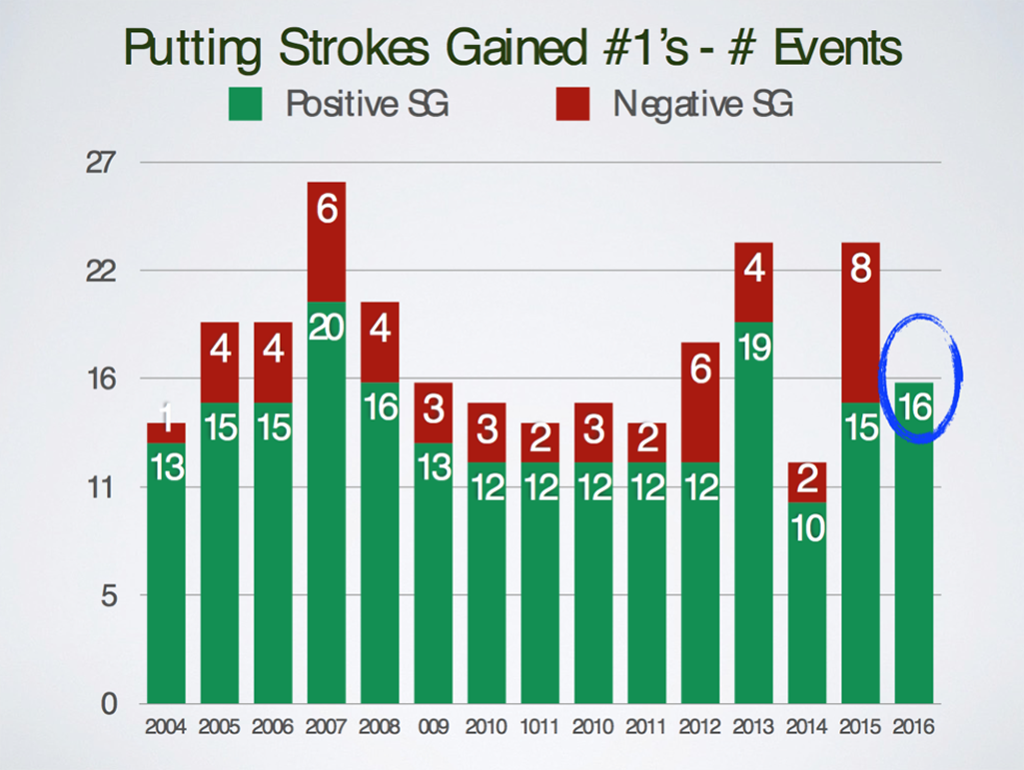
We all have our good and bad days on the greens AND, so do the best putters on Tour… except Day in 2016. In 16 events this year where Strokes Gained was measured, he never had a negative Strokes-Gained Putting result. None of the No. 1s had ever done that.
Have a look at the numbers in the graph below. Only Tiger came close in 2004 with only one negative Strokes-Gained event.
Jason Day vs. 2016 Tour Average
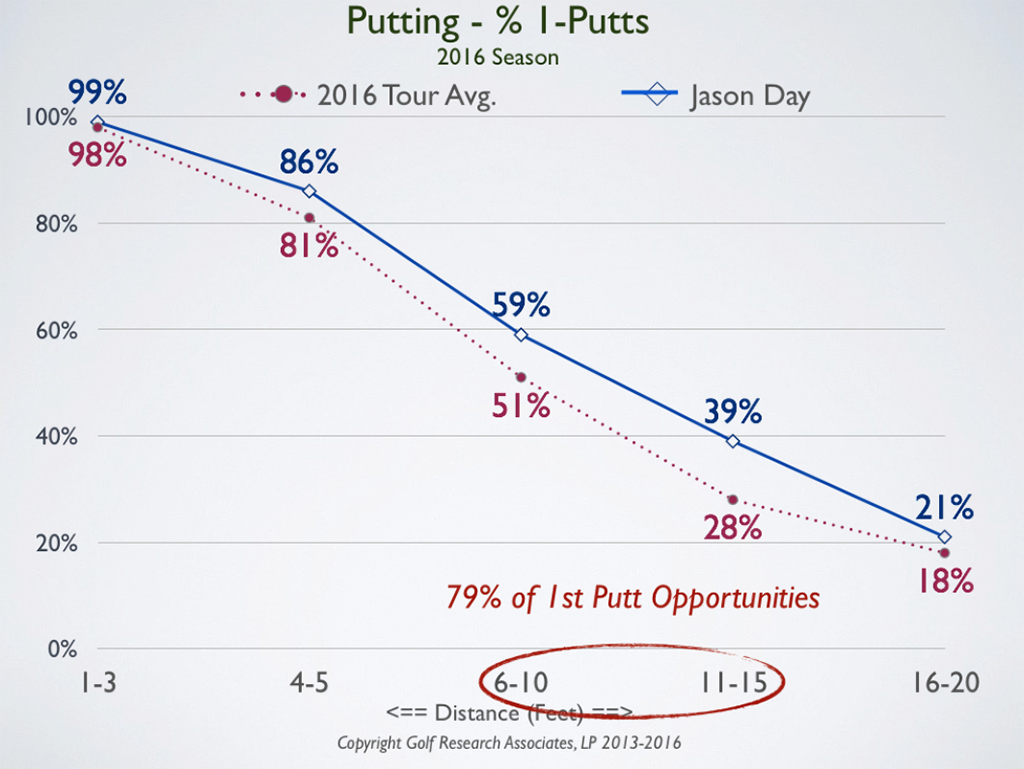
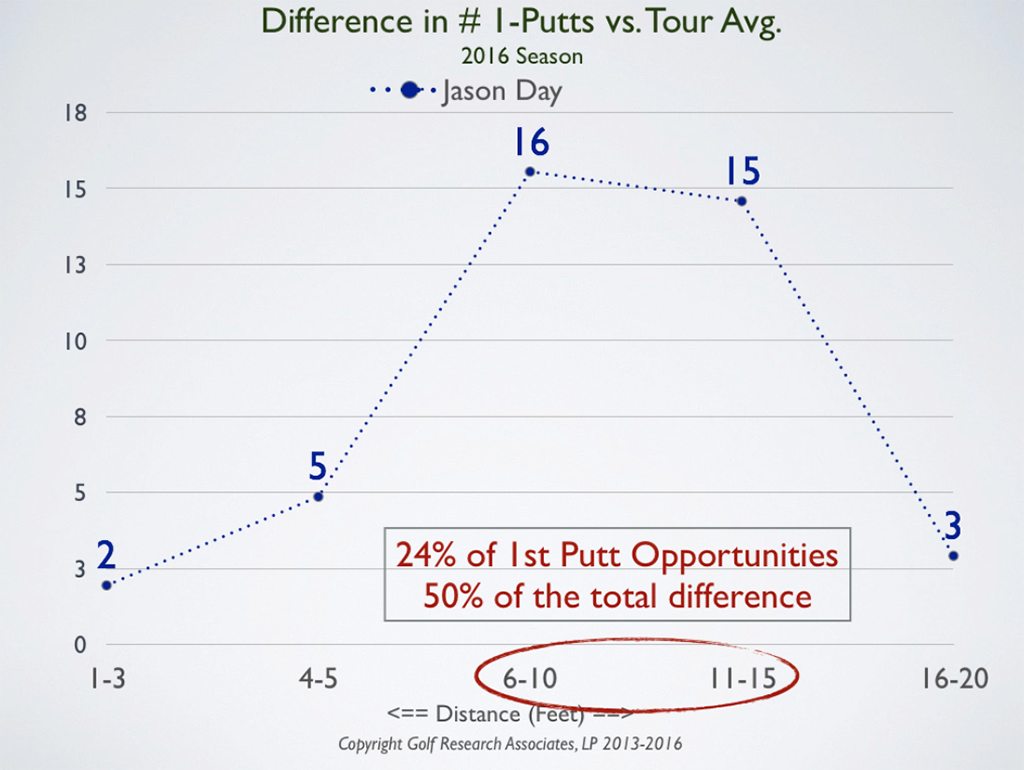
Finally, I looked into exactly what separated Day by 1.13 shots every round from the rest of the Tour in 2016. Only 18 percent of the difference resulted from fewer three-putts (see three-putt avoidance above). The remaining 82 percent resulted from increased one-putts, particularly Day’s very high standard in the range of 6-to-15 feet.
My research showed me long ago that on Tour the range of 6-10 feet separates the good putters from the pack, while the range of 11-20 feet determines the winners. Day’s putting no doubt played a major role in his three wins, ten Top-10s, $8+ million earned and his No. 1 ranking.
Is Jason’s 2016 putting season the best EVER?
We can easily agree that it is the best since 2004. The numbers are clear. And I don’t believe that there could have been a better putting season prior to 2004, because there have been too many important advancements in technology and agronomy in the past 14 years.
Technology: The quality and consistency of the balls and putters has dramatically improved, and so have the instruction tools. Further, with vastly improved analysis by distance ranges, players have much better information on exactly where they need to work to compete.
Agronomy: Putting surfaces are simply much better. Improved strains of grass and dramatically improved maintenance equipment and practices produce consistently smoother putting surfaces.
We will never know for sure, but I am confident that Day’s performance, at least as captured by ShotLink, is the best ever. It will be fun to see if it can be topped in the years to come.



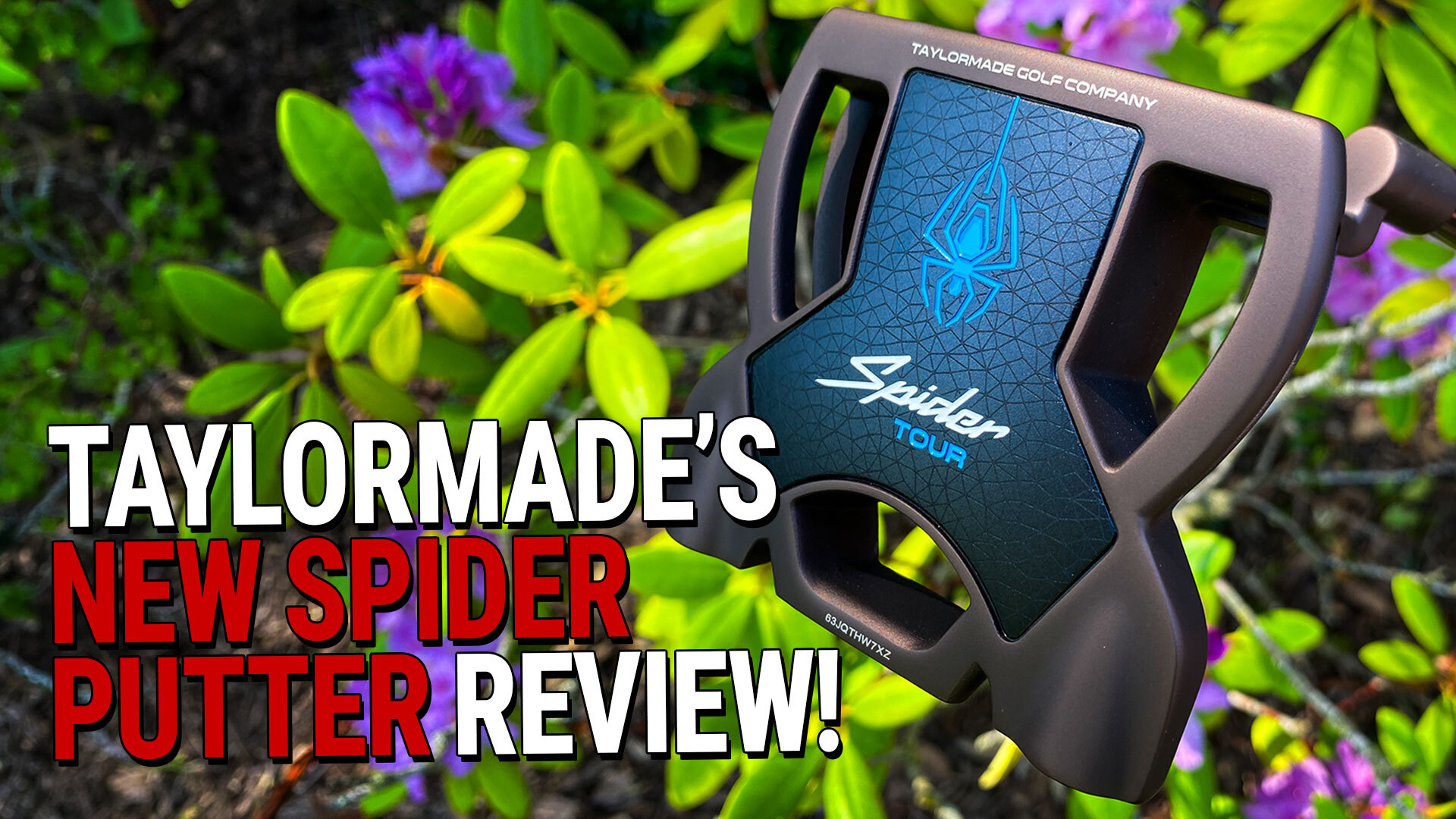
On this episode of Club Junkie, Brian dives into the all new TaylorMade Spider Tour Torched putters and breaks down everything from the unique torched finish to the performance, feel, and roll on the greens. Are these Spiders just a cosmetic upgrade, or is there more to the story?
Then, Brian is joined by Luke Williams from Odyssey Golf to discuss the highly anticipated Damascus Milled putters. Luke shares the inspiration behind the project, the challenges of working with Damascus steel, what makes these putters so special, and why collectors and players alike are excited about Odyssey’s latest premium offering.
Whether you’re a putter junkie, gear collector, or just looking for your next flatstick, this episode is packed with insights on two of the most talked-about putter releases of the year.

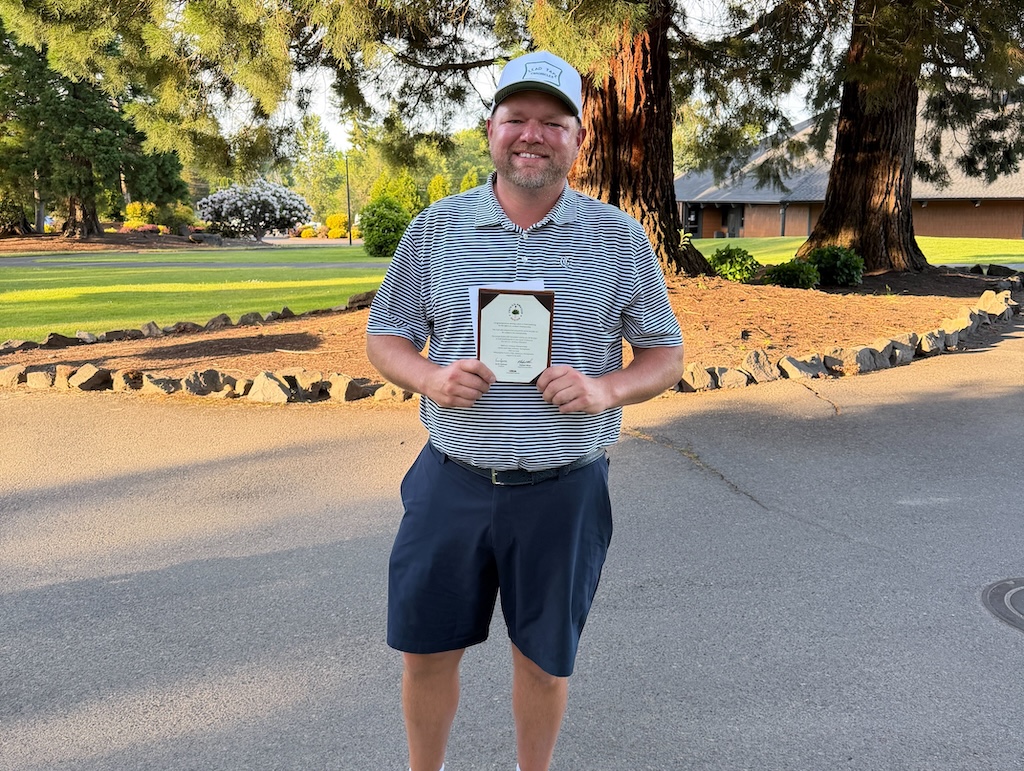
This past Monday, I played in the U.S. Amateur local qualifier at Rock Creek Country Club in Portland, Oregon. A full tee sheet from 7:30 a.m. to 1:55 p.m., the top 11 scores would make it to the U.S. Amateur final qualifying.
I teed off at 10:48 a.m.. With the 7:30 am tee time, you can get a feel for the leaders’ pace, and they were off and running on the challenging setup at Rock Creek.
View this post on Instagram
Getting to the highlight of the round on the par five 17th, a drive up the left side and 212 yards left to the front hole location. I took out a 5-iron with plans of middle of the green. The ball ended up 8 feet left of the hole, pin high. A slight downhill putt dropped in for an eagle 3 on the 17th. With the cut line looking to be anywhere from -2 to even par. This was the boost I had been waiting for all day.
With making par from the trees on 18, it was time to wait for a potential playoff with a posted score of one under par 71.
Three hours later, it was playoff time. 8 players for 6 spots. I made par on the playoff hole, which was good enough to advance to the U.S. Amateur final qualifying in July. USGA qualifiers sure deliver on all of the emotions in golf!
Club Junkie
Building my 2026 gamer WITB: Ranking the contenders and new putter projects – Club Junkie Podcast

The annual What’s In The Bag build is underway, and on this episode of Club Junkie, Brian breaks down the clubs currently leading the race for a spot in his 2026 gamer setup. From drivers and fairway woods to irons, wedges, and shafts, he ranks the equipment that’s performing best and explains what’s separating the front runners from the rest of the field.
Brian also heads into the workshop to discuss several putter projects currently on the bench. From head options and shaft choices to build ideas and testing plans, he shares what he’s working on and which putters could become serious contenders for the bag this season.
If you’re a gear junkie who loves equipment testing, club building, and the never-ending pursuit of the perfect setup, this episode is for you.
Follow Club Junkie:
Instagram: @clubjunkiepod
TikTok: @clubjunkiepod
Threads: @clubjunkiepod
X: @ClubJunkiePod

What’s the story behind Webb Simpson’s custom-stamped irons?

Memorial Tournament Tour Report: Rory McIlroy, Cameron Young switch up drivers, and more

Cadillac Championship Tour Report: Spieth’s sizable changes, McLaren Golf launches, and more

Russell Henley’s winning WITB: 2026 Charles Schwab Challenge

Kristoffer Reitan’s winning WITB: 2026 Truist Championship

Best irons 2026: Best irons overall, most forgiving irons, and more

J.T. Poston’s winning WITB: 2026 Memorial Tournament

Aaron Rai’s winning WITB: 2026 PGA Championship

Cameron Young’s winning WITB: 2026 Cadillac Championship

Details on Jason Day’s latest prototype Avoda iron setup


Christiaan Maas WITB 2026 (June)
Driver: TaylorMade Qi4D LS (8 degrees) Shaft: Fujikura Ventus TR Blue 6 X 3-wood: TaylorMade Qi10 (15 degrees) Shaft: Fujikura Ventus Black...


Ryan Palmer WITB 2026 (June)
Driver: Callaway Quantum Triple Diamond (9 degrees) Shaft: Project X HZRDUS Smoke Blue RDX 60 TX 3-wood: TaylorMade Qi10 (15 degrees) Shaft:...


Bud Cauley WITB 2026 (June)
Bud Cauley had >14 clubs in his bag when photographed prior to the Memorial Tournament. Driver: Titleist GTS2 (8 degrees) Shaft: Fujikura...


Hannah Green WITB 2026 (June)
Driver: Titleist GTS3 (10 degrees, D4 SureFit setting) Shaft: Mitsubishi Chemical Diamana RB 53 S 3-wood: Titleist GT3 (15 degrees,...
-
 Equipment7 days ago
Memorial Tournament Tour Report: Rory McIlroy, Cameron Young switch up drivers, and more
-
 News2 weeks ago
Russell Henley’s winning WITB: 2026 Charles Schwab Challenge
-
 Equipment4 days ago
Best irons 2026: Best irons overall, most forgiving irons, and more
-
 Whats in the Bag5 days ago
J.T. Poston’s winning WITB: 2026 Memorial Tournament
-
 Equipment1 week ago
Details on Jason Day’s latest prototype Avoda iron setup
-

 News2 weeks ago
Charles Schwab Challenge Tour Report: MacIntyre, Åberg and Spaun all switch putters, TaylorMade launches new Spider
-
 Equipment2 weeks ago
Details on J.J. Spaun’s surprise putter switch
-

 Popular Photo Galleries3 weeks ago
Photos from the 2026 Charles Schwab Challenge


Tony Wright
Dec 13, 2016 at 1:59 pm
Peter congratulations on an absolutely terrific article!
adam
Nov 14, 2016 at 7:10 pm
I think the stat could be further enhanced by adding the difficulty of a putt, in addition to the distance. The pro average on a straight, 8-foot uphill putt is going to be substantially better than 50%. Wouldn’t be surprised to see downhill, 8-foot sliders come in at 20%.
The good player will, of course, leave himself with easier putts. So, perhaps Day has the wedge control to dial in an 8-foot, uphill putt on a consistent basis. Does this make him a better putter, or just a better wedge player. Hmmm.
Tal
Nov 15, 2016 at 12:47 am
That’s the next stage of SG putting. Taking break angle and severity into account! That would be awesome! Although even the best wedge players in the world can’t leave themselves a straight uphill putt all the time. So Day’s good putting is unlikely to be as a result of always leaving himself straight putts. If he could do that, he may as well just drop the ball off in the hole every time. TV distorts our view of why pro golfers are better than even top amateurs. It’s little improvements in all areas that make the difference. They can’t choose exactly where to leave the ball on the green.
For perspective, his total SG tee to green (including .375 strokes per round around the greens) was .987 strokes per round. He gained 1.310 strokes per round putting. Despite gaining strokes around the greens, this shows his putting was more valuable to him than his short game, proving his putting stats are down to his putting like the author said.
adam
Nov 15, 2016 at 12:06 pm
He’s a good putter, no doubt. However, every player with a wedge in his hand is trying to create a favorable putting situation (while minimizing risk). When you can move the ball and control trajectory and distance, you’re going to leave yourself with easier putts. Isn’t that the basis of Striker’s game? Of Furyk’s?
However, I think the stat isn’t all that helpful at present. You’d need much more sophisticated data gathering and analysis. This has to be the next step for the stat to be truly meaningful.
Tal
Nov 16, 2016 at 6:00 am
I think it’s a very complete stat. There is room for improvement for sure, but it’s better than any other putting stat we have. Like you said, every player is looking for the best putt and again, these guys aren’t as accurate as tv makes them look froom 100 in. For this reason, SG is still able to measure pure putting skill better than any other stat we have. (It does take uphill and downhill into account too, by the way)
Peter
Nov 16, 2016 at 3:30 pm
Adam,
I actually started with SG Putting 28 years ago and worked with quite a number of LPGA players (easier to get to know). My observations and limited testing did NOT reveal meaningful differences in relative difficulty. When MIT got into the SG game in 2010, they agreed that an 8 ft. putt is valued at 1.5 regardless of up down or sideways.
Finally, on that point, imagine the added complexity of data entry – a major barrier to usage.
mark
Nov 14, 2016 at 10:00 am
All I have to say is Jordan Speith’s putting in 2015 was the best Ive ever seen along with Tiger when he was on top. I don’t care what stats say.
Uhit
Nov 14, 2016 at 11:04 am
They shot some outstanding putts, several times shown in the highlights of the tour…
…but the (unspectacular) average was not shown, nor remembered.
If I would collect all my spectacular shots in a best of…
…you would assume, that I have to be the best player ever…
…just like most of us, if we only look at our highlights. 😉
…but if we look at our stats (if we would collect them…), you see, that we are far away from the top.
ian
Nov 14, 2016 at 1:23 pm
Yup
Tal
Nov 14, 2016 at 5:39 pm
Spieth is an awesome putter for sure! His approach play and highly efficient driving were the keys to his great 2015 season though. His putting didn’t account for all of his winning advantage.
Uhit
Nov 13, 2016 at 1:08 pm
“Strokes-Gained Putting places a numeric value on each putting opportunity based on distance from the hole”
Is a chip from 30 ft to a hole also a putting opportunity, if the player could use a putter?
Is a put from outside the green from 30 ft to a hole also a putting opportunity?
Or has a putting opportunity to be on the green?
A close chip and a additional put from 30 ft distance, is the same as two putts from 30 ft distance?
…and independent whether both strokes happened on the green, or not?
…and a three put from 60 ft on the green vs. a 40 ft chip plus a 18 ft put plus a additional 2 ft put?
Maybe Jason Day just knew better than most, how to play the last approach shot (to get in a better position) for the following put?
I think there still are many variables left, and SG is just another try to quantify something, that is barely quantifyable in a correct manner.
Tal
Nov 13, 2016 at 6:45 pm
Only putts on the green count. Everything else around the green is accounted for by the strokes gained short game stat. It can be broken down further though.
Uhit
Nov 13, 2016 at 8:01 pm
Ok, but then, it makes not that much sense, to look at the putting SG isolated…
…because the outcome is also depending from the short game.
If Day successfully tried to achieve uphill putts with his short game, he had an advantage for his putts – if the rest of the field did not take that opportunity in the same way.
It is hard to tell, but anyway, Day was really good, and maybe even the best around the hole – more often than others during the season.
Tal
Nov 13, 2016 at 8:17 pm
SG accurately (enough) demonstrates skill in individual areas compared to the field average. It also somewhat nullifies variables such as rough length and course condition by building a database of millions of shots over time.
You’re right though; having the best SG putting stats doesn’t mean you scored the best. If you’re constantly hitting the ball to 3 feet then you’d be the best iron player in the world, but we’d learn little about your ability to putt. The SG stat system only works as a whole. I think the reason people over-analyse SG putting is because they’re still clinging to the idea that putting is the most important part of the game. SG data shows this to not necessarily be the case.
Uhit
Nov 14, 2016 at 4:28 am
Yes, you are probably right, that maybe the strive to see the putting as the holy grail of golf is a part of the over-interest in putting stats…
…and I can understand this, because if you have a 10´ birdie put on a par five, it is hard to accept, that you can make more than one put to finish the hole…
…3 strokes for 550 yards and 3 strokes for 10´ is hard to accept…
…especially with the same club in hands.
A 70 year old golfer can be a better putter than a 17 year old.
Putting is for everyone – long driving is not.
Putting is the hope for the not that gifted player…
…no matter what stats you are using.
Tal
Nov 14, 2016 at 5:20 pm
I totally agree. It’s hard to accept hitting an approach to 5 feet and missing the putt. People confuse the missed birdie opportunity because of a missed putt with the fact that putting is more important to scoring, simply because it’s the last thing you remember.
Peter
Nov 16, 2016 at 3:35 pm
Uhit,
On Tour, only putts on the putting surface count as putts. In ShotByShot.com, I recommend that players count those shots from just off the green or on the fringe to be putts. If counted as Chips, their chipping results will be artificially improved. At the same time, shots that are truly chipping opportunities ARE chips even if the putter is the club of choice.
Uhit
Nov 17, 2016 at 3:30 am
Thank you Peter for the clarification.
It is always a compromise, where to draw the line between (partly) interchangeable things.
I remember a player, that chipped on a green, over a spike mark, into the hole (Garcia?).
The SG stats are similar to a score card…
…one don´t see the quality of the single shots, but you get a good idea, how well someone played –
which is exactly the case in this article, where the SG stats help to identify a outstanding putting performance of a single player.
Hans
Nov 13, 2016 at 4:07 am
First, thanks for doing the research into how consistency was the real difference (that’s what makes this article interesting). That said, it does at the same time beg the question of what makes for the “best” putter. If some guys stats are lower because he putted worse when he was out of contention, does that make him a worse putter or simply less focused when he mattered less and money when it did matter. And we might care about the latter more, than the former. Still, a nice result by day to stay above average every single event, it says sthg good about his method.
Another thing tho, it makes me wonder how much the distribution of the types of putts a player has affects the SG stat. For instance in a day one player might have more 5-10 footers than other players. Etc for other distances. And there might be certain distances where players have a better chance of getting positive SG over the field. As an example, I could imagine if you give some guys a combo say 25-30 foot putts all day that they lag close, plus tap ins fro, from chips, that their strokes gained might not have a lot of room to be very high unless his name is spieth. But you give the same dude a bunch of 10 footers and his ability to turn a good putting day into extra strokes on the field becomes much stronger, simply because you can affect the make percentage more. Not saying that those are the distances where that would happen, but more that there might be some critical distances where you can push your SG ahead the most (or lose the most) and so what distances you putt from could affect your ability to move the SG needle.
Tal
Nov 13, 2016 at 8:33 pm
On your point about distribution of putts, that’s exactly what SG is for. It’s superior to simply counting putts as it takes both distance to the hole and how well you performed from that distance relative to the field. Let’s say you hit every shot from 150 in to 1 foot. Your SG putting would show nothing special but you’d be the greatest iron player in history and assuming your driving wasn’t horrible, you would win every tournament you played in.
Day’s superior putting performance is down to just that; superiorly consistent putting because the SG stats show that ignoring all other factors (i.e taking SG putting in isolation) he outperformed the field by over 1 stroke per round. That’s a MASSIVE advantage. His driving and approach play added further strokes to his advantage.
Peter
Nov 16, 2016 at 3:36 pm
Well Said Tal. Thanks!
Tal
Nov 13, 2016 at 8:49 pm
SG isn’t the same as just counting putts. If you hole an 8 footer, you gain more strokes to the field than holing a 2 footer. So, if Day was only ever putting from very close to the hole due to great chipping, his SG putting wouldn’t show anything special, but his SG short game would. This article has only taken putting in isolation though, so maybe putting and short game were strong for Day last season. SG though, measures pure putting skill in a way that no other stat can. If you’re interested, you should read ‘Every Shot Counts’ by Mark Broady. It answers all these questions.
K dawg
Nov 12, 2016 at 7:49 pm
Sorry but Speith’s putting the year before is the best ever. If the stats don’t identify that…then they aren’t measuring correctly.
Tal
Nov 13, 2016 at 8:35 pm
You’re basing this off of television highlights.
Pingback: Did Jason Day just have the best putting year of any Tour pro ever? – Swing Update