
Opinion & Analysis
How your shoulder blades can affect your club face: Part 2


This article was co-authored with Chris Gibson, an Australian AAA-rated golf professional. His teaching philosophy focuses on simplicity and longevity in the game, providing help for golfers at all levels. He focuses on interpreting information from technology and applying it in the simplest way possible to help his students
Before you begin reading this article, make sure you have read Part 1 in this series, otherwise not much of this is going to make sense! Here, in Part 2, Chris and I are going to offer solutions that will help you to develop better stability and control of those all-important shoulder blades.
But first, in response to requests for a more detailed photographic explanation, we will also show you the good and bad of scapula-positioning when standing upright and in a golf setup. The two models featured are an underdeveloped teen who has poor scapula control, and a top-100 player in the world who has five years of scapula stability training under his belt (in addition to other training).
You can see that in Pic 1; the teen had a lack of bulk and activation in the muscles surrounding the scapula and it appears to poke through the skin. This leads to the right shoulder sitting very low and internally rotated at set up (Pics 2 and 3), which as we suggested in Part 1 of this article, makes it ultimately more difficult to control the clubface consistently. Where as the more trained athlete (whilst still not perfect: right shoulder is low) holds his scapula better in standing and set up, which we believe gives him a better chance to repeatedly control the clubface efficiently in his action.
Pic 1
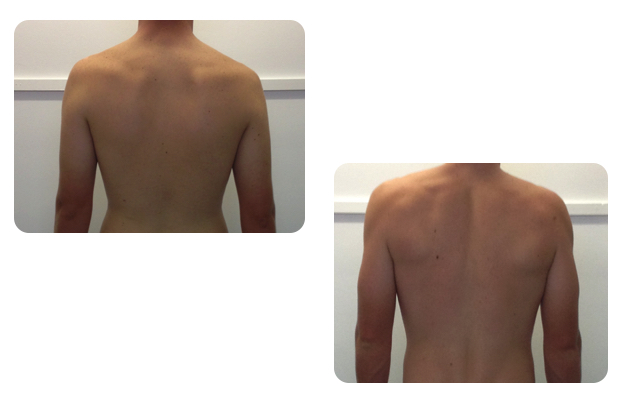
Teen (left) and top-100 player in the world.
Pic 2
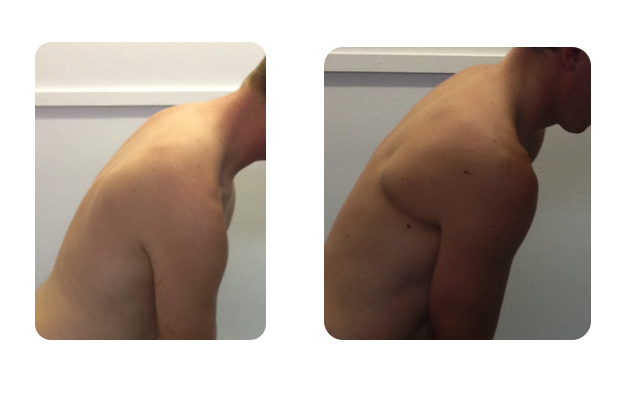
Teen (left) and top-100 player in the world.
Pic 3
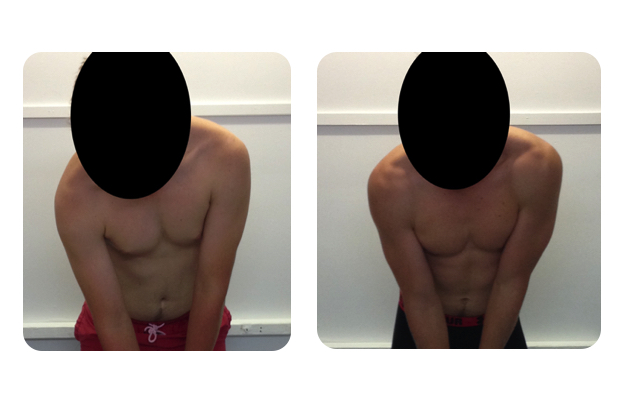
Teen (left) and top-100 player in the world.
Hopefully that clears things up for you and we can finally offer you a solution to training those scaps. The scapula is notoriously difficult to control; instinctively, we generally have poor awareness and usually aren’t very strong or stable in the muscles that surround it. Training of these muscles can be be tricky and complicated, so we have tried to simplify it for you by delivering two sets of simple exercises that we use as a starting point for many of the players (elite or otherwise) that we work with.
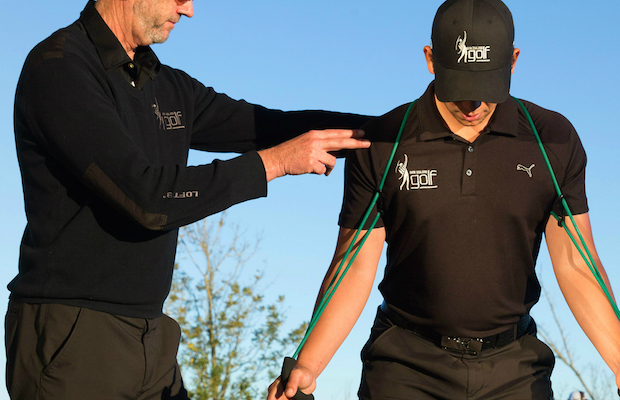
These simple drills can be done using either a piece of rubber tubing or more ideally, the training piece you will see in the photos called the Gravity Fit Thoracic Pro.
We have created one mini program for home and one mini program for the practice range. The movements are simple and don’t require any kind of in-depth anatomical knowledge to perform them correctly. We have supplied photos and descriptions of how to perform the movements, but also welcome questions and queries.
Home Exercises
Circuit – 3 Rounds – 30 seconds of rest between exercises.
- Tubing Push Out – Thoracic Pro – 12 reps
- Wall Push Up – Thoracic Pro – 12 reps
- Set Up Posture Drill – Thoracic Pro – 45 secs
- Waist to Waist Turns – Thoracic Pro – 10 reps
1. Tubing Push Out
- Purpose: Training scapula awareness, control and endurance
- Method: Stand tall, press arms forward keeping shoulder blades and spine connected to back paddle, turn palms up as you near end range. Control back to start position and repeat.

2. Wall Push Up
- Purpose: Training scapula awareness, control and endurance.
- Method: Stand tall, lower your chest toward the wall keeping your shoulder blades and spine connected to back paddle. Control back to start position and repeat.

3. Set Up Posture Drill
- Purpose: Training scapula awareness, control and endurance in golf setup.
- Method: In golf set up with hands in tubing, turn shoulders/elbows/hands outwards. Gently pulse hands against tubing.

4. Waist to Waist Turns
Purpose: Training scapula awareness, control and endurance in rotation movement pattern.
Method: In golf setup with hands in tubing, turn shoulders/elbows/hands outwards. Turn into backswing then turn into follow through. Maintain shoulder/elbow/hand positioning all the way through.
 Range Drills
Circuit – 10 rounds – 20 secs rest between drills
- Set Up Posture Drill – Thoracic Pro – 20 secs
- Waist to Waist Turns – Thoracic Pro – 10 reps
- Preset, Backswing to Impact – 5 reps
- Preset, backswing to hit ball – 3 reps
1. Set Up Posture Drill
- Purpose: Training scapula awareness, control and endurance in golf setup.
- Method: In golf set up with hands in tubing, turn shoulders/elbows/hands outwards. Gently pulse hands against tubing.

2. Waist to Waist Turns
- Purpose: Training scapula awareness, control and endurance in rotation movement pattern.
- Method: In golf set up with hands in tubing, turn shoulders/elbows/hands outwards. Turn into backswing then turn into follow through. Maintain shoulder/elbow/hand positioning all the way through.

3. Preset, Backswing to Impact
- Purpose: Practice first move, top of backswing and back to impact in controlled manner. Opportunity to discover what positions feel like with quality scapular control under low load (moving slowly).
- Method: Set club parallel to ground with good shoulder position (connected scapulae), slowly swing up to top of 3/4 backswing and back to impact.

4. Preset, backswing to hit ball
- Purpose: Taking the movement patterns and control of the scapula and applying it to hitting balls.
- Method: Set club parallel to ground with good shoulder position (connected scapulae), complete rest of swing and impact at normal speed

The equipment featured in the exercises is called a Gravity Fit Thoracic Pro. It was conceived and designed by a world leading scientist in the field of physiotherapy. Designed for the specific task of training stability and strength in the shoulder girdle and scapula, it also works really nicely when applying that quality to dynamic rotation in a golf swing context. We love using it with our students and you can get one here: www.golffitproshop.com.




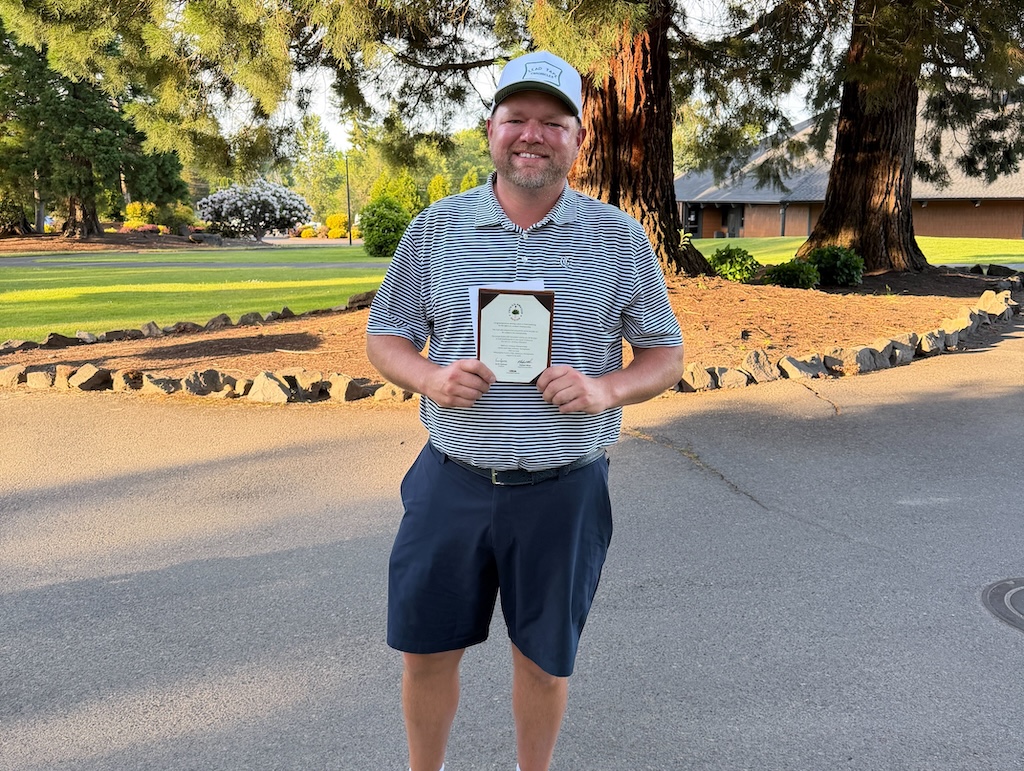
This past Monday, I played in the U.S. Amateur local qualifier at Rock Creek Country Club in Portland, Oregon. A full tee sheet from 7:30 a.m. to 1:55 p.m., the top 11 scores would make it to the U.S. Amateur final qualifying.
I teed off at 10:48 a.m.. With the 7:30 am tee time, you can get a feel for the leaders’ pace, and they were off and running on the challenging setup at Rock Creek.
View this post on Instagram
Getting to the highlight of the round on the par five 17th, a drive up the left side and 212 yards left to the front hole location. I took out a 5-iron with plans of middle of the green. The ball ended up 8 feet left of the hole, pin high. A slight downhill putt dropped in for an eagle 3 on the 17th. With the cut line looking to be anywhere from -2 to even par. This was the boost I had been waiting for all day.
With making par from the trees on 18, it was time to wait for a potential playoff with a posted score of one under par 71.
Three hours later, it was playoff time. 8 players for 6 spots. I made par on the playoff hole, which was good enough to advance to the U.S. Amateur final qualifying in July. USGA qualifiers sure deliver on all of the emotions in golf!
Club Junkie
Building my 2026 gamer WITB: Ranking the contenders and new putter projects – Club Junkie Podcast

The annual What’s In The Bag build is underway, and on this episode of Club Junkie, Brian breaks down the clubs currently leading the race for a spot in his 2026 gamer setup. From drivers and fairway woods to irons, wedges, and shafts, he ranks the equipment that’s performing best and explains what’s separating the front runners from the rest of the field.
Brian also heads into the workshop to discuss several putter projects currently on the bench. From head options and shaft choices to build ideas and testing plans, he shares what he’s working on and which putters could become serious contenders for the bag this season.
If you’re a gear junkie who loves equipment testing, club building, and the never-ending pursuit of the perfect setup, this episode is for you.
Follow Club Junkie:
Instagram: @clubjunkiepod
TikTok: @clubjunkiepod
Threads: @clubjunkiepod
X: @ClubJunkiePod
Club Junkie
Tour Edge Exotics mini driver review + TaylorMade Spider ZT Max first look – Club Junkie

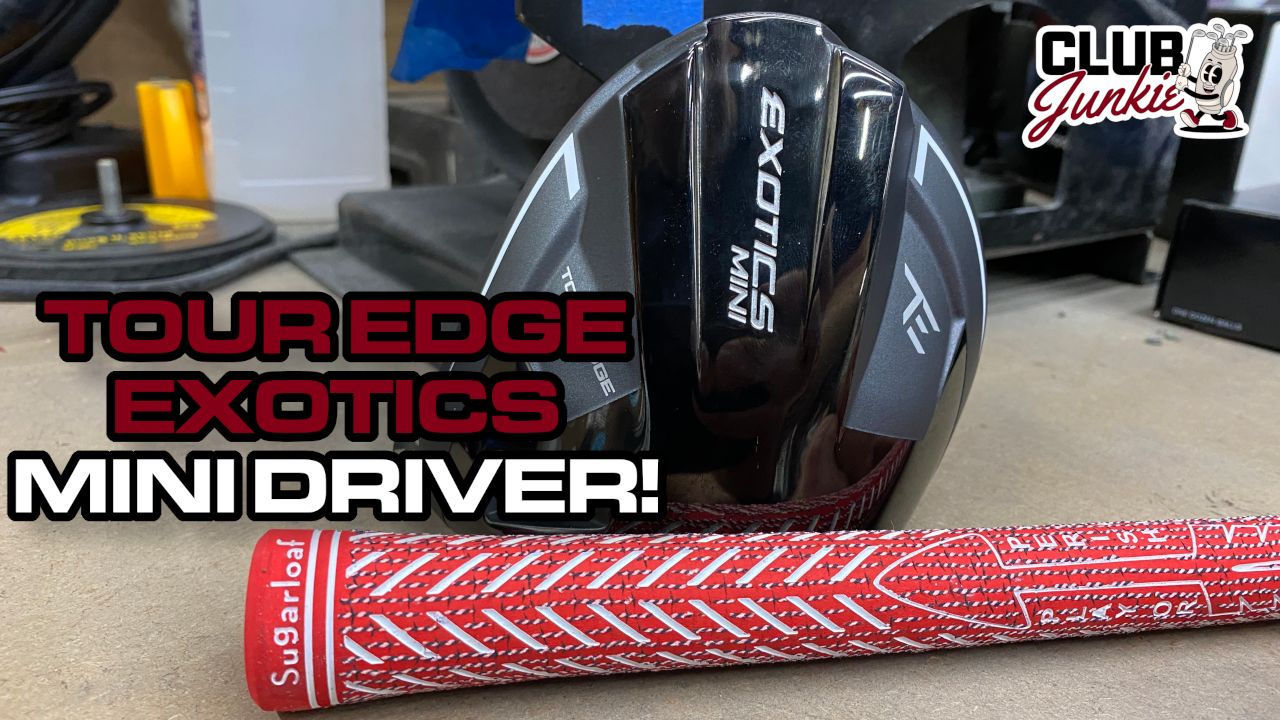
On this episode of Club Junkie, I put the new Tour Edge Exotics Mini Driver to the test and break down the performance, forgiveness, distance, and where it fits compared to a traditional driver or strong fairway wood. If you have been curious about adding a mini driver to the bag, this one is worth a look.
I also dive into the new TaylorMade Spider ZT Max putter that was recently spotted and discuss the growing zero torque putter trend. Plus, there is a closer look at the new Project X Titan Yellow shaft showing up on the PGA Tour and what makes it different from other profiles currently out there.

Justin Rose WITB 2026 (April): Full WITB breakdown with new McLaren irons

What’s the story behind Webb Simpson’s custom-stamped irons?

Memorial Tournament Tour Report: Rory McIlroy, Cameron Young switch up drivers, and more

Cadillac Championship Tour Report: Spieth’s sizable changes, McLaren Golf launches, and more

Russell Henley’s winning WITB: 2026 Charles Schwab Challenge

Kristoffer Reitan’s winning WITB: 2026 Truist Championship

Aaron Rai’s winning WITB: 2026 PGA Championship

J.T. Poston’s winning WITB: 2026 Memorial Tournament

Cameron Young’s winning WITB: 2026 Cadillac Championship

Best irons 2026: Best irons overall, most forgiving irons, and more


Bud Cauley WITB 2026 (June)
Bud Cauley had >14 clubs in his bag when photographed prior to the Memorial Tournament. Driver: Titleist GTS2 (8 degrees) Shaft: Fujikura...


Hannah Green WITB 2026 (June)
Driver: Titleist GTS3 (10 degrees, D4 SureFit setting) Shaft: Mitsubishi Chemical Diamana RB 53 S 3-wood: Titleist GT3 (15 degrees,...


Asterisk Talley WITB 2026 (June)
Driver: TaylorMade Qi4D (9 degrees) Shaft: Fujikura Ventus Blue 6 S 3-wood: TaylorMade Qi4D (16.5 degrees) Shaft: Fujikura Ventus Blue...


Brianna Do WITB 2026 (June)
Driver: Callaway Quantum Triple Diamond (9 degrees) Shaft: KBS PGW 3-wood: Callaway Elyte Titanium (15 degrees) Shaft: KBS PGW 5-wood:...
-
 Equipment6 days ago
Memorial Tournament Tour Report: Rory McIlroy, Cameron Young switch up drivers, and more
-
 News1 week ago
Russell Henley’s winning WITB: 2026 Charles Schwab Challenge
-
 Whats in the Bag3 days ago
J.T. Poston’s winning WITB: 2026 Memorial Tournament
-
 Equipment3 days ago
Best irons 2026: Best irons overall, most forgiving irons, and more
-

 Equipment1 week ago
Details on Jason Day’s latest prototype Avoda iron setup
-
 Equipment3 weeks ago
CJ Cup Byron Nelson Tour Report: Koepka and Kim’s newest putters finally get hot
-

 News2 weeks ago
Charles Schwab Challenge Tour Report: MacIntyre, Åberg and Spaun all switch putters, TaylorMade launches new Spider
-
 Equipment2 weeks ago
Details on J.J. Spaun’s surprise putter switch


Tom
Apr 19, 2024 at 1:52 pm
How is it possible for the right shoulder not to be lower at address if the right hand is below the l eft on the club?
Loui Cuppari
Aug 13, 2016 at 5:34 pm
I’ve been working on scapula control and upper arm connection for about a year now and ball striking has improved considerably after 30 odd years of frustration. I believe setting the right scapula is the main key along with connection of the upper left arm.
I think getting this scapula/upper arm control or bracing/setting right is the swing of the future.
Allan
Feb 10, 2016 at 2:05 pm
I agree with Chris. It is not super clear to me what is correct and exactly why the scapula is having such a dramatic impact of club face at impact.
Lou
Mar 19, 2016 at 12:50 am
I believe it allows you to control the lift of the club and horizontal movement (thoracic rotation) using just your “scap muscles”….Doing this gives you a better awareness of the club face is throughout the swing because you won’t be using your hands for rerouting the club head into a proper inside path….the hands can do their job of just controlling the dynamic loft and face position (the handle)….
Mike
Jan 27, 2016 at 8:31 pm
I’ve been working out with the Golf fit regimen for a 6 months and it’s really helped my rotation and flexibility. I’m 63 and my game is improving from 22 to 15 handicap over this past year. I didn’t buy this tubing thingy because I think it’s over priced and you can do it with tubing loops effectively. I just want to say that they are knowledgeable and have helped my game.
Chris
Jan 25, 2016 at 10:48 am
If internal rotation is bad, does that mean the shoulder should be externally rotated at address or during the swing? It is unclear to me from the article what the correct movement is. Any elaboration? Thanks.
rob campbell
Jan 25, 2016 at 9:46 am
If a top 100 player has been working on “scapula stability” for 5 years and hasn’t got it right, why would any normal person think this idea is worth his time? You’ve taken a wrong turn.
Ne26
Jan 24, 2016 at 10:48 am
Sooooo turns out to be another article written by someone pushing their own product.
WRX is rolling in that advertising money.
Billy
Jan 25, 2016 at 8:49 am
Why not?? Seems like you don’t quite understand the article(which is quite interesting)… Lame response