
Opinion & Analysis
The Wedge Guy: How many wedges should you carry?


At Edison Golf, we’ve been doing a number of user reviews with various forums, including this one with the GolfWRX community. I always like to try to have a personal conversation with the “winners” of these, so that we can get exactly the right specs for their wedges to be reviewed. And that conversation always starts with an examination into the 9-iron and “P-club” lofts which is currently in their bags.
But let’s be honest. In today’s iron world, that club bearing the designation “P”, is not anything close to be a true “wedge”, as the typical loft nowadays is 42 to 45 degrees . . . and a true “pitch shot” simply cannot be executed with that low a lofted club. I’ve written about the disappearance of the true “pitching wedge” HERE.
So, when we ask the question, “How many wedges should I carry?”, the starting point should be from that club to the highest lofted wedge you are comfortable having in your bag. And the answer is simple…
However many it takes to optimize your scoring range performance.
Those of you who know my work and writing over the past 25 years or so also know that I am a proponent of carrying a carefully measured “set” of wedges that give you the shotmaking control you need in prime scoring range. But what I’ve learned over those many years is that the number of wedges that is “right”, and the lofts of those wedges can be very different from one golfer to another.
Getting this right is crucially important, as your scores are more heavily influenced by your play from wedge range into the green, and your shotmaking around the greens, than by any other factor. The right “set” of wedges in your bag can make all the difference in the world.
As I repeatedly preach, taking your guidance from the PGA Tour players will not likely help you achieve your goals. These guys spend hundreds of hours each year perfecting their wedge play, and you don’t. The myriad of shots they have mastered is not realistic for you to mimic by always manipulating your swing. You are much better off adding some science to your wedge set makeup that can help you have more shot choices when you are in scoring range or trying to save par from a missed green.
How many wedges should you carry?
My basic premise on the subject is that the answer can be approached scientifically for each golfer, and it is a multi-step process:
- Begin by knowing the loft of the 9-iron and “P-club” that came with your set of irons, as optimum gapping begins there. The industry challenge of producing longer-hitting irons has led most OEMs to strengthen lofts throughout the set . . . specifically so they have a chance of winning “the launch monitor war” with their 6- or 7-iron. As those lofts have constantly been strengthened, it was apparently decided to widen the gaps between the short irons to 5 degrees from the traditional 4 that stood for decades. What this does is increase the distance differential between your 9-iron and “P-club” from what I would consider optimum. For golfers of slower swing speeds, that 5* gap might well deliver a 10-12 yard differential, but my bet is that most of you are getting a difference closer to 15 yards, or even more. That just will not let you get the distance control precision you want in prime scoring range.
- The second step is to be honest with your distances. I am a big proponent of getting on the golf course or range with a laser or GPS and really knowing how far you carry each of your short irons and wedges. Hit a number of shots from known yardages and see where they land (not including roll out). My bet is that you will find that your distances are different from what you thought they were, and that the differentials between clubs are not consistent.
- Figure out where to start. If your actual and real distance gap between your 9-iron and “P-club” is over 12-13 yards, maybe the place to start could be with a stronger P-club. You can either have your loft strengthened a bit or make the shaft ¼ to ½” longer to add a few yards to that club.
- Figure out what lofts your wedges should have. From there, I suggest selecting lofts of your wedges to build a constant full-swing yardage difference of 10-12 yards between clubs. Depending on your strength profile, that may require wedges at 4* intervals, or it might be 5 – each golfer is different. Those with very slow swing speeds might even find that 6* gaps deliver that distance progression.
- Challenge the traditional 52/56/60 or 50/54/58 setup. That first sequence of lofts became the “standard” when set-match pitching wedges were 48 degrees of loft, and the second as “P-club” lofts got even stronger. With the current crop of irons, you might find that your ideal wedge gapping starts at 47 or 48 degrees. The goal is to start where true wedge play begins and work from there to achieve ideal gapping. Though no company offers wedges in every loft, you can bend any wedge to hit your numbers exactly. Just remember, bending stronger reduces the bounce and bending weaker increases the bounce.
What many of you will find with this exercise is that it suggests that you should be carrying more wedges. That’s probably true for the vast majority of recreational golfers. I have come to realize that more wedges and fewer long clubs will usually improve your scores. After all, long or short by 25-30 feet is great at long range, but not acceptable in prime scoring range.
If you have more clubs at the long end of your bag (longer than a 5- or 6-iron) than you do at the short end (9-iron and up), then you should consider an honest self-appraisal of how often you use each club between your driver and putter. My bet is that it will be an enlightening analysis.










This past Monday, I played in the U.S. Amateur local qualifier at Rock Creek Country Club in Portland, Oregon. A full tee sheet from 7:30 a.m. to 1:55 p.m., the top 11 scores would make it to the U.S. Amateur final qualifying.
I teed off at 10:48 a.m.. With the 7:30 am tee time, you can get a feel for the leaders’ pace, and they were off and running on the challenging setup at Rock Creek.
View this post on Instagram
Getting to the highlight of the round on the par five 17th, a drive up the left side and 212 yards left to the front hole location. I took out a 5-iron with plans of middle of the green. The ball ended up 8 feet left of the hole, pin high. A slight downhill putt dropped in for an eagle 3 on the 17th. With the cut line looking to be anywhere from -2 to even par. This was the boost I had been waiting for all day.
With making par from the trees on 18, it was time to wait for a potential playoff with a posted score of one under par 71.
Three hours later, it was playoff time. 8 players for 6 spots. I made par on the playoff hole, which was good enough to advance to the U.S. Amateur final qualifying in July. USGA qualifiers sure deliver on all of the emotions in golf!
Club Junkie
Building my 2026 gamer WITB: Ranking the contenders and new putter projects – Club Junkie Podcast

The annual What’s In The Bag build is underway, and on this episode of Club Junkie, Brian breaks down the clubs currently leading the race for a spot in his 2026 gamer setup. From drivers and fairway woods to irons, wedges, and shafts, he ranks the equipment that’s performing best and explains what’s separating the front runners from the rest of the field.
Brian also heads into the workshop to discuss several putter projects currently on the bench. From head options and shaft choices to build ideas and testing plans, he shares what he’s working on and which putters could become serious contenders for the bag this season.
If you’re a gear junkie who loves equipment testing, club building, and the never-ending pursuit of the perfect setup, this episode is for you.
Follow Club Junkie:
Instagram: @clubjunkiepod
TikTok: @clubjunkiepod
Threads: @clubjunkiepod
X: @ClubJunkiePod
Club Junkie
Tour Edge Exotics mini driver review + TaylorMade Spider ZT Max first look – Club Junkie

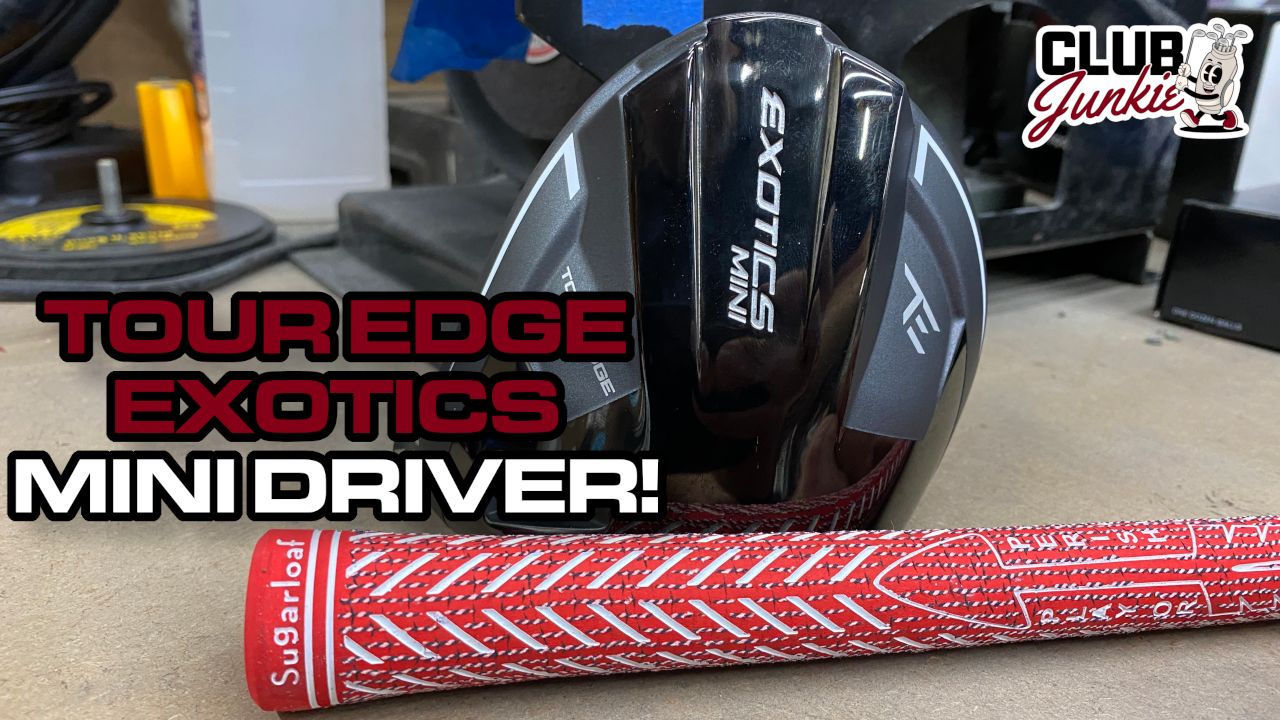
On this episode of Club Junkie, I put the new Tour Edge Exotics Mini Driver to the test and break down the performance, forgiveness, distance, and where it fits compared to a traditional driver or strong fairway wood. If you have been curious about adding a mini driver to the bag, this one is worth a look.
I also dive into the new TaylorMade Spider ZT Max putter that was recently spotted and discuss the growing zero torque putter trend. Plus, there is a closer look at the new Project X Titan Yellow shaft showing up on the PGA Tour and what makes it different from other profiles currently out there.

Justin Rose WITB 2026 (April): Full WITB breakdown with new McLaren irons

What’s the story behind Webb Simpson’s custom-stamped irons?

Memorial Tournament Tour Report: Rory McIlroy, Cameron Young switch up drivers, and more

Cadillac Championship Tour Report: Spieth’s sizable changes, McLaren Golf launches, and more

Russell Henley’s winning WITB: 2026 Charles Schwab Challenge

Kristoffer Reitan’s winning WITB: 2026 Truist Championship

Aaron Rai’s winning WITB: 2026 PGA Championship

Cameron Young’s winning WITB: 2026 Cadillac Championship

J.T. Poston’s winning WITB: 2026 Memorial Tournament

Best irons 2026: Best irons overall, most forgiving irons, and more


Bud Cauley WITB 2026 (June)
Bud Cauley had >14 clubs in his bag when photographed prior to the Memorial Tournament. Driver: Titleist GTS2 (8 degrees) Shaft: Fujikura...


Hannah Green WITB 2026 (June)
Driver: Titleist GTS3 (10 degrees, D4 SureFit setting) Shaft: Mitsubishi Chemical Diamana RB 53 S 3-wood: Titleist GT3 (15 degrees,...


Asterisk Talley WITB 2026 (June)
Driver: TaylorMade Qi4D (9 degrees) Shaft: Fujikura Ventus Blue 6 S 3-wood: TaylorMade Qi4D (16.5 degrees) Shaft: Fujikura Ventus Blue...


Brianna Do WITB 2026 (June)
Driver: Callaway Quantum Triple Diamond (9 degrees) Shaft: KBS PGW 3-wood: Callaway Elyte Titanium (15 degrees) Shaft: KBS PGW 5-wood:...
-
 Equipment5 days ago
Memorial Tournament Tour Report: Rory McIlroy, Cameron Young switch up drivers, and more
-
 News1 week ago
Russell Henley’s winning WITB: 2026 Charles Schwab Challenge
-
 Whats in the Bag3 days ago
J.T. Poston’s winning WITB: 2026 Memorial Tournament
-
 Equipment2 days ago
Best irons 2026: Best irons overall, most forgiving irons, and more
-

 Equipment1 week ago
Details on Jason Day’s latest prototype Avoda iron setup
-

 Equipment3 weeks ago
CJ Cup Byron Nelson Tour Report: Koepka and Kim’s newest putters finally get hot
-

 News2 weeks ago
Charles Schwab Challenge Tour Report: MacIntyre, Åberg and Spaun all switch putters, TaylorMade launches new Spider
-

 Equipment2 weeks ago
Details on J.J. Spaun’s surprise putter switch


Mark Blake
Apr 22, 2024 at 7:35 am
i am only using 3 wedges, its enough me. My 9 iron is 43 degrees.
Edison 47, 53, 59
but the Edison 47 goes to far!!, i might try 49, 55, 59 next time
WYBob
Nov 2, 2023 at 11:27 am
I am the same age as you Terry and have started to consider I might be carrying too many wedges (46*, 50*, 54*, and 58*). As my swing speed has decreased with age, I have noticed that the distance gaps between wedges have likewise decreased. I am now considering a set of 3 wedges at 46*, 51*, and 57* to open up a slot at the other end of my bag. I recall you are using a 57* wedge as your highest lofted club, so I’d appreciate your thoughts on my possible wedge reconfiguration. Thanks…
Bob Jones
Nov 1, 2023 at 12:00 pm
With Ben Hogan 1999 Apex irons and Titleist Vokey wedges, I have four-degree gaps starting with the 7-iron and going through 8, 9, E, 52, 56, and 60.
MarkM
Nov 1, 2023 at 9:34 am
Since I changed my irons my PW is now 45° instead of 46° so I’ve gone the 50/55/60 route and it has worked out or me.
Ben Hoagie
Oct 30, 2023 at 11:55 am
JPX 921 forged – 9i(41*), Pw(46*), Gw(51*) and a TM MG4 56*
Set makeup:
Ping G410 driver (255-260 carry)
Callaway 19* UW (220 carry off tee)
Callaway 23* apex pro HY (195-200 off the grass)
JPX 921 forged 6i-Gw (carry ranges from 180 down to 115 off the grass)
TM MG4 56* (avg 95 grass)
Odyssey White Hot Pro #9
Augustus
Nov 1, 2023 at 3:35 am
921F are 40 and 45 degrees.