
Opinion & Analysis
The Wedge Guy: Understanding iron designs, Part 2


As promised, here is the follow-up to last week’s post about understanding iron designs. Today, I’m going to tell you what to look for as you try to figure out which iron best suits your type of play and is most likely to deliver the performance you seek. Oh, and these principles apply to wedges as well.
Let me begin with a historical observation.
Up until the introduction of the first mainstream cavity back/perimeter-weighted irons, the entire market was limited to some type of forged blade design. Across the entire spectrum of brands and models, there were only subtle nuanced differences from one to the other. Some featured some kind of “muscle back”, where the mass was concentrated low in the clubhead and the shaping formed a sort of crescent on the back of the club, the majority of mass being in the center of the clubhead (from heel to toe). Others spread that mass more evenly across the back of the clubhead (i.e. the Hogan designs), while others shaped their back to provide a bit more mass toward the toe, as in the traditional Wilson Staff models.
Then the “revolution” came with the Ping Eye 2 and all its copies. These early cavity-back designs moved much of the mass to the extreme perimeter of the clubhead, leaving a thin face, which delivered a high degree of forgiveness of off-center hits, but also deteriorated the consistent distance control delivered by the traditional forged blades. They also launched the ball much higher, making long- and mid-irons much easier to hit, but compromising the traditional precision of shorter irons.
Golfers had to make choice between shotmaking precision and forgiveness of mishits.
This design “revolution” also set in motion the continual strengthening of lofts in the shorter clubs to where we are today when “P-clubs” can be as low as 42 degrees – a far cry from what a true “pitching wedge” must be. See my post on that here.
The one thing in common with both of these approaches to iron design was that “what you see is what you get.” There were no internal technologies, so a visual examination of the clubhead could tell you pretty much how that iron was going to play.
As iron technologies have advanced, many radical designs have come and gone, but the performance of the traditional blade and the traditional cavity-back remain. Modern technologies allow much more precision in making iron heads, and multi-material construction has given club designers much more freedom to explore and refine performance, but these principles of iron head design are constant. For the most part, the golf ball will react to how a clubhead’s mass is distributed and where its CG is located. Period.
Understand that for each clubhead number or loft, the weight of the clubhead does not vary by more than a few grams from model to model to model. The designers’ challenge is to position that finite amount of mass in such a way as to achieve the performance goals for that particular model. So, here are the parameters designers have to consider, and that you can consider when looking for a new set of irons:
To begin, golf ball performance is determined by how much mass will be directly behind various points of impact on the face. The reason blade designs are still preferred by the best shotmakers is that these designs put mass directly behind the point of impact with the ball, thereby giving the golfer the maximum ability to control distance, trajectory, and shape of the shot.
Conversely, if the area behind the strike zone is thin, the club will likely be “hotter” but distance consistency will be compromised.
If a large portion of the mass is positioned lower in the clubhead, that design will launch higher, and likely with less spin. While this might be desirable in the lower lofts; high launch and low spin are probably not what you want in your higher-lofted scoring clubs, say those over 37-39 degrees, and particularly not with your wedges.
If mass is concentrated in the center of the clubhead from heel to toe, center strikes will be extremely solid and repeatable, but misses toward the toe will be more compromised than a design that has the mass more evenly distributed across the entire clubhead.
If some of the mass is distributed toward the low toe area, that club will be more forgiving of toe mis-hits.
Thin, fast faces and hollow or foam-filled construction is the rage now, but the trade-off is losing some distance precision in exchange for more distance (which comes from higher launch and less spin).
Another modern development is the use of heavy tungsten inserts low in the clubhead, which adds to the higher loft and lower spin distance formula – that might be desirable in the longer irons, but that’s exactly the opposite of what you want in the scoring clubs.
Big wide soles were more the rage a while back than they are now, but the wider the sole, the lower the mass distribution, so the higher the launch angle and the lower the spin. And these super wide sole designs are not very good for tighter turf conditions.
All golf clubhead designs are bound by two distinct principles – gear effect and smash factor.
Gear effect determines the trajectory and spin the golf ball will take. The higher the clubhead mass is distributed (i.e. blade designs), the lower the ball flight and higher the spin rates. Likewise, the more mass that is distributed toward the toe or heel from the strike point, the more likely the ball will curve back to the center.
Smash factor is the efficiency of transfer of clubhead speed to ball speed. Every club has one perfect point of impact that maximizes smash factor and that transfer of energy begins to deteriorate as impact is moved away from that point. That’s why you get occasional “heaters” off most thin-faced irons and see significant distance loss on more traditional blades. It’s also why those high-face misses with traditional wedge designs just pop-up with greatly reduced distance and spin.
I hope this has been enlightening and helpful.
More from the Wedge Guy









This past Monday, I played in the U.S. Amateur local qualifier at Rock Creek Country Club in Portland, Oregon. A full tee sheet from 7:30 a.m. to 1:55 p.m., the top 11 scores would make it to the U.S. Amateur final qualifying.
I teed off at 10:48 a.m.. With the 7:30 am tee time, you can get a feel for the leaders’ pace, and they were off and running on the challenging setup at Rock Creek.
View this post on Instagram
Getting to the highlight of the round on the par five 17th, a drive up the left side and 212 yards left to the front hole location. I took out a 5-iron with plans of middle of the green. The ball ended up 8 feet left of the hole, pin high. A slight downhill putt dropped in for an eagle 3 on the 17th. With the cut line looking to be anywhere from -2 to even par. This was the boost I had been waiting for all day.
With making par from the trees on 18, it was time to wait for a potential playoff with a posted score of one under par 71.
Three hours later, it was playoff time. 8 players for 6 spots. I made par on the playoff hole, which was good enough to advance to the U.S. Amateur final qualifying in July. USGA qualifiers sure deliver on all of the emotions in golf!
Club Junkie
Building my 2026 gamer WITB: Ranking the contenders and new putter projects – Club Junkie Podcast

The annual What’s In The Bag build is underway, and on this episode of Club Junkie, Brian breaks down the clubs currently leading the race for a spot in his 2026 gamer setup. From drivers and fairway woods to irons, wedges, and shafts, he ranks the equipment that’s performing best and explains what’s separating the front runners from the rest of the field.
Brian also heads into the workshop to discuss several putter projects currently on the bench. From head options and shaft choices to build ideas and testing plans, he shares what he’s working on and which putters could become serious contenders for the bag this season.
If you’re a gear junkie who loves equipment testing, club building, and the never-ending pursuit of the perfect setup, this episode is for you.
Follow Club Junkie:
Instagram: @clubjunkiepod
TikTok: @clubjunkiepod
Threads: @clubjunkiepod
X: @ClubJunkiePod
Club Junkie
Tour Edge Exotics mini driver review + TaylorMade Spider ZT Max first look – Club Junkie

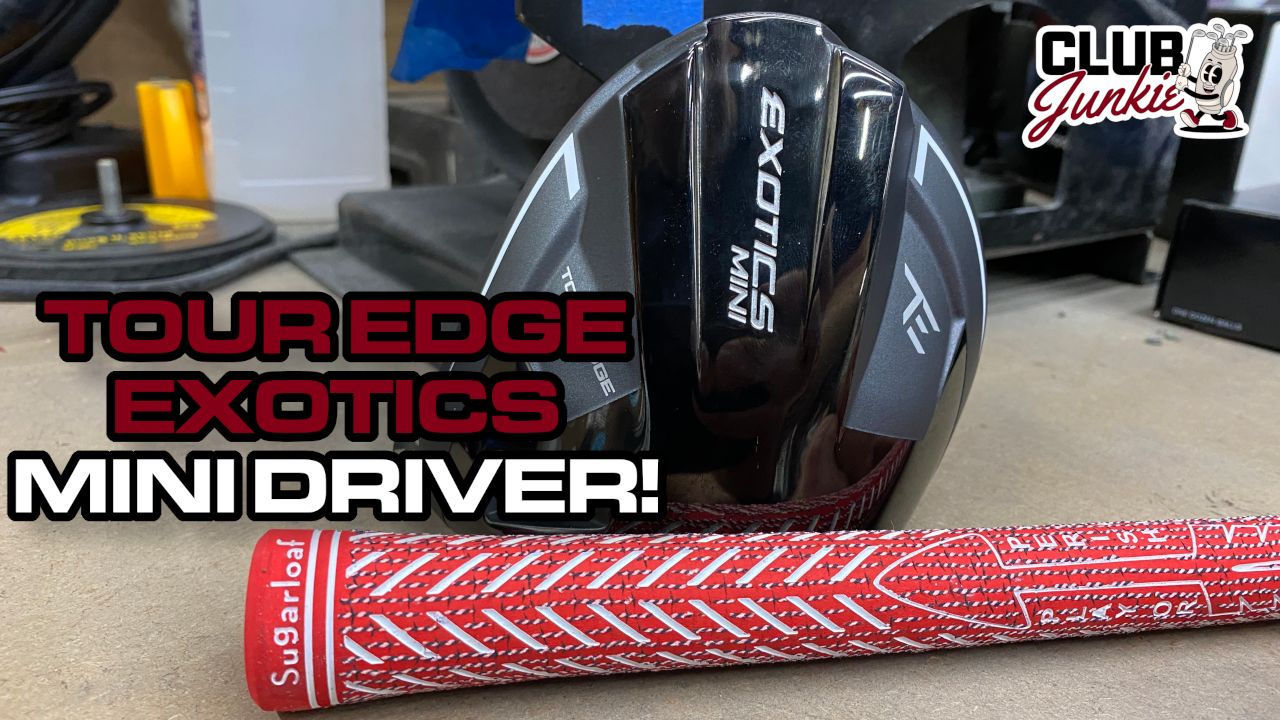
On this episode of Club Junkie, I put the new Tour Edge Exotics Mini Driver to the test and break down the performance, forgiveness, distance, and where it fits compared to a traditional driver or strong fairway wood. If you have been curious about adding a mini driver to the bag, this one is worth a look.
I also dive into the new TaylorMade Spider ZT Max putter that was recently spotted and discuss the growing zero torque putter trend. Plus, there is a closer look at the new Project X Titan Yellow shaft showing up on the PGA Tour and what makes it different from other profiles currently out there.

Justin Rose WITB 2026 (April): Full WITB breakdown with new McLaren irons

What’s the story behind Webb Simpson’s custom-stamped irons?

Memorial Tournament Tour Report: Rory McIlroy, Cameron Young switch up drivers, and more

Cadillac Championship Tour Report: Spieth’s sizable changes, McLaren Golf launches, and more

Russell Henley’s winning WITB: 2026 Charles Schwab Challenge

Kristoffer Reitan’s winning WITB: 2026 Truist Championship

Aaron Rai’s winning WITB: 2026 PGA Championship

J.T. Poston’s winning WITB: 2026 Memorial Tournament

Cameron Young’s winning WITB: 2026 Cadillac Championship

Best irons 2026: Best irons overall, most forgiving irons, and more


Bud Cauley WITB 2026 (June)
Bud Cauley had >14 clubs in his bag when photographed prior to the Memorial Tournament. Driver: Titleist GTS2 (8 degrees) Shaft: Fujikura...


Hannah Green WITB 2026 (June)
Driver: Titleist GTS3 (10 degrees, D4 SureFit setting) Shaft: Mitsubishi Chemical Diamana RB 53 S 3-wood: Titleist GT3 (15 degrees,...


Asterisk Talley WITB 2026 (June)
Driver: TaylorMade Qi4D (9 degrees) Shaft: Fujikura Ventus Blue 6 S 3-wood: TaylorMade Qi4D (16.5 degrees) Shaft: Fujikura Ventus Blue...

Brianna Do WITB 2026 (June)
Driver: Callaway Quantum Triple Diamond (9 degrees) Shaft: KBS PGW 3-wood: Callaway Elyte Titanium (15 degrees) Shaft: KBS PGW 5-wood:...
-
 Equipment6 days ago
Memorial Tournament Tour Report: Rory McIlroy, Cameron Young switch up drivers, and more
-
 News1 week ago
Russell Henley’s winning WITB: 2026 Charles Schwab Challenge
-
 Whats in the Bag3 days ago
J.T. Poston’s winning WITB: 2026 Memorial Tournament
-
 Equipment3 days ago
Best irons 2026: Best irons overall, most forgiving irons, and more
-

 Equipment1 week ago
Details on Jason Day’s latest prototype Avoda iron setup
-

 Equipment3 weeks ago
CJ Cup Byron Nelson Tour Report: Koepka and Kim’s newest putters finally get hot
-

 News2 weeks ago
Charles Schwab Challenge Tour Report: MacIntyre, Åberg and Spaun all switch putters, TaylorMade launches new Spider
-

 Equipment2 weeks ago
Details on J.J. Spaun’s surprise putter switch


Paul Hughes
Sep 2, 2023 at 8:49 pm
Why did the Eye 2 and similar launch the ball higher, given the high center of gravity (and pretty close to the face) compared to many prior clubs?
If the trajectory was higher, was it a higher launch angle or more spin?
P
Sep 2, 2023 at 10:38 pm
They’re perimeter weighted with the weight low in the face not high
Paul Hughes
Sep 11, 2023 at 3:08 pm
Look it up.
pjm
Aug 31, 2023 at 8:41 pm
Is there a reason that modern irons have rounded toes? Is it required to distribute weight? Earlier designs seem to have favored a more square toe.
D
Aug 31, 2023 at 10:00 am
“And these super wide sole designs are not very good for tighter turf conditions.”
Not true!!! How do people hit FW and Hybrids then? Massive soles! Duh
OP is a Donkey
Aug 31, 2023 at 11:50 am
Hybrids and fairway woods are not irons…. you are trying to compare apples to bowling balls. Completely different design.
D
Aug 31, 2023 at 1:21 pm
Er, it’s just a club, with a SOLE. Look at the size of the soles! How do we hit those off tight lies! Wow! lmao you eejit. We even manage to hit 460cc driver off the deck, duh
Bob
Aug 31, 2023 at 6:31 pm
The strike is different. Wide soles on irons, with which the optimum strike is slightly downward, are not good in tighter turf conditions. The optimum strike on a hybrid or fairway wood is a sweep.
Josh
Sep 1, 2023 at 11:04 am
*the optimum strike for most hybrids is still slightly downward to maximize compression.
Your fairway woods shouldn’t hit the turf, your hybrids should.
H
Sep 1, 2023 at 11:22 pm
Flipping clueless amateur doesn’t play golf never have huh