
Opinion & Analysis
The Wedge Guy: What really makes a wedge work?


Having been in the wedge business for over thirty years now, and having focused my entire life’s work on how to make wedges work better, one of my biggest frustrations is how under-informed most golfers are about wedges in general, and how misinformed most are about the elements of a wedge that really affect performance.
That under-informed and misinformed “double whammy” helps make the wedge category to be the least dynamic of the entire golf equipment industry. Consider this if you will. Golfers carry only one driver and only one putter, but an average of three wedges. BUT – and it’s a big “but” – every year, unit sales of both drivers and putters are more than double the unit sales of wedges.
So why is that?
Over those thirty-plus years, I have conducted numerous surveys of golfers to ask that very question, and I’ve complemented that statistical insight with hundreds of one-on-one interviews with golfers of all skill levels. My key takeaways are:
- Most golfers have not had a track record of improved performance with new wedges that mirror their positive experience with a new driver or putter.
- A large percentage of golfers consider their wedge play to be one of the weaker parts of their games.
- And most golfers do not really understand that wedge play is the most challenging aspect of golf.
- On that last point, I wrote a post almost two years ago addressing this very subject, “Why Wedge Mastery Is So Elusive” (read it here).
So now let’s dive into what really makes a wedge work. In essence, wedges are not that much different from all the other clubs in our bags. The three key elements that make any club do what it does are:
- The distribution of mass around the clubhead
- The shaft characteristics
- The specifications for weight, shaft length and lie angle
Let’s start from the bottom and work our way up.
For any golf club to perform to its optimum for a given golfer, these three key measurements must be correct. Shaft length and lie angle work together to help that golfer deliver the clubhead to the ball as accurately as possible time and again. If either spec is off even a little bit, quality contact will be sacrificed. The overall weight of the club is much more critical than the mystical “swing weight”, and I’ve always believed that in wedges, that overall weight should be slightly heavier than the set-match 9-iron, but not dramatically so.
We encounter so many golfers who have migrated to light steel or graphite shafts in their irons, but are still trying to play off-the-rack wedges with their heavy stiff steel shafts that complete prohibit the making of a consistent swing evolution from their short irons to their wedges.
That leads to the consistent observation that so many golfers completely ignore the shaft specifics in their wedges, even after undergoing a custom fitting of their irons to try to get the right shaft to optimize performance through the set. The fact is, to optimize performance your wedges need to be pretty consistent with your irons in shaft weight, material and flex.
Now it’s time to dive into the design of a wedge head, expanding on what I wrote in that post of two years ago (please go back to that link and read it again!)
The wedge “wizards” would have you believe that the only things that matter in wedge design are “grooves and grinds.” Nothing could be further from the truth.
Grooves can only do so much, and their primary purpose is the same as the tread on your tires – to channel away moisture and matter to allow more of the clubface to contact the ball. In our robotic testing of Edison Forged wedges – on a dry ball – the complete absence of grooves only reduced spin by 15 percent! But, when you add moisture and/or matter, that changes dramatically.
Understand the USGA hasn’t changed the Rules of Golf that govern groove geometry in over 12 years, and every company serious about their wedge product pushes those rules to the limit. There is no story here!
For years, I have consistently taken umbrage to the constant drivel about “grinds.” The fact is that you will encounter every kind of lie and turf imaginable during the life of your wedges, and unless you are an elite tour-caliber player, it is unlikely you can discern the difference from one specialized grind to another.
Almost all wedge sole designs are pretty darn good, once you learn how to use the bounce to your advantage, but that’s a post for another time.
Now, the clubhead.
Very simply, what makes any golf club work – and wedges are no different – is the way mass is distributed around the clubhead. Period.
All modern drivers are about the same, with subtle nuanced differences from brand to brand. Likewise, there are only about four distinctly different kinds of irons: Single piece tour blades, modern distance blades with internal technologies, game improvement designs with accented perimeter weighting and whatever a “super game improvement iron” is. Fairways, hybrids, even putters are sold primarily by touting the design parameters of the clubhead.
So, why not wedges?]
This has gotten long, so next week I’ll dive into “The anatomy of a wedge head.”





This past Monday, I played in the U.S. Amateur local qualifier at Rock Creek Country Club in Portland, Oregon. A full tee sheet from 7:30 a.m. to 1:55 p.m., the top 11 scores would make it to the U.S. Amateur final qualifying.
I teed off at 10:48 a.m.. With the 7:30 am tee time, you can get a feel for the leaders’ pace, and they were off and running on the challenging setup at Rock Creek.
View this post on Instagram
Getting to the highlight of the round on the par five 17th, a drive up the left side and 212 yards left to the front hole location. I took out a 5-iron with plans of middle of the green. The ball ended up 8 feet left of the hole, pin high. A slight downhill putt dropped in for an eagle 3 on the 17th. With the cut line looking to be anywhere from -2 to even par. This was the boost I had been waiting for all day.
With making par from the trees on 18, it was time to wait for a potential playoff with a posted score of one under par 71.
Three hours later, it was playoff time. 8 players for 6 spots. I made par on the playoff hole, which was good enough to advance to the U.S. Amateur final qualifying in July. USGA qualifiers sure deliver on all of the emotions in golf!
Club Junkie
Building my 2026 gamer WITB: Ranking the contenders and new putter projects – Club Junkie Podcast

The annual What’s In The Bag build is underway, and on this episode of Club Junkie, Brian breaks down the clubs currently leading the race for a spot in his 2026 gamer setup. From drivers and fairway woods to irons, wedges, and shafts, he ranks the equipment that’s performing best and explains what’s separating the front runners from the rest of the field.
Brian also heads into the workshop to discuss several putter projects currently on the bench. From head options and shaft choices to build ideas and testing plans, he shares what he’s working on and which putters could become serious contenders for the bag this season.
If you’re a gear junkie who loves equipment testing, club building, and the never-ending pursuit of the perfect setup, this episode is for you.
Follow Club Junkie:
Instagram: @clubjunkiepod
TikTok: @clubjunkiepod
Threads: @clubjunkiepod
X: @ClubJunkiePod
Club Junkie
Tour Edge Exotics mini driver review + TaylorMade Spider ZT Max first look – Club Junkie

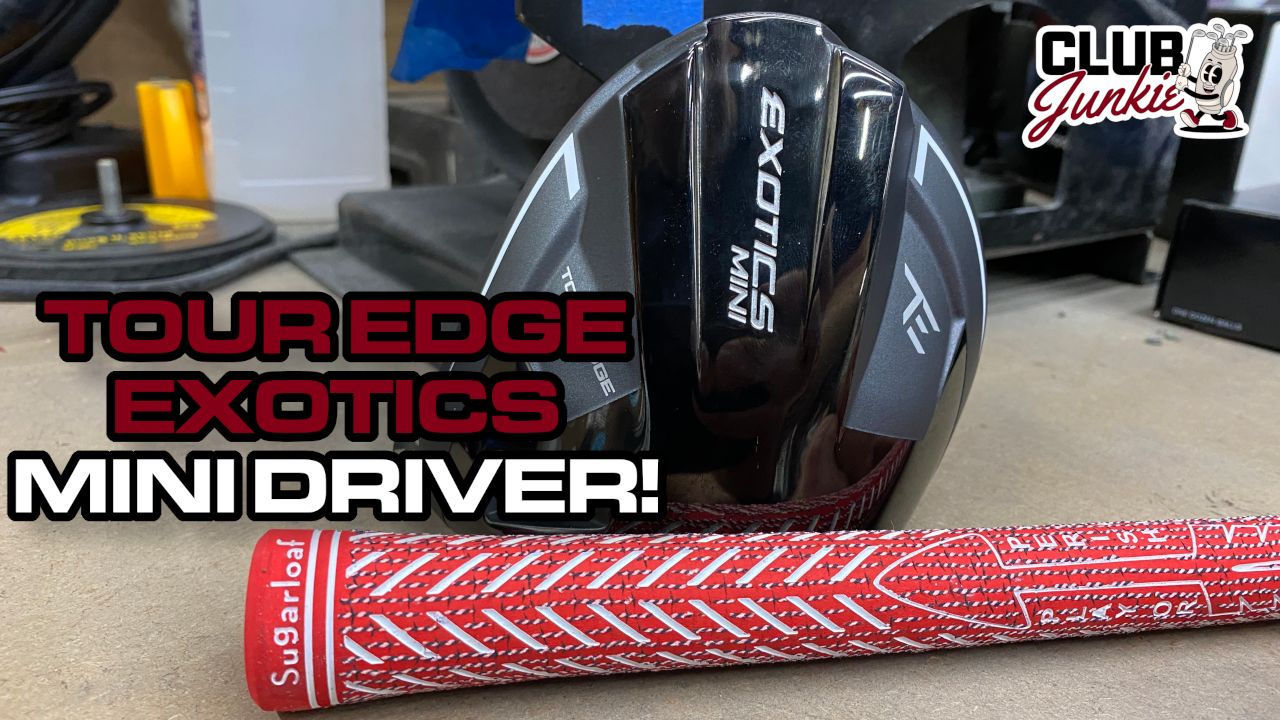
On this episode of Club Junkie, I put the new Tour Edge Exotics Mini Driver to the test and break down the performance, forgiveness, distance, and where it fits compared to a traditional driver or strong fairway wood. If you have been curious about adding a mini driver to the bag, this one is worth a look.
I also dive into the new TaylorMade Spider ZT Max putter that was recently spotted and discuss the growing zero torque putter trend. Plus, there is a closer look at the new Project X Titan Yellow shaft showing up on the PGA Tour and what makes it different from other profiles currently out there.

Justin Rose WITB 2026 (April): Full WITB breakdown with new McLaren irons

What’s the story behind Webb Simpson’s custom-stamped irons?

Memorial Tournament Tour Report: Rory McIlroy, Cameron Young switch up drivers, and more

Cadillac Championship Tour Report: Spieth’s sizable changes, McLaren Golf launches, and more

Russell Henley’s winning WITB: 2026 Charles Schwab Challenge

Kristoffer Reitan’s winning WITB: 2026 Truist Championship

Best irons 2026: Best irons overall, most forgiving irons, and more

J.T. Poston’s winning WITB: 2026 Memorial Tournament

Aaron Rai’s winning WITB: 2026 PGA Championship

Cameron Young’s winning WITB: 2026 Cadillac Championship


Ryan Palmer WITB 2026 (June)
Driver: Callaway Quantum Triple Diamond (9 degrees) Shaft: Project X HZRDUS Smoke Blue RDX 60 TX 3-wood: TaylorMade Qi10 (15 degrees) Shaft:...


Bud Cauley WITB 2026 (June)
Bud Cauley had >14 clubs in his bag when photographed prior to the Memorial Tournament. Driver: Titleist GTS2 (8 degrees) Shaft: Fujikura...


Hannah Green WITB 2026 (June)
Driver: Titleist GTS3 (10 degrees, D4 SureFit setting) Shaft: Mitsubishi Chemical Diamana RB 53 S 3-wood: Titleist GT3 (15 degrees,...


Asterisk Talley WITB 2026 (June)
Driver: TaylorMade Qi4D (9 degrees) Shaft: Fujikura Ventus Blue 6 S 3-wood: TaylorMade Qi4D (16.5 degrees) Shaft: Fujikura Ventus Blue...
-
 Equipment6 days ago
Memorial Tournament Tour Report: Rory McIlroy, Cameron Young switch up drivers, and more
-
 News2 weeks ago
Russell Henley’s winning WITB: 2026 Charles Schwab Challenge
-
 Equipment3 days ago
Best irons 2026: Best irons overall, most forgiving irons, and more
-
 Whats in the Bag4 days ago
J.T. Poston’s winning WITB: 2026 Memorial Tournament
-

 Equipment1 week ago
Details on Jason Day’s latest prototype Avoda iron setup
-
 Equipment3 weeks ago
CJ Cup Byron Nelson Tour Report: Koepka and Kim’s newest putters finally get hot
-

 News2 weeks ago
Charles Schwab Challenge Tour Report: MacIntyre, Åberg and Spaun all switch putters, TaylorMade launches new Spider
-
 Equipment2 weeks ago
Details on J.J. Spaun’s surprise putter switch


kanzas
Mar 7, 2023 at 12:21 am
THERE IS ONLY ONE WEDGE GUY AND HIS NAME IS JEFF SHEETS.
Bjorn
Feb 23, 2023 at 4:27 pm
Reid Lockhard was here!
Z
Feb 22, 2023 at 8:57 pm
I think more golfers, especially those that play CB or game improvement irons, should really try out more forgiving wedges like the CBX, Ping’s Glide wedges, or a set wedge at least for their gap wedge.
Pingback: The Wedge Guy: Anatomy of a wedge head - Fly Pin High
Pingback: The Wedge Guy: Anatomy of a wedge head – GolfWRX
Will
Feb 3, 2023 at 3:34 pm
I play a lot of golf and so far the grind seems to make a difference. The Edison does not seem to work as well as the SM9 with D grind in tight chipping shots.
Sorry.
Me
Feb 3, 2023 at 8:12 am
Edel sms. This has been done.
Bryan
Feb 2, 2023 at 11:47 pm
Is he really claiming grind doesn’t matter? I’m no pro but I find a huge difference when I do pay a 60 degree with one grind vs another. Good luck opening up a wedge with a full sole/wrong grind.