
Opinion & Analysis
The Wedge Guy: Your driver – Is it your first scoring club?


I made another visit to “Oz” yesterday, as I took time out from my business trip to Dallas to look inside a PGA Tour Superstore. As I wandered around, looking at what must have been a million dollars or more in inventory, I determined not much has changed in this business since I first started writing this blog over four years and 500 articles ago. So this morning’s blog is a revisit of a topic I wrote about way back then, which still holds true today. It was about thinking of your driver as your first scoring club.
I take great issue with the industry’s extreme, and almost complete focus on distance – not just with the driver, but with the irons as well. Without picking on anyone, some new irons have “P-clubs” 43 degrees of loft (which was an 8-iron when I was younger). Does that really help your game? Is a 6-iron easier to hit if you put an “8” on the bottom? No.
But where this quest for distance is abused the most is on drivers. We see the average driver in the store at 46-47” in length now, when the old standard was 43”, then 44” up to about 6-8 years ago. And average golfers are buying them like hotcakes. But do you realize that very few tour players are using a driver over 45” in length? Why? Because they know they cannot be reasonably accurate with longer drivers! So, if the tour players know they can’t control a driver that is 46-47” long, what the heck makes amateurs thing they can?

A few years ago, GolfSmith did an extensive live golfer test at their huge facility in Austin, Texas, where they had hundreds of golfers hit drivers of all sizes, shapes and lengths. They found that almost every golfer achieved his best average driving distance with drivers that were 43-1/2” long! Now, that was when 45” was the new “standard”, but the point remains clear to me:
Your driver is probably too long for you to hit efficiently!
The fact is, no matter what the technology, a ball hit squarely and solidly will be longer than one hit around the perimeter of the face. And you’ll hit more solid shots if your driver was shorter. You can prove this to yourself. In your next round of golf, grip down on your driver a full inch—or even two—every time you hit it. I’ll bet you’ll find that you hit more solid long drives than you have in some time. And your accuracy will be much improved.
Regardless of your skill level, there isn’t a golf course anywhere that doesn’t play easier from the fairway than it does from the rough, bunkers, OB, water, etc.

In my own case, I did this with three different drivers, and found that with each one, my best performance came when I was gripping the driver to effectively make it 44-1/4” long. I’ve been a scratch or low-handicap player my whole life and historically am a very good driver of the ball. As I began to take advantage of the new technology I found my driving accuracy failing, and I didn’t like it. So, I just began to grip down on these long drivers and my accuracy came right back, without a loss of distance!
Oh, and there’s another significant side benefit to this alteration to your driver. When you shorten it, you can use lead tape to bring the swingweight back up to where it should be. By positioning those few grams of lead tape strategically on the clubhead, you can bias your driver for a draw (weight in the toe) or fade (weight in the heel). You can also place the lead tape in the back of the head for a higher ball flight if you need it, or right on top of the crown behind the face for a lower ball flight.
It’s fun to tinker, and I trust you will find this driver tuning to be interesting and beneficial. And about that title of this article? If you don’t think the driver is your first scoring club, review your last round and count the penalty shots from the tee, and those holes where you took yourself out of play with your tee shot.








This past Monday, I played in the U.S. Amateur local qualifier at Rock Creek Country Club in Portland, Oregon. A full tee sheet from 7:30 a.m. to 1:55 p.m., the top 11 scores would make it to the U.S. Amateur final qualifying.
I teed off at 10:48 a.m.. With the 7:30 am tee time, you can get a feel for the leaders’ pace, and they were off and running on the challenging setup at Rock Creek.
View this post on Instagram
Getting to the highlight of the round on the par five 17th, a drive up the left side and 212 yards left to the front hole location. I took out a 5-iron with plans of middle of the green. The ball ended up 8 feet left of the hole, pin high. A slight downhill putt dropped in for an eagle 3 on the 17th. With the cut line looking to be anywhere from -2 to even par. This was the boost I had been waiting for all day.
With making par from the trees on 18, it was time to wait for a potential playoff with a posted score of one under par 71.
Three hours later, it was playoff time. 8 players for 6 spots. I made par on the playoff hole, which was good enough to advance to the U.S. Amateur final qualifying in July. USGA qualifiers sure deliver on all of the emotions in golf!
Club Junkie
Building my 2026 gamer WITB: Ranking the contenders and new putter projects – Club Junkie Podcast

The annual What’s In The Bag build is underway, and on this episode of Club Junkie, Brian breaks down the clubs currently leading the race for a spot in his 2026 gamer setup. From drivers and fairway woods to irons, wedges, and shafts, he ranks the equipment that’s performing best and explains what’s separating the front runners from the rest of the field.
Brian also heads into the workshop to discuss several putter projects currently on the bench. From head options and shaft choices to build ideas and testing plans, he shares what he’s working on and which putters could become serious contenders for the bag this season.
If you’re a gear junkie who loves equipment testing, club building, and the never-ending pursuit of the perfect setup, this episode is for you.
Follow Club Junkie:
Instagram: @clubjunkiepod
TikTok: @clubjunkiepod
Threads: @clubjunkiepod
X: @ClubJunkiePod
Club Junkie
Tour Edge Exotics mini driver review + TaylorMade Spider ZT Max first look – Club Junkie

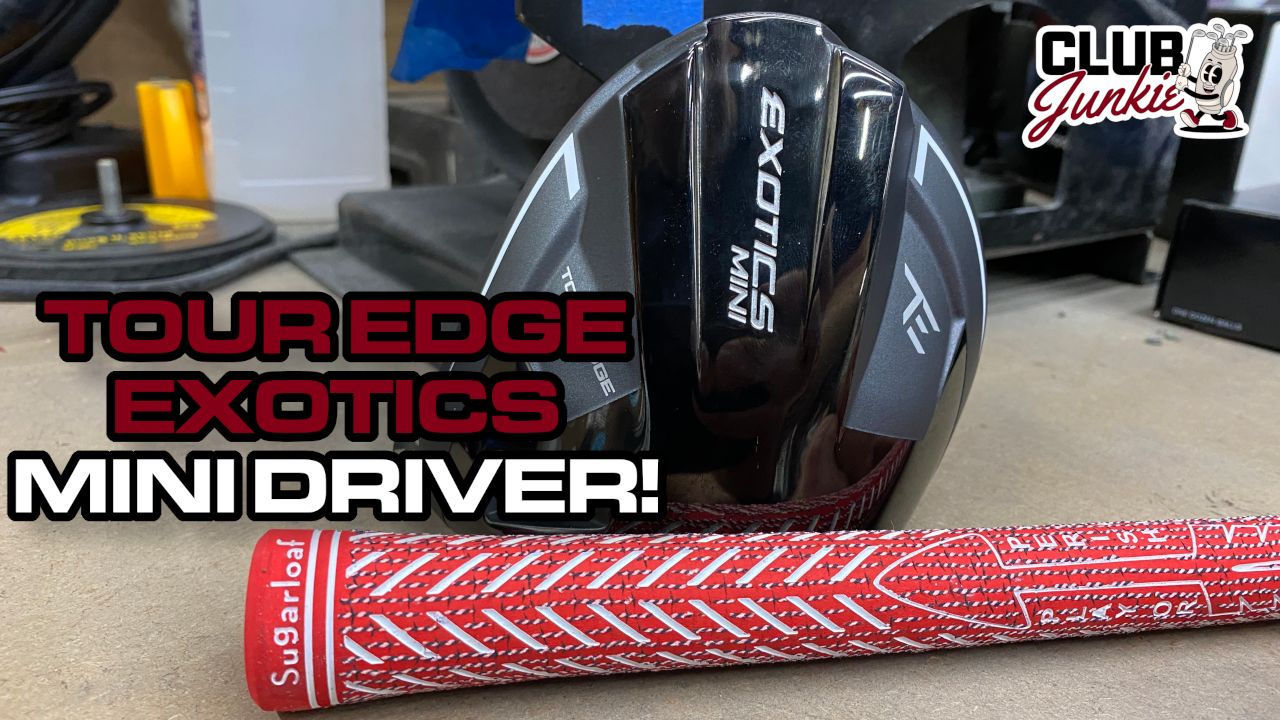
On this episode of Club Junkie, I put the new Tour Edge Exotics Mini Driver to the test and break down the performance, forgiveness, distance, and where it fits compared to a traditional driver or strong fairway wood. If you have been curious about adding a mini driver to the bag, this one is worth a look.
I also dive into the new TaylorMade Spider ZT Max putter that was recently spotted and discuss the growing zero torque putter trend. Plus, there is a closer look at the new Project X Titan Yellow shaft showing up on the PGA Tour and what makes it different from other profiles currently out there.

Justin Rose WITB 2026 (April): Full WITB breakdown with new McLaren irons

What’s the story behind Webb Simpson’s custom-stamped irons?

Memorial Tournament Tour Report: Rory McIlroy, Cameron Young switch up drivers, and more

Cadillac Championship Tour Report: Spieth’s sizable changes, McLaren Golf launches, and more

Russell Henley’s winning WITB: 2026 Charles Schwab Challenge

Kristoffer Reitan’s winning WITB: 2026 Truist Championship

Aaron Rai’s winning WITB: 2026 PGA Championship

J.T. Poston’s winning WITB: 2026 Memorial Tournament

Best irons 2026: Best irons overall, most forgiving irons, and more

Cameron Young’s winning WITB: 2026 Cadillac Championship


Bud Cauley WITB 2026 (June)
Bud Cauley had >14 clubs in his bag when photographed prior to the Memorial Tournament. Driver: Titleist GTS2 (8 degrees) Shaft: Fujikura...


Hannah Green WITB 2026 (June)
Driver: Titleist GTS3 (10 degrees, D4 SureFit setting) Shaft: Mitsubishi Chemical Diamana RB 53 S 3-wood: Titleist GT3 (15 degrees,...


Asterisk Talley WITB 2026 (June)
Driver: TaylorMade Qi4D (9 degrees) Shaft: Fujikura Ventus Blue 6 S 3-wood: TaylorMade Qi4D (16.5 degrees) Shaft: Fujikura Ventus Blue...

Brianna Do WITB 2026 (June)
Driver: Callaway Quantum Triple Diamond (9 degrees) Shaft: KBS PGW 3-wood: Callaway Elyte Titanium (15 degrees) Shaft: KBS PGW 5-wood:...
-
 Equipment6 days ago
Memorial Tournament Tour Report: Rory McIlroy, Cameron Young switch up drivers, and more
-
 News1 week ago
Russell Henley’s winning WITB: 2026 Charles Schwab Challenge
-
 Whats in the Bag3 days ago
J.T. Poston’s winning WITB: 2026 Memorial Tournament
-
 Equipment3 days ago
Best irons 2026: Best irons overall, most forgiving irons, and more
-

 Equipment1 week ago
Details on Jason Day’s latest prototype Avoda iron setup
-
 Equipment3 weeks ago
CJ Cup Byron Nelson Tour Report: Koepka and Kim’s newest putters finally get hot
-

 News2 weeks ago
Charles Schwab Challenge Tour Report: MacIntyre, Åberg and Spaun all switch putters, TaylorMade launches new Spider
-
 Equipment2 weeks ago
Details on J.J. Spaun’s surprise putter switch


Jeff
Jun 17, 2021 at 6:25 pm
Lead tape!! First, drivers and fairway woods today have a sliding weight that can be adjusted for any ball flight desired. In regards to losing swing weight. If you decide to shorten your driver length. Any qualified repair shop will be able to offer you various weight “plugs” for you to maintain your swing weight. Yes lofts over the years have gotten stronger. That is bad why? I knew a company who decided to fight the norm and put the actual club lofts on the iron head sole instead of the iron number. I remember golfers having to pull out their “cheat” sheets to see what iron they were hitting. That idea didn’t work!!!
Mike
Mar 13, 2021 at 9:53 am
My new driver is a hair under 45″ but the problem is if I shorten it to 44″, don’t I then need to shorten my 3W & 5W? I definitely think anything over 45″ is way too long for most golfers but many folks can’t understand that. But it’s been WELL over 20 years since an 8 iron (excluding the top player’s clubs) has been 43 degrees. In the Ping G5’s that I had (circa 2004) the NINE iron was 42 degrees. So let’s check ourselves w/ all this loft talk.
Lorne E
Mar 10, 2021 at 1:25 pm
Excellent article and I could not agree more. A shorter driver is a more accurate driver. The pursuit of distance has become nuts in my opinion.
As far as irons go these days, it seems to be even worse. A PW is not 43 degrees loft, it is an 8 iron. Today’s sets require you to buy extra wedges that should have been included in the expensive set you just bought.
Instead of focusing on hitting the ball further, try keeping it in play. Playing the proper tees would help as well.
johnny mike
Mar 10, 2021 at 11:16 am
man I hate this phone! didnt even spell.my name properly!
johnnh mike
Mar 10, 2021 at 11:14 am
I think you meant to say: weight in heel for a draw bias and in the tor for a fade bias.
The shorter shafts are definitely worth a try; I play mine around 44.5, but it is going to eb so player dependent. Ian Frasier at TXG has been talking about fitting some of his clients into slightly longer shafts, and Matt has been playing with them in their Autoflex expirements. It is going to be so player dependent