
Opinion & Analysis
The Wedge Guy: Why wedge mastery is so elusive


I have conducted numerous surveys of golfers over my 40-year golf industry career, because I have always believed that if you want to know what people are thinking, you simply have to ask them.
As a gearhead for wedges and a wedge designer over the past 30 years, most of my research and analysis is focused on these short-range scoring clubs and how golfers use them. What this research continually tells me is that most golfers—regardless of handicap–consider the wedges the hardest clubs in the bag to master. That’s because they are. I would even go so far as to say that the difficulty of attaining mastery even extends to the best players in the world.
Watching the Genesis Open this past weekend, for example, it seemed like these guys were hitting wedge approaches on nearly every hole. And while there were certainly many shots that covered the flag—like Max Homa’s approach on 18–there were also a great number that came up woefully short. Not what you would expect when a top-tier tour professional has a sand or gap wedge in their hands.

The simple fact is that wedges are the most difficult clubs in our bags with which to attain consistent shotmaking mastery, and that is because of the sheer design of the clubhead itself. For clarity of this article, I’m talking about those full- or near full-swing wedge shots, not the vast variety of short greenside shots we all face every round. To get mastery of those shots (like the tour pros exhibit every week), you simply have to spend lots of time hitting lots of shots, experimenting and exploring different techniques. There are no shortcuts to a deadly short game.
But today I’m talking about those prime opportunities to score, when you have a full- or near-full swing wedge into a par-five or short par four. We should live for those moments, but all too often we find ourselves disappointed in the outcome.
The good news is that’s not always all your fault.
First of all, you must understand that every wedge shot is, in effect, a glancing blow to the ball because of the loft involved. With 50 to 60 degrees of loft—or even 45 to 48 degrees with a pitching wedge—the loft of the club is such that the ball is given somewhat of a glancing blow. That demands a golf swing with a much higher degree of precision in the strike than say, an 8-iron shot.
I have always believed that most golfers can improve their wedge play by making a slower-paced swing than you might with a longer iron. This allows you to be more precise in making sure that your hands lead the clubhead through impact, which is a must when you have a wedge in your hands. Without getting into too much detail, the heavier, stiffer shaft in most wedges does not allow this club to load and unload in the downswing, so the most common error is for the clubhead to get ahead of the hands before impact, thereby adding loft and aggravating this glancing blow. I hope that makes sense.
The other aspect of wedge design that makes consistent wedge distance so elusive is the distribution of the mass around the clubhead. This illustration of a typical tour design wedge allows me to show you something I have seen time and again in robotic testing of various wedges.
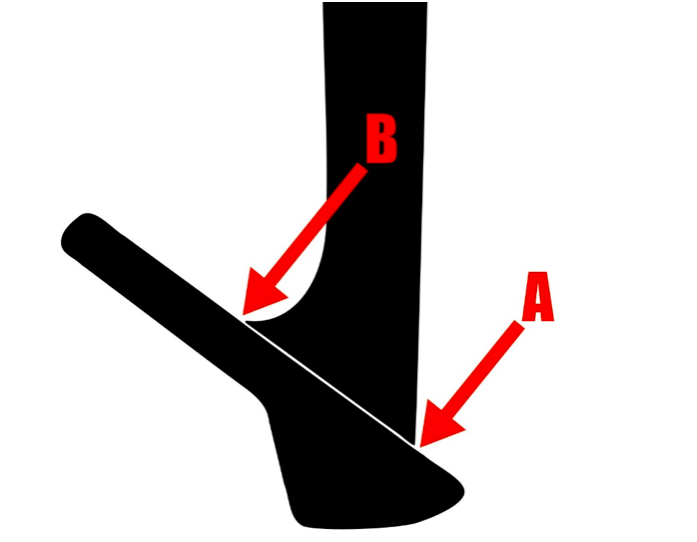
Because all the mass is along the bottom of the clubhead, the ideal impact point is low in the face (A), so that most of the mass is behind the ball. Tour players are good at this, but most recreational golfers whose wedges I’ve examined have a wear pattern at least 2-4 grooves higher on the club than I see on tour players’ wedges.
So, why is this so important?
Understand that every golf club has a single “sweet spot”–that pinpoint place where the smash factor is optimized—where clubhead speed translates to ball speed at the highest efficiency. On almost all wedges, that spot is very low on the clubhead, as indicated by the “A” arrow here, and robotic testing reveals that smash factor to be in the range of 1.16-1.18, meaning the ball speed is 16-18% higher than the clubhead speed.
To put that in perspective, smash factor on drivers can be as high as 1.55 or even a bit more, and it’s barely below that in your modern game improvement 7-iron. The fact is—wedges are just not as efficient in this measure, primarily because of the glancing blow I mentioned earlier.

But–and here’s the kicker–if you move impact up the face of a wedge just half to five-eights of an inch from the typical recreational golfer’s impact point, as indicated by the “B” arrow, smash factor on ‘tour design’ wedges can be reduced to as low as 0.92 to 0.95. That costs you 40 to 60 feet on a 90-yard wedge shot . . . because you missed “perfect” by a half-inch or less!
So, that shot you know all too well—the ball sitting up and caught a bit high in the face—is going fall in the front bunker or worse. That result is not all your fault. The reduced distance is a function of the diminished smash factor of the wedge head itself.
That same half-inch miss with your driver or even your game-improvement 7-iron is hardly noticeable.




This past Monday, I played in the U.S. Amateur local qualifier at Rock Creek Country Club in Portland, Oregon. A full tee sheet from 7:30 a.m. to 1:55 p.m., the top 11 scores would make it to the U.S. Amateur final qualifying.
I teed off at 10:48 a.m.. With the 7:30 am tee time, you can get a feel for the leaders’ pace, and they were off and running on the challenging setup at Rock Creek.
View this post on Instagram
Getting to the highlight of the round on the par five 17th, a drive up the left side and 212 yards left to the front hole location. I took out a 5-iron with plans of middle of the green. The ball ended up 8 feet left of the hole, pin high. A slight downhill putt dropped in for an eagle 3 on the 17th. With the cut line looking to be anywhere from -2 to even par. This was the boost I had been waiting for all day.
With making par from the trees on 18, it was time to wait for a potential playoff with a posted score of one under par 71.
Three hours later, it was playoff time. 8 players for 6 spots. I made par on the playoff hole, which was good enough to advance to the U.S. Amateur final qualifying in July. USGA qualifiers sure deliver on all of the emotions in golf!
Club Junkie
Building my 2026 gamer WITB: Ranking the contenders and new putter projects – Club Junkie Podcast

The annual What’s In The Bag build is underway, and on this episode of Club Junkie, Brian breaks down the clubs currently leading the race for a spot in his 2026 gamer setup. From drivers and fairway woods to irons, wedges, and shafts, he ranks the equipment that’s performing best and explains what’s separating the front runners from the rest of the field.
Brian also heads into the workshop to discuss several putter projects currently on the bench. From head options and shaft choices to build ideas and testing plans, he shares what he’s working on and which putters could become serious contenders for the bag this season.
If you’re a gear junkie who loves equipment testing, club building, and the never-ending pursuit of the perfect setup, this episode is for you.
Follow Club Junkie:
Instagram: @clubjunkiepod
TikTok: @clubjunkiepod
Threads: @clubjunkiepod
X: @ClubJunkiePod
Club Junkie
Tour Edge Exotics mini driver review + TaylorMade Spider ZT Max first look – Club Junkie

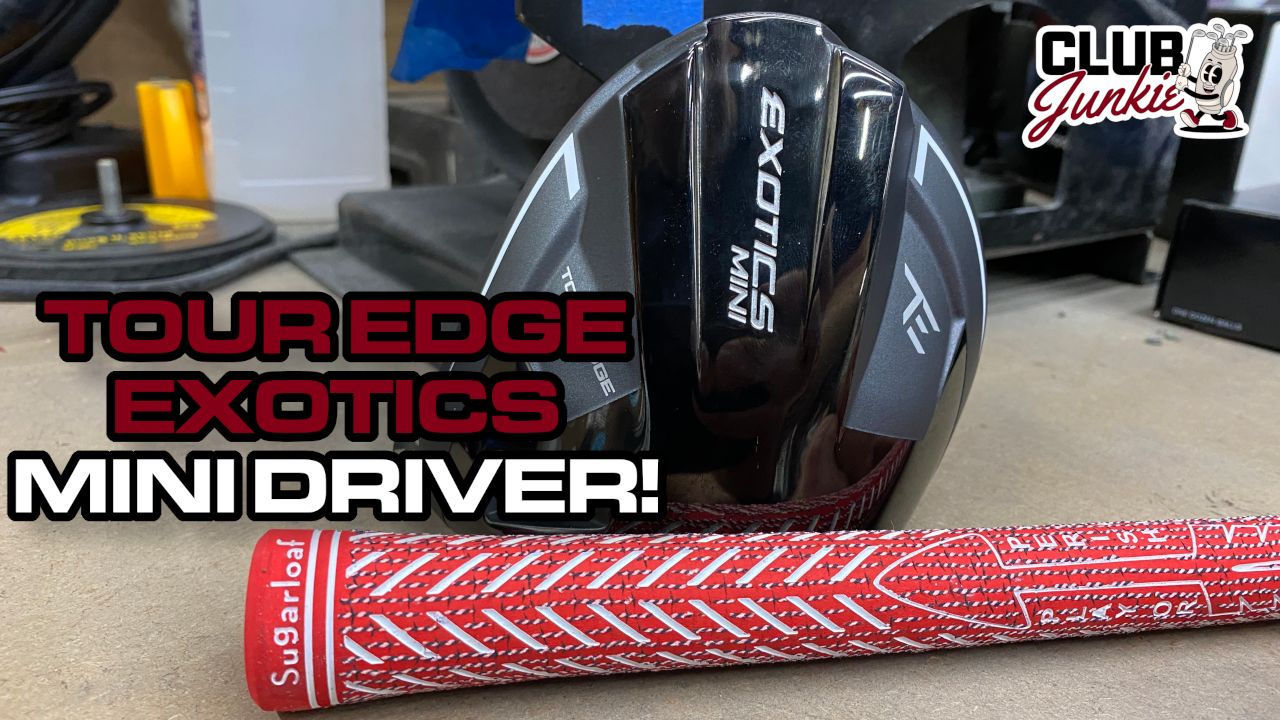
On this episode of Club Junkie, I put the new Tour Edge Exotics Mini Driver to the test and break down the performance, forgiveness, distance, and where it fits compared to a traditional driver or strong fairway wood. If you have been curious about adding a mini driver to the bag, this one is worth a look.
I also dive into the new TaylorMade Spider ZT Max putter that was recently spotted and discuss the growing zero torque putter trend. Plus, there is a closer look at the new Project X Titan Yellow shaft showing up on the PGA Tour and what makes it different from other profiles currently out there.

Justin Rose WITB 2026 (April): Full WITB breakdown with new McLaren irons

What’s the story behind Webb Simpson’s custom-stamped irons?

Memorial Tournament Tour Report: Rory McIlroy, Cameron Young switch up drivers, and more

Cadillac Championship Tour Report: Spieth’s sizable changes, McLaren Golf launches, and more

Russell Henley’s winning WITB: 2026 Charles Schwab Challenge

Kristoffer Reitan’s winning WITB: 2026 Truist Championship

Aaron Rai’s winning WITB: 2026 PGA Championship

Cameron Young’s winning WITB: 2026 Cadillac Championship

J.T. Poston’s winning WITB: 2026 Memorial Tournament

Best irons 2026: Best irons overall, most forgiving irons, and more


Bud Cauley WITB 2026 (June)
Bud Cauley had >14 clubs in his bag when photographed prior to the Memorial Tournament. Driver: Titleist GTS2 (8 degrees) Shaft: Fujikura...


Hannah Green WITB 2026 (June)
Driver: Titleist GTS3 (10 degrees, D4 SureFit setting) Shaft: Mitsubishi Chemical Diamana RB 53 S 3-wood: Titleist GT3 (15 degrees,...


Asterisk Talley WITB 2026 (June)
Driver: TaylorMade Qi4D (9 degrees) Shaft: Fujikura Ventus Blue 6 S 3-wood: TaylorMade Qi4D (16.5 degrees) Shaft: Fujikura Ventus Blue...

Brianna Do WITB 2026 (June)
Driver: Callaway Quantum Triple Diamond (9 degrees) Shaft: KBS PGW 3-wood: Callaway Elyte Titanium (15 degrees) Shaft: KBS PGW 5-wood:...
-
 Equipment5 days ago
Memorial Tournament Tour Report: Rory McIlroy, Cameron Young switch up drivers, and more
-
 News1 week ago
Russell Henley’s winning WITB: 2026 Charles Schwab Challenge
-
 Whats in the Bag3 days ago
J.T. Poston’s winning WITB: 2026 Memorial Tournament
-
 Equipment3 days ago
Best irons 2026: Best irons overall, most forgiving irons, and more
-

 Equipment1 week ago
Details on Jason Day’s latest prototype Avoda iron setup
-
 Equipment3 weeks ago
CJ Cup Byron Nelson Tour Report: Koepka and Kim’s newest putters finally get hot
-

 News2 weeks ago
Charles Schwab Challenge Tour Report: MacIntyre, Åberg and Spaun all switch putters, TaylorMade launches new Spider
-
 Equipment2 weeks ago
Details on J.J. Spaun’s surprise putter switch


Pingback: The Wedge Guy: What really makes a wedge work? – GolfWRX
Pingback: The Wedge Guy: Re-think mid-range wedge shots – GolfWRX
Jack Nash
Mar 8, 2021 at 9:30 am
My favorite clubs in the bag. Plenty of practice and “willing” to try a shot that you’re not normally comfortable with will give you confidence in the long run. One thing the Best wedge players have is a great imagination. That’s something that you can’t teach but can get close to with, again, plenty of range practice. Many times I’ll practice a min. of an hour just with 3 wedges. Practice, practice, practice.
Cecil B Jansen
Mar 1, 2021 at 2:13 pm
So here’s the heads-up for new wedge development – particularly for the “average” golfer.
Wedges with more oomph in the face area most likely struck by “average” golfers.
I’m working on it…………..
Aksel Nielsen
Feb 26, 2021 at 2:13 am
Smash factor of 1.55 om driver ? What driver are u using ?
ChipNRun
Feb 25, 2021 at 2:02 pm
Terry,
Good detail in article, the A-B diagram shows clearly what golf tipsters have been hint at for years.
As for possible solutions: In 2016, the Vokey SM6 model came out with the Progressive Center of gravity. For PW and GW, Center of Gravity is about where the A is in the diagram. For SW, CoG is slightly below the B, but certainly higher on face. The LW CoG is slightly above the B.
So, has Vokey come up with a solution to the problem?
BUT, in 2018 when Hogan redid their Equalizer wedges, H went the other way: On 48*, 50* and 52*wedges, H went with higher center of gravity so golfers could hit more piercing full shots. Sand wedges: middle C0G… and LWs, low CoG so players could hit high shots that stop in part from high descent angle.
So, can you say whether Vokey or Hogan has the “best ideas?”
ChipNRun
Feb 25, 2021 at 2:05 pm
P.S. Tom Wishon came up with the idea (circa 2014?) of a slightly higher CoG in one of his wedge models. But, I can’t find the discussion online.
Ben
Feb 26, 2021 at 9:08 am
Seems that the 979SS irons have a lower CoG for longer irons indeed.