
Opinion & Analysis
Note to Sir Nick: Does Bryson DeChambeau really need to improve his wedge game?

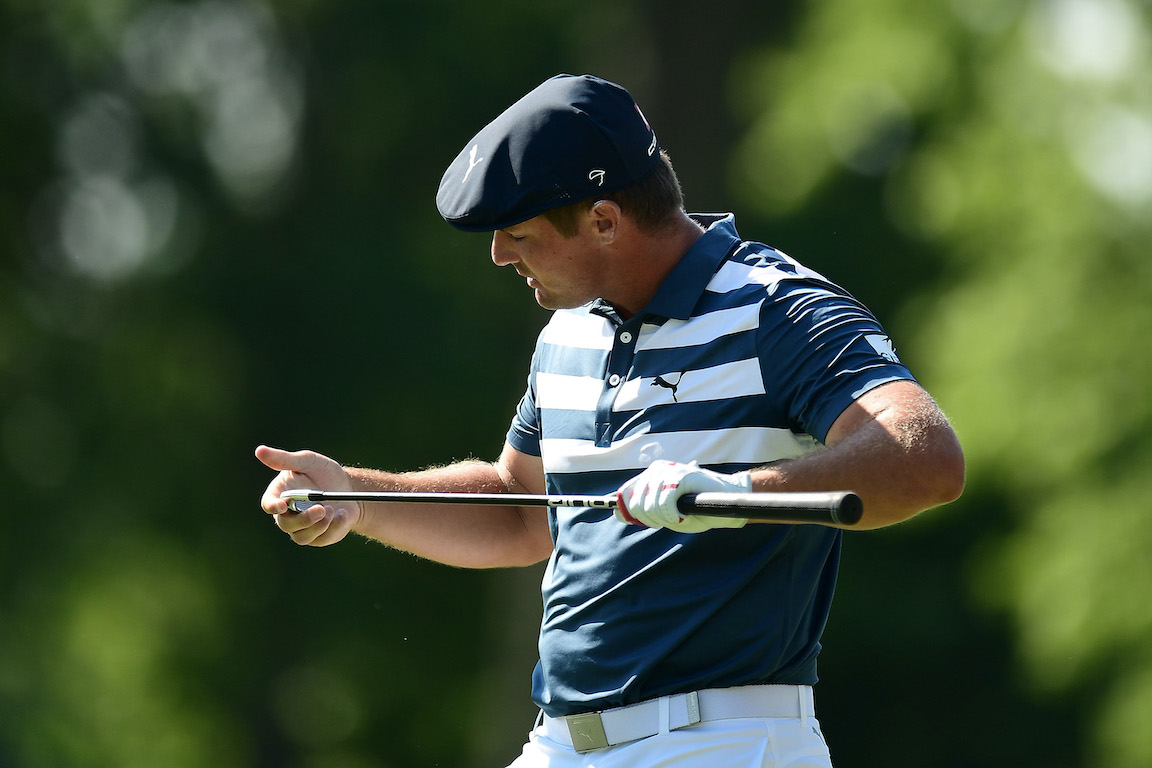
I especially enjoyed the final round of last week’s Rocket Mortgage Classic—watching the battle of the two big ballers. As always, I was interested in Sir Nick Faldo’s commentary about the weakness in Bryson DeChambeau’s game–his wedges–and that he should make an equipment switch to tighten up this part of his game. Indeed, our Ryan Barath made the same suggestion in an article July 3.
I was all in—not only as a big fan of Sir Nick and Jim Nantz—but Bryson’s 6-iron-length wedges have always looked awkward to me. On Monday, I received several calls from instructor clients/friends asking if I could support Sir Nick’s analysis. Never one to back down from a challenge, I agreed to take a deep dive into the difference between Bryson’s game in 2019 and thus far in 2020.
The data is a bit thin—69 Shotlink rounds in 2019 vs. only 42 in 2020 through Rocket Mortgage. Nonetheless, I’d submit that we have representative samples.
Here is what I found.
DRIVING
Strokes Gained # and (Ranking):
- 2019: .412 (24)
- 2020: 1.11 (2)
This is a giant leap in Strokes Gained and ranking. OK, but Strokes Gained is an abstract number and not all about distance. Why the jump?
Distance: 302.5 (34) => 323 (1). Again, quite a jump. 20.5 yards in distance ON AVERAGE. Impressive!
Errors: .4 per round => .15/round. I have worked with lots of Tour players and reducing errors is extremely difficult. Most do it by prudently cutting back on distance. To pick up over 20 yards AND cut ERRORS* by 62.5% is miraculous! For perspective, the average of the PGA Tour in 2019 was .62 errors/round. So, Bryson is outdriving EVERYONE by 21 yards AND making less than 25% of the ERRORS*? Extraordinary!
[*Driving errors are Balls hit out of play that require an advancement to return to normal play or penalty results.]
APPROACH SHOTS
Strokes Gained:
- 2019: .236 (Rank 54)
- 2020: .428 (Rank 38)
Not a great improvement, but an improvement nonetheless. This is mainly because Bryson’s accuracy from the fairway went from 62% to 70%.
PUTTING
Strokes Gained:
- 2019: .372 (Rank 28)
- 2020: .690 (Rank 12)
Another substantial improvement. Two things stand out:
- Reduced 3-Putts from .49/round to .33 (Tour avg. is .51) – excellent jump!
- In the always critical 6-10 ft. range, his makes went from 54% to 62% (Tour Avg. is 52%). Again, over 42 rounds, this is as much improvement in a Tour player as I have seen.
WEDGE PLAY
In my work with Tour players, I consider this to be shots from 50 to 125 yards. Bryson may very well extend this range with his length, but I chose to stay with it because I have years of data on the Tour level play for comparison.
I measure:
- # shots – How many shots a player faces on average per round.
- % Greens Hit – As opposed to the Tour’s Proximity that includes greens missed w/i 30 yards of the edge.
- Putting distance when hit (My Proximity)
- Down-in – The average shots needed to get the ball in the hole.
I am going to stick with shots from the fairway only as they are over 70% of these shots for everyone.
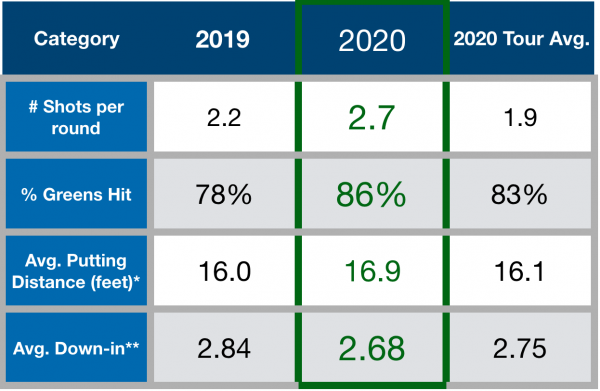
*Avg. Putting Distance when the shots hit the green.
**Avg. Down-in: The # of shots need to hole out.
Mr. DeChambeau has performed an extremely noteworthy feat in that he has not only dramatically increased his driving distance BUT his accuracy to boot. Further, he has improved EVERY facet of his game, including his oft-criticized wedge game. And not just a little. If we do the math on his Down-In improvement: 2.84 to 2.68 = .16/shot X 114 shots in 2020 = 18 strokes saved this year.
In my studies of the value of a stroke on Tour, at Bryson’s current top-10 level, each stroke is worth $50-70,000. I tip my hat to him!




This past Monday, I played in the U.S. Amateur local qualifier at Rock Creek Country Club in Portland, Oregon. A full tee sheet from 7:30 a.m. to 1:55 p.m., the top 11 scores would make it to the U.S. Amateur final qualifying.
I teed off at 10:48 a.m.. With the 7:30 am tee time, you can get a feel for the leaders’ pace, and they were off and running on the challenging setup at Rock Creek.
View this post on Instagram
Getting to the highlight of the round on the par five 17th, a drive up the left side and 212 yards left to the front hole location. I took out a 5-iron with plans of middle of the green. The ball ended up 8 feet left of the hole, pin high. A slight downhill putt dropped in for an eagle 3 on the 17th. With the cut line looking to be anywhere from -2 to even par. This was the boost I had been waiting for all day.
With making par from the trees on 18, it was time to wait for a potential playoff with a posted score of one under par 71.
Three hours later, it was playoff time. 8 players for 6 spots. I made par on the playoff hole, which was good enough to advance to the U.S. Amateur final qualifying in July. USGA qualifiers sure deliver on all of the emotions in golf!
Club Junkie
Building my 2026 gamer WITB: Ranking the contenders and new putter projects – Club Junkie Podcast

The annual What’s In The Bag build is underway, and on this episode of Club Junkie, Brian breaks down the clubs currently leading the race for a spot in his 2026 gamer setup. From drivers and fairway woods to irons, wedges, and shafts, he ranks the equipment that’s performing best and explains what’s separating the front runners from the rest of the field.
Brian also heads into the workshop to discuss several putter projects currently on the bench. From head options and shaft choices to build ideas and testing plans, he shares what he’s working on and which putters could become serious contenders for the bag this season.
If you’re a gear junkie who loves equipment testing, club building, and the never-ending pursuit of the perfect setup, this episode is for you.
Follow Club Junkie:
Instagram: @clubjunkiepod
TikTok: @clubjunkiepod
Threads: @clubjunkiepod
X: @ClubJunkiePod
Club Junkie
Tour Edge Exotics mini driver review + TaylorMade Spider ZT Max first look – Club Junkie

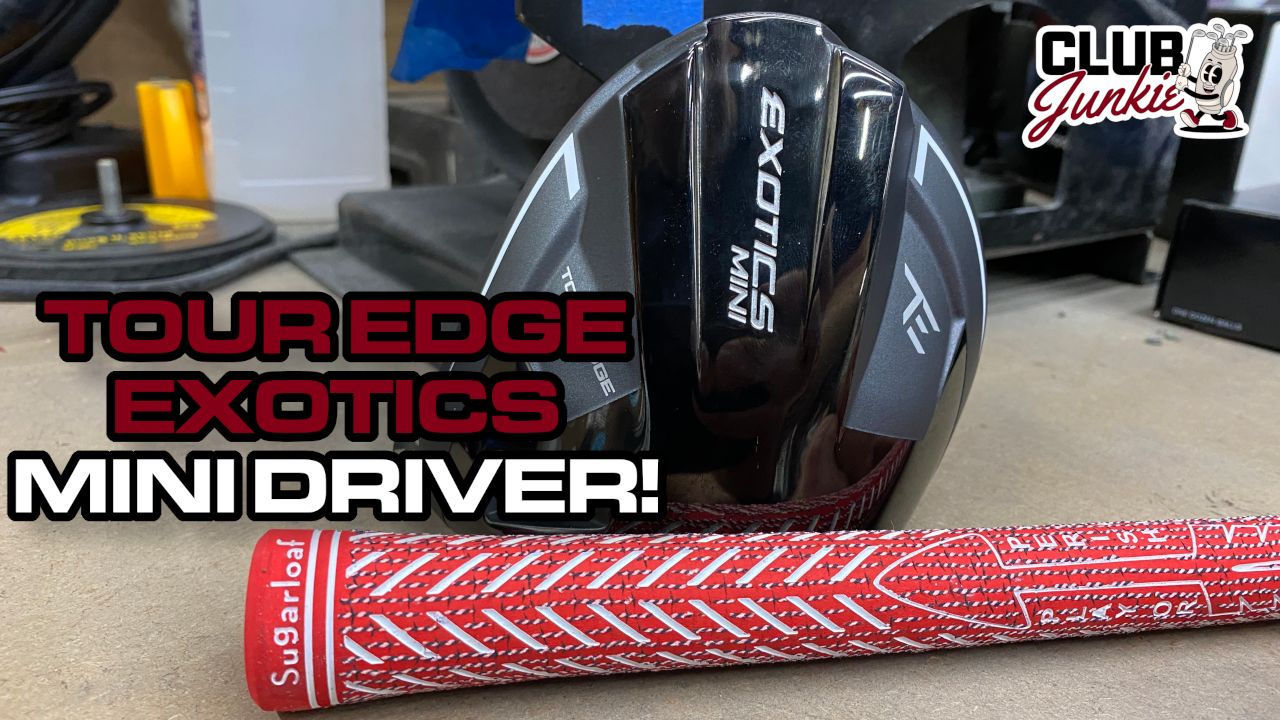
On this episode of Club Junkie, I put the new Tour Edge Exotics Mini Driver to the test and break down the performance, forgiveness, distance, and where it fits compared to a traditional driver or strong fairway wood. If you have been curious about adding a mini driver to the bag, this one is worth a look.
I also dive into the new TaylorMade Spider ZT Max putter that was recently spotted and discuss the growing zero torque putter trend. Plus, there is a closer look at the new Project X Titan Yellow shaft showing up on the PGA Tour and what makes it different from other profiles currently out there.

Justin Rose WITB 2026 (April): Full WITB breakdown with new McLaren irons

What’s the story behind Webb Simpson’s custom-stamped irons?

Memorial Tournament Tour Report: Rory McIlroy, Cameron Young switch up drivers, and more

Cadillac Championship Tour Report: Spieth’s sizable changes, McLaren Golf launches, and more

Russell Henley’s winning WITB: 2026 Charles Schwab Challenge

Kristoffer Reitan’s winning WITB: 2026 Truist Championship

Aaron Rai’s winning WITB: 2026 PGA Championship

J.T. Poston’s winning WITB: 2026 Memorial Tournament

Cameron Young’s winning WITB: 2026 Cadillac Championship

Best irons 2026: Best irons overall, most forgiving irons, and more


Bud Cauley WITB 2026 (June)
Bud Cauley had >14 clubs in his bag when photographed prior to the Memorial Tournament. Driver: Titleist GTS2 (8 degrees) Shaft: Fujikura...


Hannah Green WITB 2026 (June)
Driver: Titleist GTS3 (10 degrees, D4 SureFit setting) Shaft: Mitsubishi Chemical Diamana RB 53 S 3-wood: Titleist GT3 (15 degrees,...


Asterisk Talley WITB 2026 (June)
Driver: TaylorMade Qi4D (9 degrees) Shaft: Fujikura Ventus Blue 6 S 3-wood: TaylorMade Qi4D (16.5 degrees) Shaft: Fujikura Ventus Blue...

Brianna Do WITB 2026 (June)
Driver: Callaway Quantum Triple Diamond (9 degrees) Shaft: KBS PGW 3-wood: Callaway Elyte Titanium (15 degrees) Shaft: KBS PGW 5-wood:...
-
 Equipment6 days ago
Memorial Tournament Tour Report: Rory McIlroy, Cameron Young switch up drivers, and more
-
 News1 week ago
Russell Henley’s winning WITB: 2026 Charles Schwab Challenge
-
 Whats in the Bag3 days ago
J.T. Poston’s winning WITB: 2026 Memorial Tournament
-
 Equipment3 days ago
Best irons 2026: Best irons overall, most forgiving irons, and more
-

 Equipment1 week ago
Details on Jason Day’s latest prototype Avoda iron setup
-
 Equipment3 weeks ago
CJ Cup Byron Nelson Tour Report: Koepka and Kim’s newest putters finally get hot
-

 News2 weeks ago
Charles Schwab Challenge Tour Report: MacIntyre, Åberg and Spaun all switch putters, TaylorMade launches new Spider
-
 Equipment2 weeks ago
Details on J.J. Spaun’s surprise putter switch


Steve M
Jul 14, 2020 at 10:40 pm
I think most of the courses have been quite ‘soft’ so far this year, with scores hitting crazy numbers. In Hilton Head for instance , his driving lifted the balls over all the trouble that the course was designed for.
I am betting if you run the same numbers next Monday, they are going to look drastically different. I wouldn’t be surprised if he missed the cut.
Mark M
Jul 13, 2020 at 1:01 pm
Bryson has obviously made a commitment to hitting the driver straight and much longer. He’s already well on the way to accomplishing that goal. It’s a major point of emphasis for right now, which means he has probably not practiced or worked on his iron and specifically wedge game as much as a result.
HE knows getting the wedges better calibrated is the next step and I guarantee you that he will put in that work when he feels the time is right. When he does, everyone better look out because he will be nearly unbeatable when he plays well.
Shane
Jul 13, 2020 at 10:37 am
He is hitting more greens, but hitting them further from the hole. The fact that his ‘down-in’ numbers have improved while proximity has gotten worse points to a simple fact. He is making more putts. I think his current putting stats bear this out. So long story short, he really has not improved much with his wedges, but his putting has been great.