
Opinion & Analysis
The Wedge Guy: Looking at your team – Part 2


Last week’s post started this dialog about carefully examining your set make-up to see if you are really carrying the right mix of clubs to give you the best chances of optimizing your scoring. Now let’s take that analysis to the next level to see if it won’t help you assess the team you’ve put together.
At each end of the set, we have the driver and putter, so we’ll leave those out of the mix for team building. Everyone needs them, so that leaves 12 players to fill in the roster. I like to divide those 12 players into 3 distinct groups:
Distance clubs. These are the fairways and maybe your longest hybrid or two, or even your longest iron. Their most common purpose is to move the ball down the fairway, or position it off the tee when a driver isn’t the best choice. Distance control isn’t that critical with these shots – even 50-60 feet long or short is usually fine. With these, we want the ball to remain in play to keep us “in the hole.” Even when you use these clubs for a long approach shot, as long as they keep us around the green somewhere safe, we’re looking pretty good. The distance clubs typically are those with less than 22-24 degrees of loft. If you are playing the correct tees for your distance, you’ll use these clubs 5-8 times per round at most. Few golfers really need more than 2-3 of these.
Positioning clubs. These are the clubs with which slightly over half of our approach shots will be played. This group includes irons and/or hybrids, with lofts of 22-24 degrees up to 36-37*; that covers the 4/5 iron or hybrid up through the 8 iron. When we play a shot with these clubs, we have a little tighter expectation of how close we will end up to the hole, but generally, here too, a shot that ends up within 35-50 feet of the hole is a good one, even at the short end of this range – it certainly is at the long end. If you are playing the right tees for your distance and skill level, you shouldn’t be using these clubs for more than 2/3 of your approach shots.
Scoring clubs. These are the tools with which you will likely determine your score for the day, the ones with over 37-38 degrees of loft. When you put one of these in your hands, it’s because you are in prime scoring range, whether it is for a short approach or a recovery shot. These are the clubs that should allow you to “take it to the course”, giving you putts for birdies and saving pars. They require—and you should expect—pinpoint distance accuracy, as these shots are more often missed long and short than right/left. You should have one of these clubs in your hands on each of the par fives, at least 3-4 short par fours and maybe a par three, and all your shots after missing greens. They are your ‘money clubs’, allowing you to score well when the distance and positioning clubs are ‘behaving’, and save scores when they are not.
Because of the different demands and expectations we have for these three groups of clubs, it makes sense that we would have progressively tighter distance differentials–or gaps–between clubs in each group.
Distance clubs that deliver club-to-club differentials of 15-20 yards are fine–you can cut the distance differential down by about half by simply gripping down on the longer club by one half to three-quarters of an inch.
Positioning clubs that should deliver distance differentials of 15-17 yards. Again, when more precision when needed, you can cut each gap in half by simply gripping down, which should give you distance accuracy of 20-25 feet.
Between your scoring clubs is where you want the gaps to be the tightest, because a shot that is 20-25 feet long or short from only 80-125 yards is not fine. In this range, you need to be able to “dial in” your shots to no more than 5- to 7-yard increments with consistency, regardless of your handicap. And the only way to do that consistently is to have your club arsenal arranged to give you tighter gaps “mechanically”, rather than to rely on your feel and ability to throttle down to dissect a 15-20 yard gap with precision.
In summary, this basic principle of “building your team” is actually quite simple. The closer you get to the green, the tighter your expectations should be, and the better your performance should be. Building your team with balance and the proper assignments will help you achieve that goal.




This past Monday, I played in the U.S. Amateur local qualifier at Rock Creek Country Club in Portland, Oregon. A full tee sheet from 7:30 a.m. to 1:55 p.m., the top 11 scores would make it to the U.S. Amateur final qualifying.
I teed off at 10:48 a.m.. With the 7:30 am tee time, you can get a feel for the leaders’ pace, and they were off and running on the challenging setup at Rock Creek.
View this post on Instagram
Getting to the highlight of the round on the par five 17th, a drive up the left side and 212 yards left to the front hole location. I took out a 5-iron with plans of middle of the green. The ball ended up 8 feet left of the hole, pin high. A slight downhill putt dropped in for an eagle 3 on the 17th. With the cut line looking to be anywhere from -2 to even par. This was the boost I had been waiting for all day.
With making par from the trees on 18, it was time to wait for a potential playoff with a posted score of one under par 71.
Three hours later, it was playoff time. 8 players for 6 spots. I made par on the playoff hole, which was good enough to advance to the U.S. Amateur final qualifying in July. USGA qualifiers sure deliver on all of the emotions in golf!
Club Junkie
Building my 2026 gamer WITB: Ranking the contenders and new putter projects – Club Junkie Podcast

The annual What’s In The Bag build is underway, and on this episode of Club Junkie, Brian breaks down the clubs currently leading the race for a spot in his 2026 gamer setup. From drivers and fairway woods to irons, wedges, and shafts, he ranks the equipment that’s performing best and explains what’s separating the front runners from the rest of the field.
Brian also heads into the workshop to discuss several putter projects currently on the bench. From head options and shaft choices to build ideas and testing plans, he shares what he’s working on and which putters could become serious contenders for the bag this season.
If you’re a gear junkie who loves equipment testing, club building, and the never-ending pursuit of the perfect setup, this episode is for you.
Follow Club Junkie:
Instagram: @clubjunkiepod
TikTok: @clubjunkiepod
Threads: @clubjunkiepod
X: @ClubJunkiePod
Club Junkie
Tour Edge Exotics mini driver review + TaylorMade Spider ZT Max first look – Club Junkie

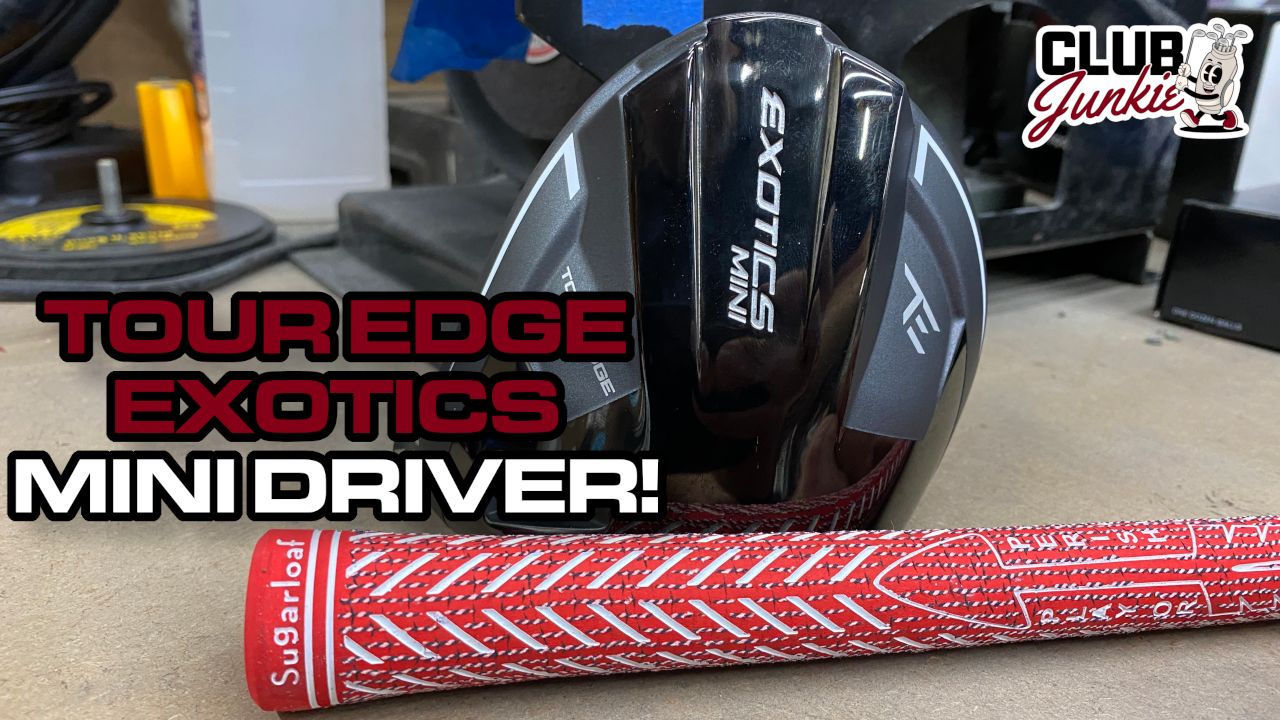
On this episode of Club Junkie, I put the new Tour Edge Exotics Mini Driver to the test and break down the performance, forgiveness, distance, and where it fits compared to a traditional driver or strong fairway wood. If you have been curious about adding a mini driver to the bag, this one is worth a look.
I also dive into the new TaylorMade Spider ZT Max putter that was recently spotted and discuss the growing zero torque putter trend. Plus, there is a closer look at the new Project X Titan Yellow shaft showing up on the PGA Tour and what makes it different from other profiles currently out there.

Justin Rose WITB 2026 (April): Full WITB breakdown with new McLaren irons

What’s the story behind Webb Simpson’s custom-stamped irons?

Memorial Tournament Tour Report: Rory McIlroy, Cameron Young switch up drivers, and more

Cadillac Championship Tour Report: Spieth’s sizable changes, McLaren Golf launches, and more

Russell Henley’s winning WITB: 2026 Charles Schwab Challenge

Kristoffer Reitan’s winning WITB: 2026 Truist Championship

Best irons 2026: Best irons overall, most forgiving irons, and more

J.T. Poston’s winning WITB: 2026 Memorial Tournament

Aaron Rai’s winning WITB: 2026 PGA Championship

Cameron Young’s winning WITB: 2026 Cadillac Championship


Ryan Palmer WITB 2026 (June)
Driver: Callaway Quantum Triple Diamond (9 degrees) Shaft: Project X HZRDUS Smoke Blue RDX 60 TX 3-wood: TaylorMade Qi10 (15 degrees) Shaft:...


Bud Cauley WITB 2026 (June)
Bud Cauley had >14 clubs in his bag when photographed prior to the Memorial Tournament. Driver: Titleist GTS2 (8 degrees) Shaft: Fujikura...


Hannah Green WITB 2026 (June)
Driver: Titleist GTS3 (10 degrees, D4 SureFit setting) Shaft: Mitsubishi Chemical Diamana RB 53 S 3-wood: Titleist GT3 (15 degrees,...


Asterisk Talley WITB 2026 (June)
Driver: TaylorMade Qi4D (9 degrees) Shaft: Fujikura Ventus Blue 6 S 3-wood: TaylorMade Qi4D (16.5 degrees) Shaft: Fujikura Ventus Blue...
-
 Equipment6 days ago
Memorial Tournament Tour Report: Rory McIlroy, Cameron Young switch up drivers, and more
-
 News2 weeks ago
Russell Henley’s winning WITB: 2026 Charles Schwab Challenge
-
 Equipment3 days ago
Best irons 2026: Best irons overall, most forgiving irons, and more
-
 Whats in the Bag4 days ago
J.T. Poston’s winning WITB: 2026 Memorial Tournament
-

 Equipment1 week ago
Details on Jason Day’s latest prototype Avoda iron setup
-
 Equipment3 weeks ago
CJ Cup Byron Nelson Tour Report: Koepka and Kim’s newest putters finally get hot
-

 News2 weeks ago
Charles Schwab Challenge Tour Report: MacIntyre, Åberg and Spaun all switch putters, TaylorMade launches new Spider
-
 Equipment2 weeks ago
Details on J.J. Spaun’s surprise putter switch


Dtrain
Jan 8, 2020 at 9:56 pm
Wow. That was informative. Reads like a Golf Digest article from 1979.