
Opinion & Analysis
The Frost Delay: Building a Fitness Routine (Part II)

First off, I’d love to start off with a quick follow up to the previous fitness column. There were a ton of great comments on the front page and in the forums about both the philosophy and methodology of the exercise routine I described. With that in mind, it seems important to emphasize a critical point that might have been lost in the shuffle—fitness routines are very personal. Much like a golf swing, for optimum success it’s both important to:
- Find one that works for you
- Find a professional that can help you along the way
With that being said, this second fitness column will be broken into a couple parts. The first will focus on establishing a routine of simple stretches that can be done anywhere (without any equipment, etc). The second will focus on golf-swing specific strength aids.
Stretching
Disclaimer: Just like weight training and cardio, it’s critical that you stretch correctly–if you have any doubts, please consult with a professional.
Here are some general rules for stretching:
- Stretching is not a warm-up, and is vastly more effective if you’ve done some light cardio before hand.
- Stretch in a balanced fashion. If you stretch your right hamstring, make sure you stretch your left as well.
- Don’t bounce. This can tear muscles and create scar tissue, leaving you less flexible than when you started.
- Pain is bad. Tension is good, but it you’re pushing it to pain, you’ve gone to far and run the risk of doing real damage.
- Keep stretching. Much like weight training and cardio, stretching works better if you do it 3-to-4 times a week, rather than “when you’re feeling stiff” (I suck at this one).
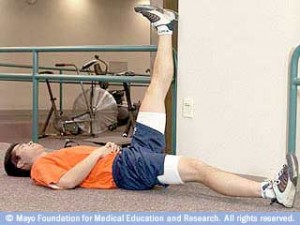
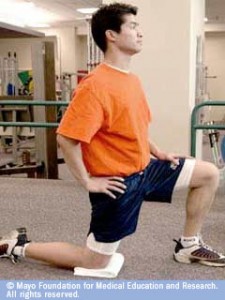
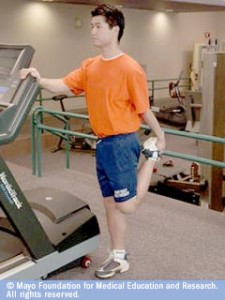
Here’s an example of a golf-specific routine I do. When applicable, I’ve included images and paraphrased descriptions from the Mayo Clinic for illustration. I recommend doing each stretch for 30 seconds, or 2 reps of 15-20 seconds (which I prefer). Do some research and find out what will be best for you.
HAMSTRINGS:
Lie on the floor near a corner wall or door frame. Rest your leg against the wall, keeping your knee slightly bent. Gently stretch the knee out, until you feel the back of your leg stretch. Repeat with the other leg.
HIP FLEXORS:
Kneel on your knee, placing your other leg in front of you. Place your hand on your waist so that you avoid leaning forward (keep your back straight). Slowly lean forward, putting more weight on your front leg. Repeat with other leg.
QUADS:
While standing, hold onto a wall or a sturdy piece of furniture for support. Pull your heel up and back until you feel a stretch in the front of your leg. Repeat with other leg.
CALVES:
Stand at arms length from a wall or a sturdy piece of furniture. Place one leg in front of the other as shown. Slowly lean forward while keeping your back heel on the ground, holding your back straight and hips forward. Repeat with the other leg.

SHOULDERS:
Bring your arm across your body. Hold it with your other arm (either above or below the elbow) as shown. Repeat with the other arm.
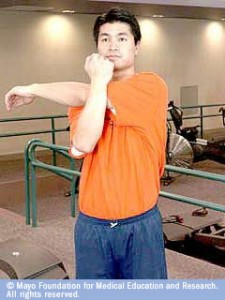
PECS:
Mayo doesn’t have an image for this stretch, but it is achieved by standing perpendicular from a wall. With a straight back, place your hand flat on the wall, and gently turn your body away from the wall, feeling the stretch in you pec muscle. Repeat with the other side.
—————
The back is a place where I spend a great deal of time, as I had an L5/S1 micro-discectomy when I was 22. If you have a healthy back, you probably don’t need to spend as much time as I do on the lower back.
LOWER BACK–KNEE TO CHEST:
Lie on a firm surface with your heels on the floor and gently pull one knee towards your chest, keeping the opposite leg in a relaxed and comfortable position. Switch legs and repeat, then do the same stretch with both legs.

LOWER BACK–SEATED ROTATIONAL STRETCH:
Sit in an armless chair. Cross one leg over the other, and brace your elbow against your knee (see picture). Twist and stretch to the side, then switch to the other side.

LOWER BACK–BRIDGES:
Lie on your back with your feet flat on the floor. Tighten your gluteal and abdominal muscles and raise your hips to form a straight line between your knees and your shoulders. Hold for three breaths and repeat. (try to work your way up to 30 reps).

UPPER BACK–SHOULDERS:
Stand in a relaxed position with your arms extended in front of you. Pull your shoulder blades back with a slight bend in the elbow—your arms should spread a bit wider as you do this.

UPPER BACK–POSTURE:
Sorry, no pic again, but this one has really helped my posture at address. It’s very simple—just roll up a towel, and set it between your shoulder blades as you lay flat on the ground. Make sure your outside should blades are touching. This one you can do in two sets of 60.
Of course, these are just a few of the thousands of stretches a golfer could do. What I love about these is that I can do them all at home or in a hotel while watching TV. And remember, they’re significantly more effective after a short warm-up.
GOLF STRENGTH AIDS:
Again, there are hundreds of these on the market, and I’m sure that almost any of them could lead a faithful golfer to some noticeable success, I’m just going to talk about a couple. In addition, I would not use these in the place of actual strength training, just as a supplement.
I already explained how sometime around 1990 I invented the hybrid (I kid, I kid), so I might as well take credit for inventing the weighted club as well. My dad used to experiment with clubmaking back in the wood-wood era, and decided to make a head out of some ridiculously heavy wood (might have been mahogany). He then filled up the shaft about halfway with buck-shot. Next thing you know, we had a very heavy (and very loud) weighted club.
These days you can choose from several weighted clubs, the most popular being the Momentus. I bought one of these a while back, and can definitely feel how it makes you stronger. I always had some concerns over what it did for my golf swing, as it tended to mess with my tempo and slow down my transition a bit, though.
I believe an improvement has been made on the idea of the weighted club, and that’s the Powerchute. It’s a similar technology to the parachutes “real” athletes started using in the late ’80s for resistance training. The Powerchute quickly attaches to any driver, and only provides resistance on the down swing, therefore allowing your swing to remain “normal” (or at least as normal as a swing can feel when it’s attached to a parachute). I’ve been swinging the Powerchute in the mornings during my indoor range sessions, and really feel like it’s been helping a great deal with both my strength and my control.
Click here for more discussion in the “Instruction & Academy” forum.
NEXT COLUMN: Breaking the monotony of an indoor range session.




This past Monday, I played in the U.S. Amateur local qualifier at Rock Creek Country Club in Portland, Oregon. A full tee sheet from 7:30 a.m. to 1:55 p.m., the top 11 scores would make it to the U.S. Amateur final qualifying.
I teed off at 10:48 a.m.. With the 7:30 am tee time, you can get a feel for the leaders’ pace, and they were off and running on the challenging setup at Rock Creek.
View this post on Instagram
Getting to the highlight of the round on the par five 17th, a drive up the left side and 212 yards left to the front hole location. I took out a 5-iron with plans of middle of the green. The ball ended up 8 feet left of the hole, pin high. A slight downhill putt dropped in for an eagle 3 on the 17th. With the cut line looking to be anywhere from -2 to even par. This was the boost I had been waiting for all day.
With making par from the trees on 18, it was time to wait for a potential playoff with a posted score of one under par 71.
Three hours later, it was playoff time. 8 players for 6 spots. I made par on the playoff hole, which was good enough to advance to the U.S. Amateur final qualifying in July. USGA qualifiers sure deliver on all of the emotions in golf!
Club Junkie
Building my 2026 gamer WITB: Ranking the contenders and new putter projects – Club Junkie Podcast

The annual What’s In The Bag build is underway, and on this episode of Club Junkie, Brian breaks down the clubs currently leading the race for a spot in his 2026 gamer setup. From drivers and fairway woods to irons, wedges, and shafts, he ranks the equipment that’s performing best and explains what’s separating the front runners from the rest of the field.
Brian also heads into the workshop to discuss several putter projects currently on the bench. From head options and shaft choices to build ideas and testing plans, he shares what he’s working on and which putters could become serious contenders for the bag this season.
If you’re a gear junkie who loves equipment testing, club building, and the never-ending pursuit of the perfect setup, this episode is for you.
Follow Club Junkie:
Instagram: @clubjunkiepod
TikTok: @clubjunkiepod
Threads: @clubjunkiepod
X: @ClubJunkiePod
Club Junkie
Tour Edge Exotics mini driver review + TaylorMade Spider ZT Max first look – Club Junkie

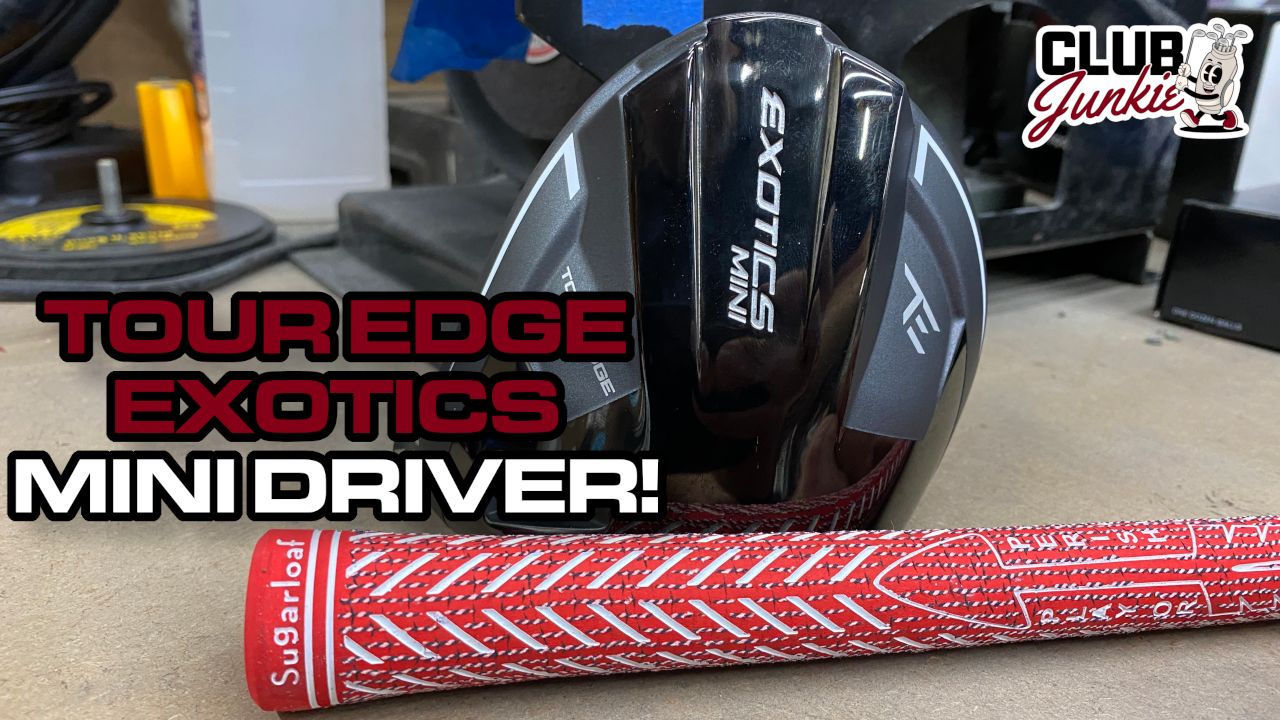
On this episode of Club Junkie, I put the new Tour Edge Exotics Mini Driver to the test and break down the performance, forgiveness, distance, and where it fits compared to a traditional driver or strong fairway wood. If you have been curious about adding a mini driver to the bag, this one is worth a look.
I also dive into the new TaylorMade Spider ZT Max putter that was recently spotted and discuss the growing zero torque putter trend. Plus, there is a closer look at the new Project X Titan Yellow shaft showing up on the PGA Tour and what makes it different from other profiles currently out there.

Justin Rose WITB 2026 (April): Full WITB breakdown with new McLaren irons

What’s the story behind Webb Simpson’s custom-stamped irons?

Memorial Tournament Tour Report: Rory McIlroy, Cameron Young switch up drivers, and more

Cadillac Championship Tour Report: Spieth’s sizable changes, McLaren Golf launches, and more

Russell Henley’s winning WITB: 2026 Charles Schwab Challenge

Kristoffer Reitan’s winning WITB: 2026 Truist Championship

J.T. Poston’s winning WITB: 2026 Memorial Tournament

Aaron Rai’s winning WITB: 2026 PGA Championship

Best irons 2026: Best irons overall, most forgiving irons, and more

Cameron Young’s winning WITB: 2026 Cadillac Championship


Bud Cauley WITB 2026 (June)
Bud Cauley had >14 clubs in his bag when photographed prior to the Memorial Tournament. Driver: Titleist GTS2 (8 degrees) Shaft: Fujikura...


Hannah Green WITB 2026 (June)
Driver: Titleist GTS3 (10 degrees, D4 SureFit setting) Shaft: Mitsubishi Chemical Diamana RB 53 S 3-wood: Titleist GT3 (15 degrees,...


Asterisk Talley WITB 2026 (June)
Driver: TaylorMade Qi4D (9 degrees) Shaft: Fujikura Ventus Blue 6 S 3-wood: TaylorMade Qi4D (16.5 degrees) Shaft: Fujikura Ventus Blue...


Brianna Do WITB 2026 (June)
Driver: Callaway Quantum Triple Diamond (9 degrees) Shaft: KBS PGW 3-wood: Callaway Elyte Titanium (15 degrees) Shaft: KBS PGW 5-wood:...
-
 Equipment6 days ago
Memorial Tournament Tour Report: Rory McIlroy, Cameron Young switch up drivers, and more
-
 News1 week ago
Russell Henley’s winning WITB: 2026 Charles Schwab Challenge
-
 Whats in the Bag3 days ago
J.T. Poston’s winning WITB: 2026 Memorial Tournament
-
 Equipment3 days ago
Best irons 2026: Best irons overall, most forgiving irons, and more
-

 Equipment1 week ago
Details on Jason Day’s latest prototype Avoda iron setup
-

 Equipment3 weeks ago
CJ Cup Byron Nelson Tour Report: Koepka and Kim’s newest putters finally get hot
-

 News2 weeks ago
Charles Schwab Challenge Tour Report: MacIntyre, Åberg and Spaun all switch putters, TaylorMade launches new Spider
-

 Equipment2 weeks ago
Details on J.J. Spaun’s surprise putter switch


Dorse
Dec 19, 2012 at 6:40 pm
Thanks Dan,
Very timely as I was going to search out something like this. Look forward to reading your other articles (have not seen part 1 as of yet). Will check it out.
I like the fact it can be done anywhere. I travel for work a lot and spend more time in Hotel rooms than at home it seems.