
Opinion & Analysis
You say you want to break 100… but how bad do you actually want it?


Ninety-nine is a magic number for golfers.
For most, unfortunately, that goal based around outside pressure from the golfing community that you’re not a “real” golfer until you break 100. The whole thing is a bit ridiculous, because really the difference between 27-over par and 28-over is nominal. Also, what does that number really mean in the grand scope of things? How difficult was the course? What were the conditions that day? Was it a one-round fluke never to be achieved again? Although, admittedly, double digits vs. triple digits under the “total score” section of the scorecard always looks cleaner.
Regardless, you’ve decided that your goal is to break 100, whatever the reason is. I commend it, and I highly encourage golfers, and people in general, to have goals that breed positivity and self-improvement. I think we can all agree that as long as it’s not negatively effecting your health (financial, physical, relational or otherwise), that the goal for a golfer to break 100, and learning the discipline and work ethic to do so, is a positive.
So how does a golfer actually achieve that arbitrary, yet commendable, goal of breaking 100?
Unfortunately, shooting 99 or lower cannot be spoken into existence, read in a book, or even read online on GolfWRX. But since you’re here reading this anyway, I want help provide direction so that you can achieve your goal. The problem for most, and the barrier that prevents many from amassing less than 100 total strokes in a round of golf, is that it requires work and discipline; I’ll explain what I mean by both.
Work
Start by identifying the flaws in your game and where strokes go to waste. Audit your last few rounds, and what caused your score to balloon.
Was it poor chipping? Then go to the short game area and hit 1000 chip shots. Bring your sand wedge into your apartment/condo/house and work on your technique (apologies in advance to your neighbors or significant other). Experiment with different methods, and when you find one that works, do it a thousand times. Invest in a full-length mirror (I bought mine at TJ Maxx for less than $20) to observe what your body is doing versus what you want it to do.
Was it poor putting? Then hit 1000 putts on the putting green. Make 100 three footers in a row. Then make 50 four-footers in a row. Then take one ball and play “18 holes” on the putting green, trying to shoot 36 or lower every time (this is the best, most practical distance control drill I know of).
Was it the fact you top/duff too many shots? Then head to the range and learn how to hit down on the ball and take a divot. Do this as often as possible, every moment you can spare. If your hands haven’t developed calluses, you probably aren’t practicing enough.
Point here is, identify your weakness and work to fix it. You don’t need an instructor or a book or a YouTube video to teach you either; what you need to do is put in the hours teaching yourself how to improve and ingraining those feels.
Discipline
Play it safe during the round more often.
You’re not going to break 100 because you pulled off that one miraculous recovery shot from the trees to save one stroke. Actually, you’re probably going to shoot over 100 because you made a 10 while trying to shape a low cut between two branches and it ricocheted out of bounds.
Instead, you need to systematically piece apart the golf course, avoiding trees and hazards and wasted strokes as often as possible along the way,
Mistakes will happen. But mistakes in course management and decision making is unacceptable. You don’t need to go for every par 4 in two shots or every par 5 in 3 shots, or fire at pins that are tucked behind bunkers, or hit flop shots to short-sided pins. The goal is to advance the ball forward and in the air while avoiding any hazards or trees. If you miss a fairway off the tee, the No. 1 priority is to get the ball back in the fairway above all else. If you miss a green, the goal is to get the ball onto the green regardless of where the pin is located. Take 200-yard approach shots and cut them into two 100-yard shots. Play par fours as three-shot holes, and even some par threes as two-shot-holes.
You save strokes by avoiding big numbers, not by going for reckless shots that you probably cannot pull off.
Here’s my strategy to break 100 in action.
In conclusion
If you’re not willing to practice harder and more effectively off the golf course, or you’re not willing to be mentally disciplined throughout all 18 holes on the golf course, then breaking 100 will either be a fluke, or it will not happen.
If you clicked on this article looking for the secret to breaking 100, I’m sorry I let you down. If you want to break 100, the answer is in the dirt, and in the five inch space between your ears. Yes, that’s a double Ben Hogan reference.
So, get to work, because 100 isn’t going to break itself.
Related





This past Monday, I played in the U.S. Amateur local qualifier at Rock Creek Country Club in Portland, Oregon. A full tee sheet from 7:30 a.m. to 1:55 p.m., the top 11 scores would make it to the U.S. Amateur final qualifying.
I teed off at 10:48 a.m.. With the 7:30 am tee time, you can get a feel for the leaders’ pace, and they were off and running on the challenging setup at Rock Creek.
View this post on Instagram
Getting to the highlight of the round on the par five 17th, a drive up the left side and 212 yards left to the front hole location. I took out a 5-iron with plans of middle of the green. The ball ended up 8 feet left of the hole, pin high. A slight downhill putt dropped in for an eagle 3 on the 17th. With the cut line looking to be anywhere from -2 to even par. This was the boost I had been waiting for all day.
With making par from the trees on 18, it was time to wait for a potential playoff with a posted score of one under par 71.
Three hours later, it was playoff time. 8 players for 6 spots. I made par on the playoff hole, which was good enough to advance to the U.S. Amateur final qualifying in July. USGA qualifiers sure deliver on all of the emotions in golf!
Club Junkie
Building my 2026 gamer WITB: Ranking the contenders and new putter projects – Club Junkie Podcast

The annual What’s In The Bag build is underway, and on this episode of Club Junkie, Brian breaks down the clubs currently leading the race for a spot in his 2026 gamer setup. From drivers and fairway woods to irons, wedges, and shafts, he ranks the equipment that’s performing best and explains what’s separating the front runners from the rest of the field.
Brian also heads into the workshop to discuss several putter projects currently on the bench. From head options and shaft choices to build ideas and testing plans, he shares what he’s working on and which putters could become serious contenders for the bag this season.
If you’re a gear junkie who loves equipment testing, club building, and the never-ending pursuit of the perfect setup, this episode is for you.
Follow Club Junkie:
Instagram: @clubjunkiepod
TikTok: @clubjunkiepod
Threads: @clubjunkiepod
X: @ClubJunkiePod
Club Junkie
Tour Edge Exotics mini driver review + TaylorMade Spider ZT Max first look – Club Junkie

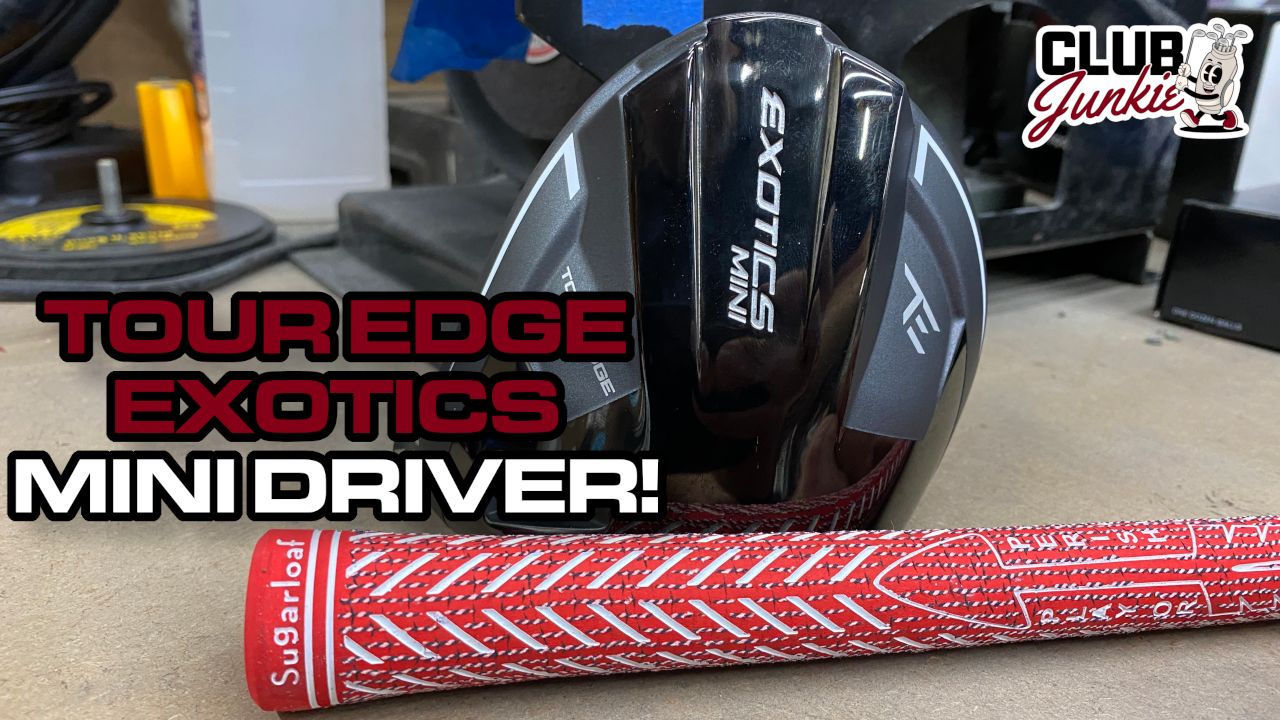
On this episode of Club Junkie, I put the new Tour Edge Exotics Mini Driver to the test and break down the performance, forgiveness, distance, and where it fits compared to a traditional driver or strong fairway wood. If you have been curious about adding a mini driver to the bag, this one is worth a look.
I also dive into the new TaylorMade Spider ZT Max putter that was recently spotted and discuss the growing zero torque putter trend. Plus, there is a closer look at the new Project X Titan Yellow shaft showing up on the PGA Tour and what makes it different from other profiles currently out there.

What’s the story behind Webb Simpson’s custom-stamped irons?

Memorial Tournament Tour Report: Rory McIlroy, Cameron Young switch up drivers, and more

Cadillac Championship Tour Report: Spieth’s sizable changes, McLaren Golf launches, and more

Russell Henley’s winning WITB: 2026 Charles Schwab Challenge

Kristoffer Reitan’s winning WITB: 2026 Truist Championship

Best irons 2026: Best irons overall, most forgiving irons, and more

J.T. Poston’s winning WITB: 2026 Memorial Tournament

Aaron Rai’s winning WITB: 2026 PGA Championship

Cameron Young’s winning WITB: 2026 Cadillac Championship

Details on Jason Day’s latest prototype Avoda iron setup


Christiaan Maas WITB 2026 (June)
Driver: TaylorMade Qi4D LS (8 degrees) Shaft: Fujikura Ventus TR Blue 6 X 3-wood: TaylorMade Qi10 (15 degrees) Shaft: Fujikura Ventus Black...


Ryan Palmer WITB 2026 (June)
Driver: Callaway Quantum Triple Diamond (9 degrees) Shaft: Project X HZRDUS Smoke Blue RDX 60 TX 3-wood: TaylorMade Qi10 (15 degrees) Shaft:...


Bud Cauley WITB 2026 (June)
Bud Cauley had >14 clubs in his bag when photographed prior to the Memorial Tournament. Driver: Titleist GTS2 (8 degrees) Shaft: Fujikura...


Hannah Green WITB 2026 (June)
Driver: Titleist GTS3 (10 degrees, D4 SureFit setting) Shaft: Mitsubishi Chemical Diamana RB 53 S 3-wood: Titleist GT3 (15 degrees,...
-
 Equipment7 days ago
Memorial Tournament Tour Report: Rory McIlroy, Cameron Young switch up drivers, and more
-
 News2 weeks ago
Russell Henley’s winning WITB: 2026 Charles Schwab Challenge
-
 Equipment4 days ago
Best irons 2026: Best irons overall, most forgiving irons, and more
-
 Whats in the Bag5 days ago
J.T. Poston’s winning WITB: 2026 Memorial Tournament
-
 Equipment1 week ago
Details on Jason Day’s latest prototype Avoda iron setup
-

 Equipment3 weeks ago
CJ Cup Byron Nelson Tour Report: Koepka and Kim’s newest putters finally get hot
-

 News2 weeks ago
Charles Schwab Challenge Tour Report: MacIntyre, Åberg and Spaun all switch putters, TaylorMade launches new Spider
-

 Equipment2 weeks ago
Details on J.J. Spaun’s surprise putter switch


Dave r
Aug 29, 2018 at 9:04 pm
I find the more I practice the luckier I get. Can’t practice the short game enough.
George
Aug 29, 2018 at 1:22 pm
Golf is like life. You get out of it what you put into it. FACT!!
Mat
Aug 28, 2018 at 10:13 pm
If you want to break 100, simply take out every club longer than your 8-iron. Play 40 shots with that 8-iron. Once you break 100, put the 7-iron in, and repeat.
No one does this, because it isn’t fun, but boy does it work!!
Rascal
Aug 29, 2018 at 12:52 am
How bad do you really want it, indeed.
ryan simmons
Aug 28, 2018 at 12:34 pm
if you can’t break 100 pick a new sport
Rockin1234
Aug 28, 2018 at 1:36 pm
^^^^^^ doesn’t have any eraser left on his pencil after the round
Dr Broccoli
Aug 29, 2018 at 12:03 pm
It’s comments like this that discourage beginning golfers, and make them think that all good golfers are pretentious jerks. This guy doesn’t speak for the vast majority of people that play golf.
dvers
Aug 30, 2018 at 8:51 am
Ryan Simmons, Global Ambassador for the Game of Golf:
There are a lot of pretentious, self-aggrandizing takes on GolfWRX, but this sums them all up in under 10 words. Congrats!