
Opinion & Analysis
Jason Day’s shoulder: More concerning than it seems?

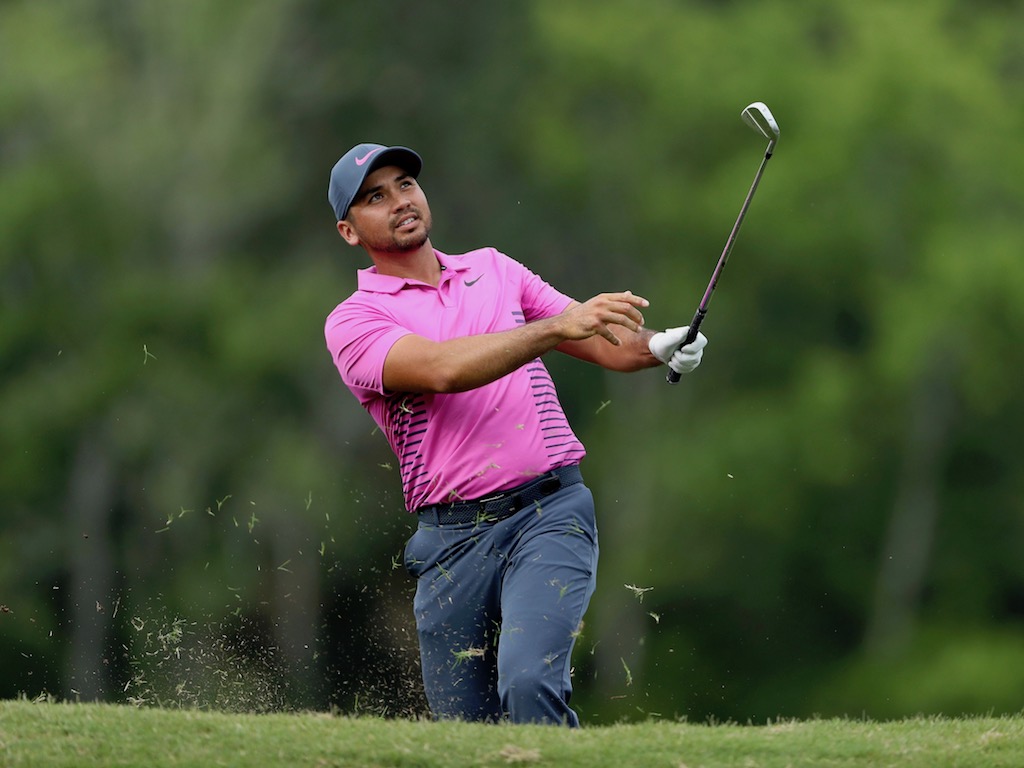
If you watched The Players Championship last weekend, you probably saw Jason Day tweak his shoulder on the 16th hole on Sunday. He addressed the injury in his post-round press conference and it caught my attention. Check out this video of the press conference to hear the entire clip.
A few things about what he said stuck out to me:
- “Every now and then it happens where my shoulder feels like it pops out, but it’s like more of a sting”
- Feeling a “pop” and “sting” in his lead (left) shoulder
- Pain is usually during the transition from the top of the backswing to the downswing
- He’s been doing shoulder exercises to “stay loose”
Just by watching Jason Day’s swing, it seems pretty evident that he is a hypermobile athlete. This simply means that his joints tend to be naturally looser, enabling him to achieve the tremendous positions he does in his swing. This can become problematic, however, when hypermobility becomes instability. Instability of the shoulder can lead to recurrent and frequent subluxations and/or dislocations of the glenohumeral (shoulder) joint.
Shoulder Injuries in Golfers

Photo Credit: Arrow PT
Shoulder injuries account for 8-18 percent of all golf-related injuries. The most common shoulder injuries to the lead shoulder are posterior instability and acromioclavicual (AC) joint injury. Both of these injuries tend to be painful at the top of the backswing when the lead arm is in near-maximal horizontal adduction (reaching across your body). This position creates a compressive force through the AC Joint, which may cause pain.
Maximal horizontal adduction also places stress on the posterior capsule of the shoulder. During the transition from the top of the backswing to the downswing, the hips and trunk begin to rotate towards the target. In elite golfers, the arms tend to lag behind, creating a tremendous amount of torque. This can lead to something termed the “adduction stretch” in the swing when the arm bone contacts the rib cage and the humeral head exerts a posterior force. Repeated over thousands of times, this can lead to posterior instability of the shoulder (especially in a naturally hypermobile person).
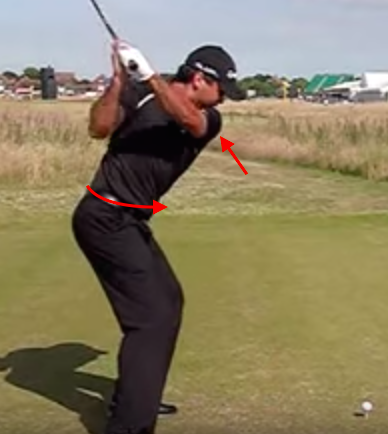
Notice that Day’s hips have fired towards the target, but his shoulders are lagging behind. This is a move that creates tremendous torque and clubhead speed but also stresses the shoulder joint and capsule.
Golfers with posterior instability may suffer from posterior subluxations. A subluxation is when the shoulder slides out of the joint and immediately slides back in. This is different from a dislocation, where the joint remains separated until it is physically put back into place.

Photo Credit: Back And Body Clinic
Symptoms of a subluxation include:
- A feeling of the shoulder moving out and in of the joint
- A feeling of looseness in the shoulder
- Pain, weakness, or numbness of the arm
Should Jason Day Be Concerned?
I’m not here to diagnose Jason Day with any medical condition. I have not evaluated his shoulder, and I do not have enough information to make any kind of an informed diagnosis. But, if it barks like a dog…
Is Day’s shoulder injury something that could negatively impact him in the foreseeable future? I would argue yes. If he does indeed have posterior instability of his lead shoulder with recurrent subluxations during his golf swing, this may be a problem that nags him for a while to come.
Conservative treatment for posterior instability typically features physical therapy focusing on improving rotator strength and stability. The rotator cuff can help stabilize the shoulder during the golf swing and prevent excessive motion of the humeral head within the socket when it is functioning properly. Medical research shows that conservative treatment of posterior instability is often successful, but not for every person. One study reports only 25 percent that golfers with posterior instability were able to return to golf after undergoing physical therapy. This study is old and has a few issues, but still, this is a pretty low percentage.
Surgical treatment of posterior instability is an option. The surgery includes tightening the capsule to prevent further subluxations. One of the major drawbacks of this surgery is that it may be tough to get full cross-body range of motion back after the capsule is tightened. This can make it difficult for golfers to get back to their old swing style after surgery.
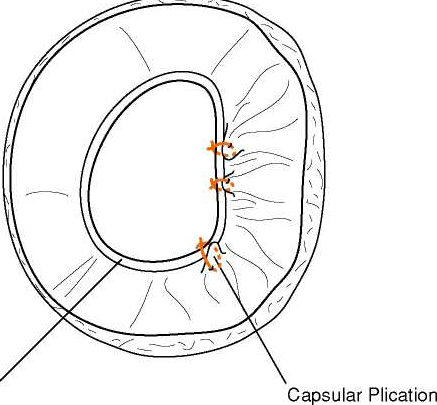
Surgical repair of the capsule showing the tightening of the capsule.
Overall, shoulder injuries, particularly to the lead shoulder, can be problematic for golfers of all ability levels. I sincerely hope that Jason Day is able to overcome his shoulder pain and continue to play at his current level.









This past Monday, I played in the U.S. Amateur local qualifier at Rock Creek Country Club in Portland, Oregon. A full tee sheet from 7:30 a.m. to 1:55 p.m., the top 11 scores would make it to the U.S. Amateur final qualifying.
I teed off at 10:48 a.m.. With the 7:30 am tee time, you can get a feel for the leaders’ pace, and they were off and running on the challenging setup at Rock Creek.
View this post on Instagram
Getting to the highlight of the round on the par five 17th, a drive up the left side and 212 yards left to the front hole location. I took out a 5-iron with plans of middle of the green. The ball ended up 8 feet left of the hole, pin high. A slight downhill putt dropped in for an eagle 3 on the 17th. With the cut line looking to be anywhere from -2 to even par. This was the boost I had been waiting for all day.
With making par from the trees on 18, it was time to wait for a potential playoff with a posted score of one under par 71.
Three hours later, it was playoff time. 8 players for 6 spots. I made par on the playoff hole, which was good enough to advance to the U.S. Amateur final qualifying in July. USGA qualifiers sure deliver on all of the emotions in golf!
Club Junkie
Building my 2026 gamer WITB: Ranking the contenders and new putter projects – Club Junkie Podcast

The annual What’s In The Bag build is underway, and on this episode of Club Junkie, Brian breaks down the clubs currently leading the race for a spot in his 2026 gamer setup. From drivers and fairway woods to irons, wedges, and shafts, he ranks the equipment that’s performing best and explains what’s separating the front runners from the rest of the field.
Brian also heads into the workshop to discuss several putter projects currently on the bench. From head options and shaft choices to build ideas and testing plans, he shares what he’s working on and which putters could become serious contenders for the bag this season.
If you’re a gear junkie who loves equipment testing, club building, and the never-ending pursuit of the perfect setup, this episode is for you.
Follow Club Junkie:
Instagram: @clubjunkiepod
TikTok: @clubjunkiepod
Threads: @clubjunkiepod
X: @ClubJunkiePod
Club Junkie
Tour Edge Exotics mini driver review + TaylorMade Spider ZT Max first look – Club Junkie

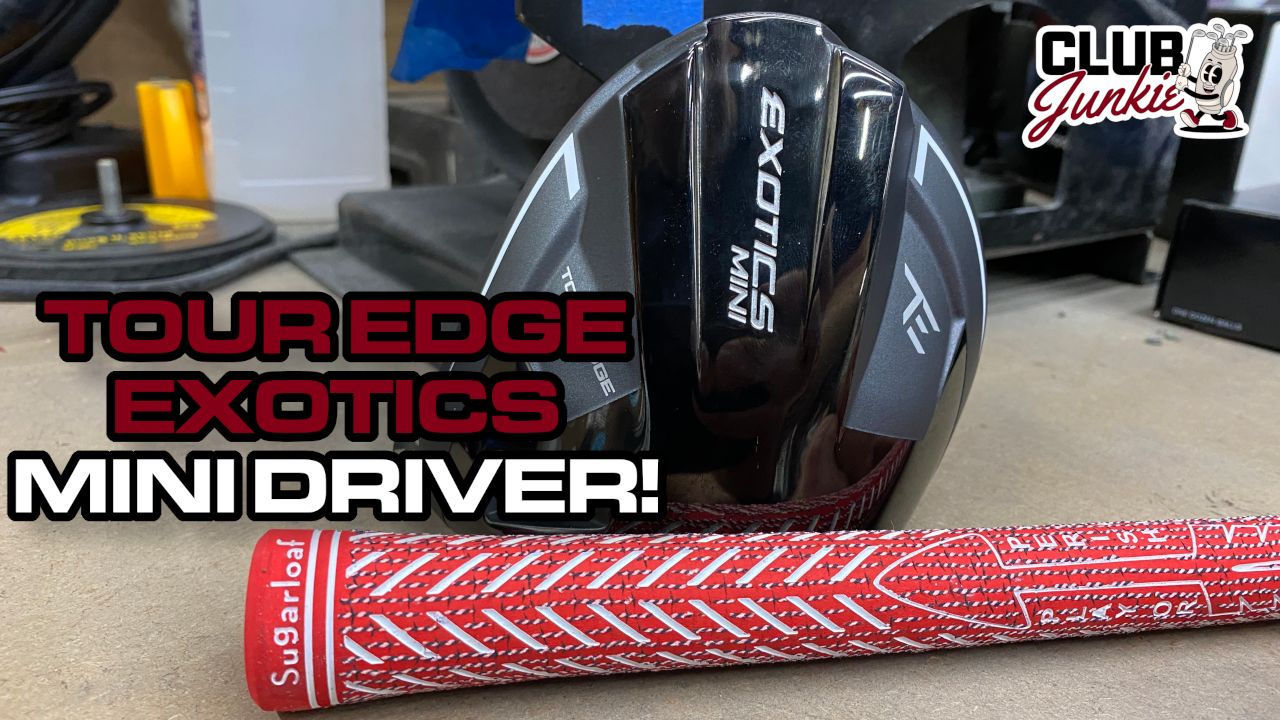
On this episode of Club Junkie, I put the new Tour Edge Exotics Mini Driver to the test and break down the performance, forgiveness, distance, and where it fits compared to a traditional driver or strong fairway wood. If you have been curious about adding a mini driver to the bag, this one is worth a look.
I also dive into the new TaylorMade Spider ZT Max putter that was recently spotted and discuss the growing zero torque putter trend. Plus, there is a closer look at the new Project X Titan Yellow shaft showing up on the PGA Tour and what makes it different from other profiles currently out there.

Justin Rose WITB 2026 (April): Full WITB breakdown with new McLaren irons

What’s the story behind Webb Simpson’s custom-stamped irons?

Memorial Tournament Tour Report: Rory McIlroy, Cameron Young switch up drivers, and more

Cadillac Championship Tour Report: Spieth’s sizable changes, McLaren Golf launches, and more

Russell Henley’s winning WITB: 2026 Charles Schwab Challenge

Kristoffer Reitan’s winning WITB: 2026 Truist Championship

Aaron Rai’s winning WITB: 2026 PGA Championship

J.T. Poston’s winning WITB: 2026 Memorial Tournament

Cameron Young’s winning WITB: 2026 Cadillac Championship

Best irons 2026: Best irons overall, most forgiving irons, and more


Bud Cauley WITB 2026 (June)
Bud Cauley had >14 clubs in his bag when photographed prior to the Memorial Tournament. Driver: Titleist GTS2 (8 degrees) Shaft: Fujikura...


Hannah Green WITB 2026 (June)
Driver: Titleist GTS3 (10 degrees, D4 SureFit setting) Shaft: Mitsubishi Chemical Diamana RB 53 S 3-wood: Titleist GT3 (15 degrees,...


Asterisk Talley WITB 2026 (June)
Driver: TaylorMade Qi4D (9 degrees) Shaft: Fujikura Ventus Blue 6 S 3-wood: TaylorMade Qi4D (16.5 degrees) Shaft: Fujikura Ventus Blue...

Brianna Do WITB 2026 (June)
Driver: Callaway Quantum Triple Diamond (9 degrees) Shaft: KBS PGW 3-wood: Callaway Elyte Titanium (15 degrees) Shaft: KBS PGW 5-wood:...
-
 Equipment6 days ago
Memorial Tournament Tour Report: Rory McIlroy, Cameron Young switch up drivers, and more
-
 News1 week ago
Russell Henley’s winning WITB: 2026 Charles Schwab Challenge
-
 Whats in the Bag3 days ago
J.T. Poston’s winning WITB: 2026 Memorial Tournament
-
 Equipment3 days ago
Best irons 2026: Best irons overall, most forgiving irons, and more
-

 Equipment1 week ago
Details on Jason Day’s latest prototype Avoda iron setup
-

 Equipment3 weeks ago
CJ Cup Byron Nelson Tour Report: Koepka and Kim’s newest putters finally get hot
-

 News2 weeks ago
Charles Schwab Challenge Tour Report: MacIntyre, Åberg and Spaun all switch putters, TaylorMade launches new Spider
-

 Equipment2 weeks ago
Details on J.J. Spaun’s surprise putter switch


Kevin
May 20, 2018 at 5:26 pm
What jason experiences is actually the anterior impingement which means soft tissues (primarily tendons) get pinched in the frontal compartment. It is likely to be caused by the posterior instability given jason is such a gym nerd. It wont be surprising if he suffers shoulder pain from doing excessive (compared to what a golfer actually need) weight training. Treatment for the antierior impingement requires addessing the posterior laxity too.
When we look at jason and aaron wise, plus other young fella who drives the ball long and accurately utilising a traditional swing with modern tweak, what is the point of heavy weight training.
Mike Scaduto
May 20, 2018 at 8:26 pm
I would agree that there is probably a combination of posterior instability and anterior impingement/subacromial impingement. The two seem to go together in golf shoulder injuries. And I agree that that could be secondary to posterior impingement.
I wouldn’t necessarily blame that on working out, however. I’m not sure what he does it in the gym and his routine could definitely be contributing, but there are a ton of golfers who lift weights and don’t feel like their shoulders are popping out of the socket during their swing.
Thanks for the read and the comment, appreciate it!
Hawkeye77
May 20, 2018 at 11:53 am
Not going to diagnose, but pretty much did, lol. A good read/reminder for anyone experiencing shoulder issues and author may be proven correct in his non-diagnosis. Something feels odd folks, get it checked out!
Mike Scaduto
May 20, 2018 at 8:30 pm
Again, I don’t know the complete picture of Jason Day’s shoulder by any means. His recent injury/media coverage provided a good platform to discuss the most common shoulder injuries in golfers. Although how he describes what’s going on does seem to point in the direction outlined in the article.
Thanks for the comment!
ray
May 20, 2018 at 9:58 am
Day is the biggest wimp on tour. If he injured his ankle like Tony Finau did at the Masters, he would be in a full body cast and traction for 6 months.
Capsulorrhaphy (capsule tightening procedures) are fraught with complications and can often result in poor outcomes and severe arthritis.
Mike Scaduto
May 20, 2018 at 8:33 pm
He has certainly had a few medical issues, but I wouldn’t call him a wimp. When your greatest asset is your body and health and millions of dollars are on the line, it is probably wise to be cautious.
Medical literature seems to be saying that capsular shifts/capsulorrhaphy procedures have poor outcomes. They are being done less frequently, especially in relatively young athletes.
Point misser
May 20, 2018 at 9:24 am
Smart – swing so hard that you hurt yourself. 0% chance this guy is still able to play when he’s 40
JM
May 20, 2018 at 7:07 am
Wow, this hits home because I suffered (I feel) something similar recently. Would golfers with posterior subluxations show up on an xray and/or an MRI? I had something going on for weeks and all of a sudden something felt like it shifted big time in my shoulder and the relief started. I’m sure the cortisone shot shortly after that helped as well. Initial reports on my MRI show nothing abnormal but I couldn’t do things in the gym or play golf for weeks. I found that to be very unusual for someone under 40.
Mike Scaduto
May 20, 2018 at 8:59 pm
JM– Sorry to hear you’re experiencing shoulder pain.
Diagnostic imaging can be a helpful tool assisting in the diagnosis of shoulder pain, but it is not 100% reliable by any means. X-rays would be able to detect any fractures in the bones while an MRI would be able to assess whether ligamentous structures are intact. MRI would not be my go to tool to diagnose posterior instability, unless it happened during a traumatic event (ie car crash)
As a PT, I try to rely more on the subjective history (what the client tells me happened) and actually moving their shoulder around than on MRIs. Research supports this in most cases, the exception being a traumatic injury.
I would suggest seeing a qualified PT to help reduce pain and promote strength and stability in your shoulder! Thanks for the comment JM.
Butch Harmon
May 19, 2018 at 9:55 pm
When i saw this story i guessed 2 things. It was his left shoulder and he let go of the club with his right hand on the followthrough. I found the swing on youtube and it confirmed both of my guesses. Jason, do not let go of the club with your right hand!!
John
May 19, 2018 at 7:16 pm
He’s made favorite player… but he’s made of glass