
Opinion & Analysis
10 Little things that will make a BIG difference in your game


What I find again and again with my students is that they believe the keys to better scoring lie in hitting their drives farther or adding another 10 yards of distance to their irons. And of course, I’d be the first to agree that distance plays an important role in scoring, but there are so many other contributing factors. Below are 10 tips for better scoring, which are going to help you score better right away.
10) Your first putt
The problem with long-putting is that you may at times become preoccupied with the line of the putt without paying the proper level of attention to speed, which dictates distance the ball will roll out. As the line of the putt is of secondary importance, your focus should be on those factors that affect speed. Your final thought before striking the putt should be speed with only a general concern for the line of the putt.
9) Bunker Play: Get out, get on, get in
In bunker player, there are three levels of expertise. The first level is the ability to get out of the bunker on a regular basis. The second level is the ability to get the ball out of the bunker and have it finish anywhere on the green. The third level is the ability to play a shot from the bunker that ends up close to the pin. You must work through each of these stages, one at a time, to eventually become an expert bunker player.
8) Greenside shots
In earlier days, the chip-shot played an important role in the game. But with the change in today’s maintenance practices, it has become virtually extinct. The grass around the greens is now allowed to grow considerably longer, dictating a different approach than in the past. The best club to use for these shots is not the traditional 7-8-9 irons, or even the pitching wedge, but a sand or lob wedge. The clubs (56-60 degrees) are heavier, allowing them to cut through the grass while at the same time, because of their added loft, allowing you to be more aggressive when playing these shots.
7) Let go of score
A major impediment to scoring is keeping track of where you stand with par on a moment-to-moment basis. Should you be a player who is constantly concerned with score, looking forward or back, you are making the mistake of not staying in “the now.” You must learn to control your thought process, which takes mental discipline. The proof of that discipline is at the end of the round. You should be surprised at the exact total of your score.
6) Elevation affects distance
The ability to adjust for elevation is to a large degree instinctive. The best approach is to think in terms of determining, to the best of your ability, whether the differential is one, two or three clubs and then commit to your decision. The shot will play longer going uphill and shorter going downhill.
5) Playing from sidehill lies
In the case of sidehill lies, the ball is inclined to curve in the same direction as the hill slopes. Should the ball be ABOVE YOUR FEET, it will tend to curve to your left. Also, because the ball is physically closer to you then from a level lie, you must effectively shorten the length of the club. The best approach is to choke up on the handle or stand a little taller at address. In cases where the ball is BELOW YOUR FEET, the ball is physically further from you, dictating that you must maintain your forward posture as you play the shot. The ball will tend to curve to your right.
4) Avoid the big number
A number greater than 3-over par on any given hole could be considered a “big number.” There are several reasons why you or other players mix in a big number with their score, even when penalty shots are not a factor. The nature of the game dictates that at some point you will play a poor shot. The question is how you react to that shot mentally and emotionally. Are you able to immediately put it behind you, or do you allow your emotions to spill over into the next hole causing you to play a succession of poor shots?
The basic rule after hitting into trouble is to get out of trouble with your next shot. You should choose a LOW RISK option that gets you “back down the road.” You may be tempted to play the “hero shot,” which often backfires into an even larger score. You should practice trouble shots on the range and on the course learning how to hit the ball high or low, while at the same time having the ability to curve it in both directions.
3) Playing in the wind
The wind adds another dimension to the game. The difference between playing on a windy day when the gusts are over 20 mph and playing on a day when there is no wind is like the difference between chess and checkers. The two games use the same board, but they are vastly different in their complexity. A player who consistently strikes the ball in the center of the club-face will have an advantage over other less skilled players, as his ball will be less affected by the wind.
2) Make your misses count
You may only hit a few “perfect shots” during your round. The rest will be “misses” of varying degrees. A percentage of these shot will fall under the category of “good misses,” which are shots that are eminently playable. Do you find this concept hard to accept? You may be looking through the “prism of perfection.” A ball that goes a reasonable distance and in the intended direction should be not be accepted as good fortune.
1) Play the course for shape
In the game of billiards, a skillful player is always looking at least one shot ahead while making sure that the next shot is as easy as possible. In golf, this means finding the best angle off the tee — one that is both safe and proves the best access to the pin. In preparing for competition, walking the hole backward in your imagination can be helpful in seeing what the architect intended when he constructed the hole. From there, you can develop a comprehensive “game plan.”
What now? I would suggest that you systematically work your way through each of the 10 steps on the practice range while observing the outcome, and then as you become more confident, test them out on the golf course… and watch your scores come down.





This past Monday, I played in the U.S. Amateur local qualifier at Rock Creek Country Club in Portland, Oregon. A full tee sheet from 7:30 a.m. to 1:55 p.m., the top 11 scores would make it to the U.S. Amateur final qualifying.
I teed off at 10:48 a.m.. With the 7:30 am tee time, you can get a feel for the leaders’ pace, and they were off and running on the challenging setup at Rock Creek.
View this post on Instagram
Getting to the highlight of the round on the par five 17th, a drive up the left side and 212 yards left to the front hole location. I took out a 5-iron with plans of middle of the green. The ball ended up 8 feet left of the hole, pin high. A slight downhill putt dropped in for an eagle 3 on the 17th. With the cut line looking to be anywhere from -2 to even par. This was the boost I had been waiting for all day.
With making par from the trees on 18, it was time to wait for a potential playoff with a posted score of one under par 71.
Three hours later, it was playoff time. 8 players for 6 spots. I made par on the playoff hole, which was good enough to advance to the U.S. Amateur final qualifying in July. USGA qualifiers sure deliver on all of the emotions in golf!
Club Junkie
Building my 2026 gamer WITB: Ranking the contenders and new putter projects – Club Junkie Podcast

The annual What’s In The Bag build is underway, and on this episode of Club Junkie, Brian breaks down the clubs currently leading the race for a spot in his 2026 gamer setup. From drivers and fairway woods to irons, wedges, and shafts, he ranks the equipment that’s performing best and explains what’s separating the front runners from the rest of the field.
Brian also heads into the workshop to discuss several putter projects currently on the bench. From head options and shaft choices to build ideas and testing plans, he shares what he’s working on and which putters could become serious contenders for the bag this season.
If you’re a gear junkie who loves equipment testing, club building, and the never-ending pursuit of the perfect setup, this episode is for you.
Follow Club Junkie:
Instagram: @clubjunkiepod
TikTok: @clubjunkiepod
Threads: @clubjunkiepod
X: @ClubJunkiePod
Club Junkie
Tour Edge Exotics mini driver review + TaylorMade Spider ZT Max first look – Club Junkie

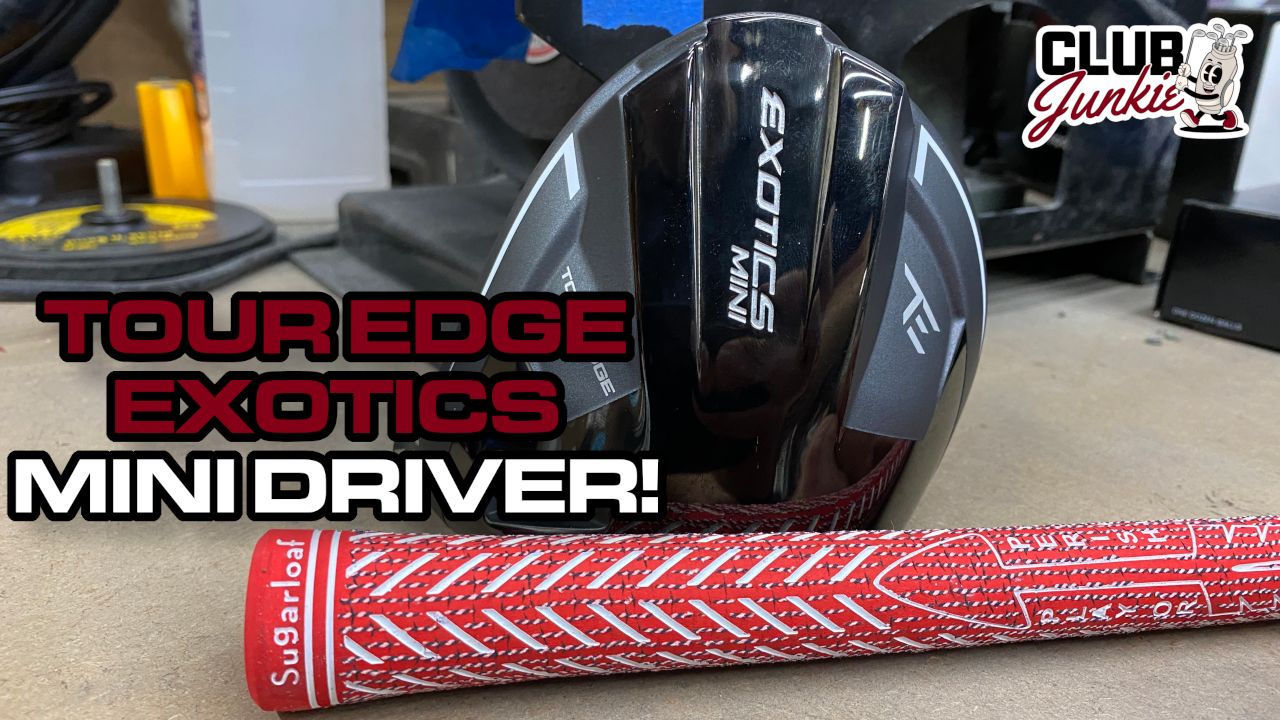
On this episode of Club Junkie, I put the new Tour Edge Exotics Mini Driver to the test and break down the performance, forgiveness, distance, and where it fits compared to a traditional driver or strong fairway wood. If you have been curious about adding a mini driver to the bag, this one is worth a look.
I also dive into the new TaylorMade Spider ZT Max putter that was recently spotted and discuss the growing zero torque putter trend. Plus, there is a closer look at the new Project X Titan Yellow shaft showing up on the PGA Tour and what makes it different from other profiles currently out there.

Justin Rose WITB 2026 (April): Full WITB breakdown with new McLaren irons

What’s the story behind Webb Simpson’s custom-stamped irons?

Memorial Tournament Tour Report: Rory McIlroy, Cameron Young switch up drivers, and more

Cadillac Championship Tour Report: Spieth’s sizable changes, McLaren Golf launches, and more

Russell Henley’s winning WITB: 2026 Charles Schwab Challenge

Kristoffer Reitan’s winning WITB: 2026 Truist Championship

Best irons 2026: Best irons overall, most forgiving irons, and more

J.T. Poston’s winning WITB: 2026 Memorial Tournament

Aaron Rai’s winning WITB: 2026 PGA Championship

Cameron Young’s winning WITB: 2026 Cadillac Championship


Ryan Palmer WITB 2026 (June)
Driver: Callaway Quantum Triple Diamond (9 degrees) Shaft: Project X HZRDUS Smoke Blue RDX 60 TX 3-wood: TaylorMade Qi10 (15 degrees) Shaft:...


Bud Cauley WITB 2026 (June)
Bud Cauley had >14 clubs in his bag when photographed prior to the Memorial Tournament. Driver: Titleist GTS2 (8 degrees) Shaft: Fujikura...


Hannah Green WITB 2026 (June)
Driver: Titleist GTS3 (10 degrees, D4 SureFit setting) Shaft: Mitsubishi Chemical Diamana RB 53 S 3-wood: Titleist GT3 (15 degrees,...


Asterisk Talley WITB 2026 (June)
Driver: TaylorMade Qi4D (9 degrees) Shaft: Fujikura Ventus Blue 6 S 3-wood: TaylorMade Qi4D (16.5 degrees) Shaft: Fujikura Ventus Blue...
-
 Equipment6 days ago
Memorial Tournament Tour Report: Rory McIlroy, Cameron Young switch up drivers, and more
-
 News2 weeks ago
Russell Henley’s winning WITB: 2026 Charles Schwab Challenge
-
 Equipment3 days ago
Best irons 2026: Best irons overall, most forgiving irons, and more
-
 Whats in the Bag4 days ago
J.T. Poston’s winning WITB: 2026 Memorial Tournament
-

 Equipment1 week ago
Details on Jason Day’s latest prototype Avoda iron setup
-
 Equipment3 weeks ago
CJ Cup Byron Nelson Tour Report: Koepka and Kim’s newest putters finally get hot
-

 News2 weeks ago
Charles Schwab Challenge Tour Report: MacIntyre, Åberg and Spaun all switch putters, TaylorMade launches new Spider
-

 Equipment2 weeks ago
Details on J.J. Spaun’s surprise putter switch


millennial82
May 14, 2018 at 12:37 pm
Rod Lindenberg is a Sr. Jedi in golf. Thank you for the lessons, i will surely train in all 10 this weekend.
Bob Jones
May 14, 2018 at 12:32 pm
Fabulous list. I would add the importance of doing whatever it takes to get the ball in the fairway off the tee. The pros can drive the ball anywhere and still make par; we can’t.
ButchT
May 14, 2018 at 12:07 pm
Very good article!
Sherwin
May 13, 2018 at 11:28 pm
I believe this is one of the best article written for GolfWRX. Why the negative responses? I don’t get it. I think the author is spot-on.
Albert
May 13, 2018 at 7:22 pm
Okay, let’s get this straight:
11. Cheat
12. Imbibe
13. No x-e-s
14. Void
15. Page Sp.
16. ??????
BParsons
May 13, 2018 at 3:41 pm
15. Take Paige Spirniac out for a photoshoot before and after round.. BOOM BABY
ogo
May 13, 2018 at 3:10 pm
14. Void yourself so that your lower bowel is unburdened of waste material. A glycerine suppository does wonders to start the process. You will have that floating feeling throughout the round while others labor absorbing their contaminate material. 😮
ogo
May 13, 2018 at 3:05 pm
13. Avoid x-e-s first thing in the morning as it will drain you of essential fluids needed to pulverize the ball off the first tee and thereafter. Save and store your energy for the game, not the gal.
Tom
May 13, 2018 at 11:58 am
great article Mr. Lidenberg. Many facts over looked by golfers,mostly weekenders and some I forgot about.
larry
May 13, 2018 at 9:57 am
maybe the worst i’ve ever read! Shank
ogo
May 12, 2018 at 10:35 pm
12. Imbibe before the first tee. Alcohol is a depressant and will eliminate all your first tee jitters and keep you from a panic attack. Bobby Jones and Moe Norman all took a wee dram of Scotch whiskey to settle their golfing nerves. Many still do.
James T
May 12, 2018 at 11:29 pm
I subscribe to sipping an Italian Sports Drink during the round to keep the swing lubricated. i.e. A pinot grigio from Tuscany.
Obee
May 12, 2018 at 7:32 pm
Wow! Somebody understands the elements of scoriing!! 🙂
KAndyMan
May 12, 2018 at 2:40 pm
Great article! Simple, to the point and great things to always have in the back of your mind at all times. I personally think the first putt and playing the hole backwards are the 2 best. They come into play on almost every hole. My dad beat into my head at an early age to “get your line close but most important your speed even closer on your first putt”.
James T
May 12, 2018 at 2:29 pm
Pursuant to #4. Be emotional before the shot. Be emotional after the shot. No matter if something good or bad just happened. DURING the shot be a robot, unaffected by human emotions, because good or bad emotions can ruin the current shot.
ogo
May 12, 2018 at 2:20 pm
11. Cheat. Ignore the USGA/R&A Rules of Golf, particularly after slicing your drive into the deep rough. Don’t play stroke and distance back to the tee. Carry a second ball in your pocket and quietly dropping it and saying you found your ‘lost’ ball.
apple support
May 12, 2018 at 1:27 pm
Those who are playing Golf or love to play this at some point in time should follow these rules and things that are mentioned here. If anyone wants to be a pro in the game, then all the aspects of the game should be known.