
Opinion & Analysis
How valuable is hitting the fairway, really?


Hitting more than 50 percent of fairways has long been considered a good goal for amateur golfers. The winners on the PGA Tour tend to hit 70 percent. I have long maintained, however, that it is not the number of fairways HIT that matters. Instead, it is the relative severity of fairways MISSED.
Think about it. By the one-dimensional Fairways Hit stat, every miss is the same. A perfect lie in the first cut is exactly the same as a drive in a hazard… or even OB. There is nothing in the 650+ PGA Tour stats about this. In all, there are 60 stats in seven categories that relate to driving performance, but none about penalties! Like PGA Tour players don’t make any?
Let’s see exactly how important the old tried-and-true Driving Accuracy (Percentage of Fairways Hit) really is. To test it, I used two data clusters: the 2017 PGA Tour season (14,845 ShotLink rounds) and my ShotByShot.com database for the average male golfer (15 to 19 handicappers – 4,027 rounds).
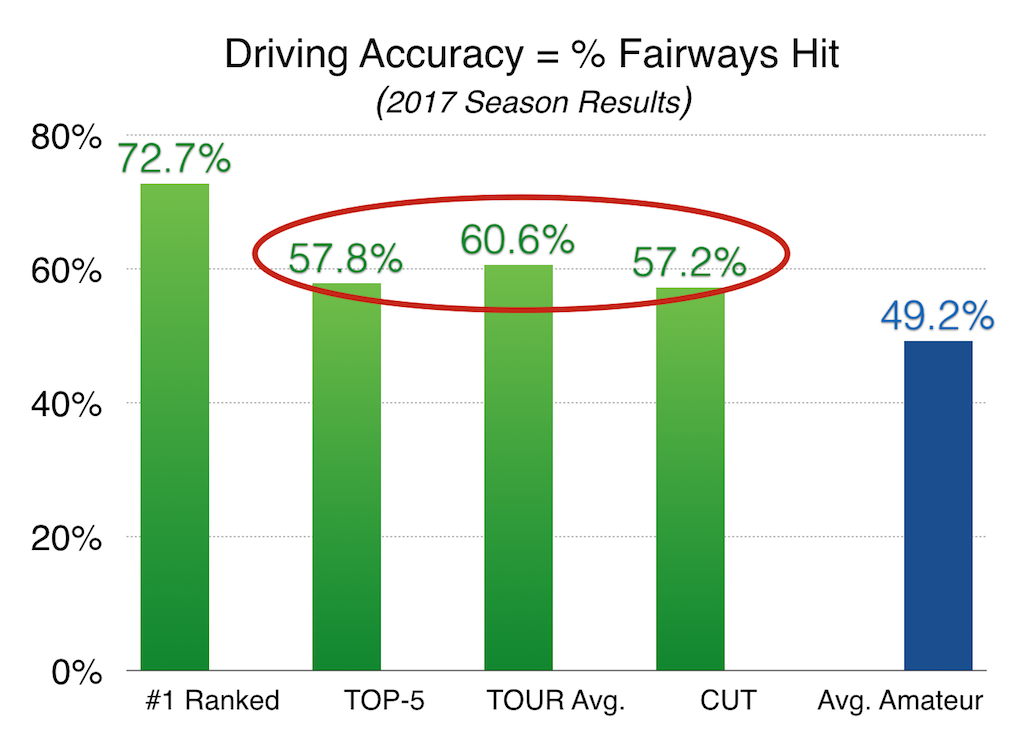
For the graph below, I started with the No. 1-ranked player in the Driving Accuracy category: Ryan Armour. He certainly was accurate by this measure, but why did he only rank 100th in 2017 Strokes Gained Off the Tee with a barely positive 0.020?
Next I looked at the actual top-5 PGA Tour money winners (J. Thomas, J Spieth, D. Johnson, H. Matsuyama and J. Rohm), the 2017 PGA Tour average, and all PGA Tour players that missed the cut in 2017. We all know the significant scoring differences between these three categories of players, but it’s difficult to see a meaningful difference in the fairways hit. They’re not even separated by half a fairway. How important could this stat be?
For those that have not tried ShotByShot.com, our analysis includes Strokes Gained and Relative Handicap comparisons. That enables users to easily differentiate between FIVE MISS categories below based upon severity. The final three categories are what we consider to be Driving Errors:
- Good lie/Opportunity: One can easily accomplish their next goal of a GIR or advancement on a par-5.
- Poor Lie/Opportunity: One could accomplish the next goal, but it will require a very good shot.
- No Shot: Requires an advancement to return to normal play.
- Penalty-1: Penalty with a drop.
- OB/Lost: Stroke and distance penalty, or shot replayed with a stroke penalty.
As we are fortunate enough to work with several PGA Tour players at Shot by Shot, we have access to ShotLink data and can provide those clients with the same valuable insight.
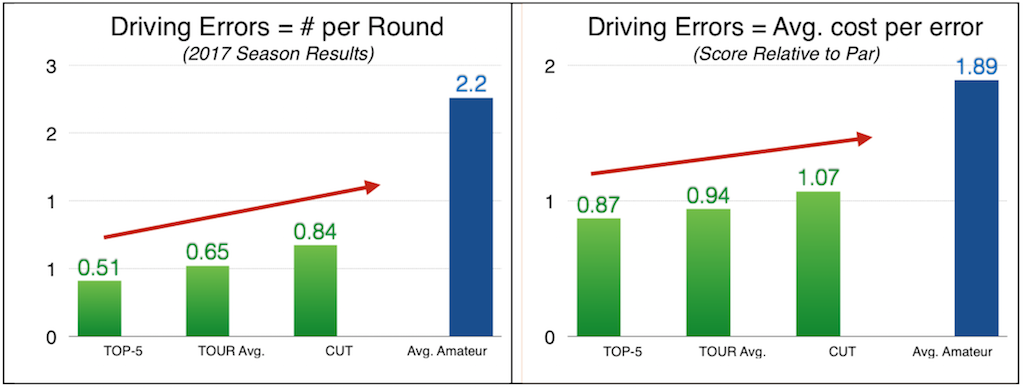
Let’s see how the frequency and severity of driving errors relates to the above groups of players (removing Mr. Armour, as he simply helped us prove the irrelevance of Driving Accuracy). The graphs below display the number of Driving Errors per round and the Average Cost Per Error. Note the strong and consistent correlation between the number and the cost of errors at each of the four levels of performance.
Finally, the average cost of the errors is heavily driven by the three degrees of severity outlined above (No Shot, Penalty, OB/Lost). The graph below compares the relative number and cost of the three types of errors for the average golfer and PGA Tour players. The major difference is that PGA Tour players do not seem to have a proper share of OB/Lost penalties. I found only TWO in the 14,000+ ShotLink rounds. While I accept that the most severe faux pas are significantly less frequent on the PGA Tour, I also believe there must have been more than two.
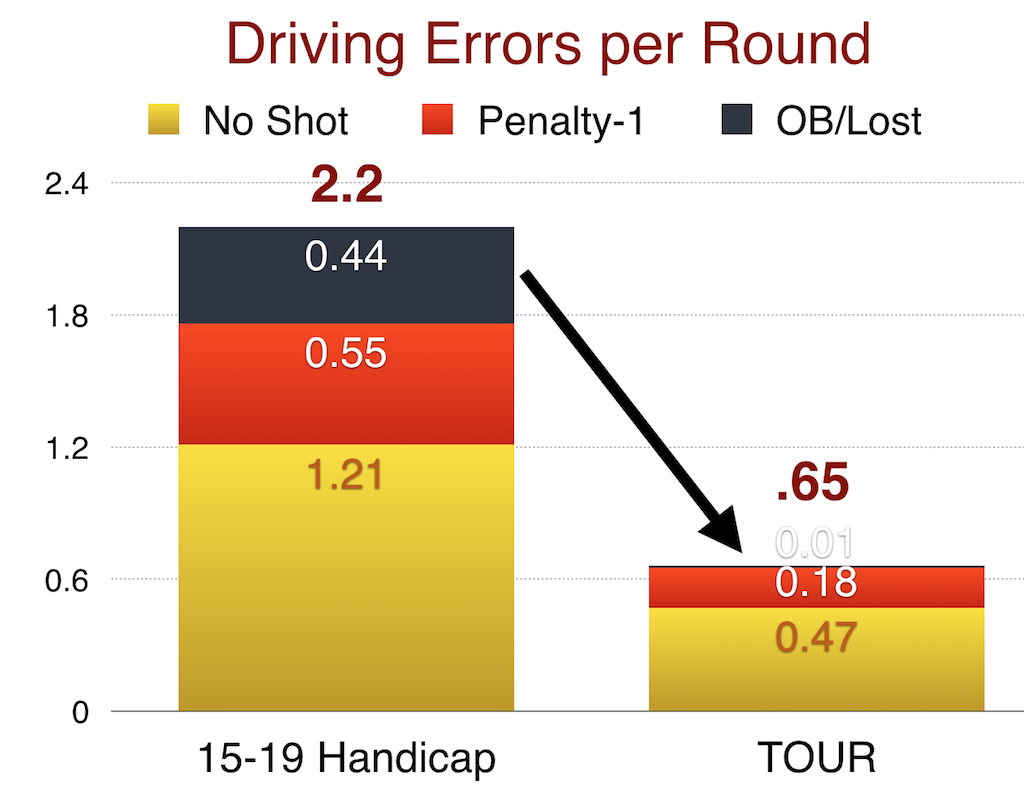
Why so few? First and foremost, PGA Tour players REALLY ARE good. Next, the galleries stop a lot of the wayward shots. And finally, I believe that many of the ShotLink volunteer data collectors may not actually know or care about the difference between a Penalty and OB/Lost.
Author’s Note: If you want to know your Strokes Gained Off the Tee (Driving) and exactly how important your fairways and the misses are, log onto ShotByShot.com for a 1-Round FREE Trial.




This past Monday, I played in the U.S. Amateur local qualifier at Rock Creek Country Club in Portland, Oregon. A full tee sheet from 7:30 a.m. to 1:55 p.m., the top 11 scores would make it to the U.S. Amateur final qualifying.
I teed off at 10:48 a.m.. With the 7:30 am tee time, you can get a feel for the leaders’ pace, and they were off and running on the challenging setup at Rock Creek.
View this post on Instagram
Getting to the highlight of the round on the par five 17th, a drive up the left side and 212 yards left to the front hole location. I took out a 5-iron with plans of middle of the green. The ball ended up 8 feet left of the hole, pin high. A slight downhill putt dropped in for an eagle 3 on the 17th. With the cut line looking to be anywhere from -2 to even par. This was the boost I had been waiting for all day.
With making par from the trees on 18, it was time to wait for a potential playoff with a posted score of one under par 71.
Three hours later, it was playoff time. 8 players for 6 spots. I made par on the playoff hole, which was good enough to advance to the U.S. Amateur final qualifying in July. USGA qualifiers sure deliver on all of the emotions in golf!
Club Junkie
Building my 2026 gamer WITB: Ranking the contenders and new putter projects – Club Junkie Podcast

The annual What’s In The Bag build is underway, and on this episode of Club Junkie, Brian breaks down the clubs currently leading the race for a spot in his 2026 gamer setup. From drivers and fairway woods to irons, wedges, and shafts, he ranks the equipment that’s performing best and explains what’s separating the front runners from the rest of the field.
Brian also heads into the workshop to discuss several putter projects currently on the bench. From head options and shaft choices to build ideas and testing plans, he shares what he’s working on and which putters could become serious contenders for the bag this season.
If you’re a gear junkie who loves equipment testing, club building, and the never-ending pursuit of the perfect setup, this episode is for you.
Follow Club Junkie:
Instagram: @clubjunkiepod
TikTok: @clubjunkiepod
Threads: @clubjunkiepod
X: @ClubJunkiePod
Club Junkie
Tour Edge Exotics mini driver review + TaylorMade Spider ZT Max first look – Club Junkie

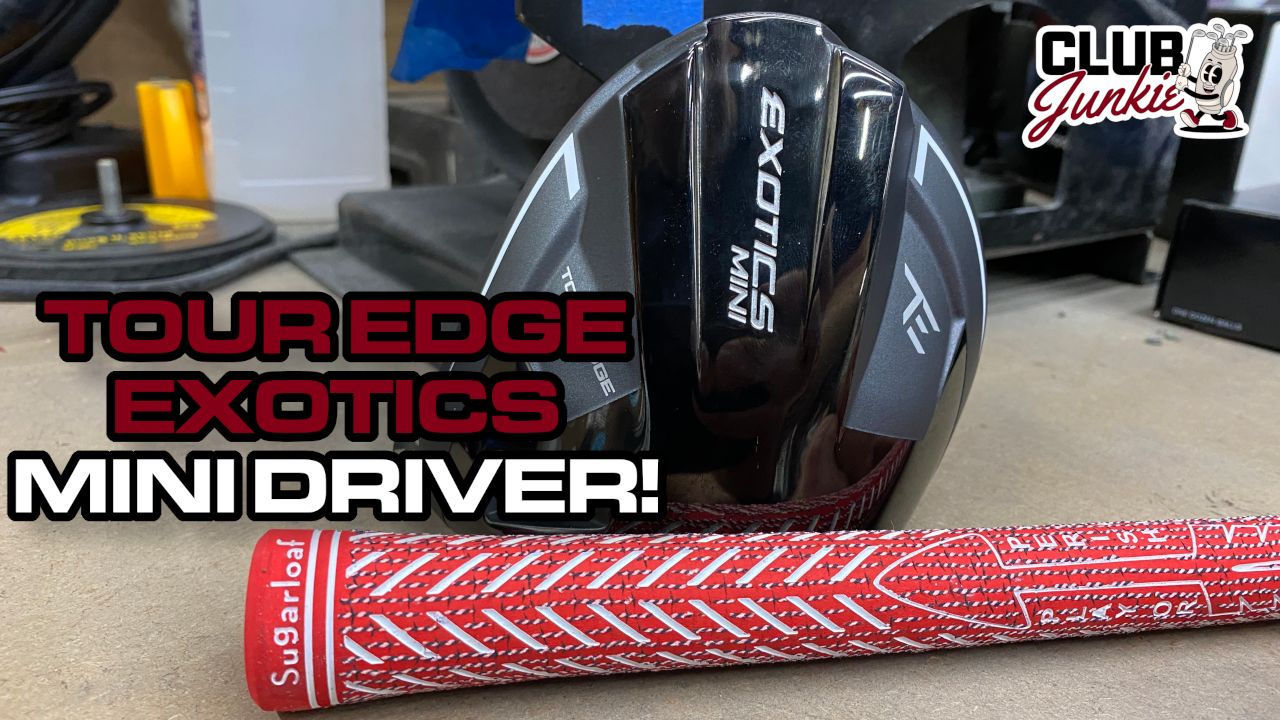
On this episode of Club Junkie, I put the new Tour Edge Exotics Mini Driver to the test and break down the performance, forgiveness, distance, and where it fits compared to a traditional driver or strong fairway wood. If you have been curious about adding a mini driver to the bag, this one is worth a look.
I also dive into the new TaylorMade Spider ZT Max putter that was recently spotted and discuss the growing zero torque putter trend. Plus, there is a closer look at the new Project X Titan Yellow shaft showing up on the PGA Tour and what makes it different from other profiles currently out there.

Justin Rose WITB 2026 (April): Full WITB breakdown with new McLaren irons

What’s the story behind Webb Simpson’s custom-stamped irons?

Memorial Tournament Tour Report: Rory McIlroy, Cameron Young switch up drivers, and more

Cadillac Championship Tour Report: Spieth’s sizable changes, McLaren Golf launches, and more

Russell Henley’s winning WITB: 2026 Charles Schwab Challenge

Kristoffer Reitan’s winning WITB: 2026 Truist Championship

Best irons 2026: Best irons overall, most forgiving irons, and more

J.T. Poston’s winning WITB: 2026 Memorial Tournament

Aaron Rai’s winning WITB: 2026 PGA Championship

Cameron Young’s winning WITB: 2026 Cadillac Championship


Ryan Palmer WITB 2026 (June)
Driver: Callaway Quantum Triple Diamond (9 degrees) Shaft: Project X HZRDUS Smoke Blue RDX 60 TX 3-wood: TaylorMade Qi10 (15 degrees) Shaft:...


Bud Cauley WITB 2026 (June)
Bud Cauley had >14 clubs in his bag when photographed prior to the Memorial Tournament. Driver: Titleist GTS2 (8 degrees) Shaft: Fujikura...


Hannah Green WITB 2026 (June)
Driver: Titleist GTS3 (10 degrees, D4 SureFit setting) Shaft: Mitsubishi Chemical Diamana RB 53 S 3-wood: Titleist GT3 (15 degrees,...


Asterisk Talley WITB 2026 (June)
Driver: TaylorMade Qi4D (9 degrees) Shaft: Fujikura Ventus Blue 6 S 3-wood: TaylorMade Qi4D (16.5 degrees) Shaft: Fujikura Ventus Blue...
-
 Equipment6 days ago
Memorial Tournament Tour Report: Rory McIlroy, Cameron Young switch up drivers, and more
-
 News2 weeks ago
Russell Henley’s winning WITB: 2026 Charles Schwab Challenge
-
 Equipment3 days ago
Best irons 2026: Best irons overall, most forgiving irons, and more
-
 Whats in the Bag4 days ago
J.T. Poston’s winning WITB: 2026 Memorial Tournament
-

 Equipment1 week ago
Details on Jason Day’s latest prototype Avoda iron setup
-
 Equipment3 weeks ago
CJ Cup Byron Nelson Tour Report: Koepka and Kim’s newest putters finally get hot
-

 News2 weeks ago
Charles Schwab Challenge Tour Report: MacIntyre, Åberg and Spaun all switch putters, TaylorMade launches new Spider
-

 Equipment2 weeks ago
Details on J.J. Spaun’s surprise putter switch


Jason
Mar 19, 2018 at 4:58 pm
Players know where the boundaries of the shot are, and they aren’t always the boundaries of the fairway. At my course (lots of water, light rough) you’re regularly playing up the side and a good (but not great) shot will find the harmless light rough. Likewise, an aggressive tee shot over a corner might run out of fairway, but the distance saved is worth the small cost of maybe catching light rough. The best pros might not find the fairway as often simply becasue they trust their game enough to take the more challenging line – and know that they can handle a small “penalty” in the form of light rough (and fairway missed stat) if that’s the price. So yeah, fairways hit doesn’t matter, the only thing that matters is the ‘did you hit it somewhere you were ok with standing over the ball’ stat – and I’m not sure how you measure that, except that it probably correlates with good judgement, temperament and good skills. Not sure there’s a stat for it though, and not sure there needs to be.
James T
Mar 19, 2018 at 10:27 am
“How valuable is hitting the fairway, really?”
After Sunday, ask Tiger Woods.
Bruce Hart
Mar 18, 2018 at 11:01 am
If I miss a fairway, especially if I’m playing by myself, I may never find the ball which would mean slowing play by going back to the tee (or hitting a lot of provisionals) or just not playing by the rules (which is what I usually do). Sometimes even hitting the fairway isn’t a guarantee because the ball can plug. I have found that bright Volvik Vivid balls can help. When the rough is up, it’s windy and clover are everywhere I can’t afford to spray driver. I’d like to do an experiment where you take a pro and put them on a standard muni course (no gallery, no grandstands, no tv coverage, no spotters) by themselves and see how many lost balls they have. I think the pros play a different game.
CrashTestDummy
Mar 18, 2018 at 2:14 am
There still is a premium on good ball striking. Yeah the severity of fairways missed matters, but the best ball strikers will have much less severe missed fairways. The best ball strikers are always at the top of the leaderboards consistently. Whenever their ball striking goes awry they start missing cuts. When they miss putts, they are still making cuts or placing well because they are avoiding bogeys and the big numbers. Bottom line is missed fairways and greens means bogeys and big numbers.
There should probably be a stat for “strokes gained with missed fairway” or “strokes lost with missed fairway”. That would be a telltale metric for knowing the severity of missed fairways.
James T
Mar 17, 2018 at 8:05 pm
Personally, I think Greens in Regulation is far more important to scoring. Rare is the course that has U.S. Open rough that keeps you from going for the green.
Tal
Mar 19, 2018 at 2:24 am
True, but pure greens in regulation doesn’t tell us why greens were missed. Poor driving makes hitting a GIR more difficult so if someone is driving really well and still hits very few greens, their iron play is probably to blame. Whereas if they are missing greens and their driving is poor, that helps paint a picture as to why.
larrybud
Mar 17, 2018 at 5:10 pm
Unfortunately, with shotbyshot, and any other system with user driven data, you’re relying on a data which has zero verification to it (unlike shotlink). In other words, you have no idea how accurate the data is which players have entered that you’re basing your analysis.
Sean Foster-Nolan
Mar 17, 2018 at 3:05 pm
I think it depends on the golf course. My home course is littered with hazards and has little rough to speak of. If you miss the fairway there is a good chance you will find a hazard.
But overall I agree.
Doug
Mar 17, 2018 at 1:48 pm
If I miss a fairway there is a 50% chance that my ball gets lost. So I better go for 100% fairway even when that means I can‘t use my driver