
Opinion & Analysis
Do Taller Golfers Have An Advantage?


You would assume that height would be an advantage in golf. After all, taller golfers have the potential to hit the ball farther based simply on their limb length, mass, and overall body strength. Doesn’t a taller golfer’s ability to drive the ball as much as 30 yards or 50 yards past his shorter opponent give him a head start that can’t be overcome?
Well, there’s that well-known fable concerning the tortoise and the hare, and we all know how that turned out. A fast start is no guarantee of a fast finish. Maybe that’s the point that Harvey Penick was attempting to make in his own way when he said, “The woods are full of big hitters.” I think you would agree that there’s is no point in hitting the ball a long way off the tee if doesn’t end up in the fairway consistently.
Charlie Danielson
After working with a number of tall players over the years, I had come to the conclusion that height was a not an advantage. In fact, with only a few exceptions, it seemed to be a distinct disadvantage.
In considering this subject, I thought of my former student Charlie Danielson, who was 6-feet 5-inches tall. I‘d worked with Charlie through his high school years up until the week that he left to play for Coach Mike Small at the University of Illinois, where he helped his team capture the NCAA Championship. In working with Charlie, I found that the plane of his swing could vary as much as a foot over the course of a single week. In this regard, he was not the exception to the rule, but more the norm when it came to be working with tall players.
The advantage that Charlie had was that he was fully capable of hitting good shots even when the plane of swing was less than ideal. He was like a great hitter in baseball; he would just adjust to the height of the pitch and make it work.
The Taller Player
The logical assumption, as mentioned earlier, would be that a taller player would naturally hit the ball farther than a shorter player. And that distance would then allow the taller player to outperform the smaller player every time. That contention would certainly seem to be evidenced by looking at today’s modern wonder boys, Dustin Johnson at 6-feet 4-inches and Jordan Spieth at 6-feet 1-inch. Between them, they’ve have won a total of nine events and a total of $17 million on the PGA Tour in an eight-month period.
That said, I’ve found over the years that there are six areas where tall players typically struggle. These six areas constitute what I refer to as “The Taller Player Syndrome,” and these problems ultimately affect a player’s ability to score.
The Taller Player Syndrome
No. 1: The Setup
The first disadvantage is related to setting up to the ball. How does it make sense that a player who is 6-feet 5-inches tall would use the same length irons as another player who is 5-feet 7-inches tall? And yet, realistically, the most an iron can extended is about an inch before it becomes unmanageable. In this case, there is a difference of 10 inches in height between these two players.
The taller player must then account for this difference in the setup, which becomes exceedingly awkward — especially with the shorter irons. This is in contrast to the shorter player, who only needs to bend slightly forward from the hips, place the sole of his club on the ground, and then make a swing.
No. 2: Lower Body Instability
The distance from the taller player’s feet to his knees, and the distance from his knees to his hips, is considerably greater than the shorter player. This lends itself to general instability in the lower body, especially where the length of the legs is disproportionate to the torso, ensuring poor balance throughout the swing.
No. 3: Excessive Knee-Drive
There is a universal tendency for taller players to develop excessive knee-drive on their downswing, causing them to finish with their backs in an arched position as if they were doing the side-ways limbo. This places excessive pressure on the lumbar region of the back.
No. 4: Lower Back Issues
In many cases, I’ve found that taller golfers have legs that are not equal in length, which creates setup and balance issues. There are three possible causes for the apparent disparity in leg length:
- The first possible cause can be genetic, meaning that the length of the leg bones on either side of the body are unequal, which is actually quite rare.
- The second possible cause, which is more common, occurs when the pelvis has been torqued in one direction or another. In a case where the pelvis has been twisted to the left, the right leg becomes functionally longer while the left becomes shorter. The reverse is true when the pelvis is twisted in the opposite direction.
- A third possible cause is when the stronger and less flexible muscles on one side of the body take over. This has the effect of pulling the lower spine out of alignment and in the process, pinching delicate nerves. which is the basis of pain. Those players with this condition will universally complain of periodic or chronic back pain, which often grows worse with age.
No. 5: Fluctuating Spine Angle
The arc of the swing revolves around the spine, which is inclined forward at address. This angle must be retained throughout the swing until the ball is struck, which makes for consistent shot-making. The required angle at address is considerably more acute for a taller player than a shorter player, making it more difficult to retain the angle through impact.
No. 6: Variable Backswing Plane
The most significant problem for the taller player, as mentioned earlier, is the variety of planes in which the club can be swung. The plane can vary from horizontal to vertical and everywhere else in between.
In contrast, a shorter player has, for the most part, only one swing plane. And invariably it’s the correct one, because it comes more naturally to them than the taller player. The inability to swing the club on the same plane on a consistent basis ultimately leads to variations in performance.
PGA Tour Money List
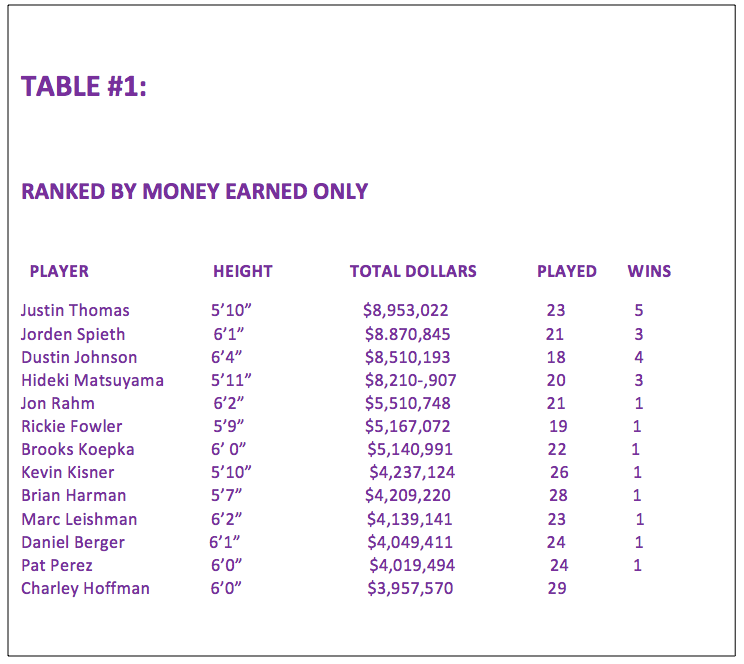
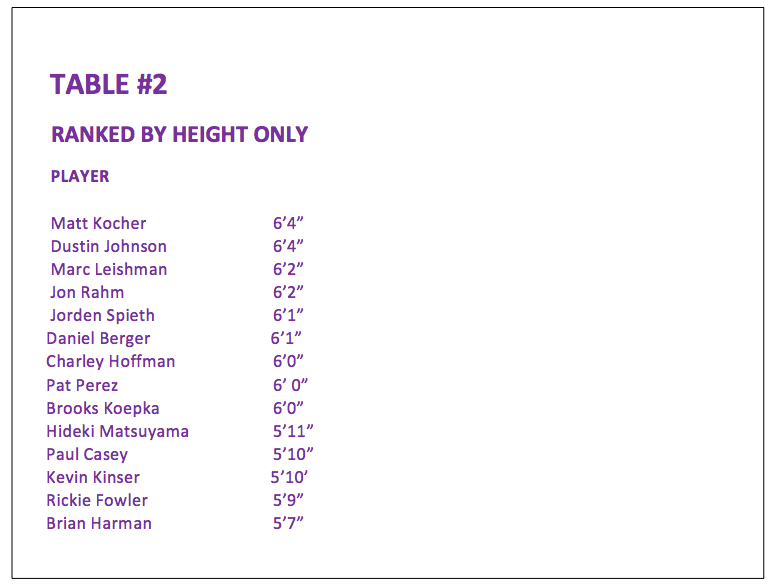
I decided to look at the top-15 players on this year’s PGA Tour Money List to determine if there was a connection between the height of the players and how well they performed in terms of dollars earned between January 1 and August 31, 2017, as outlined above.
The study would hardly meet scientific guidelines, based on (1) limited sampling, (2) short time period, (3) lack of a control group.
The Study
The study was not designed to prove or disprove any one theory. I simply wanted to determine in rather short order if there was a plausible correlation between a player’s height and the number of dollars they earned on the PGA Tour.
The study would seem to suggest that in terms of dollars earned, height is neither an advantage or a disadvantage. That said, a broader study conducted in a purely scientific manner “might” reveal additional insight on the subject.
- The numbers indicate that taller players on the PGA Tour do not hold an advantage over shorter players.
- In the reverse, shorter players on the PGA Tour may hold a slight advantage over taller players based on their durability, making them less prone to injury.
- The amount of money earned on an average by those players under 6-feet tall is virtually same as the amount of money earned by those players over 6-feet tall.
- The numbers suggest that the composite height of “the perfect golfer” has increased from previous years to between 5-feet 11-inches and 6-feet tall.
- The numbers are skewed in favor of taller players by Dustin Johnson and Matt Kuchar, who are both 6-feet 4-inches tall. Were these two players NOT among the top-15 money winners, the average height of the entire group would dip toward the shorter side.
Some additional findings included:
- The shortest player in the group is Brian Harman at 5-feet 7-inches.
- There are a six players who are below 6-feet, while there are nine players who are 6-feet or taller.
- The average amount of money won by the six players under 6-feet was $5,714,844, while the average amount of money won by the nine players over 6-feet was $5,323,572.
In many other sports, height is an advantage and in some cases a requirement. In this regard, golf is unique. The height of the player is for the most part irrelevant when it comes to earning, and by extension, playing the game well.
Would these same findings apply to amateur golfers across the board, including those with handicaps from scratch to 30? That grouping would have to be studied on an independent basis to reach a valid conclusion, though a plausible assumption is that it would be similar.
In addition, this limited study indicates that height of “the perfect golfer” would seem to be increasing. This may well be due to the fact that the sport is attracting bigger and better athletes, who might have chosen to play another sport in prior generations, but were attracted by the fame and fortune that golf now offers its stars.



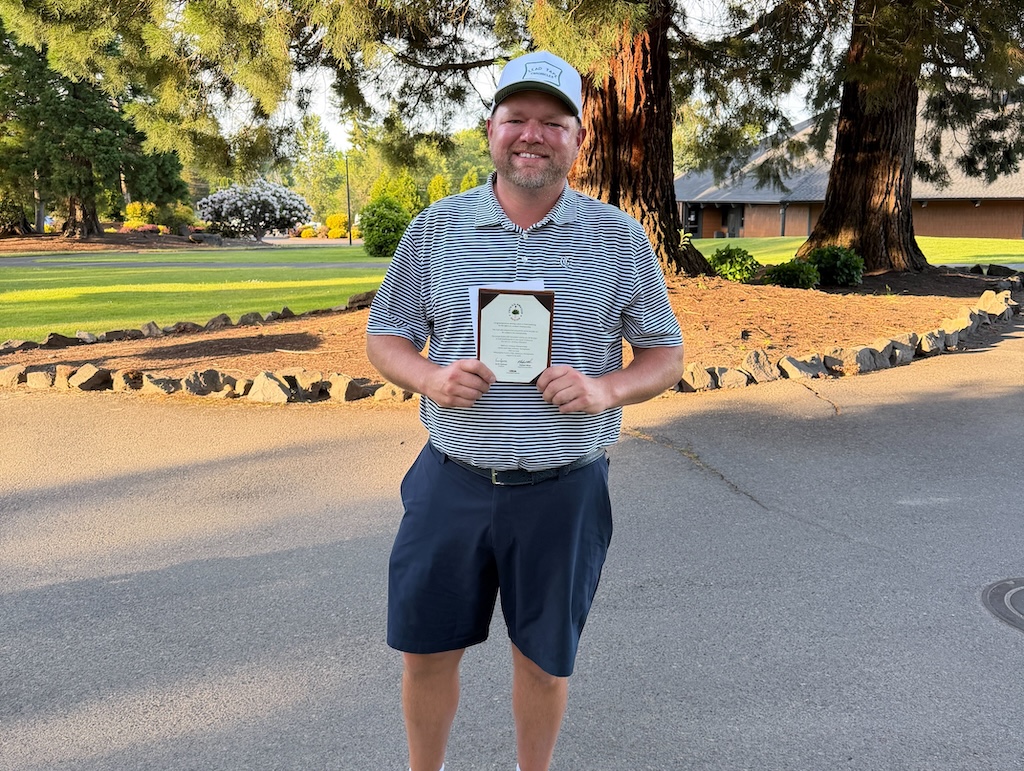
This past Monday, I played in the U.S. Amateur local qualifier at Rock Creek Country Club in Portland, Oregon. A full tee sheet from 7:30 a.m. to 1:55 p.m., the top 11 scores would make it to the U.S. Amateur final qualifying.
I teed off at 10:48 a.m.. With the 7:30 am tee time, you can get a feel for the leaders’ pace, and they were off and running on the challenging setup at Rock Creek.
View this post on Instagram
Getting to the highlight of the round on the par five 17th, a drive up the left side and 212 yards left to the front hole location. I took out a 5-iron with plans of middle of the green. The ball ended up 8 feet left of the hole, pin high. A slight downhill putt dropped in for an eagle 3 on the 17th. With the cut line looking to be anywhere from -2 to even par. This was the boost I had been waiting for all day.
With making par from the trees on 18, it was time to wait for a potential playoff with a posted score of one under par 71.
Three hours later, it was playoff time. 8 players for 6 spots. I made par on the playoff hole, which was good enough to advance to the U.S. Amateur final qualifying in July. USGA qualifiers sure deliver on all of the emotions in golf!
Club Junkie
Building my 2026 gamer WITB: Ranking the contenders and new putter projects – Club Junkie Podcast

The annual What’s In The Bag build is underway, and on this episode of Club Junkie, Brian breaks down the clubs currently leading the race for a spot in his 2026 gamer setup. From drivers and fairway woods to irons, wedges, and shafts, he ranks the equipment that’s performing best and explains what’s separating the front runners from the rest of the field.
Brian also heads into the workshop to discuss several putter projects currently on the bench. From head options and shaft choices to build ideas and testing plans, he shares what he’s working on and which putters could become serious contenders for the bag this season.
If you’re a gear junkie who loves equipment testing, club building, and the never-ending pursuit of the perfect setup, this episode is for you.
Follow Club Junkie:
Instagram: @clubjunkiepod
TikTok: @clubjunkiepod
Threads: @clubjunkiepod
X: @ClubJunkiePod
Club Junkie
Tour Edge Exotics mini driver review + TaylorMade Spider ZT Max first look – Club Junkie

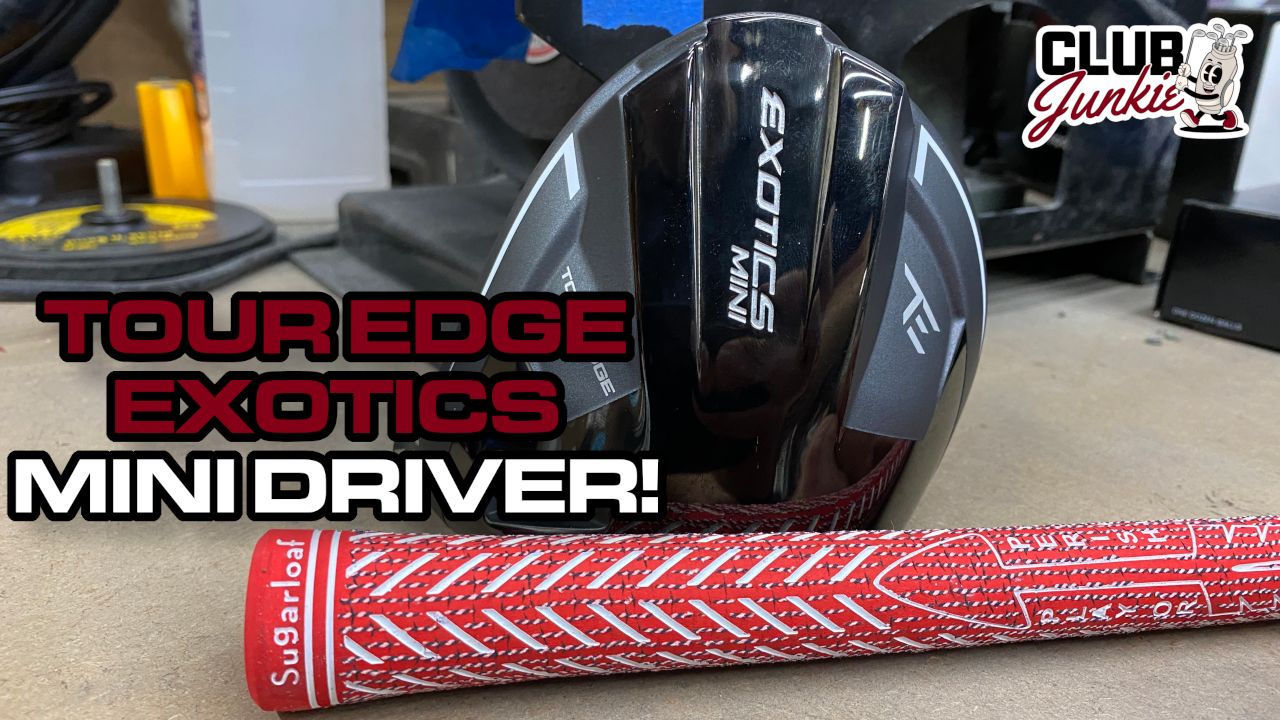
On this episode of Club Junkie, I put the new Tour Edge Exotics Mini Driver to the test and break down the performance, forgiveness, distance, and where it fits compared to a traditional driver or strong fairway wood. If you have been curious about adding a mini driver to the bag, this one is worth a look.
I also dive into the new TaylorMade Spider ZT Max putter that was recently spotted and discuss the growing zero torque putter trend. Plus, there is a closer look at the new Project X Titan Yellow shaft showing up on the PGA Tour and what makes it different from other profiles currently out there.

Justin Rose WITB 2026 (April): Full WITB breakdown with new McLaren irons

What’s the story behind Webb Simpson’s custom-stamped irons?

Memorial Tournament Tour Report: Rory McIlroy, Cameron Young switch up drivers, and more

Cadillac Championship Tour Report: Spieth’s sizable changes, McLaren Golf launches, and more

Russell Henley’s winning WITB: 2026 Charles Schwab Challenge

Kristoffer Reitan’s winning WITB: 2026 Truist Championship

Best irons 2026: Best irons overall, most forgiving irons, and more

J.T. Poston’s winning WITB: 2026 Memorial Tournament

Aaron Rai’s winning WITB: 2026 PGA Championship

Cameron Young’s winning WITB: 2026 Cadillac Championship


Ryan Palmer WITB 2026 (June)
Driver: Callaway Quantum Triple Diamond (9 degrees) Shaft: Project X HZRDUS Smoke Blue RDX 60 TX 3-wood: TaylorMade Qi10 (15 degrees) Shaft:...


Bud Cauley WITB 2026 (June)
Bud Cauley had >14 clubs in his bag when photographed prior to the Memorial Tournament. Driver: Titleist GTS2 (8 degrees) Shaft: Fujikura...


Hannah Green WITB 2026 (June)
Driver: Titleist GTS3 (10 degrees, D4 SureFit setting) Shaft: Mitsubishi Chemical Diamana RB 53 S 3-wood: Titleist GT3 (15 degrees,...


Asterisk Talley WITB 2026 (June)
Driver: TaylorMade Qi4D (9 degrees) Shaft: Fujikura Ventus Blue 6 S 3-wood: TaylorMade Qi4D (16.5 degrees) Shaft: Fujikura Ventus Blue...
-
 Equipment6 days ago
Memorial Tournament Tour Report: Rory McIlroy, Cameron Young switch up drivers, and more
-
 News2 weeks ago
Russell Henley’s winning WITB: 2026 Charles Schwab Challenge
-
 Equipment3 days ago
Best irons 2026: Best irons overall, most forgiving irons, and more
-
 Whats in the Bag4 days ago
J.T. Poston’s winning WITB: 2026 Memorial Tournament
-
 Equipment1 week ago
Details on Jason Day’s latest prototype Avoda iron setup
-
 Equipment3 weeks ago
CJ Cup Byron Nelson Tour Report: Koepka and Kim’s newest putters finally get hot
-

 News2 weeks ago
Charles Schwab Challenge Tour Report: MacIntyre, Åberg and Spaun all switch putters, TaylorMade launches new Spider
-
 Equipment2 weeks ago
Details on J.J. Spaun’s surprise putter switch


Pingback: How Tall Is Harman - Stardom Times
Pingback: Do Tall Golfers Have An Advantage - Pros And Cons Of Being Tall For Golf - (MUST READ Before You Buy)
Duhg
Oct 16, 2017 at 10:26 am
Being taller can be an advantage if you are a very good athlete. If you are a weekend warrior hack, then it probably works against you.
8thehardway
Oct 14, 2017 at 7:24 am
This article only makes sense if the author is 6’5″ and wants to convince his 5’8″ buddies to take fewer strokes.
Jack Nash
Oct 13, 2017 at 8:22 pm
Taller golfers? Like The Golden Bear?
Walt Kihm
Aug 11, 2023 at 2:43 pm
The G Bear is 5’10” & his hands below average in size.
He ran the 100 yard dash in high school & started on the basketball team.
Walt Kihm
Aug 11, 2023 at 3:23 pm
Chi Chi Rodrequez was 5’3″ or 5’4″ & could hit a driver 300 yards with the old persimmon heads. I saw him do on the practice range in St. Louis.
He would hit 1 high draw & then hit a high fade & the 2 balls would crisscross in the air.
Tony Hadley
Oct 13, 2017 at 4:24 pm
Facts don’t care about your feelings Maruman. Try reading “The Bell Curve.” It will help you out.
Marcello
Oct 13, 2017 at 12:49 pm
At 6.6″, this sure makes sense to me.
Does anyone have any references in FL for golf instructors who specifically teach tall golfers?
Peter in Parker
Oct 13, 2017 at 10:53 am
I have noticed that heavier set folks can really drive the ball far. So if you are not tall…..eat eat eat !! Put on those carbs……..
Cheesehead42
Oct 13, 2017 at 10:25 am
I am 6’9″ so I can probably offer a little bit of first-hand experience.
1. Longer levers may allow for more club head speed but in my experience, the longer the club is moving, the more time there is for something to get off track. Imagine someone who is 5’10” swinging a 50″ driver versus myself swinging a 45″ driver. Yes, if everything is timed correctly you can generate some power/speed but you need a swing that is really dialed in to take full advantage of it.
2. It is a pain in the a$$ to get fitted. Getting fitted sounds great as long as what they have in the cart fits you. After a lot of trial and error, I finally got into a set that truly fits me….. +2″ length and +6’5* upright on irons and wedges. There is not a fitting cart in the world with those options.
3. We (tall people) bend over for everything (reaching down to open a door, ducking to walk through a door, bending down to hug your wife, etc) so we want to stand upright as much as possible. This includes with our swing. Coming out of the swing early has been something that I gave up trying to fix and decided to just adapt my swing to it. I play to a 9 now and feel that will go down but it has only gotten better after I decided to adapt a swing to my body rather than trying to emulate what YouTube tells me.
Ardbeggar
Oct 13, 2017 at 8:48 am
I’m convinced! I’m going to start practising getting taller.
larry
Oct 13, 2017 at 8:26 am
terrible read
MB
Oct 13, 2017 at 2:45 am
This needs a good 25-year study and not just some short term earnings based off the Fedex Cup race.
Grizz
Oct 13, 2017 at 2:57 pm
I agree, a much longer study would be better. Nicklaus was what? 5’11” and could drive the ball with old equipment over 300 yards. His short game lacked though, but I think that is because he hit more greens and didn’t need the short game as much and didn’t practice like he should.
I also think the study needs to include arm length and leg power and core strength. I’m 6 ft. But have the arms of the average length of someone 6’3-6’4. With that fulcrum/leverage and very strong and quick core, I’m long off the tee and fairly accurate. But my shorter mid-range 30-80 yards is the worst part of my game. It’s not the lack of practice but I think the long arms have trouble with getting into that rhythm.
Mark
Oct 12, 2017 at 8:21 pm
May I suggest you search for an excellent discussion in the Clubmaking forum on fitting clubs for tall golfers. If you do bother to read this you will realise that your statement ” And yet, realistically, the most an iron can extended is about an inch before it becomes unmanageable.” reveals you to be someone who has limited club fitting experience.
Casey Svejkovsky
Oct 12, 2017 at 4:38 pm
If you look at Phil Mickelson who’s 6’3″, he hits it all over the place and still finds a way to win tournaments. It all comes down to who has the best short game, at the end of the day, not who can hit it the straightest. Coaches now can find away around a disadvantage
Walt Kihm
Aug 11, 2023 at 2:49 pm
You don’t want Phil in the trees; he will pull off a miracle shot. I would want him in the fairway.
Bishop
Oct 12, 2017 at 4:19 pm
I feel height provides no advantage to a player. As a 5’6″ hack, I’m still able to consistently out-drive most of my playing partners, and all of them are taller than me.
A couple of big-hitters who are short: Ben Hogan (who was 5’7″ and 135 pounds) and Rory (who’s also 5’7″).
M. Vegas
Oct 12, 2017 at 4:52 pm
5’6” is probably rounded up a lil…
Not much luck with the cart girls, I’d also bet
Peeny
Oct 13, 2017 at 2:46 am
Who cares if you are taller or shorter!? This game is a game of adversity (for everyone).
This article and these comments just seem to bash based on a physical trait that people have no control over, and has the same framework as racism. C’mon guys – just go out there and have some fun. Don’t worry about what everyone else is doing.
Cornwall1888
Oct 13, 2017 at 11:26 am
Mcilroy is about 5’9″
Bishop
Oct 13, 2017 at 3:05 pm
Thanks for the correction, Cornwall. I had understood that he was shorter, but after researching, you’re definitely right.
M. Vegas
Oct 13, 2017 at 6:50 pm
Yea learn some facts Troyer
Kurt Guldi
Oct 12, 2017 at 2:44 pm
Not a bad article. Though I feel like it is pretty generic. I’m a taller player at 6’3″. However, my arms and legs are short for my height-(72″ arm span, 30″ inseam”). So for example, the section referring to club length….. someone who is 10″ taller will also generally have longer arms which would offset the height difference somewhat. Also, someone like me who is taller but has shorter legs, doesn’t have the same issues with lower body instability as someone who has the typical leg length.
Mat
Oct 12, 2017 at 3:54 pm
Agreed. Let’s do the same calculation by Wingspan:Height ratio.
2putttom
Oct 12, 2017 at 8:47 pm
Kurt your nick name shall be T Rex :~)
Matt
Oct 12, 2017 at 12:39 pm
Gotta love golf. Still to this day the most “egalitarian” sport physically. Which is why golfers are the most talented athletes on Earth. We have basically the entire world population to compete against. Those other sports have about 3% of the population to contend with. The reason is so much force in a golf shot comes from the player’s athletic ability to deliver a large spring into the back of the ball. If coordinated enough a relatively “weak” athlete like Justin Thomas (I am comparing him to what is required to even be on the gridiron or baseball diamond), can leverage a golf club and hit the ball further than those much larger. Its athleticism to use a golf club properly, but the club is a huge equalizer. A baseball bat does not flex much, its basically brute force with all the energy coming purely from the body. Football and basketball have obvious physical limitations, with basketball so ridiculous is almost funny – literally freaks of nature. How many 6’9″ people do you see, you could literally go weeks in a big city and not spot one, not to mention 7′ or something).
Tommy
Oct 12, 2017 at 12:09 pm
I’ve said all this for years. With their short irons, taller players can have trouble even reaching the ball properly. Look at Keegan Bradley, how he’s all bent over and contorted to reach it properly. It’s very tough to fit a taller person with club length…almost impossible for someone with longer legs.
C
Oct 12, 2017 at 2:45 pm
Pretty sure Keegan is properly fit into his clubs. That’s just his stance and swing.
Scott
Oct 13, 2017 at 10:05 am
I will say the difficultly in fitting taller amateur players is the day to day variation in the address position which causes a number of the items discussed in the article. I am about 6′ 1″ or so with a very long wing span. I have difficultly maintaining what I feel is a proper address on a day to day basis. Just something that needs to be worked through
Greg V
Oct 12, 2017 at 11:49 am
In the days of persimmon, it was helpful to be “closer to your work.” Look at players such as Tom Watson, Lanny Wadkins, Ben Crenshaw. Even Jack Nicklaus was only 5′ 10″. Now that 460 cc drivers are the norm, and good lightweight graphite shafts make longer clubs more feasible, golfers up to 6’2″ or 6’3″ are still plenty close to their work.
Bruce Ferguson
Oct 12, 2017 at 1:25 pm
I’m 6’3″. As the the argument of longer limbs giving an advantage, I can’t say. I can say that, in my experience, a big reason I don’t play blade-sized irons is that they look so tiny from my height. If I were 5’9″ or shorter, I might be more confident playing a compact iron head. I might also fit better in some of those sports cars I fancy . . .
Ryan
Oct 12, 2017 at 11:45 am
Average height of an American male is 5’9”. Only Brian Harmon is shorter. Everyone else is average or above… feels like a correlation to me.
C
Oct 12, 2017 at 1:29 pm
Came here to say this.
Dan
Oct 13, 2017 at 1:20 pm
I was going to pint this exact thing out. The average American male is 5’9″ now, and back when I was a kid it was 5’7″, that was when Jack playing so even then he was 3″ above the norm. I think there is no doubt height is an advantage, it’s hard to ignore physics and those extra lever lengths help. Two people of exactly the same intrinsic skill, will perform differently because of the physics involved if they are different in height, or other dimension. Comparing the top golfers with average height shows that most are above average, and if you look at women’s golf this evidence becomes even more profound.