
Opinion & Analysis
Jonas Blixt Case Study: From Back Pain to PGA Tour Win

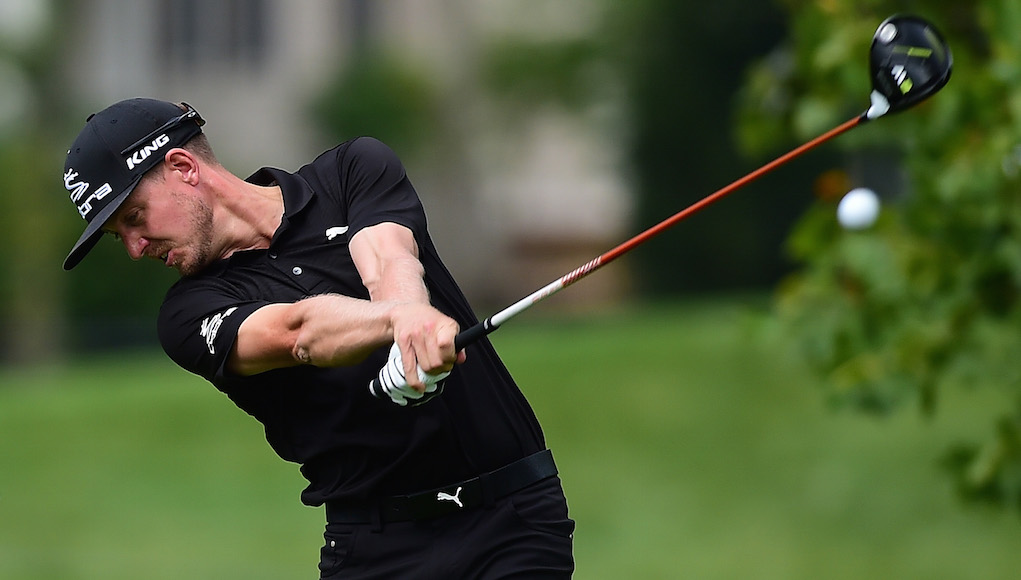
This is a case study on professional golfer Jonas Blixt and his eight-month journey from severe and persistent back pain to a PGA Tour win. It was written to offer insight into the work that a dedicated professional put into his body and his game after a setback due to a significant injury. The case study also serves to highlight the importance of training for posture, spinal strength, and shoulder girdle stability: three areas of training that are often misunderstood and under-appreciated.
The majority of Jonas’ rehab and progression forward was performed using GravityFit exercise techniques and products. GravityFit is an Australian-based company that specializes in a science-based approach to training the body for spinal strength, injury prevention, posture, and golf movement patterns.
Background: Jonas, 32, and is in his sixth season on the PGA Tour. He’s won three times in his career (2012 Frys.com Open, 2013 Greenbrier Classic, 2017 Zurich Classic), and his best finish in a major came in 2012 when he finished T2 at the Masters.
Strengths: Putting, Around the Green. Career-average rank of 33rd in Strokes Gained Putting. Career-average rank of 36th in Strokes Gained Around the Green.
Weaknesses: Off the Tee, Iron Play. Career-average rank of 143rd Strokes Gained Off the Tee. Career-average rank of 158th in Strokes Gained Approach the Green.
Physical Training History: College program at Florida State University. Exposure to various different methods of training stability, mobility, strength, and power since turning professional.
First Contact
Jonas came to see me with after having received two cortisone shots for back pain resulting from herniated discs leading to nerve compression in his lower back. He also received another shot for pain referring into his left glute/hip, suspected at the time to be caused by facet joint inflammation. His desire was initially to return to a pain-free state, and then to improve his long game by hitting more fairways and greens, thereby gaining strokes on the field in the Strokes Gained Off the Tee and Strokes Gained Approach the Green categories. If that outcome could be accompanied by an increase in distance, then that would be a bonus.
After conducting the initial screening and assessment, I highlighted the following areas as priorities for improvement:
- Lumbar and cervical spine posture (lower back and neck).
- Core awareness, stability, and control.
- Arm and body connection movement pattern in rotation.
- Quality of rotation movement pattern from thoracic spine (mid and upper back).
- Mobility in right shoulder (external rotation), thoracic spine (rotation and extension), ankle (dorsi flexion), and quad tightness.
I believed that improving these areas would not only help Jonas move better in his golf swing, but more importantly at that stage, help take strain away from his lower back.
Of particular interest was how Jonas performed in a series of tests for awareness control and stability of the lumbar core (think core muscles and lower back). This seven-stage series of tests is called the Core Body Benchmark. It was developed by GravityFit to provide a more objective measure of core control that could be easily administered in any setting.
Jonas failed the last four tests in the series:
- Hinge Forward
- Hinge Forward with Rotation
- Single Leg Hinge Forward
- Single Leg Rotation
Despite a history of core training, Jonas was unable to use his core muscles effectively in the movements that he repeated up to a thousand times per week: hinging forward, balancing, and rotating (the key components of the golf swing). Click through for more info on the Core Body Benchmark testing protocol.
Initial Program: These assessment findings, combined with the recent back injury, immediately lead me to write Jonas’ first program using predominantly GravityFit tools and techniques, which are specifically designed for strengthening the spine and improving posture. Luckily, we had a few weeks before the first tournament of the 2017 season, so it was time to go work. Below is a snapshot of the initial program, including a few photos of Jonas and myself demonstrating the exercises.
Program 1
A very basic daily program that focused on establishing good posture, as well as training basic spinal stability and quality of rotation. This program also included a 20-minute walk in the soft sand (Jonas lives near the beach) and a range of self-massage and stretching exercises. The exercises are below and were performed using the Gravity Cap and GravityFit TPro.
Movement Patterns
- 1A: Gravity Cap Walk
- 1B: Gravity Cap Knee Lifts
- 1C: Stomp and Pulse
- 1D: Split-Stance Backswing
- 1E: Split-Stance Follow Through
Conditioning
- 1: Beach Walk
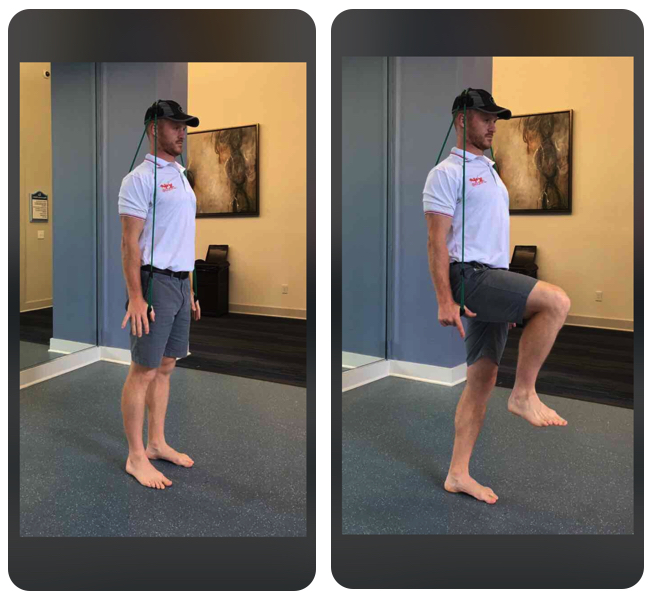
Figure 1
Gravity Cap Knee Lifts (Figure 1): This exercise establishes a solid upright posture, stretching tall against the resistance provided by the Gravity Cap.
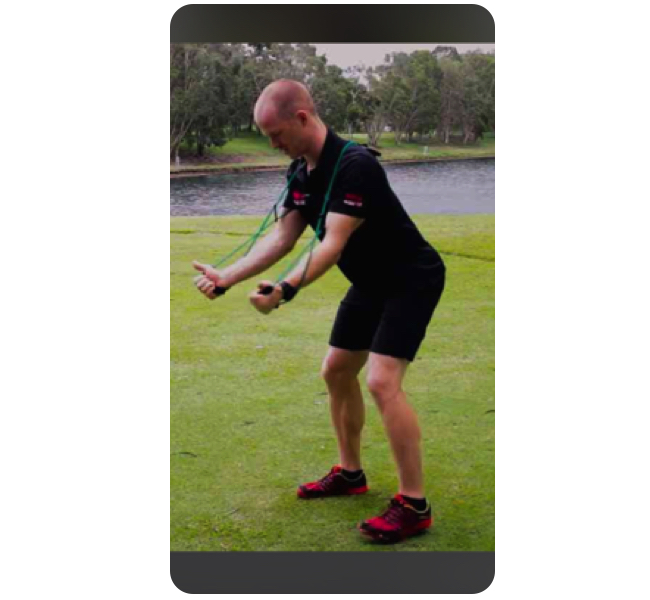
Figure 2
Stomp and Pulse (Figure 2): Here I’m training golf posture using the TPro for postural feedback and scapula/shoulder stability and control.
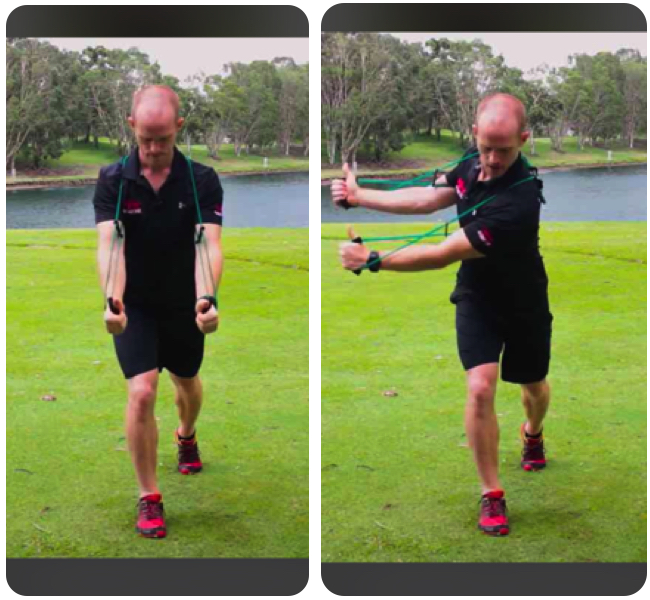
Figure 3
Split-Stance Backswing (Figure 3): Training dynamic rotation using the TPro while working on balance and control with the split stance.
Program 2
After two weeks of the initial program, we progressed into more traditional exercises (squat, lunge, push, pull) with the addition of the GravityFit TPro and Core Awareness Belt (CAB) to give audio and kinaesthetic feedback on quality of movement and postural control. We also advanced the specific posture and rotation exercises to add some more complexity and challenge. As you can see in the video below, at this stage even a simple bodyweight squat was a challenge for Jonas.
Strength
- 1A: Body-Weight Squat
- 1B: Push Up
- 1C: BW Backward Lunge
- 1D: Cable 1-Arm Row
- 1E: Mini Mountain Climber
- 1F: Pallof Press
Movement Patterns
- 1A: Gravity Cap Hurdle Walk
- 1B: Split-Squat Rotate
- 1C: Jonas Backswing Drill
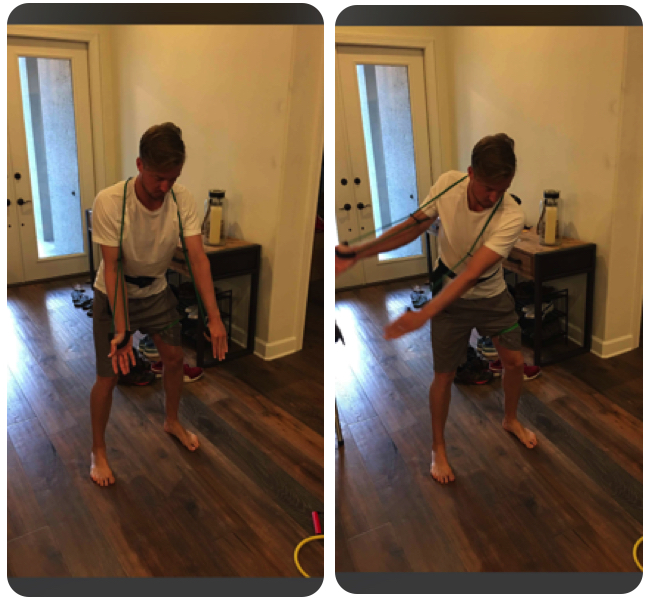
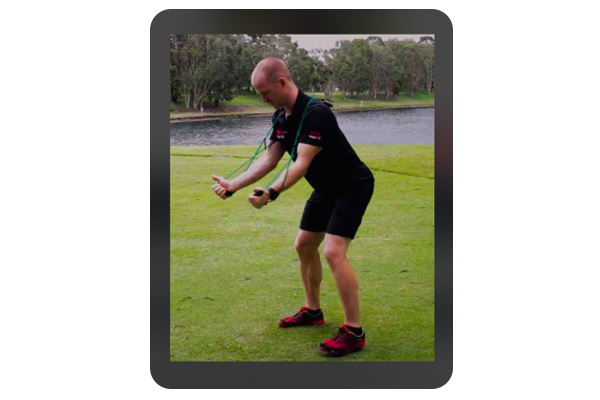
Figure 4
Jonas Backswing Drill (Figure 4): Jonas is using the TPro and the Core Awareness Belt (CAB). Notice the hand position: right palm up, left palm down. This was a custom feel for Jonas that he wanted to train in his backswing.
Video 1
Body-Weight Squat (Video 1): Jonas initially struggled to squat while maintaining his posture. A combination of ankle mobility restriction and lack of core control made it very difficult for him.
About 5 weeks after our initial session, the fall series events came around Jonas decided to play. We continued to gradually increase the complexity of the exercises, each program requiring a little more from the perspective of stability and postural control. The majority was still only using bodyweight and some light band resistance.
Programs 3 and 4
At this point, Jonas was really starting to improve his movement quality and balance.
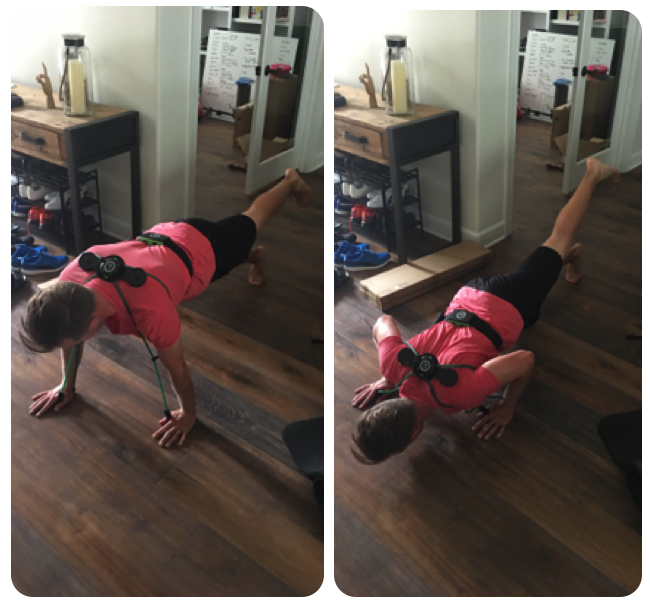
Figure 5
Split-Hand, One-Foot Push Up (Figure 5): An advanced version of a push up, again using the TPro and CAB to provide feedback on the quality of posture and movement. This is a fairly typical example of advancing an exercise’s difficulty without adding external load.
Program 3
Strength
- 1A: Overhead Squat
- 1B: Split-Hand, One-Foot Push Up
- 1C: Lateral Lunge with Knee Lift
- 1D: Single-Arm, Split-Stance Pulldown
- 1E: Prone Turn Under
- 1F: Split-Stance Pallof Press
- 1G: Lying Glute Bridge, Foot Up
Movement Patterns
- 1A: Gravity Cap Hurdle Walk
- 1B: Jonas Backswing Drill
- 1C: Follow Through
Program 4
Stability
- 1A: Knee Band Crab Walks
- 1B: Crawling
Strength
- 1A: Goblet Squat
- 1B: Resistance Band Push Up
- 2A: Bulgarian Split Squat
- 2B: Cable 1-Arm Row
- 3A: 1-Leg Band Push Out
- 3B: Pallof Hold
Video 2
Lateral Lunge with Knee Lift (Video 2): This exercise is really quite challenging to perform with balance and control while avoiding the audio feedback that the CAB provides when the core isn’t working properly.
Video 3
Single-Arm, Split-Stance Pulldown (Video 3): Again, a variation on a simple exercise with the aim of introducing a balance and co-ordination challenge.
Return to Playing
Jonas’ transition back to golf wasn’t exactly smooth. Despite showing significant signs of improvements in his movement quality and overall back pain, he was still struggling with occasional flashes of pain into his left glute during play and when getting up and down from a low, seated position. His results and Strokes Gained statistics tell the story of on-course performance.
- Results: Four events, three missed cuts and a T48
- Strokes Gained Off The Tee: -1.441
- Strokes Gained Approach the Green: -0.464
Over the six-week Christmas break, it was decided that a complete rest from golf was a good idea. This would allow Jonas’ back more time to heal and also offered him the opportunity to receive some treatment and advice for the occasional flashes of pain that seemed to be hanging around. Dr. Craig Davies and the Swedish Spine Institute had very effective input into helping resolve the issue, which was eventually identified as a glute med/min tendonitis. Meanwhile, we continued to progress the difficulty of the training programs and added some more significant load.
Program 5
We moved into more traditional strength movements and methods of loading. These were all done still using the GravityFit equipment to provide postural feedback.
Stability
- 1A: Fall to Wall – 2 Arms
- 1B: Single Arm Turn Under
Strength
- 1A: BB Front Squat
- 1B: DB Bent Over Row
- 2A: DB Step Up
- 2B: Torsonator Shoulder Press
- 3A: Suspended Leg Lift – Bent Knee
- 3B: Prone Hold 2 Limb Switch
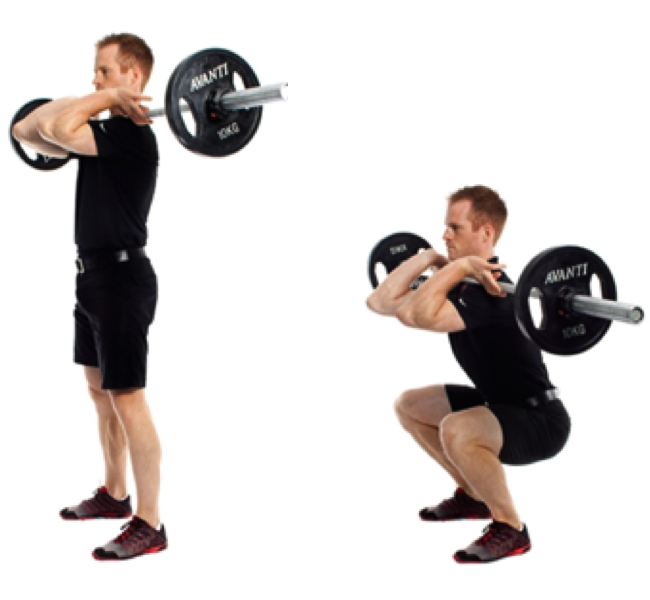
Figure 6
Barbell Front Squat (Figure 6): This is a classic strength exercise that requires excellent squat mechanics and postural control to be performed safely.
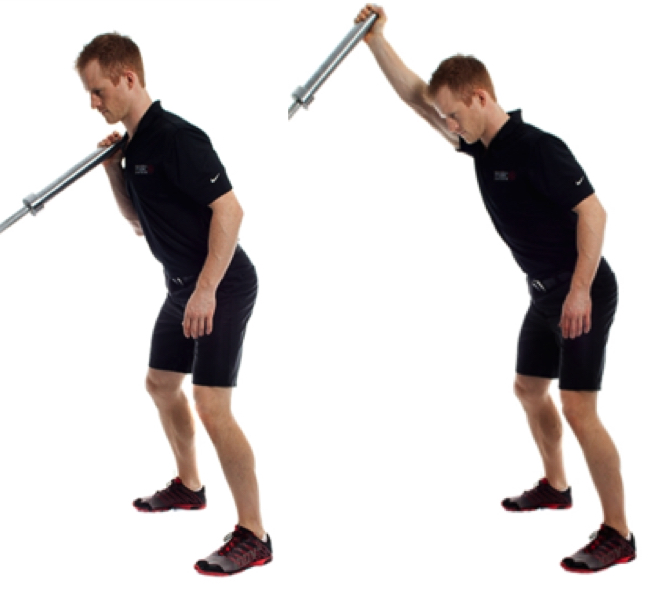
Figure 7
Torsonator Shoulder Press (Figure 7): Using a uni-lateral (one-sided) external loading technique requires more from the core and postural stabilizers. It was a big step forward when Jonas was able to comfortably perform these exercises.
2017
With the New Year came a return to practice and first start in the Sony Open. All traces of pain by this time had been eliminated, and Jonas’ elusive long game seemed to be showing significant signs improvement through his first few events of the year.
- Strokes Gained Approach Green: -0.217 (his career average was -0.44)
- Strokes Gained Off the Tee: +0.242 (his career average was -0.24)
- Club Head Speed: Increased to 112.5 mph from (108.5 mph at first event of 2017 fall season)
Building to a Win
As we moved forward into the spring tournaments, I progressed Jonas on to much more traditional strength-and-conditioning training sessions while still using the GravityFit equipment to provide feedback on posture and technique. We also continued to retain the daily exercises that focus on postural control with spinal strength and stability.
Program 6
Strength
- 1: Barbell Squat to Box
- 2: Dumbell Reverse Lunge
- 3: Barbell Hip Thrust
- 4A: Underhand Pull Up
- 4B: Plate-Weighted Push Up
- 4C: Dumbell High Row
Core
- 1A: V Sit
- 1B: Split-Stance Pallof Press
- 1C: Back Hyperextensions – Arms Up
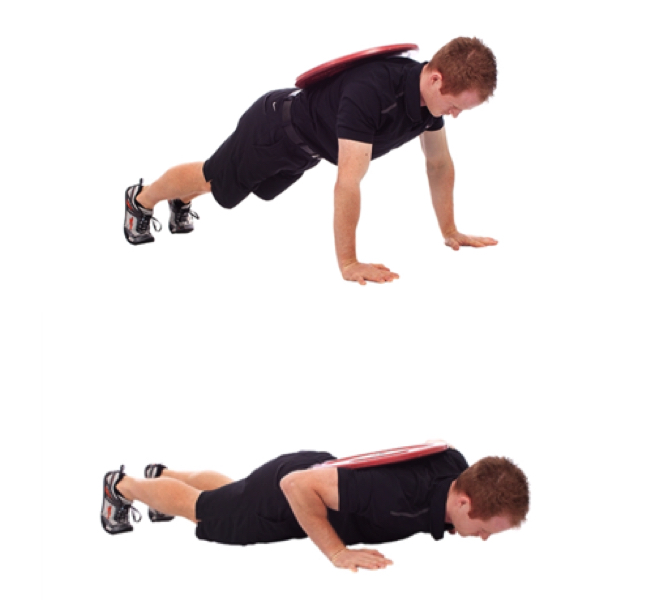
Figure 8
Plate-Weighted Push Up (Figure 8): We moved to standard variations of exercises like this and adding more external load with the aim of eliciting a strength and muscle growth response (as opposed to stability before).
Video 4
Barbell Squat to Box (Video 4): We used the box to avoid the lower-back strain that is most acute at the bottom of a squat. This is a natural progression toward full squats.
Jonas should be applauded for his tenacity, conviction, and work ethic during this tough time. He has used a potentially career-threatening injury as an opportunity to improve his body to new levels. He’s also become more resistant to injury using the GravityFit techniques and equipment to develop superior postural awareness and control, plus strength and stability around his spine, shoulders, and hips. These improvements, combined with better rotational movement patterns, have improved his body for golf and seem to be having a positive transfer to his ball striking.
This all went along way to helping Jonas collect his third PGA Tour win at the Zurich Classic of New Orleans with partner Cameron Smith. Cameron is also a client of mine, and he has been using GravityFit equipment and techniques for years to train his posture and movement patterns.
For more information on the GravityFit exercise tools and techniques I used with Jonas, as well as Cameron Smith, click through to GravityFit’s website. For more information on my online training, service check out my Golf Fit Pro website.



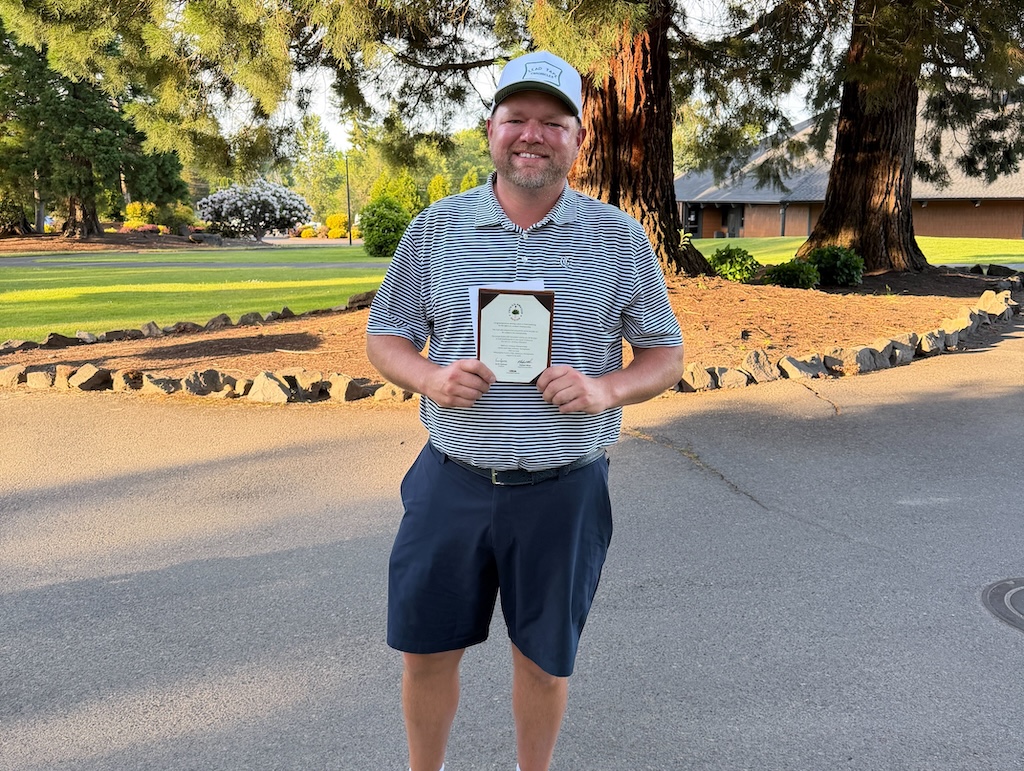
This past Monday, I played in the U.S. Amateur local qualifier at Rock Creek Country Club in Portland, Oregon. A full tee sheet from 7:30 a.m. to 1:55 p.m., the top 11 scores would make it to the U.S. Amateur final qualifying.
I teed off at 10:48 a.m.. With the 7:30 am tee time, you can get a feel for the leaders’ pace, and they were off and running on the challenging setup at Rock Creek.
View this post on Instagram
Getting to the highlight of the round on the par five 17th, a drive up the left side and 212 yards left to the front hole location. I took out a 5-iron with plans of middle of the green. The ball ended up 8 feet left of the hole, pin high. A slight downhill putt dropped in for an eagle 3 on the 17th. With the cut line looking to be anywhere from -2 to even par. This was the boost I had been waiting for all day.
With making par from the trees on 18, it was time to wait for a potential playoff with a posted score of one under par 71.
Three hours later, it was playoff time. 8 players for 6 spots. I made par on the playoff hole, which was good enough to advance to the U.S. Amateur final qualifying in July. USGA qualifiers sure deliver on all of the emotions in golf!
Club Junkie
Building my 2026 gamer WITB: Ranking the contenders and new putter projects – Club Junkie Podcast

The annual What’s In The Bag build is underway, and on this episode of Club Junkie, Brian breaks down the clubs currently leading the race for a spot in his 2026 gamer setup. From drivers and fairway woods to irons, wedges, and shafts, he ranks the equipment that’s performing best and explains what’s separating the front runners from the rest of the field.
Brian also heads into the workshop to discuss several putter projects currently on the bench. From head options and shaft choices to build ideas and testing plans, he shares what he’s working on and which putters could become serious contenders for the bag this season.
If you’re a gear junkie who loves equipment testing, club building, and the never-ending pursuit of the perfect setup, this episode is for you.
Follow Club Junkie:
Instagram: @clubjunkiepod
TikTok: @clubjunkiepod
Threads: @clubjunkiepod
X: @ClubJunkiePod
Club Junkie
Tour Edge Exotics mini driver review + TaylorMade Spider ZT Max first look – Club Junkie

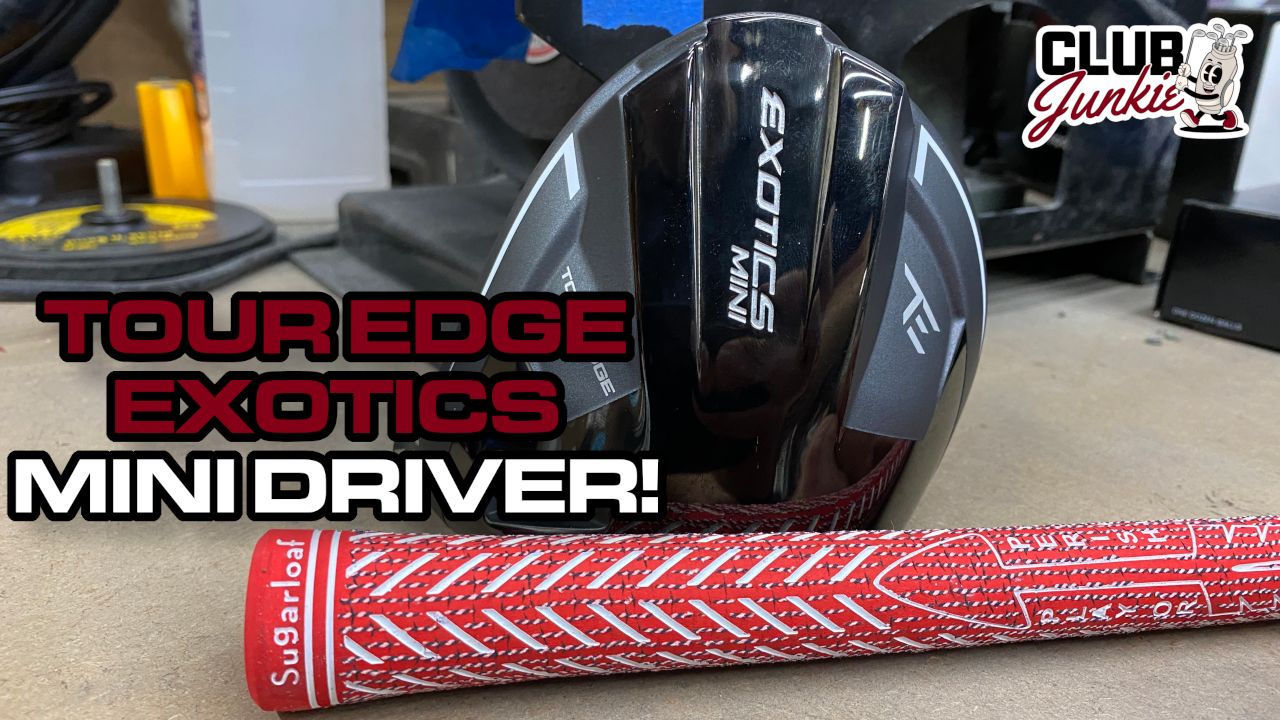
On this episode of Club Junkie, I put the new Tour Edge Exotics Mini Driver to the test and break down the performance, forgiveness, distance, and where it fits compared to a traditional driver or strong fairway wood. If you have been curious about adding a mini driver to the bag, this one is worth a look.
I also dive into the new TaylorMade Spider ZT Max putter that was recently spotted and discuss the growing zero torque putter trend. Plus, there is a closer look at the new Project X Titan Yellow shaft showing up on the PGA Tour and what makes it different from other profiles currently out there.

Justin Rose WITB 2026 (April): Full WITB breakdown with new McLaren irons

What’s the story behind Webb Simpson’s custom-stamped irons?

Memorial Tournament Tour Report: Rory McIlroy, Cameron Young switch up drivers, and more

Cadillac Championship Tour Report: Spieth’s sizable changes, McLaren Golf launches, and more

Russell Henley’s winning WITB: 2026 Charles Schwab Challenge

Kristoffer Reitan’s winning WITB: 2026 Truist Championship

Aaron Rai’s winning WITB: 2026 PGA Championship

J.T. Poston’s winning WITB: 2026 Memorial Tournament

Best irons 2026: Best irons overall, most forgiving irons, and more

Cameron Young’s winning WITB: 2026 Cadillac Championship


Bud Cauley WITB 2026 (June)
Bud Cauley had >14 clubs in his bag when photographed prior to the Memorial Tournament. Driver: Titleist GTS2 (8 degrees) Shaft: Fujikura...


Hannah Green WITB 2026 (June)
Driver: Titleist GTS3 (10 degrees, D4 SureFit setting) Shaft: Mitsubishi Chemical Diamana RB 53 S 3-wood: Titleist GT3 (15 degrees,...


Asterisk Talley WITB 2026 (June)
Driver: TaylorMade Qi4D (9 degrees) Shaft: Fujikura Ventus Blue 6 S 3-wood: TaylorMade Qi4D (16.5 degrees) Shaft: Fujikura Ventus Blue...

Brianna Do WITB 2026 (June)
Driver: Callaway Quantum Triple Diamond (9 degrees) Shaft: KBS PGW 3-wood: Callaway Elyte Titanium (15 degrees) Shaft: KBS PGW 5-wood:...
-
 Equipment6 days ago
Memorial Tournament Tour Report: Rory McIlroy, Cameron Young switch up drivers, and more
-
 News1 week ago
Russell Henley’s winning WITB: 2026 Charles Schwab Challenge
-
 Whats in the Bag3 days ago
J.T. Poston’s winning WITB: 2026 Memorial Tournament
-
 Equipment3 days ago
Best irons 2026: Best irons overall, most forgiving irons, and more
-

 Equipment1 week ago
Details on Jason Day’s latest prototype Avoda iron setup
-

 Equipment3 weeks ago
CJ Cup Byron Nelson Tour Report: Koepka and Kim’s newest putters finally get hot
-

 News2 weeks ago
Charles Schwab Challenge Tour Report: MacIntyre, Åberg and Spaun all switch putters, TaylorMade launches new Spider
-

 Equipment2 weeks ago
Details on J.J. Spaun’s surprise putter switch


rosey
Aug 30, 2017 at 7:25 pm
great article!
And in case anyone cares, I’d definitely buy the “swing kit” off gravityfit if were half price. But $111 is crazy expensive!
Gnam
Aug 30, 2017 at 12:22 pm
Was Tiger right about his glutes not activating? 🙂
EngineerBob
Aug 30, 2017 at 3:40 pm
Vertically or horizontally? Now that he’s on all those prescription and recreational drugs he must be totally limpid …. if you know what I mean.
BH
Aug 30, 2017 at 8:54 am
Overall, this is an informative article. I appreciate this because I am someone who has back pain and is constantly working to make sure I keep it in control.
What I don’t appreciate is that the article implies that using GravityFit is THE way to do all of this. I incorporate most of these exercises into my workouts even without your product. So it’s frustrating for me to read this and get the impression that he had to use this product to get back to game shape. Any good fitness instructor could have worked with him and got him back all without that product.
Scott
Aug 30, 2017 at 8:26 am
Yes, proper rest after hitting a thousand balls is overlooked, especially by the young. There are always exceptions to the rule, but most will not escape the inevitable physical breakdown
Oppai
Aug 30, 2017 at 1:55 am
Geez, with all these exercises he had to do get fit and pain free, you would have thought he was a lazy fat slob of a weekend warrior trying to cut it on tour. Unbelievable that a player has to do all this just to stay with it on tour now.
Chris
Aug 30, 2017 at 7:46 am
It’s only in this particular case. Not every tour player need to go through all this.
SH
Aug 29, 2017 at 3:04 pm
Great article.. we hear that these guys train, but rarely get a glimpse into their regiment. Very cool!
Brad
Aug 29, 2017 at 3:36 pm
Visualize the training regimen and you too will be great in your mind.
SH
Aug 29, 2017 at 4:07 pm
I don’t think being great in our mind is an issue for any of us
Brad M.
Aug 29, 2017 at 1:57 pm
I’ve been a fan of bodyweight work for a long time. Adding resistance bands and the occasional extra load of weight (like in the standard pushup) is great after strength/stamina and fixing general fitness deficiencies have been accomplished. For the non-pro who may play/practice 2-10 times a month, are free weights and intensive weight training advised? Especially if we can’t afford (or simply won’t use) an expert for ongoing technical assistance?
Brad
Aug 29, 2017 at 3:34 pm
The average recreational play will never make a commitment to conditioning and training because they ‘don’t have the time’. They simply play for fun with their equally decrepit buddies and yukking their way painfully slowly down the course.
Of course a new set of SGI clubs ($1395), latest driver and fairways ($795) and a studio putter ($395) should make a significant improvement in their game. Oh, and ProV1s($50) for total tour quality WITB weapons. It’s a shame the clubs will get scratched up.
Instructors. trainers? Forget it, better to buy a rangefinder and great shoes and nifty clothes.
Boss
Aug 29, 2017 at 10:56 am
So, what you’re saying is, he wasn’t very fit before. LOL
Now he’s a bit more fitter, stronger.
But why not also change his swing and have him lift his left heel and swing with a more classic swing and let go of the finish and not strike a pose with feet down and torque twist that caused his problem like all modern swingers with the same problem?
Brad
Aug 29, 2017 at 10:53 am
Pro golfers injure their spine because they practice in an insane obsessive-compulsive manner. It’s all due to overuse, overstress and breakdown injury which is not given enough time to heal. IOW, they are oblivious to their injurious mental state and just continue on a downward spiral. These guys just fail and fade away. Blixt is an exception, but his chronic injury will haunt him forever.