
Opinion & Analysis
A Modern Blueprint to Breaking 80


Background
When I was lucky enough to join a golf club many years ago, my No. 1 goal was to become a real 5-handicap. But first, I had to figure out how to break 90 on my new difficult golf course. I played on weekends and 9-holes after work without seeing improvement. I took one lesson from the pro, who laughed at my list of ambitious goals. His response was, “OK, but how about we start with letting me see you hit a 5-iron.” His prescription was a minor grip change and much more practice time on the range.
In my second month of membership, I signed up for my first event: a one-day member-guest with my 70-year-old, 36-handicap father who had introduced me to golf when I was seven. We played nine holes every Saturday at a public course in Washington, DC, that had no hazards and no sand traps – just nine tees, nine circular greens and one gigantic fairway. When I was 12, “real sports” took over and I dropped golf and my dad.
Anyway, here we were at my great new club getting ready to play in our first event together. My dad, a lofty 36, and me, a shiny new 14-handicap. I was nervous for myself, but I was much more nervous for my Dad. How he would enjoy — or NOT enjoy — the long, difficult test of golf. I was so nervous, I guess, that I started to hit shanks on the practice tee… and I couldn’t figure out how to stop them. Finally, it was time to head to the tee for the shotgun start. To my horror, we were starting on the most difficult par-3 on the course. It was 165 yards over WATER and we were paired with two fairly good golfers that I didn’t know.
“Go ahead,” one of them said. “Lead us off!”
Not wanting to expose my dad to the extreme pressure of going first, I took the tee. I somehow summoned my inner pride and made a fairly good swing with my 6 iron. I did NOT s_____, and my tee shot hit the green. I not only broke 90; I shot 78. Dad chimed in on a couple of holes with his two strokes and we won low net. It’s amazing what can happen when one totally forgets score and focuses on the process of selecting and hitting quality shots.
From there, I worked hard on my game and reached my 5-handicap goal and more. It led me to start a business providing a new type of golf statistics and analysis for golfers, now known as Strokes Gained, and you can read about the History of Strokes Gained on my website www.ShotByShot.com.
Want to break 80? Here is my blueprint
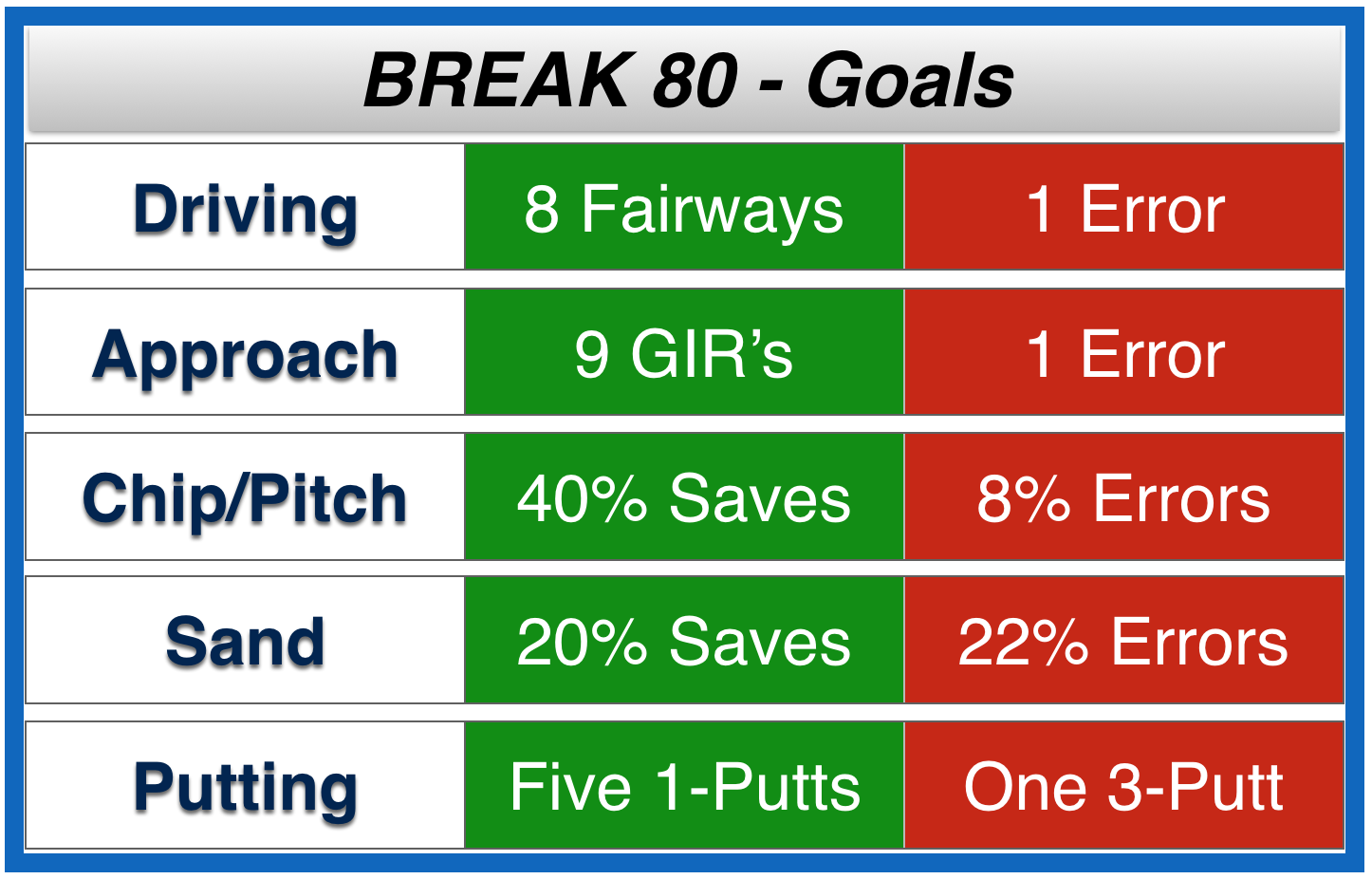
The game of golf is a puzzle and all the pieces fit together. Further, each round is a mix of good shots, average shots and bad shots/errors. The challenge is to determine which piece of your game’s unique puzzle is your greatest weakness in order to target your improvement efforts on the highest impact area. If you track the simple good and bad outcomes listed below for a few rounds, your strengths and weaknesses will become apparent.
Tee Game/Driving

Distance: I’ll ignore this and assume you’re playing from the appropriate tees for your game.
Fairways: Hitting fairways is important, as we are all more accurate from the short grass.
Errors: Far more important than Fairways Hit is the FREQUENCY and SEVERITY of misses. ShotByShot.com users record THREE types of Driving Errors:
- No Shot: You have missed in a place from which you do not have a normal next shot, requiring some sort of advancement to get the ball back to normal play. Preferably, your one error will be of this, less costly, nature.
- Penalty: A one-stroke penalty due to hazard or unplayable lie.
- Lost/OB: Stroke and distance penalty
Approach Shots
 Error = Penalty/Second: This means either a penalty, or a shot hit so poorly that you are left with yet another full approach shot from greater than 50 yards of the hole.
Short Game (shots from within 50 yards of the hole)
If you miss NINE Greens, you will have EIGHT of these greenside save opportunities.
Chip/Pitch shots
 Errors = Shots that miss the green. The fringe does not count as an error
Sand shots
You should have ONE of these greenside save opportunities.

Errors = Shots that miss the green. The fringe does not count as an error
Putting
You need 32 putts.

Good luck, and please let me know if and when you are successful.
Chart
Click to enlarge.




This past Monday, I played in the U.S. Amateur local qualifier at Rock Creek Country Club in Portland, Oregon. A full tee sheet from 7:30 a.m. to 1:55 p.m., the top 11 scores would make it to the U.S. Amateur final qualifying.
I teed off at 10:48 a.m.. With the 7:30 am tee time, you can get a feel for the leaders’ pace, and they were off and running on the challenging setup at Rock Creek.
View this post on Instagram
Getting to the highlight of the round on the par five 17th, a drive up the left side and 212 yards left to the front hole location. I took out a 5-iron with plans of middle of the green. The ball ended up 8 feet left of the hole, pin high. A slight downhill putt dropped in for an eagle 3 on the 17th. With the cut line looking to be anywhere from -2 to even par. This was the boost I had been waiting for all day.
With making par from the trees on 18, it was time to wait for a potential playoff with a posted score of one under par 71.
Three hours later, it was playoff time. 8 players for 6 spots. I made par on the playoff hole, which was good enough to advance to the U.S. Amateur final qualifying in July. USGA qualifiers sure deliver on all of the emotions in golf!
Club Junkie
Building my 2026 gamer WITB: Ranking the contenders and new putter projects – Club Junkie Podcast

The annual What’s In The Bag build is underway, and on this episode of Club Junkie, Brian breaks down the clubs currently leading the race for a spot in his 2026 gamer setup. From drivers and fairway woods to irons, wedges, and shafts, he ranks the equipment that’s performing best and explains what’s separating the front runners from the rest of the field.
Brian also heads into the workshop to discuss several putter projects currently on the bench. From head options and shaft choices to build ideas and testing plans, he shares what he’s working on and which putters could become serious contenders for the bag this season.
If you’re a gear junkie who loves equipment testing, club building, and the never-ending pursuit of the perfect setup, this episode is for you.
Follow Club Junkie:
Instagram: @clubjunkiepod
TikTok: @clubjunkiepod
Threads: @clubjunkiepod
X: @ClubJunkiePod
Club Junkie
Tour Edge Exotics mini driver review + TaylorMade Spider ZT Max first look – Club Junkie

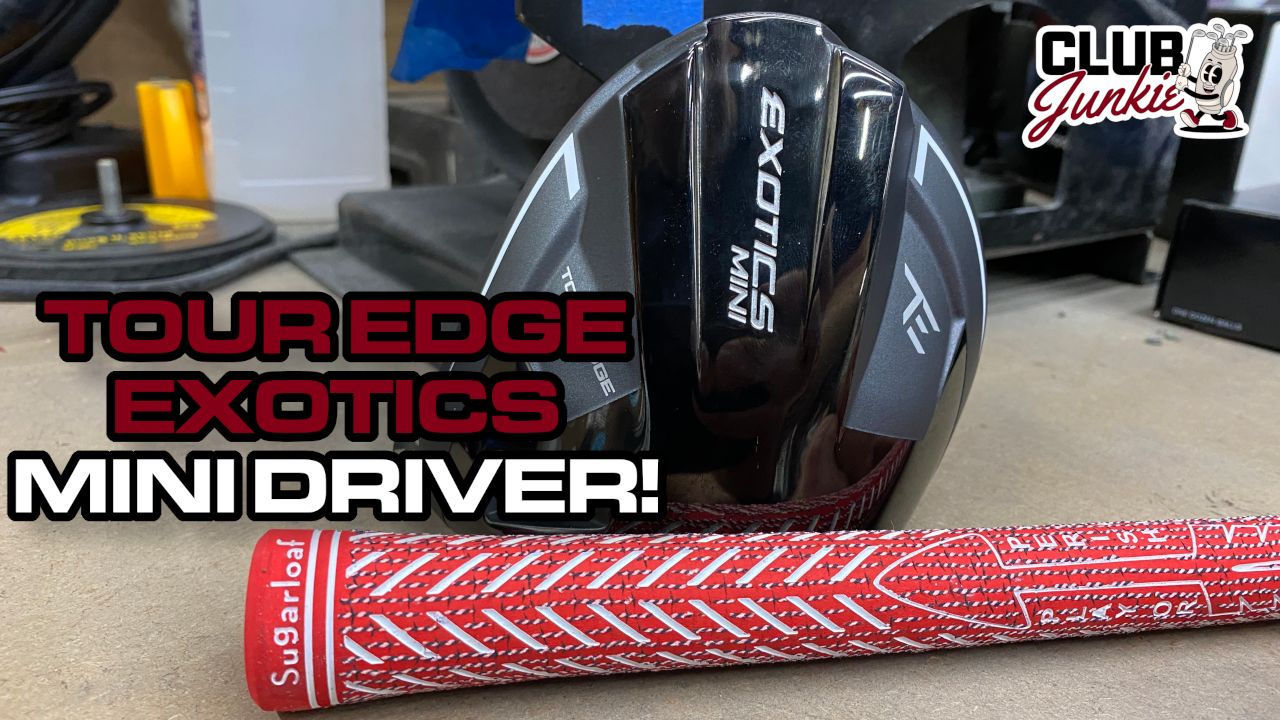
On this episode of Club Junkie, I put the new Tour Edge Exotics Mini Driver to the test and break down the performance, forgiveness, distance, and where it fits compared to a traditional driver or strong fairway wood. If you have been curious about adding a mini driver to the bag, this one is worth a look.
I also dive into the new TaylorMade Spider ZT Max putter that was recently spotted and discuss the growing zero torque putter trend. Plus, there is a closer look at the new Project X Titan Yellow shaft showing up on the PGA Tour and what makes it different from other profiles currently out there.

Justin Rose WITB 2026 (April): Full WITB breakdown with new McLaren irons

What’s the story behind Webb Simpson’s custom-stamped irons?

Memorial Tournament Tour Report: Rory McIlroy, Cameron Young switch up drivers, and more

Cadillac Championship Tour Report: Spieth’s sizable changes, McLaren Golf launches, and more

Russell Henley’s winning WITB: 2026 Charles Schwab Challenge

Kristoffer Reitan’s winning WITB: 2026 Truist Championship

Aaron Rai’s winning WITB: 2026 PGA Championship

J.T. Poston’s winning WITB: 2026 Memorial Tournament

Cameron Young’s winning WITB: 2026 Cadillac Championship

Best irons 2026: Best irons overall, most forgiving irons, and more


Bud Cauley WITB 2026 (June)
Bud Cauley had >14 clubs in his bag when photographed prior to the Memorial Tournament. Driver: Titleist GTS2 (8 degrees) Shaft: Fujikura...


Hannah Green WITB 2026 (June)
Driver: Titleist GTS3 (10 degrees, D4 SureFit setting) Shaft: Mitsubishi Chemical Diamana RB 53 S 3-wood: Titleist GT3 (15 degrees,...


Asterisk Talley WITB 2026 (June)
Driver: TaylorMade Qi4D (9 degrees) Shaft: Fujikura Ventus Blue 6 S 3-wood: TaylorMade Qi4D (16.5 degrees) Shaft: Fujikura Ventus Blue...


Brianna Do WITB 2026 (June)
Driver: Callaway Quantum Triple Diamond (9 degrees) Shaft: KBS PGW 3-wood: Callaway Elyte Titanium (15 degrees) Shaft: KBS PGW 5-wood:...
-
 Equipment6 days ago
Memorial Tournament Tour Report: Rory McIlroy, Cameron Young switch up drivers, and more
-
 News1 week ago
Russell Henley’s winning WITB: 2026 Charles Schwab Challenge
-
 Whats in the Bag3 days ago
J.T. Poston’s winning WITB: 2026 Memorial Tournament
-
 Equipment3 days ago
Best irons 2026: Best irons overall, most forgiving irons, and more
-

 Equipment1 week ago
Details on Jason Day’s latest prototype Avoda iron setup
-
 Equipment3 weeks ago
CJ Cup Byron Nelson Tour Report: Koepka and Kim’s newest putters finally get hot
-

 News2 weeks ago
Charles Schwab Challenge Tour Report: MacIntyre, Åberg and Spaun all switch putters, TaylorMade launches new Spider
-
 Equipment2 weeks ago
Details on J.J. Spaun’s surprise putter switch


EddieEdwards
Aug 2, 2017 at 1:14 am
Most important, you need to keep your drive in play, minimize penalties, and have a shot at the green most of the time. Next you need to hit greens or miss close. If you can do this, it’s unlikely your short game and putting will be that far behind. A couple up and downs, longer putts made, close approaches and you will break 80 and have a good day. On a bad day, penalties, duffs, 3 putts, burning the edges, an errant shot will keep you in the eighties.
I’ve broke 80 several times, par once recently. Hopefully, I don’t have to resort to playing from the womens tees to break 70.
BobInNH
Jun 14, 2017 at 9:32 am
I walk half the time and ride half the time on a very hilly course in the White Mountains of New Hampshire. My scores do not depend on that fact. But, while walking I sometimes shoot my lowest scores because I am totally focused on my game, and not for looking for balls and taking care of the other guy.
golfraven
May 18, 2017 at 8:47 am
Stats are way to go and each serious player should collect their own independent of Hcp. I would be looking at the avarage on the PGA tour. Considering that avarage for GIR is 66%, FIR 61% and scrambling 60% ish, this are the numbers to strive for in the first place to put down a reasonable score. Assuming you don’t 3/4 putt on 50% of the holes you should be in good shape.
If you want to break 80 or Par then my best advise is to take your scorecard hopefully with a course map and set a strategy for each hole how you hit it of the tee (fade, draw or straight) and most importantly the landing spot of the ball on the fairway and green. Start recording where you miss it (also on the green) and this will give you and idea what to work on.
Play your game and shots for instance the hybrid (if what is required) of the tee even if big Joe hits a driver – don’t bother what others play unless those guys are aspiring players and you practice with them.
From the stats you should get a picture of your range, patterns and tendencies and you can adjust your practice and course management accordingly.
Photo
May 18, 2017 at 1:10 am
The more I play and the closer I get to breaking 80, my tee ball has become the difference maker. An OB on the back 9 has been my downfall each time i’ve been close. Distance plus the strokes are killer. Other than driving, 3 putts are a nemesis. Outside 40 feet, the 2 putt % needs to be much higher. Good data!
Dell Man
May 17, 2017 at 5:32 pm
This is great. I started keeping stats when I play almost any round. Fairways, Greens, and Putts. I also putt little tick marks when I get into the sand and circle it when I get up and down. Keeping the stats don’t necessarily make you play better, but they give you a better idea of what is costing you strokes. And if you can figure out what is really costing you strokes based on trends over several rounds, then you can use your likely minimal practice time to focus on those aspects. I struggle hitting full mid-irons shots and it has cost me because I hit 10 or more fairways quite often, but I’m hooking 7/8-irons and wasting the opportunities. So instead of hitting drivers on the range, I have been working hard on mid/short irons. This is a good way to break down your rounds. Good stuff.
larrybud
May 17, 2017 at 3:30 pm
9 GIRS is PLENTY to break 80. I’m a 2 index who averages 55% girs. I just don’t make big numbers.
Even when I was a lousy 40-42% GIRS I shot half my rounds under 80 and was a 4-5 index.
setter02
May 17, 2017 at 1:47 pm
Personally off the tee is the biggest issue. If I’m in the fairway off the tee, I’ll likely have a good day regardless of ball striking and putting (unless a complete outlier day happens) as I know I will avoid big numbers unless something is seriously off. Can’t go wrong with avoiding costly penalties (which likely also hurt you mentally for the rest of the hole) and being in a good position into the green.
Scott
May 18, 2017 at 12:12 pm
Agreed. I have never had a great round if my driving was bad.
Gurn
May 16, 2017 at 5:14 pm
95- (GIR *2) = score
Assuming you putt to a Hula hoop distance… NO 3 putts
So 8 GIR is minimum to break 80, 9-11 is a better goal..
4-5 GIR a side is my goal…
Gurn
Adam
May 16, 2017 at 3:56 pm
This matches up with my experience really well. I got down to a single digit handicap after just a few years of playing. From my second season to my third I dropped from a 16 to a shaky 6, and it was almost entirely due to cleaning up mistakes. My ball striking improved just enough that I largely stopped hitting tee shots into the woods/water, and largely stopped duffing iron shots. I still missed half the greens, but I learned how to miss in places where I had relatively straightforward chips. I don’t think I even made more birdies – I just stopped throwing shots away.
Max
May 16, 2017 at 2:39 pm
Nice blueprint. For me, the GIR is definitely the difference for breaking 80 since I count anything withing 6 feet as a gimme. On a good day 7 GIR can get it done, but the more the merrier.
Also, you forgot the number one tip: Play a par 70 course!
Jack
May 16, 2017 at 11:01 pm
Anything within 6 feet as a gimme? Well that’s one way to lower your score lol. Look up the pro averages from 6 feet.
ROY
May 17, 2017 at 11:02 am
Why not move that magic circle back to 10 feet and shoot for breaking 70?? At 15 feet the course record is in danger!!!
Scott
May 18, 2017 at 12:15 pm
HAHAHAHA. 6 foot gimmes! I love it! You turned your course into a par 60 with that method.
Sh
May 16, 2017 at 2:27 pm
Try doing that on a US Open set up. You’d be hard pressed to break 100 this way.
JC
May 16, 2017 at 4:40 pm
When was the last time any of us played on a US open setup, dweeb.
B
May 16, 2017 at 10:03 pm
That’s the point. That this article doesn’t put handicap and slope to the formula because different courses will require different means to break that same 80.
Jack
May 16, 2017 at 11:02 pm
If you can’t break 100 on a US open setup then you shouldn’t be playing on it expecting to score well. What’s your point? Most of us should pick courses that suit our skill level.
DW
May 17, 2017 at 2:55 am
1000 yard Par 3 9-hole courses, then?
birdie
May 16, 2017 at 2:25 pm
Another example of good shot or bad shot…you’re 120yd out, you cold top your approach and it rolls to front of green?
just seems there is a difference in using the above in tracking scoring and tracking actual ball striking or playing level. are we trying to get to a point we’re tracking the quality of shots or simply the outcomes.
BobInNH
Jun 14, 2017 at 9:38 am
“you’re 120yd out, you cold top your approach and it rolls to front of green?”
We call that a “son-in-law” shot. Meaning that, it was not what you expected, but in the end it turned out pretty good!”
dapadre
May 16, 2017 at 2:24 pm
Love love love this!
My pro who also happens to have played pro sports ( NHL) and became scratch himself within 2 years of taking up golf, uses this philosophy and Ive used it to break 80 several times. His approach, cut the game into little strategical pieces based on GIR. 7-10 GIR almost guarantees me I will break 80. I simply focus on the task at hand, hitting the green, INSTEAD of getting to the hole. I know it sounds absurd, but that mental picture is easier.
birdie
May 16, 2017 at 2:22 pm
my only question is regarding tracking errors in driving. is it only based on the outcome of the shot, or the actual shot. if you slice it into an opposing fairway and have a good look at the green, do you count this as an error even though the outcome is very playable.
PSG
May 16, 2017 at 2:10 pm
This is a great format in terms of how to think about how to break 80. I think it is a very thought-provoking article.
My only issue with it is that it is way way too broad, and ignores that each shot influences the next, so it doesn’t actually show you what you need to work on.
For example, you want five one-putts. But practicing putting isn’t the best way to improve your one-putt percentage or number. The best way to get better at putting (And it isn’t close) is to hit the ball closer to the hole. There is no putter on Earth who is worse from 10 feet than the best PGA Tour putter is from 20. “5 one putts” sounds like a putting statistic, but it isn’t. Its an approach statistic. It should be in the approach box, not the putting box. Avoiding 3 putts should be the only thing in the putting category, because it is the only thing that evaluates solely putting skill.
Similarly, “fairways” is meaningless. I can hit the fairway with a pitching wedge. While this is an extreme example, you will always be less accurate the longer you are (i will miss much further 1* open swinging 110 than 90 – the 90 will be a “fairway” in your system, the 110 won’t).
Its the same thing with “chip/pitch” shots. Whats the best way to get up and down more often? And by “best way” I mean “most efficient way to practice”. Its not to hit pitches and chips until your hands bleed, its to improve your approach shots! If you hit one extra green, you can “get up and down” one more time by two-putting instead of pitching/chipping.
This entire article should simply say “practice your driving and your approach shots” because that’s all that matters until you are around scratch. There is no amount of chipping, pitching or putting practice that will make up for hitting it closer and hitting the green more often. None. Zero.
It is always more efficient to improve your putting, pitching and chipping by improving your approach shots. Practicing putting, chipping and pitching is a horrifically inefficient way to break 80 (and this doesn’t even include missing in the right spots – your article treats all missed greens equally, when this couldn’t be further from the truth – missing in the right spot is just as important to pitching and chipping success as technique).
So, great article concept, just too long – you didn’t need to go past driver and approach. The rest doesn’t matter until you get up around scratch.
Please note I DID NOT SAY pitching, chipping and putting don’t matter. I said that practicing them is way less efficient than practicing your full swing and your full swing controls how difficult your putting, chipping and pitching are on the course. Of course practicing them will “help”, but practicing chipping is silly unless your approach shots are around scratch level – you will automatically be better because you’ll hit more greens and have to chip less.
“A Marine and a Navy man are using the restroom. The Marine leaves without washing his hands. The Navy man says “in the navy, they teach us to wash our hands. The marine says “in the marines, they teach us not to piss on our hands. ” Hitting greens is not pissing on your hands.
“32 putts” is meaningless. If I hit it an inch from the hole on every hole I would get 18 putts!!!!! Best putter in the world!!!!!!! Until a certain very high level, the full swing is all that matters.
Brandon
May 16, 2017 at 3:00 pm
Great comment
Iutodd
May 16, 2017 at 5:02 pm
I disagree that tee shots and approach shots are all that matters until you are around scratch. Nor do I think that practicing putting is an inefficient way to practice if you are trying to break 80.
I’m actively trying to break 80 so I feel like I can comment on this with some meaningfulness. I’ve broken 40 for 9 many times but have never been able to put it together.
Because on a par 72 course – getting to 79 means only giving up seven shots to par. Obviously if I hit every fairway and hit every approach shot to an inch I’d break 80. Then I’d have my girlfriend Jennifer Lawrence pick me up from the course in her Ferrari and fly to Vegas for the weekend. Practicing with that goal in mind just has no basis in reality.
Missing fairways and greens are all part of being a golfer. The best golfers in the world miss fairways and greens all the time so it’s quite likely that I’m going to miss just as many, if not more. So in order to only give up seven shots to par you have to be able to limit mistakes in every aspect of your game. So you need to hit about 8 of 14 fairways. You need to hit about 9 of 18 greens. You need to have around 5 one putts and maybe sneak a birdie in there to make up for the inevitable 3 putt or drive that goes awry. When you miss the green you need to be able to get up and down 3 or 4 times out of 9 or 10 greens missed.
The point he is trying to make – and he says it pretty clearly – is that breaking 80 involves EVERY skill you have. You have to drive the ball cleanly, get onto the green and 2 putt. You only have 7 strokes to give up. Yes limiting mistakes off the tee and on your approach is important…but it’s not any more important than chipping and putting well.
I think if you were trying to break 90 focusing just on tee shots and approach shots would make sense. But if you’re trying to break 80? You gotta make putts and you have to score. That means you have to make putts.
Denny Jones
May 16, 2017 at 9:19 pm
+1
TR1PTIK
May 17, 2017 at 8:53 am
Agreed. The one and only time I’ve managed to break 80 I drove the ball decent (only getting into severe trouble on one hole – damn water!), hit 7 greens, pitched/chipped well, and putted slightly better than average (which is about 1.89 putts/hole). Simply put, it took every aspect of my game working together to achieve that feat. Since then, I haven’t been able to sniff 80 because pitching/chipping has been horrible and I haven’t been hitting enough greens. On the rare occasion pitching/chipping has been good, my driving or putting has slipped. You gotta be able to do it all moderately well and manage the course.
PineStreetGolf
May 17, 2017 at 9:19 am
Read the part of my post that said “PLEASE NOTE”.
I’m not saying putting isn’t important. Of course it is. What I’m saying is that no amount of practice with your putter will make you better at putting than hitting the ball five feet closer to the hole. Its not that “putting doesn’t matter” or “putting practice is stupid” its that “the best way to practice putting is to hit it closer”.
There is no better way to get “good” at putting than to make your putts shorter by being better at irons.
Iutodd
May 17, 2017 at 5:19 pm
I just don’t agree. Billy Horschel is T51 in terms of proximity to hole after his approach shots. He averages almost 36 ft! Number 1 is Chez Reavie at 33′. Alex Noren is last at 43′.
The average 10 handicap golfer is probably, what, 50 feet? What does being 5 feet closer to the hole get me?
I don’t think I’d make significantly more putts from 45 feet than from 50 feet – I don’t think anyone would. I make more 5 footers than 10 footers for sure – but THAT is down to chipping and lag putting – not approach shots or tee shots. That is true for pros as well and the statistics bear that out. Even inside 100 yards the average pro hits it to like 15-20 feet.
Bottom line here: 79 is a great score for me – it’s about 6 shots better than my average round of 85 – so it’s like Rickie Fowler shooting a 62. Rickie can’t ball strike his way to a 62 and I can’t ball strike my way to a 79. Gotta make putts and I have to save strokes in all aspects of my game.
wrxer
May 17, 2017 at 5:01 am
@ psg- players who hit their shots 1 inch from the hole struggle for breaking 50 in stead of 80.
Nevertheless your point is clear.
Leezer
May 17, 2017 at 1:59 pm
Sounds like you’re looking for a real plan. Here’s the article from 2012… the links are dead on this site but you can find them by digging a little. http://www.golf.com/instruction/how-break-80-your-six-week-plan-lifetime-low-scores
iShankEveryArticle
May 16, 2017 at 2:10 pm
Great article. A hack like me needs a blueprint for breaking 90 though…
Radim Pavlicek
May 18, 2017 at 3:49 am
No OOB. Simple as that.
Alex
May 16, 2017 at 12:20 pm
What you just described is looking at every shot in a vacuum. Don’t look at the entire round, don’t think about the hole on the score, focus on the task that is immediately at hand. There is no water, there is no green side bunker, the only thing that should be going through your mind is if you hit that 6 iron the way you should, it will go 170, and the rest will take care of itself. Getting to low single digit handicap is entirely mental. Being able to repeat the right mindset over 18 holes is what makes for good scores.
Gareth Roberts
May 16, 2017 at 11:00 am
Hi Peter,
How would you recommend tweaking those numbers to look at shooting low 70’s? (for context I’ve just been cut to 5 and keen to keep getting lower meaning regular rounds in the low 70’s are necessary)
Thanks,
Gareth
Peter Sanders
May 17, 2017 at 8:36 am
Gareth,
Briefly, GIR’s should go up to 11 or 12 and weed out all the errors and short game saves to 50%.
I hope this helps.
Steve Dodds
May 16, 2017 at 10:28 am
I’ve always based it on GIR. If, using your formula, you have 9 GIR, and get up and down on 40% of the greens you miss, that’s 13 pars. That gives you an 8 shot buffer for the other five holes. So you can have 3 bogeys and two doubles.
First time I broke 80 I had a couple of birdies which made up for the triple I had on the last as I limped over the line.
Peter
May 16, 2017 at 10:42 am
Thanks Steve,
Yes, birdies provide a nice cushion. Bear in mind, those 9 GIR’s are only pars if followed by 2-Putts. Also, the errors sited tend to result in bogeys or worse unless followed by 1-Putts. It is a complicated puzzle.
BobInNH
Jun 14, 2017 at 9:41 am
Seven shot buffer, not eight.