
Opinion & Analysis
The myth of playing to your handicap, and why it’s ruining your expectations

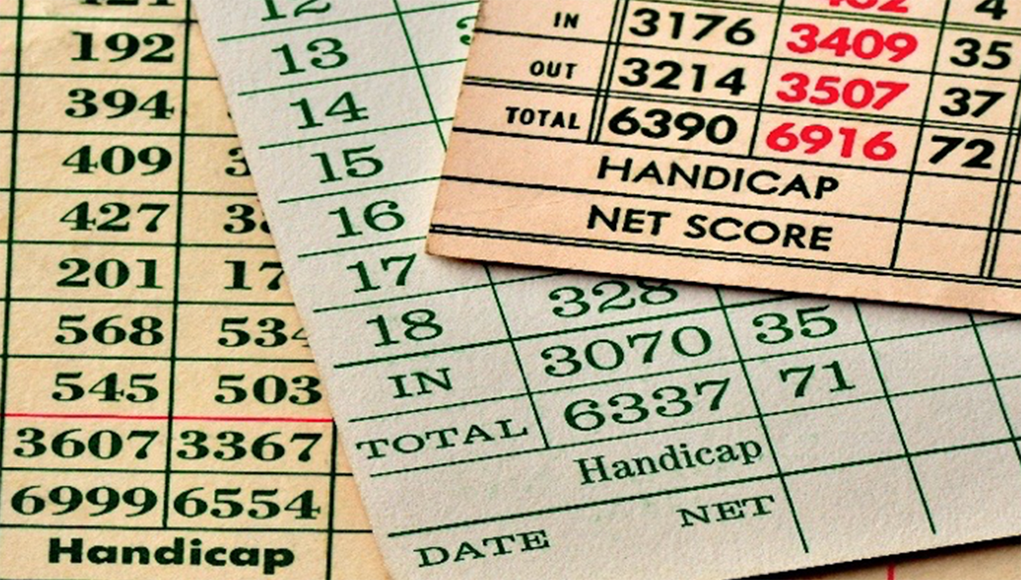
When was the last time you came in from a round of golf, shooting four or five strokes higher than expected, and said, “Huh, that’s fine. Maybe I’ll do better next time.” For most of you reading this article, this rarely (if ever) happens. Why? Because you love golf, you’re competitive, and you expect to shoot a certain score every time out.
For many golfers, that score is defined by their handicap. As a fellow golfer, I can sympathize with lofty expectations, but where we need to look is the basis of your expectations and why typical thinking could lead to regular disappointment in your scoring.
You Are Not Your Handicap
I can’t tell you how many times I’ve heard players say, “I didn’t play to my handicap,” therefore insinuating they had a bad round. What does “playing to your handicap” actually mean, though? Well, if your course handicap is 10, then it means shooting 10 strokes over the course rating.
Take a course that’s a par-70 and has a course rating of 71.0. Playing to your handicap means shooting 81. Pretty simple. Now, keep in mind that the USGA handicap system uses the 10 best scores out of your last 20 to determine your current handicap. Therefore, the scores used to make up your handicap are a picture of your best golf. It does not take into account the times you had one of those days.
Imagine being a salesman and being evaluated on your best six months in the last year. That might be nice, right? But is it a picture of who you truly are as a salesman?
You Are Your Average
With an in-depth look at your score history, you can gain a clearer picture of where your game truly stands. In the real-life example below, I plotted a 10-handicapper’s scores on a course with a rating of 71.0. He had a range of scores from 76 to 90 and an average of 83.85.
This player’s score history is very typical of the majority of regular golfers out there. Most will have a spread of 12-15 strokes (better players usually have an even wider spread) and have roughly two thirds of their scores within 3-5 shots of the average.
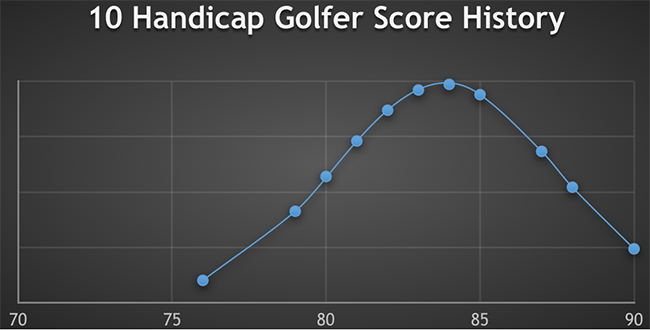
Notice that this player has only played to his handicap five times! He has, however, scored average or better nine times out of the last 20 rounds and a fraction above average (84) three additional times. If his expectation is to play to his handicap or better every time out, he’s going to leave the golf course disappointed 75 percent of the time. With a better understanding of his average score, he’s more likely to accept an 83 or an 85 as it’s a more realistic expectancy of his game at this point in time.
Don’t get me wrong. I’m not suggesting that players shouldn’t intend to play well. Having a clear intention of playing great golf is a fantastic way to begin any round. However, expecting to play our best and not accepting anything less can create a constant sense of frustration and actually keep players from playing to their potential more often.
Dr. Rick Jensen, a sports psychologist who has coached multiple men’s and women’s tour professionals to major championship victories, categorizes this as a “focus of energy problem,” which is often highlighted by unrealistic expectations that lead to anxiety and frustration.
“You can only play better than average half the time,” Dr. Jensen points out, which highlights an important fact. Your average score is the truest picture of your game. Don’t be the player who hides from the facts. Instead, put together a plan to improve.
Be Realistic and Look for Opportunities
An honest look at your scores can lead to an evaluation of why you’re shooting the numbers you are and where you have opportunities to shave off some strokes. Start viewing your average as the number you want to lower instead of your course handicap or handicap index. I recommend using a stat -tracking program, such as ShotbyShot.com, which will prioritize the area(s) where you need to focus in order to improve your average score.
If you choose to track your stats on your own, be sure to consider the following:
- All missed fairways are not the same, as just tracking fairways hit or missed can be misleading. Are you driving it 3 yards into the rough or behind trees and into hazards? If you’re driving it in play, just not always in the fairway, then your driver may not be the problem.
- Hitting greens in regulation is critical to scoring, but not the whole picture. Driving the ball in play should give you opportunities to get the ball on the green, but how close are you hitting it to the hole when you have the chance? If your approach shots are too far from the hole, it will lead to more three putts and higher scores.
- We know that having a good short game is a quick recipe to shooting lower scores, but merely tracking up and downs may not provide enough information. Be sure to keep track of how far you’re chipping and pitching the ball from the hole. Leaving yourself 12 feet every time for par or bogey will not lead to consistent saves. If you’re chipping it to 5 feet and missing the putts, however, then your short putting needs to take priority.
Most of us can agree that players with negative outlooks on their golf game rarely play to their potential. Only evaluating yourself based on your best scores leads to a constant grind to play your very best, which we know is not going to happen every time we tee it up. Make sure to appreciate your best golf, and have a clear intention to play great whenever you play.
Be realistic with where you are as a player, however, and use the numbers as a way to evaluate your improvement over time. Work on the areas of your game that will positively influence your scoring, and enjoy the process. You’re more likely to walk off the course happy… and maybe even with a couple of your friend’s dollars in your pocket.




This past Monday, I played in the U.S. Amateur local qualifier at Rock Creek Country Club in Portland, Oregon. A full tee sheet from 7:30 a.m. to 1:55 p.m., the top 11 scores would make it to the U.S. Amateur final qualifying.
I teed off at 10:48 a.m.. With the 7:30 am tee time, you can get a feel for the leaders’ pace, and they were off and running on the challenging setup at Rock Creek.
View this post on Instagram
Getting to the highlight of the round on the par five 17th, a drive up the left side and 212 yards left to the front hole location. I took out a 5-iron with plans of middle of the green. The ball ended up 8 feet left of the hole, pin high. A slight downhill putt dropped in for an eagle 3 on the 17th. With the cut line looking to be anywhere from -2 to even par. This was the boost I had been waiting for all day.
With making par from the trees on 18, it was time to wait for a potential playoff with a posted score of one under par 71.
Three hours later, it was playoff time. 8 players for 6 spots. I made par on the playoff hole, which was good enough to advance to the U.S. Amateur final qualifying in July. USGA qualifiers sure deliver on all of the emotions in golf!
Club Junkie
Building my 2026 gamer WITB: Ranking the contenders and new putter projects – Club Junkie Podcast

The annual What’s In The Bag build is underway, and on this episode of Club Junkie, Brian breaks down the clubs currently leading the race for a spot in his 2026 gamer setup. From drivers and fairway woods to irons, wedges, and shafts, he ranks the equipment that’s performing best and explains what’s separating the front runners from the rest of the field.
Brian also heads into the workshop to discuss several putter projects currently on the bench. From head options and shaft choices to build ideas and testing plans, he shares what he’s working on and which putters could become serious contenders for the bag this season.
If you’re a gear junkie who loves equipment testing, club building, and the never-ending pursuit of the perfect setup, this episode is for you.
Follow Club Junkie:
Instagram: @clubjunkiepod
TikTok: @clubjunkiepod
Threads: @clubjunkiepod
X: @ClubJunkiePod
Club Junkie
Tour Edge Exotics mini driver review + TaylorMade Spider ZT Max first look – Club Junkie

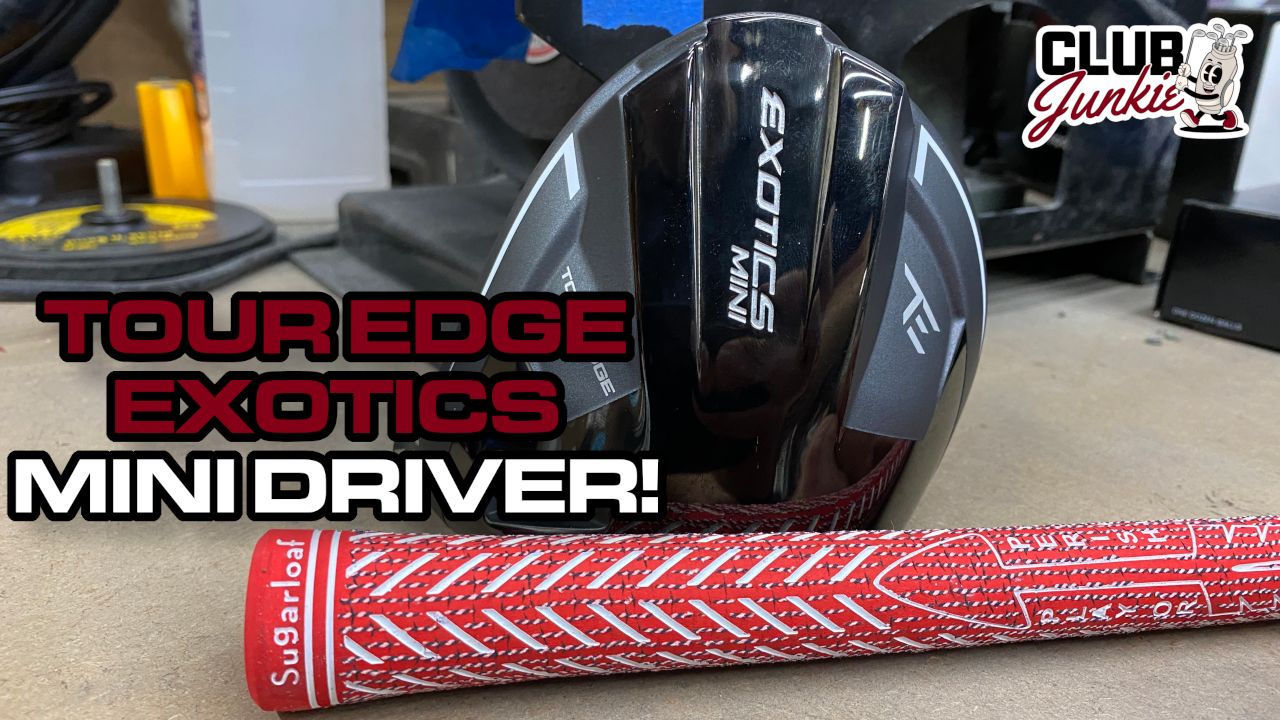
On this episode of Club Junkie, I put the new Tour Edge Exotics Mini Driver to the test and break down the performance, forgiveness, distance, and where it fits compared to a traditional driver or strong fairway wood. If you have been curious about adding a mini driver to the bag, this one is worth a look.
I also dive into the new TaylorMade Spider ZT Max putter that was recently spotted and discuss the growing zero torque putter trend. Plus, there is a closer look at the new Project X Titan Yellow shaft showing up on the PGA Tour and what makes it different from other profiles currently out there.

What’s the story behind Webb Simpson’s custom-stamped irons?

Memorial Tournament Tour Report: Rory McIlroy, Cameron Young switch up drivers, and more

Cadillac Championship Tour Report: Spieth’s sizable changes, McLaren Golf launches, and more

Russell Henley’s winning WITB: 2026 Charles Schwab Challenge

Kristoffer Reitan’s winning WITB: 2026 Truist Championship

Best irons 2026: Best irons overall, most forgiving irons, and more

J.T. Poston’s winning WITB: 2026 Memorial Tournament

Aaron Rai’s winning WITB: 2026 PGA Championship

Cameron Young’s winning WITB: 2026 Cadillac Championship

Details on Jason Day’s latest prototype Avoda iron setup


Christiaan Maas WITB 2026 (June)
Driver: TaylorMade Qi4D LS (8 degrees) Shaft: Fujikura Ventus TR Blue 6 X 3-wood: TaylorMade Qi10 (15 degrees) Shaft: Fujikura Ventus Black...


Ryan Palmer WITB 2026 (June)
Driver: Callaway Quantum Triple Diamond (9 degrees) Shaft: Project X HZRDUS Smoke Blue RDX 60 TX 3-wood: TaylorMade Qi10 (15 degrees) Shaft:...


Bud Cauley WITB 2026 (June)
Bud Cauley had >14 clubs in his bag when photographed prior to the Memorial Tournament. Driver: Titleist GTS2 (8 degrees) Shaft: Fujikura...


Hannah Green WITB 2026 (June)
Driver: Titleist GTS3 (10 degrees, D4 SureFit setting) Shaft: Mitsubishi Chemical Diamana RB 53 S 3-wood: Titleist GT3 (15 degrees,...
-
 Equipment7 days ago
Memorial Tournament Tour Report: Rory McIlroy, Cameron Young switch up drivers, and more
-
 News2 weeks ago
Russell Henley’s winning WITB: 2026 Charles Schwab Challenge
-
 Equipment4 days ago
Best irons 2026: Best irons overall, most forgiving irons, and more
-
 Whats in the Bag4 days ago
J.T. Poston’s winning WITB: 2026 Memorial Tournament
-
 Equipment1 week ago
Details on Jason Day’s latest prototype Avoda iron setup
-

 Equipment3 weeks ago
CJ Cup Byron Nelson Tour Report: Koepka and Kim’s newest putters finally get hot
-

 News2 weeks ago
Charles Schwab Challenge Tour Report: MacIntyre, Åberg and Spaun all switch putters, TaylorMade launches new Spider
-

 Equipment2 weeks ago
Details on J.J. Spaun’s surprise putter switch


Steven
Oct 20, 2016 at 12:11 pm
Great article. This also illustrates many sports psychologists points that focusing on score isn’t what leads to success. Goals should focus more on the process. Count how many times in a round you made the smooth swing you worked on or something like that. Focusing on the process of getting better is what actually leads to success (decreased handicap).
Dean
Oct 27, 2016 at 7:18 pm
Agreed! Process will produce results more often than focusing on score. Focused practice that addresses your needs will help scores come down quicker.
mat
Oct 19, 2016 at 11:00 am
maybe trying to have other expectations than lowering your handicap will make you a ( better, happier) golfer?
Dean
Oct 20, 2016 at 7:21 am
Well, happier would depend on the person but lowering your handicap would mean lower scores and therefore becoming a “better” golfer!
Double Mocha Man
Oct 21, 2016 at 11:41 am
I think it’s time for Smizzle to post his own picture.
BD57
Oct 18, 2016 at 9:28 pm
Truth be told, you “play to your handicap” in the neighborhood of 25% of the time.
A handicap is based upon best 10 of 20 scores, and ‘averaging’ is involved, which (in very rough terms) means 1/2 of those 10 scores will be ‘better’ than average and 1/2 will be worse.
So if you start “playing to your current handicap” – at least, as most people mean it when they say it – your handicap is going to be GOING DOWN.
And you won’t be playing to it any more. 🙂
Ron
Oct 18, 2016 at 4:54 pm
Don’t forget about equitable scoring. My handicap would be a lot closer to my average if I was allowed to post the occasional snowman or worse that I take. Since I’m limited to no more than a 7 on any hole, my handicap is artificially low.
Dean
Oct 20, 2016 at 7:23 am
Great point Ron and even more evidence of why your handicap is not the best reflection of your game. Track your scores without adjusting for equitable stroke control and that’s going to be the most accurate picture of your game.
KK
Oct 20, 2016 at 7:54 pm
You limit yourself to no more than a 7 on any hole. That’s called cheating. Not everyone cheats.
Pingback: The myth of playing to your handicap, and why it’s ruining your expectations | Swing Update
Sean
Oct 17, 2016 at 9:28 pm
Well said Dean. You raise a good point, one I never was really cognizant of.
Dean
Oct 20, 2016 at 7:24 am
Thanks Sean!
Nick
Oct 17, 2016 at 3:30 pm
I wish the handicap system would be more around an average or like you middle 50% of scores, I feel like it may help lower handicap players compete against higher handicap players.
Tom D
Oct 17, 2016 at 2:51 pm
I never thought of my handicap index as an average. I do know that the only way to lower my index is to score lower. That’s why I use my index as the target score for each round. If I shoot under, my index will eventually go down. If I shoot over, my index will eventually go up. I want a little challenge when I start a round, to push me to play better and/or practice better. I couldn’t really tell if the point of the article was “Don’t feel bad if you shoot over your handicap” or “Don’t try to shoot your handicap, it’s too hard and you need less challenge in your golf game.”
Since I don’t make living from playing golf, there really isn’t any pressure on me to play better or score lower. Using my handicap index as my target score gives me at least a little pressure in an otherwise meaningless round.
Dave r
Oct 17, 2016 at 1:03 pm
Good article and right on , But this still does not take care of the baggers but then that’s another topic ,and how do you control it?
Egor
Oct 17, 2016 at 3:10 pm
Sandbagging a handicap should be hard to do (it’s not, but it should be) and the handicap system makes provision for that.
1st, The 10 highest of the last 20 scores are thrown out.
2nd, scores are supposed to be attested whenever possible. USGA requires 3 scores per year to be attested or the player should have NH next to their index.
3rd, T scores according to 10-3 can reduce the handicap accordingly
4th, the handicap committee has the *responsibility* of adjusting a player’s handicap if it is determined their handicap is not reflective of their playing ability.
If your handicap chairman is not doing his job or the handicap committee of the club isn’t, they should be corrected or the USGA made aware so that corrections can be made. A handicap is only as accurate as the player posting scores and then the committee reviewing the scores and playing along with the player in question.
It’s not perfect, but if the handicap committee follows the rules the USGA has worked out, it should be more difficult for someone to sandbag. It’s not impossible and if someone wants to cheat, they will.
Double Mocha Man
Oct 17, 2016 at 12:33 pm
Somewhat on topic… related. For all of you out there who think you hit the ball longer than you actually do (most of us) jump on your computer and make a chart showing how far you hit each club. Print it out. Carry it in your bag.
Now, through the magic of word processing on your computer, go back and TAKE 5 YARDS OFF every club distance. Print it out, carry it in your bag. Use that one on the course. Use the other one to blow your nose. Watch your scores improve.
Paul Dunn
Oct 17, 2016 at 11:41 am
I’ve always worked on the basis that you should only really play to your handicap or better every one in five rounds. Doing so more than that will most likely result in a handicap cut, and rightly so.
Chris
Oct 17, 2016 at 11:01 am
This article is spot on. Just this morning on Golf Channel’s Morning Drive, they were perpetuating the myth that your handicap is your average in their bell curve segment. Ironically, the intent was to illustrate that your scores have scatter.
AJS
Oct 17, 2016 at 11:00 am
Good article. If scores are normally distributed, the difference between the average of your last 20 stroke differentials versus the average of your 10 best is the standard deviation of your scores, probably about 3 strokes. And don’t forget about the impact of slope when going from handicap to “expected” score. Even for a scratch/plus player this could add 1 stroke.
Dean
Oct 20, 2016 at 7:26 am
Yes, for the players I’ve tracked, I’ve found a typical standard deviation of 3-4 strokes,
Egor
Oct 17, 2016 at 10:37 am
I use two things to analyze my game – TheGrint.com for free handicap and ArccosGolf.com for tracking what I’m actually doing on the course. After 60+ rounds in Arccos, I know where some of my weakness is – driving in the fairway – so I’ve devoted some time to fix what I’m doing wrong with my driver. I’m getting better at putting it 250-270 in the fairway with my driver.
TheGrint gives me a free real handicap that I can use for tournament play (I don’t.. ever ..) but it also let’s me know that I float between 11.5 – 13.5 depending on my rounds.
Mr. Wedge
Oct 17, 2016 at 10:32 am
Article is spot on. Most people simply do not understand the USGA handicapping system and inadvertently equate it to their “average”. I try to educate and simplify by telling people it’s what you would expect to shoot if you are having a really good round.
Eric C O'Brien
Oct 17, 2016 at 10:23 am
Expectations ! Why is that so often one scores best on the day that one’s expectations are low ?
Double Mocha Man
Oct 17, 2016 at 10:19 am
I don’t let my score, up or down, frustrate me. I’m looking for a certain quality of shots that I expect to execute based on past performance. And I’m looking for consistency. I can have a higher score and leave the course elated. Or I can have a lower score and exit the course puzzled.
Paul
Oct 17, 2016 at 10:11 am
I also think people tend to over estimate their handicap which tends to let them down. Ive heard a lot of guys say, “Oh I’m a 10.” And they’ve never shot below an 90 in their life. If people were honest about their handicap they would enjoy them game more. I worked hard for my 22 handicap!!!! LOL
Tom.
Oct 17, 2016 at 1:49 pm
honesty in this sport is rare. But I do agree.
Philip
Oct 17, 2016 at 9:42 am
I think of my handicap as a target to beat – nothing more. I usually play to my average which tends to float close to my handicap.