
Opinion & Analysis
Does the average golfer putt better or worse on FAST greens?


A few months ago, the GolfWRX Editorial Team emailed me three story ideas. The first two have worked out quite well (you can read them here and here), so I decided to dig into the third. Being somewhat of a grizzled veteran, I thought that I knew the answer to the above question… but could I prove it by researching the ShotByShot.com 160,000+ round database?
From the very beginning, 27 years ago, I have enabled ShotByShot users the flexibility to categorize their rounds by what I believe to be meaningful filters. Two of these filters are germane to this topic: Green Speed (fast, medium or slow) and Format (non-tournament vs. match play or stroke play tournament rounds). With considerable help from my genius programmer, we selected 17,000+ fairly recent rounds that represent the average 15-19 handicap golfer. We then sliced up the putting analysis according to the above green speed and format filters.
Let me try to anticipate and answer some obvious questions.
- Aren’t one man’s fast greens another’s medium or even slow? Absolutely! But as we have no way of knowing, I decided to ignore this variable and accept the indicated speed at face value.
- Do average golfers actually use these filters? Yes! The program has defaults for those who choose not to, but again, we can only evaluate the information provided.
The default for green speed is medium, and 71 percent of the selected rounds were medium. The default for format is non-tournament, which accounted for 84 percent of the rounds. These numbers made sense to me, as the average 15-19 handicap golfer tends to not participate in many tournaments, especially not stroke play where one must hole out on every hole.
The Answer?
It was what I expected, but nowhere near as dramatic. Putting was slightly better on slow- and medium-speed greens, and the putting on non-tournament greens were slightly better than tournaments.
- 1-Putt Percentages: These were within one percentage point across all categories, from a high of 18.9 precent on medium greens to a low of 18.1 percent of fast greens.
- 3-Putt Percentages were a bit more interesting. A low of 12.5 percent on medium greens vs. a high of 14.3 percent on fast greens. Again, not a great difference.
- Tournament vs. Non-tournament: Rounds recorded as stroke play also showed themselves to be more difficult, which makes sense.
What I found most interesting was the incidence of Four Putts. I used to say that the vast majority of golfers go through an entire career and never 4-putt. Why? They simply pick up after three putts. I was wrong when it comes to our ShotByShot.com subscribers, as they do record their 4-putts. I know that I generally 4-putt once a year. When it happens, I am never happy but always tell myself: “Look on the bright side, we got that out of the way and now won’t have to worry about it for the rest of the year.”
In a Putting Distance Control study of the 2015 PGA Tour, I learned that there were 88 four-putts and five 5-putts recorded by ShotLink last year. More than I would have guessed!
But here’s what I found interesting about our average golfer study; the incidence of 4-putts more than doubled from medium, non-tournament (one 4-putt every 20 rounds) to fast, stroke play rounds (one every nine rounds). This clearly demonstrates the added pressure of having to hole out when it counts.
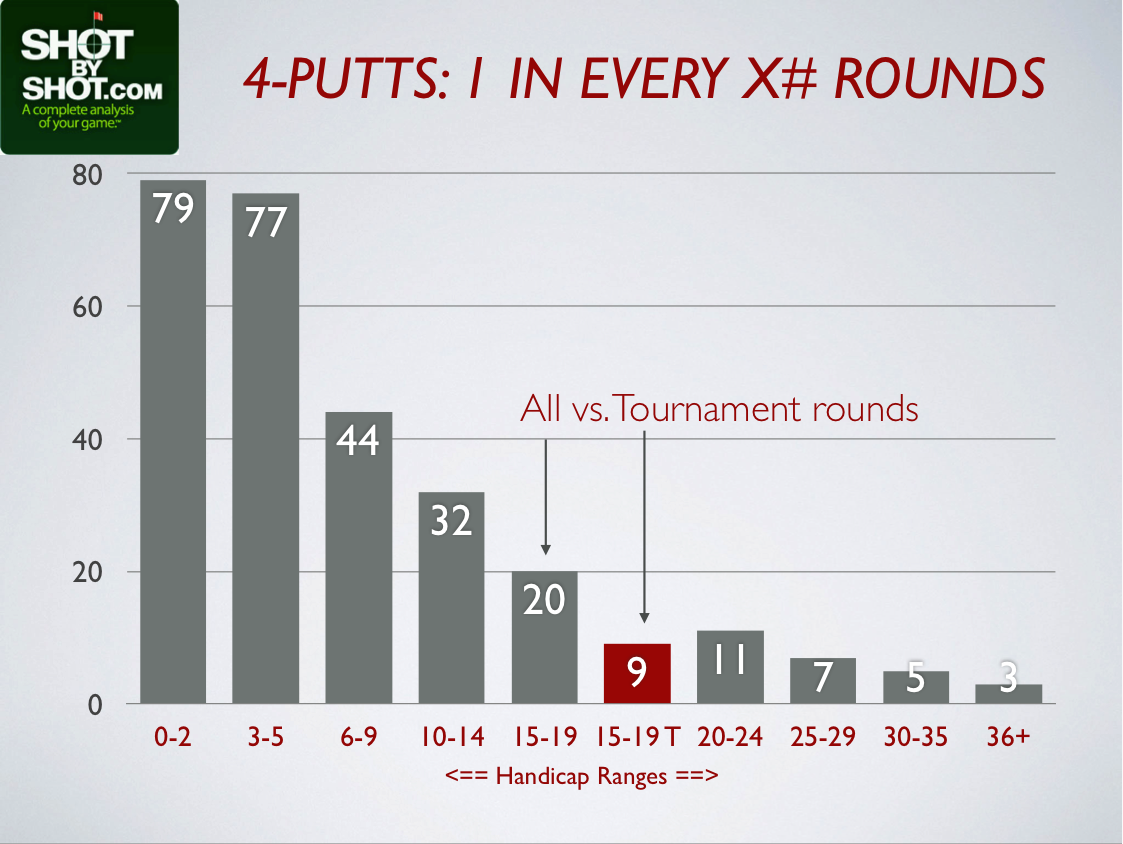
How often do you 4-putt? Do you fall into the NEVER category, or one of the handicap ranges in the chart above?
In conclusion, fast greens (or at least greens golfers consider to be fast) are more difficult for the average golfer. They pose a greater challenge for distance control, leading to more 3- and 4-putts. That’s why before starting a round on an “away” course, I recommend golfers spend some time on the putting green to get a feel for the speed. I like to place tees 30 feet apart, and putt two balls back and forth until I have a great feel for my 30-foot stroke. As the vast majority of lag opportunities fall in the 20-40 foot range, you can measure most of yours lag putts as a slight variation of that 30-foot stroke. You will also avoid a big surprise if the greens are what you consider fast.










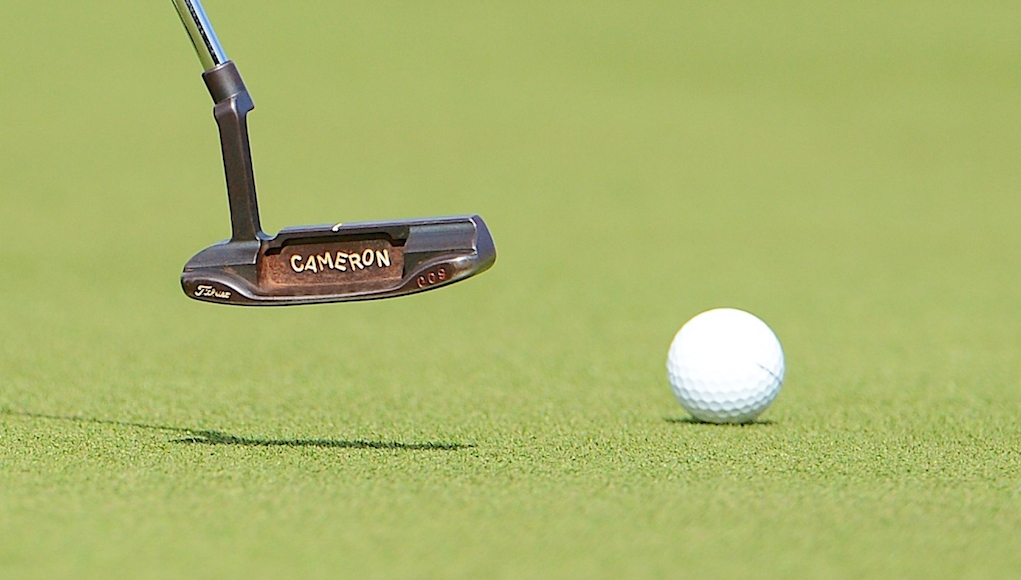


This past Monday, I played in the U.S. Amateur local qualifier at Rock Creek Country Club in Portland, Oregon. A full tee sheet from 7:30 a.m. to 1:55 p.m., the top 11 scores would make it to the U.S. Amateur final qualifying.
I teed off at 10:48 a.m.. With the 7:30 am tee time, you can get a feel for the leaders’ pace, and they were off and running on the challenging setup at Rock Creek.
View this post on Instagram
Getting to the highlight of the round on the par five 17th, a drive up the left side and 212 yards left to the front hole location. I took out a 5-iron with plans of middle of the green. The ball ended up 8 feet left of the hole, pin high. A slight downhill putt dropped in for an eagle 3 on the 17th. With the cut line looking to be anywhere from -2 to even par. This was the boost I had been waiting for all day.
With making par from the trees on 18, it was time to wait for a potential playoff with a posted score of one under par 71.
Three hours later, it was playoff time. 8 players for 6 spots. I made par on the playoff hole, which was good enough to advance to the U.S. Amateur final qualifying in July. USGA qualifiers sure deliver on all of the emotions in golf!
Club Junkie
Building my 2026 gamer WITB: Ranking the contenders and new putter projects – Club Junkie Podcast


The annual What’s In The Bag build is underway, and on this episode of Club Junkie, Brian breaks down the clubs currently leading the race for a spot in his 2026 gamer setup. From drivers and fairway woods to irons, wedges, and shafts, he ranks the equipment that’s performing best and explains what’s separating the front runners from the rest of the field.
Brian also heads into the workshop to discuss several putter projects currently on the bench. From head options and shaft choices to build ideas and testing plans, he shares what he’s working on and which putters could become serious contenders for the bag this season.
If you’re a gear junkie who loves equipment testing, club building, and the never-ending pursuit of the perfect setup, this episode is for you.
Follow Club Junkie:
Instagram: @clubjunkiepod
TikTok: @clubjunkiepod
Threads: @clubjunkiepod
X: @ClubJunkiePod
Club Junkie
Tour Edge Exotics mini driver review + TaylorMade Spider ZT Max first look – Club Junkie

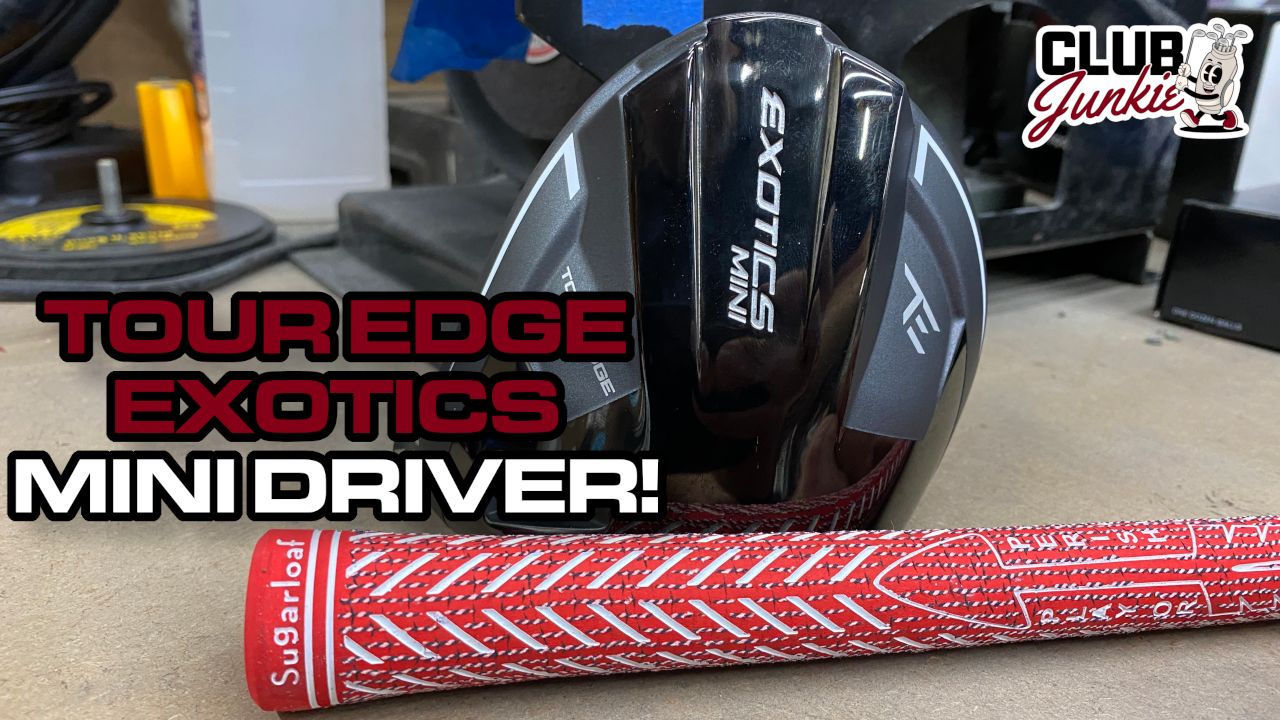
On this episode of Club Junkie, I put the new Tour Edge Exotics Mini Driver to the test and break down the performance, forgiveness, distance, and where it fits compared to a traditional driver or strong fairway wood. If you have been curious about adding a mini driver to the bag, this one is worth a look.
I also dive into the new TaylorMade Spider ZT Max putter that was recently spotted and discuss the growing zero torque putter trend. Plus, there is a closer look at the new Project X Titan Yellow shaft showing up on the PGA Tour and what makes it different from other profiles currently out there.

Justin Rose WITB 2026 (April): Full WITB breakdown with new McLaren irons

What’s the story behind Webb Simpson’s custom-stamped irons?

Memorial Tournament Tour Report: Rory McIlroy, Cameron Young switch up drivers, and more

Cadillac Championship Tour Report: Spieth’s sizable changes, McLaren Golf launches, and more

Russell Henley’s winning WITB: 2026 Charles Schwab Challenge

Kristoffer Reitan’s winning WITB: 2026 Truist Championship

Best irons 2026: Best irons overall, most forgiving irons, and more

J.T. Poston’s winning WITB: 2026 Memorial Tournament

Aaron Rai’s winning WITB: 2026 PGA Championship

Cameron Young’s winning WITB: 2026 Cadillac Championship


Ryan Palmer WITB 2026 (June)
Driver: Callaway Quantum Triple Diamond (9 degrees) Shaft: Project X HZRDUS Smoke Blue RDX 60 TX 3-wood: TaylorMade Qi10 (15 degrees) Shaft:...


Bud Cauley WITB 2026 (June)
Bud Cauley had >14 clubs in his bag when photographed prior to the Memorial Tournament. Driver: Titleist GTS2 (8 degrees) Shaft: Fujikura...


Hannah Green WITB 2026 (June)
Driver: Titleist GTS3 (10 degrees, D4 SureFit setting) Shaft: Mitsubishi Chemical Diamana RB 53 S 3-wood: Titleist GT3 (15 degrees,...


Asterisk Talley WITB 2026 (June)
Driver: TaylorMade Qi4D (9 degrees) Shaft: Fujikura Ventus Blue 6 S 3-wood: TaylorMade Qi4D (16.5 degrees) Shaft: Fujikura Ventus Blue...
-
 Equipment6 days ago
Memorial Tournament Tour Report: Rory McIlroy, Cameron Young switch up drivers, and more
-
 News2 weeks ago
Russell Henley’s winning WITB: 2026 Charles Schwab Challenge
-
 Equipment3 days ago
Best irons 2026: Best irons overall, most forgiving irons, and more
-
 Whats in the Bag4 days ago
J.T. Poston’s winning WITB: 2026 Memorial Tournament
-

 Equipment1 week ago
Details on Jason Day’s latest prototype Avoda iron setup
-
 Equipment3 weeks ago
CJ Cup Byron Nelson Tour Report: Koepka and Kim’s newest putters finally get hot
-

 News2 weeks ago
Charles Schwab Challenge Tour Report: MacIntyre, Åberg and Spaun all switch putters, TaylorMade launches new Spider
-
 Equipment2 weeks ago
Details on J.J. Spaun’s surprise putter switch


Grizz01
Aug 3, 2016 at 8:24 pm
Totally missed the most important factor. Which made all this null and void. The conditions of the greens. The author is concluding that slow, medium and fast greens are all in tournament shape. Smooth rolling and such. I’ve played some high end courses after playing my muni. I always putt better on the high end course and they are much faster. The roll way better and I can read them better.
Andrew Todd Yocum
Aug 3, 2016 at 10:57 pm
I agree with this Grizz01. Feel the exact same way.
Christian
Aug 4, 2016 at 4:04 am
This is true. It’s very rare for hairy greens to be uniformly hairy. To add, I always putt better on fast greens, sliw greens makes my stroke more forced/less smooth.
Rev G
Aug 3, 2016 at 7:27 am
This is assuming that the non-speed factors of the greens are the same, which I wouldn’t think they would be. The courses that can afford to keep greens up at faster speeds are usually those with greens that have had more difficulty put in them by the “big name” architect they had design their course. Typically courses with slower greens are the smaller budget courses that had less extensive shaping of the greens. To me greens with slope, tiers, level changes and saddles are the ones that are tough to putt -regardless of speed – but because of the expense, courses that have those feature also typically are faster.
ooffa
Aug 3, 2016 at 7:27 am
I put better on temporary greens during the winter.
SirShives
Aug 2, 2016 at 2:02 pm
Prior to this summer, I can only remember having one 4 putt in 15 or so years of playing golf. (I’m not saying I’ve only ever had one 4 putt, just that I can only remember that one.) Earlier this summer, I recorded 2 in one round playing at a course with crazy fast greens. To be fair, the starter warned us the greens were going to be that way. This course had recently replaced their greens and they were dealing with a combination of maturing grass and a very hot, dry start to the summer. It’s brutal to have your buddies ask you “How’d you shoot?” and sum up your round with “I had 2 FOUR PUTTS!!” ????????????
Justin
Aug 2, 2016 at 1:45 pm
As a low handicapper, I will almost always putt better on greens that are faster AND roll true. I believe the simple reason behind this is the less you have to take the putter head back, the less chance you have of altering your stroke. A 30 foot flat putt on greens that stimp out around 8 or 9 requires a significant hit to get the ball to the hole. Put that same put on a green that rolls to a 12 and you need significantly less force behind the ball to get it there. Less force causes less “skidding” after impact and gets the ball rolling on line faster.
That being said, what I have noticed is that the courses that have greens which run a little bit faster also tend to be tougher overall. They’ll have at least a few greens with multiple tiers and tend to have more undulation overall. So, after factoring that into the equation, I think that the “slope” of the greens and what a golfer is used to playing on factor much more into success or failure than the actual speed of the greens. In fact, it would be nice if each course slope rating was divided into two groups: Through the green and on the green. The combination of those would give you your total slope. Take 2 courses with an overall slope of 130 and figure out that 1 of them has greens that rate out at a slope of 75 and the other only 60. Invariably you find that one will be harder on the greens and the other is more about ball placement off the tee and approach shots.
A lot of golfers rely on reviews on various websites when deciding what course to play on their destination vacations or a little outside their normal area. I feel that if slope (moreso than course rating because slope accounts for your handicap level) was used to measure both green difficulty along with the rest of the course, more golfers would choose to play courses based on their skill set. Everyone wants to have a good time out there and while some courses (Pebble, Sawgrass, Pinehurst, etc) will be played regardless of difficulty, most can make a more educated decision about where to spend their hard-earned money versus how well they “may” play. Lately I’ve struggled with the driver but have always been a very good putter and would likely choose a course with tough greens over one that had tough tee shots and approaches. Some may feel the exact opposite and would not look forward to a hellish day on the greens. My best scores ever have come on days where my putter was hot and if I actually tracked the stats I bet those days would also show up as the longest feet of putts made I’ve had all time. I’ve had incredible ball striking rounds where I’ve not broken par because I either wasn’t familiar with the greens or just had an off putting day. I’v ealso shot under par when I felt my swing was way off that particular day.
We always hear that putting is the key to improving your game, but I also think it’s the key to the enjoyment of the game. Not everyone can drive the ball over 300 yards and very few who can’t will ever build up enough strength or the proper fundamentals to do so. BUT, everyone has the opportunity to sink a 30+ foot putt, and the feeling that produces is so magical that you may just start to feel like a golfer after you had lost all hope 🙂
larrybud
Aug 2, 2016 at 11:46 am
c’mon now, we all know 1/2/3 putt percentages are MEANINGLESS! Unless you have a strokes gained chart, you can’t glean anything from these stats.
1 putt percentage may be more because players chip farther from the hole on faster greens (short sided chips are harder to get close on fast greens!).
3 jack percentage may be more because the first putt distance is greater on fast greens (ball rolls out more on fast greens, effectively making the green smaller!)
Peter Sanders
Aug 2, 2016 at 5:13 pm
Larrybud,
You are correct that Strokes Gained is the true measure of putting performance and I of course had it and used it. That said, it is just a number and I felt it more meaningful to describe the % 1-Putts, 3 and 4-Putts that make up the number.
Other Paul
Aug 2, 2016 at 11:33 am
Greens are usually super slow in the spring where i live. And then medium all summer. We got a ton of rain this year and no heat waves yet so the greens are healthy and short. Balls roll far right now. In the spring i averaged 1.9 putts per hole. And then i had a few rounds with hand full of 3 putts, now i am used to it again and my average is dropping back down to under 2 per hole.
Sm
Aug 2, 2016 at 9:59 am
It’s not just speed that matters when it comes to Average Joe’s courses.
It can’t just be fast.
It also has to be smooth. I bet even Average Joe’s stats would go up if the greens he played on more often than not were smooth.
BlakLanner
Aug 2, 2016 at 10:54 am
I agree completely. I am far from the greatest putter but I can adjust to the speed of greens within a hole or two if they are consistent and smooth. However, when I am on a course with inconsistent or bumpy greens (like the muni courses around here with the brutal weather we have had this summer), my putting greatly suffers since I cannot trust any feel from previous greens or even if the ball will follow a line without bouncing around in a few spots.
Shallowface
Aug 2, 2016 at 9:14 am
Regardless of green speed, one major factor in three putting is the fact that at so many courses the person setting the pins doesn’t follow the USGA’s suggestion that the area three feet around the cup be as level as possible. They’ll set them on the sides of slopes, on top of ridges, anywhere but where they should. It leads to what I call “McDonald’s Putts,” where you have a three footer that breaks a foot and the roll of the ball is in the shape of an arch. How often do see a three footer on TV played any further than the top edge of the hole? Not often. No wonder they make more than we do.
Obee
Aug 2, 2016 at 10:53 am
Totally true. For the most part, the tour plays “USGA-spec” greens, that have a maximum slope of ~2 – 2.5 degrees in the pinnable areas, which makes for boring putting. I much prefer slightly slower greens (9 – 10 on the stimp), but with MORE contour. Makes putting much more of a challenge.
Philip
Aug 2, 2016 at 11:33 am
What! There is a recommendation on this – I’m going to look it up and give it to our course pro and greens keeper. We have a few holes where the ball will never stop near the hole and just keep rolling off the green 10-20+ feet away. If you carefully place it – it will stop rolling almost immediately.
Shallowface
Aug 2, 2016 at 12:20 pm
http://www.usga.org/rulesfaq/rules_answer.asp?FAQidx=143&Rule=16
Shallowface
Aug 2, 2016 at 12:23 pm
Just posted the link to the USGA document, Philip. I hope everyone that deals with this issue will present it to their pro and superintendent, because it is blatantly obvious the vast majority of them have never seen it.
Philip
Aug 2, 2016 at 12:50 pm
… it will start (duh) rolling immediately
JJVas
Aug 3, 2016 at 12:00 pm
So totally true. Living in the Northeast and playing all of the classics that run WAY WAY WAY faster than Ross and Tillinghast ever had in mind gets ridiculous when the Super has a bad day.
Shallowface
Aug 2, 2016 at 9:08 am
The only problem with your last suggestion is I have yet to play at a course where the speed of the practice green and the speed of the greens on the course were anywhere near the same. 🙂
Philip
Aug 2, 2016 at 12:55 pm
I only played one course where the two practice greens where an exact match for the course, but given the entire new huge, oak clubhouse (the locker doors were an inch or two of oak) that required an oak forest – I would expect no less (one would expect it for the price they ask for a round). It also has hosted a few professional events. Any other course I just check my alignment, otherwise, the speed of the practice green can mess up the first couple of holes for my expectation of green speeds.
Justin
Aug 2, 2016 at 1:51 pm
I find that the vast majority of practice greens in Southern California roll much truer and are in better shape than the greens out on the course. I really wish they would do something about this, but i understand that it’s easier to manicure and keep in good shape a green that sits next to the clubhouse and gets the most use. I will say that more of the courses I’ve played in AZ have matching practice and course greens than here for sure. I also know that it’s harder to replicate like conditions green to green on bent vs bermuda as bent is a more delicate grass in my opinion (it’s also the perfect putting grass when properly manicured!)
Keith V Shannon
Aug 21, 2016 at 7:09 am
I totally agree here. I’ve fallen into this trap a few times, I’ll warm up with my putter on the clubhouse green, then head out to the first hole and watch my lag putt blow by the hole and come to a stop in the rough off the green because the stimp is as much as double on the course, even at private courses. Then I spend the rest of the round recalibrating muscle memory, being afraid of my putting strength and not really regaining any ability to stick the ball a clublength from the hole until the round is long since blown.
Maybe the club wants the practice green to look nicer because it’s right there. Maybe the shade of the clubhouse or outbuildings requires thicker grass to avoid losing it altogether. Maybe higher traffic calls for a thicker carpet. Maybe the course groundskeepers aren’t responsible for those greens, that’s a job for the separate landscaping crew (made up of the scrubs the greensmaster doesn’t trust with the money grass yet). Whatever it is, it’s extremely frustrating to the casual golfer who doesn’t get practice rounds on the course before the putts start to count.
It’s gotten to the point that I don’t practice my putting at the course before the round, and I don’t pay attention to the actual roll distance after impact when warming up my chipshots; if I want to practice, there are a few ranges near me that do a better job at replicating local courses’ stimps than the clubs seem to be capable of on their own practice greens. Then on the day of a round I trust my muscle memory, with more minor adjustments based on the first few holes.