
Opinion & Analysis
How to track some of the most important stats in golf


I have been studying the game of golf from a statistical standpoint for 27 years. In 1992, I launched a new form of analysis that I called Strokes Lost and Saved, now known as Strokes Gained. My system was built around encouraging golf instructors and players to move away from the traditional, one-dimensional stats (fairways, GIR’s, sand saves and number of putts) to this much more accurate method. Traditional golf stats can be misleading as they give one-dimensional, yes/no answers to describe a complicated, multi-dimensional game.
The inability of these stats to shed light on performance is what motivated me to create ShotByShot.com, which gives golfers real insight and answers about their strengths and weaknesses with comparative data relevant to their handicap level. It’s a simple, powerful tool, but I’m often pressed for an even simpler solution by golf professionals, who ask:
“What is the most important stat in golf? If I were to get my players to keep ONE stat, what should it be?”
My quick, somewhat sharp-edged, answer to that question is: “If there were such an all-important stat, I would be out of business.” I guess I have mellowed, and can suggest a “starter stat” to provide instructors and golfers something simple that adds value: Have your players track their major ERRORS!
I realized years ago that frequency and severity of errors does more to establish every player’s scoring level than all of the good shots hit. Further, the ability to identify and limit these errors is the most efficient way to improve.
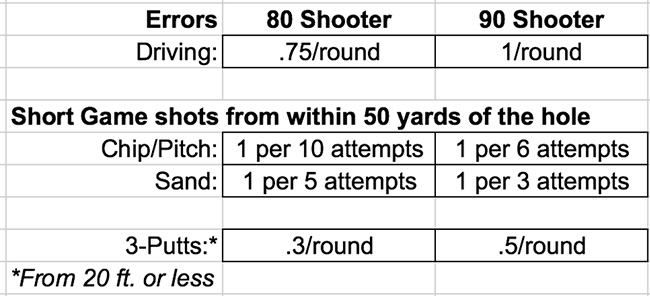
Below, I have defined the most frequent and costly errors in the game, and can provide the average frequency of these errors for the typical 80 and 90 shooters. This data comes from ShotByShot.com’s robust database of more than 250,000 rounds entered and analyzed. See how your game matches up over three to five rounds:
1. Driving errors. There are three types:
- No Shot result: Drive hit out of play requiring an advancement shot to return to normal play.
- Penalty-1 result: Hazard for unplayable lie.
- OB/Lost result: Lost or out of bounds.
2. Short Game errors: Chip/pitch and sand shots (separately) from all positions within 50 yards of the hole that MISS the green.
3. Three-Putts: From within 20 feet of the hole or less.
In your next few rounds, track these four errors on four lines of a separate scorecard. For driving errors and 3-putts (within 20 feet), simply mark the holes where these mistakes occur. For chip/pitch and sand shots, mark the hole where each short game shot is successful (on the green) with a check and those that miss the green with an X. This way you will know the total number of shots in each short game category as well as the relative number of errors.
Compare your results from three to five rounds with the chart below and your major weakness should become clear. Work to mitigate that weakness and you will achieve meaningful improvement. Then repeat the process until you have NO major weakness in your game.
The Averages




This past Monday, I played in the U.S. Amateur local qualifier at Rock Creek Country Club in Portland, Oregon. A full tee sheet from 7:30 a.m. to 1:55 p.m., the top 11 scores would make it to the U.S. Amateur final qualifying.
I teed off at 10:48 a.m.. With the 7:30 am tee time, you can get a feel for the leaders’ pace, and they were off and running on the challenging setup at Rock Creek.
View this post on Instagram
Getting to the highlight of the round on the par five 17th, a drive up the left side and 212 yards left to the front hole location. I took out a 5-iron with plans of middle of the green. The ball ended up 8 feet left of the hole, pin high. A slight downhill putt dropped in for an eagle 3 on the 17th. With the cut line looking to be anywhere from -2 to even par. This was the boost I had been waiting for all day.
With making par from the trees on 18, it was time to wait for a potential playoff with a posted score of one under par 71.
Three hours later, it was playoff time. 8 players for 6 spots. I made par on the playoff hole, which was good enough to advance to the U.S. Amateur final qualifying in July. USGA qualifiers sure deliver on all of the emotions in golf!
Club Junkie
Building my 2026 gamer WITB: Ranking the contenders and new putter projects – Club Junkie Podcast

The annual What’s In The Bag build is underway, and on this episode of Club Junkie, Brian breaks down the clubs currently leading the race for a spot in his 2026 gamer setup. From drivers and fairway woods to irons, wedges, and shafts, he ranks the equipment that’s performing best and explains what’s separating the front runners from the rest of the field.
Brian also heads into the workshop to discuss several putter projects currently on the bench. From head options and shaft choices to build ideas and testing plans, he shares what he’s working on and which putters could become serious contenders for the bag this season.
If you’re a gear junkie who loves equipment testing, club building, and the never-ending pursuit of the perfect setup, this episode is for you.
Follow Club Junkie:
Instagram: @clubjunkiepod
TikTok: @clubjunkiepod
Threads: @clubjunkiepod
X: @ClubJunkiePod
Club Junkie
Tour Edge Exotics mini driver review + TaylorMade Spider ZT Max first look – Club Junkie

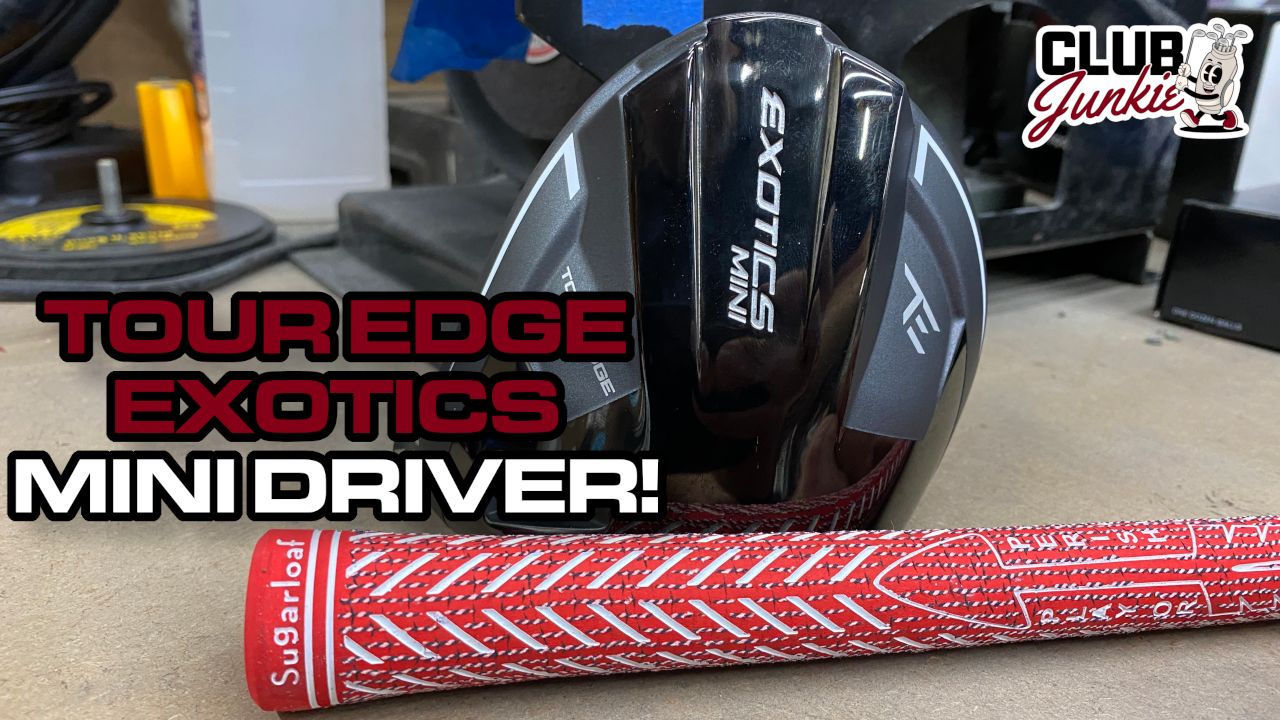
On this episode of Club Junkie, I put the new Tour Edge Exotics Mini Driver to the test and break down the performance, forgiveness, distance, and where it fits compared to a traditional driver or strong fairway wood. If you have been curious about adding a mini driver to the bag, this one is worth a look.
I also dive into the new TaylorMade Spider ZT Max putter that was recently spotted and discuss the growing zero torque putter trend. Plus, there is a closer look at the new Project X Titan Yellow shaft showing up on the PGA Tour and what makes it different from other profiles currently out there.

What’s the story behind Webb Simpson’s custom-stamped irons?

Memorial Tournament Tour Report: Rory McIlroy, Cameron Young switch up drivers, and more

Cadillac Championship Tour Report: Spieth’s sizable changes, McLaren Golf launches, and more

Russell Henley’s winning WITB: 2026 Charles Schwab Challenge

Kristoffer Reitan’s winning WITB: 2026 Truist Championship

Best irons 2026: Best irons overall, most forgiving irons, and more

J.T. Poston’s winning WITB: 2026 Memorial Tournament

Aaron Rai’s winning WITB: 2026 PGA Championship

Cameron Young’s winning WITB: 2026 Cadillac Championship

Details on Jason Day’s latest prototype Avoda iron setup


Christiaan Maas WITB 2026 (June)
Driver: TaylorMade Qi4D LS (8 degrees) Shaft: Fujikura Ventus TR Blue 6 X 3-wood: TaylorMade Qi10 (15 degrees) Shaft: Fujikura Ventus Black...


Ryan Palmer WITB 2026 (June)
Driver: Callaway Quantum Triple Diamond (9 degrees) Shaft: Project X HZRDUS Smoke Blue RDX 60 TX 3-wood: TaylorMade Qi10 (15 degrees) Shaft:...


Bud Cauley WITB 2026 (June)
Bud Cauley had >14 clubs in his bag when photographed prior to the Memorial Tournament. Driver: Titleist GTS2 (8 degrees) Shaft: Fujikura...


Hannah Green WITB 2026 (June)
Driver: Titleist GTS3 (10 degrees, D4 SureFit setting) Shaft: Mitsubishi Chemical Diamana RB 53 S 3-wood: Titleist GT3 (15 degrees,...
-
 Equipment6 days ago
Memorial Tournament Tour Report: Rory McIlroy, Cameron Young switch up drivers, and more
-
 News2 weeks ago
Russell Henley’s winning WITB: 2026 Charles Schwab Challenge
-
 Equipment3 days ago
Best irons 2026: Best irons overall, most forgiving irons, and more
-
 Whats in the Bag4 days ago
J.T. Poston’s winning WITB: 2026 Memorial Tournament
-
 Equipment1 week ago
Details on Jason Day’s latest prototype Avoda iron setup
-

 Equipment3 weeks ago
CJ Cup Byron Nelson Tour Report: Koepka and Kim’s newest putters finally get hot
-

 News2 weeks ago
Charles Schwab Challenge Tour Report: MacIntyre, Åberg and Spaun all switch putters, TaylorMade launches new Spider
-

 Equipment2 weeks ago
Details on J.J. Spaun’s surprise putter switch


Jason
Jun 6, 2016 at 1:19 pm
Peter, I am interested in how this compares to GIR targets for 80s shooter. I am a mid-high 80s shooter struggling to get into low 80s. I have read other statisticians say GIR is the strongest correlation to score, and their analysis shows 8 GIR per round is general target to break 80. My personal stats also show the most correlation of GIR to score and I rarely hit that magic 8 number. This article has no mention of GIR. I tracked my stats versus these errors and the only shortcoming I see is I am about 5% off in the short game category – which is only about 1 shot per round. Is it viable to track the total errors per round – as one day may be driving, another short game, etc…This is really interesting material.
Peter
Jun 6, 2016 at 3:56 pm
Jason,
GIR’s is the most valuable of the “Traditional”, one-dimensional stats and there generally is a direct correlation between # GIR’s and scoring. Further, you are barking… in the right direction with your goal of 8 GIR’s to break 80. In our database of 250,000+ rounds, the 79 shooter averages 8.3 GIR’s. That said, the game is a puzzle and there are many important pieces that must all fit together. If GIR’s were the tell all stat, I would not be in business. It is why I created ShotByShot.com and what is now called Strokes Gained to remove the mystery from golf stats.
I hope this helps.
ParHunter
Jun 6, 2016 at 9:58 am
” that I called Strokes Lost and Saved, now known as Strokes Gained”
So it was you who invented Strokes Gained not Mark Broadie? Does Mark Broadie know that he didn’t actually invent Stokes Gained ;-)?
Peter Sanders
Jun 6, 2016 at 11:29 am
ParHunter,
Yes, I have spoken with him about it. Further in his book, he was careful to say that “…he implemented Strokes Gained in 2005…”
Other Paul
Jun 5, 2016 at 9:55 pm
My stats for my last round would be useless. I played 9 holes. 6/7 fairways. Gir 7/9. And 1.9 putts per hole. The course didnt maintain a bunker and it had lots of weeds in it and my laser picked up the weeds and not the stick. Laser said 170. I landed right in the middle and made double bogey. A few holes later i landed in a bunker that was full of rocks and wasn’t maintained so i picked up my ball and went backwards away from the hole (i didnt want to scratch my new wedge…) The whole area was bare and i skulled it over for another double bogey. Rest of my round was my best this season with a bogey and a two birdies. Maybe i should play better courses ????
Peter Sanders
Jun 6, 2016 at 9:22 am
I agree Other Paul! Only 9 holes would be a very small sample on any course.
Double Mocha Man
Jun 5, 2016 at 9:41 pm
This analysis is sooooo true! The only thing keeping me from consistently shooting in the low 70’s to high 60’s are the 4-5 bad shots I hit per round. But if I play defensively trying not to hit those bad shots I will hit more of them. Seemingly a contradiction. Your thoughts Peter???
Peter Sanders
Jun 6, 2016 at 9:21 am
I understand, one cannot play defensively. My old pro taught me to look at it differently – to evaluate every shot opportunity as a green light (go for it), yellow light (play conservatively), or red light opportunity (play to avoid the error). Each of these situations simply help determine the target. Once the appropriate target is selected, the shot is executed full out without fear. Make sense?
Double Mocha Man
Jun 6, 2016 at 11:17 am
Yes, it does. Thanks. Wish I could be a teen again when I had no fear.
Robert
Jun 5, 2016 at 2:32 pm
Peter, I loved shotbyshot free trial and saw the videos that it used to be $59. Any chance you’ll be doing a sale for that price anytime soon?
Other Paul
Jun 5, 2016 at 9:47 pm
Lol. Smizzle always cracks me up.
Peter Sanders
Jun 6, 2016 at 9:25 am
Thanks Robert, I will have to fix that. When we added the approach shot feature last May to complete the entire Strokes Gained puzzle we raised the price. I have been at this for 27 year and need to cover my substantial costs at some point. Sorry.
Robert
Jun 6, 2016 at 12:23 pm
Hey Peter,
No problem, just wondering. Thanks for the response.
ooffa
Jun 5, 2016 at 1:16 pm
The only stat that really matters is if there is more money in your wallet after your match then there was before.
Sparty
Jun 5, 2016 at 11:11 am
What is the difference between OB/Lost ball and No Shot Result?
Peter Sanders
Jun 5, 2016 at 12:16 pm
No shot is the least costly of the Driving errors. It is a ball hit to a position that requires some sort of advancement shot to return to normal play. Behind a tree, etc.
OB/Lose is either Out of Bounds or a Lost ball – both stroke and distance penalties.
Eric Granata
Jun 4, 2016 at 8:30 pm
How do you change your definition of each error for a player who shoots low 70s. I assuming driving stays the same, but how do you define an error in the short game area / 3 putts?
Peter Sanders
Jun 5, 2016 at 12:18 pm
Eric,
I don’t change the definitions. If you shoot in the 70’s, a. well done and b. you should experience very few of these errors.
Adam
Jun 4, 2016 at 7:06 pm
2 questions:
Why do 3 putts only matter within 20 feet? Is it normal to 3 putt outside of that range for people who shoot 80 and 90?
Why do you select 50 yards as the short game range rather than looking at a normal GIR?
Is the point just to show where you’re losing strokes that are easier to save?
Jim
Jun 4, 2016 at 8:26 pm
The tour average within 20 feet is 2 putts. Over 20 feet and the tour average begins to tic slowly over 2 putts. For example at 30 feet the average is 2.1 or something like that. So the thought is you should be making all putts within 20 feet in 2 putts or less.
If you miss GIR chances are you are with 50 yards of a hole and you will need to chip and 1 putt to save par. My making a mistake here your shot at par goes away completely. GIR gives you a better chance of making par, but being able to scramble for par is also just as important if not more important. The tour average for GIR is 75%, so that remaining 25% can make or break you.
Peter Sanders
Jun 5, 2016 at 12:31 pm
Jim,
Thanks for your supporting comments. I have to call you to task on the Tour stats that you mention:
1. “Tour average w/i 20 ft. is 2 putts.” – The 2.0 distance on Tour is 34 ft. That means that they average 2 putts from that point and will do better inside that.
2. “The Tour avg. for GIR is 75%” The winners on Tour average only 70% GIR’s. The Tour average in 2015 for GIR’s was 64.5%.
Jim
Jun 6, 2016 at 7:00 am
Yup, I don’t have the latest stats. Your stats seem to help more though now. I’m sure the probability of making 2 putts within 20 feet is higher the lower the handicap. My whole thing was the 20 feet is a must for 2 putts. If you can’t 2 putt within 20 feet, your got work to do.
The 64.5% GIR is a stronger argument for your 50 yard stat. That means 35.5% of shots will be scrambles for par, and missing those will have a huge impact on your score. I’m sure there is also a sliding scale for handicap. The higher the handicap the lower the GIR% is, but even at that, that means the higher the scramble% is. Meaning you have an even greater importance on being able to scramble within 50 yards.
Peter Sanders
Jun 6, 2016 at 9:29 am
You are correct about the sliding scale for GIR’s. It is the most important of all of the “traditional” stats. There is a direct correlation between GIR’s and score – always. A GIR means two good things:
1. Your game has been efficient enough to get there in regulation.
2. It is always a birdie opportunity of some length.
The 90 shooter averages less than 5 GIR’s.
Double Mocha Man
Jun 6, 2016 at 11:27 am
I’ve come up with a stat I call BGIR. (Bigger Green in Regulation”) If I’m a few yards off the green with an easy chip or on the fringe where I can easily putt I count these as BGIR’s… they almost always still result in pars, the occasional birdie. It’s when I miss the green by 10 -15 yards that I am in trouble. My BGIR rate is about 72%. It’s that 28% that kills my score.
Double Mocha Man
Jun 6, 2016 at 11:30 am
Oh, and the occasional smothered duck hook…
Peter Sanders
Jun 5, 2016 at 12:25 pm
Adam,
Q 1: Yes, it is fairly normal for the 80 and 90 shooter to 3-Putt from outside 20 feet. The average 2.00 putt distance for the 90 shooter is inside 20 feet. While 3-Putts outside are not good, I do not consider them to be Errors.
Q 2: Good Q! I had a lot of help and advice from notable instructors like Chuck Cook, Jack Lumpkin and Hank Johnson early on. We all finally agreed that within 50 yards was clearly short game for every handicap level – 75 yard can be a full approach shot for many.