
Equipment
Callaway’s XR 16 Drivers: Revealing photos from the Boeing Factory

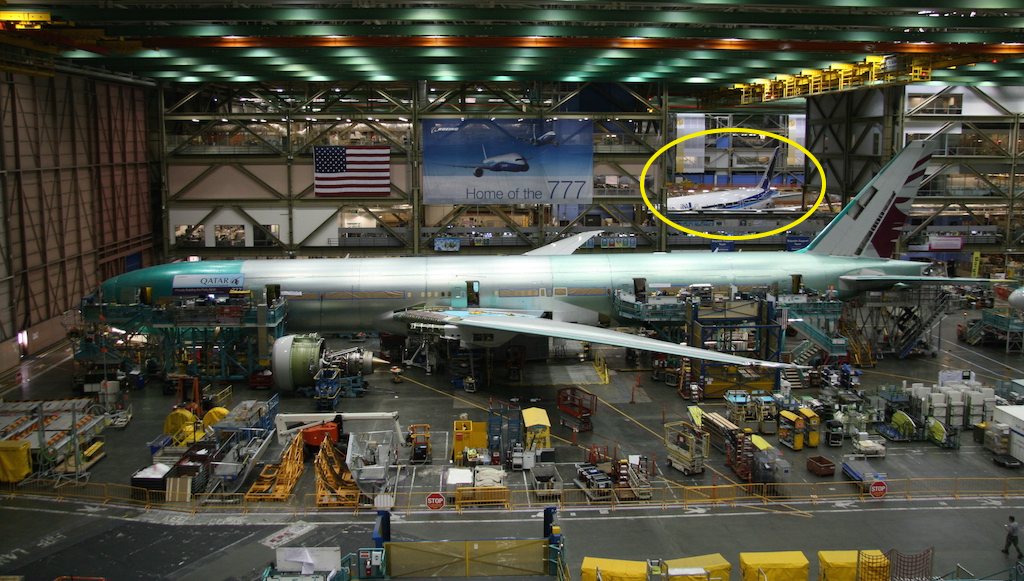
Recently, I was lucky enough to partake in a tour of The Boeing Company’s Everett Factory near Seattle, and pick the brains of its Aerospace engineers and tour guides. But this is a golf website, why should you care, right?
Well, for its new XR 16 and XR 16 Pro drivers, Callaway Golf teamed up with engineers from Boeing to develop a more aerodynamically sound driver. Read more about the technology here.
Why Boeing? With a mutual interest in how things fly — whether it’s airplanes or golf balls — it “was a great opportunity for collaboration” between the companies, according to Evan Gibbs, head of metal woods at Callaway Golf.
Also, at Boeing, there exists a group of young engineers collectively named O.N.E. (Opportunities for New Engineers), who use their intelligence and passion for problem solving for projects outside their everyday work of making airplane wings more efficient. So when Callaway asked Boeing to help make its new drivers faster and more efficient for golfers, Boeing had just the group of engineers for the job.
So a group of about a half-dozen O.N.E. engineers were given 3-4 months — a significantly shorter period of time than aerospace engineers are typically provided — to design an “add-on” to the crown of Callaway’s new drivers.
As Boeing Aerodynamics Engineer Adam Clark explained, there are many differences and similarities between the aerodynamic puzzles of airplanes and drivers.
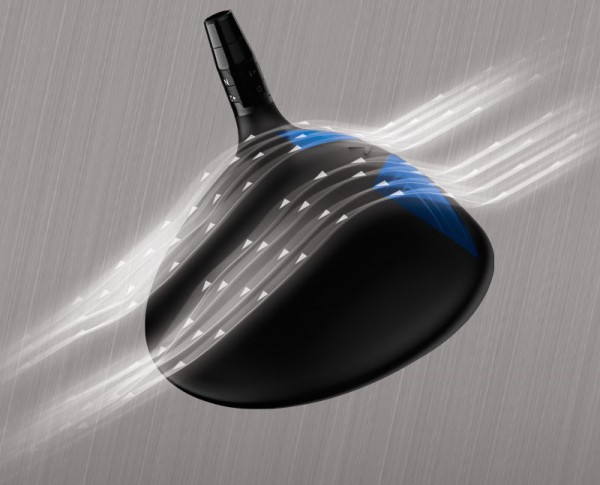
I paraphrase:
Both have to do with laminar and turbulent flow. An airplane wing needs to be streamlined to reduce friction, as does the relatively rotund body of a golf driver head. The solution is very similar.
Here’s what the Boeing engineers came up with:
-

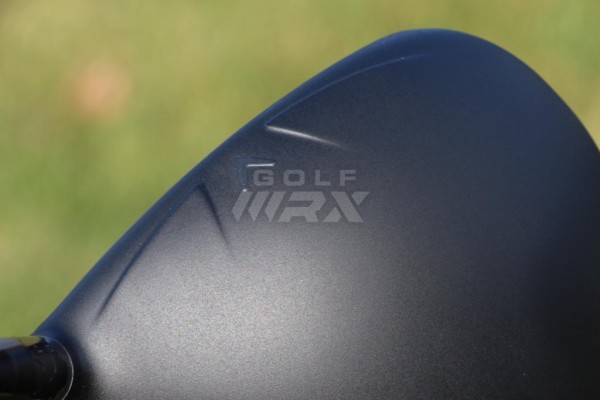
- Callaway’s XR 16 Pro driver crown, with protrusions, or “speed steps,” designed for better aerodynamics.
-

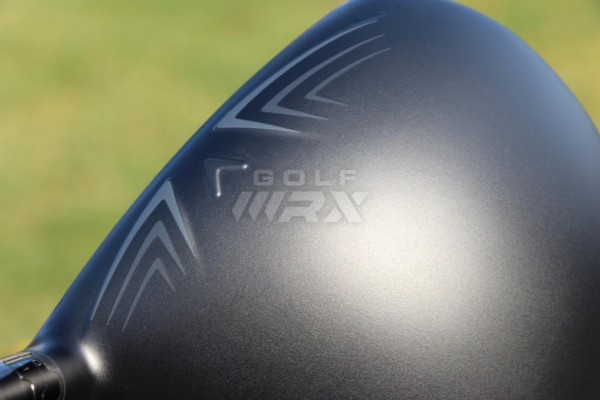
- Callaway’s XR 16 also has “speed steps,” with a slightly different design than the XR 16 Pro.
Below, I relay some ridiculously interesting facts, photos and information I learned about Boeing, its Everett facility, its airplanes and its engineering processes. I hope the photos below do Boeing’s airplane assembly factory justice, because the visuals were nothing short of breath-taking.
So we begin, Revealing Photos: The Aero Edition.
Welcome to Boeing
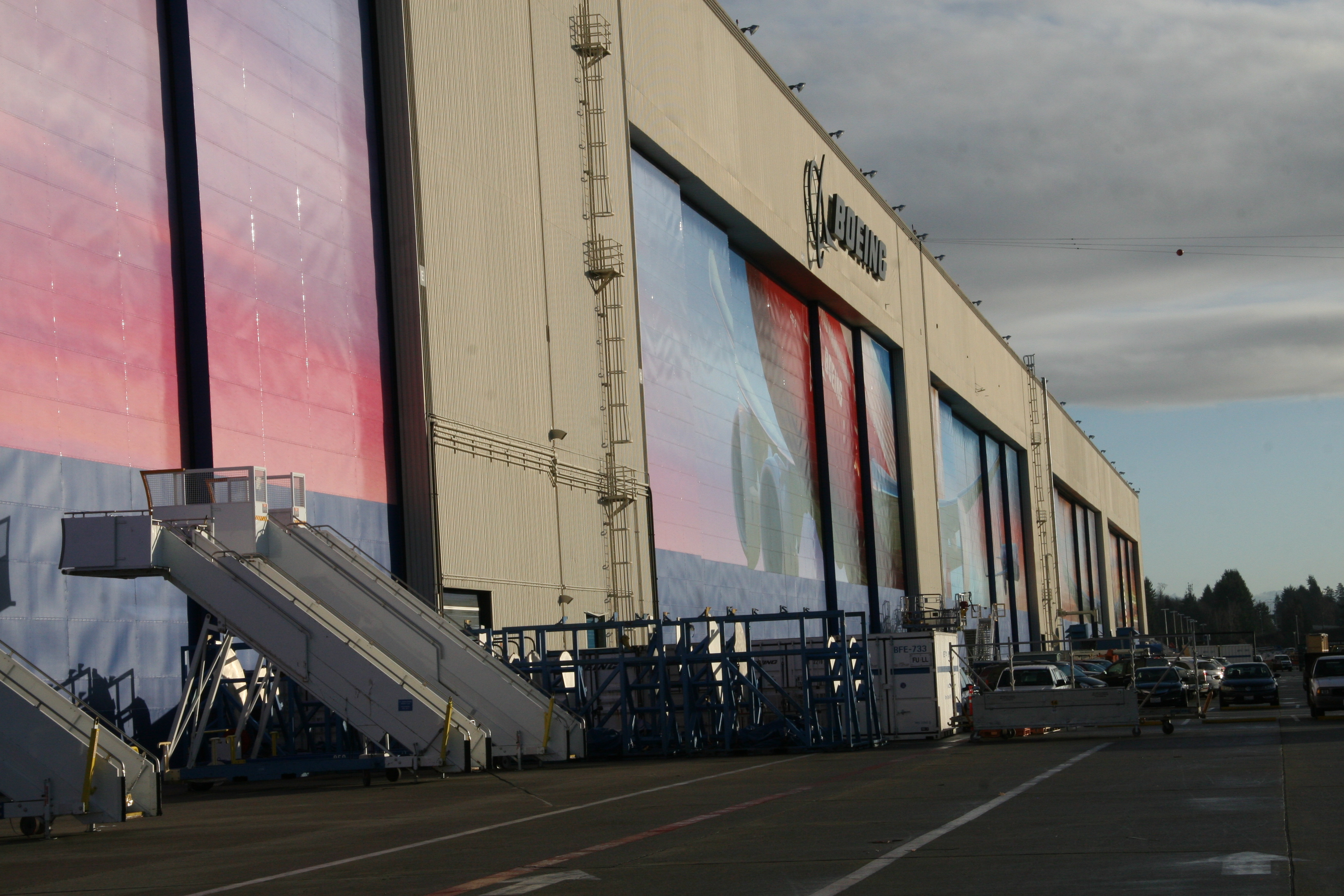
 It’s difficult to explain just how big the Boeing Factory really is. You can see how small the plane in the parking lot looks in comparison to the building, but maybe these facts will give it better perspective.
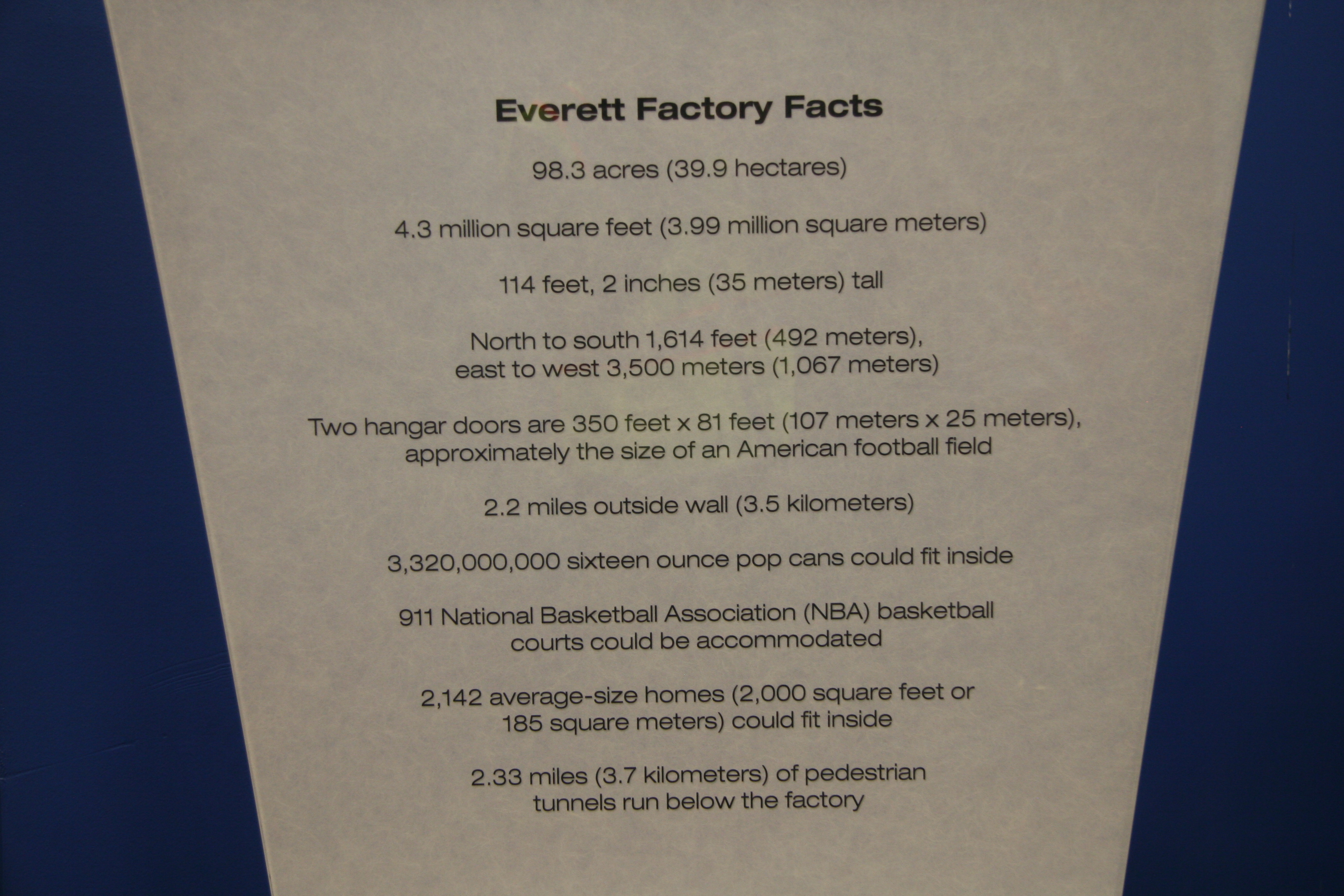
“Two hangar doors… approximately the size of an American football field.”
That means the Seattle Seahawks could play a football game on two of the hangar doors on the outside of the building (although it would probably be safer to put the doors flat on the ground first).
And in case you ever doubted the passion of Seahawks fans, it’s rare to be at Boeing’s Seattle factory without seeing a flag with the number 12 (12th man) somewhere in your line of site.
 So welcome to Boeing’s Seattle Facility, home of Seahawks’ 12th men and women. Lets go inside, shall we?
An “aerial” look
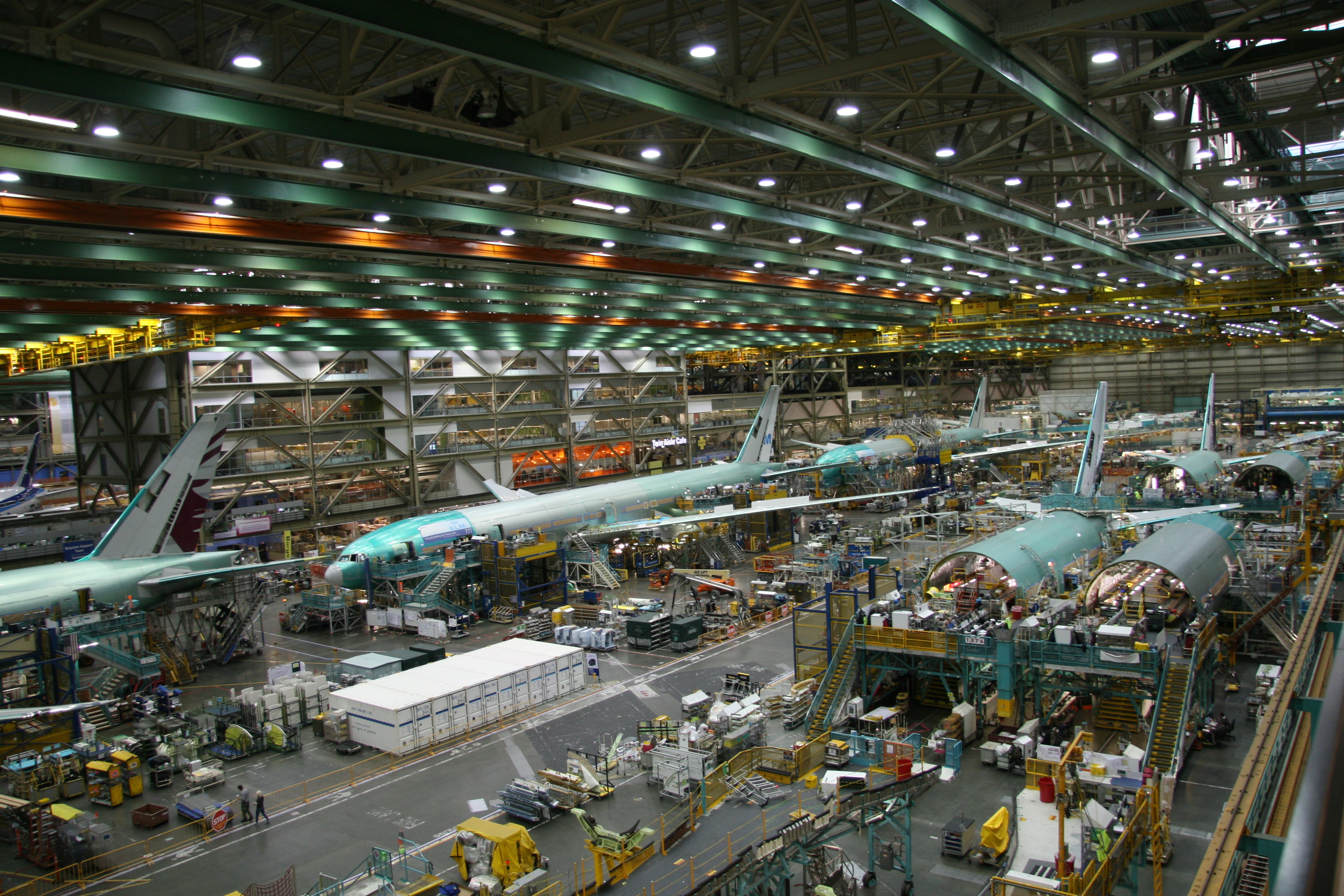
Rows of Boeing’s 737s, 747s, 767s and 777s — some of which are made from over 1 million parts — are built by troops of men and women. Contrary to popular belief, the number of the plane refers to when it was designed, not its size. The bigger the number, the newer the design.
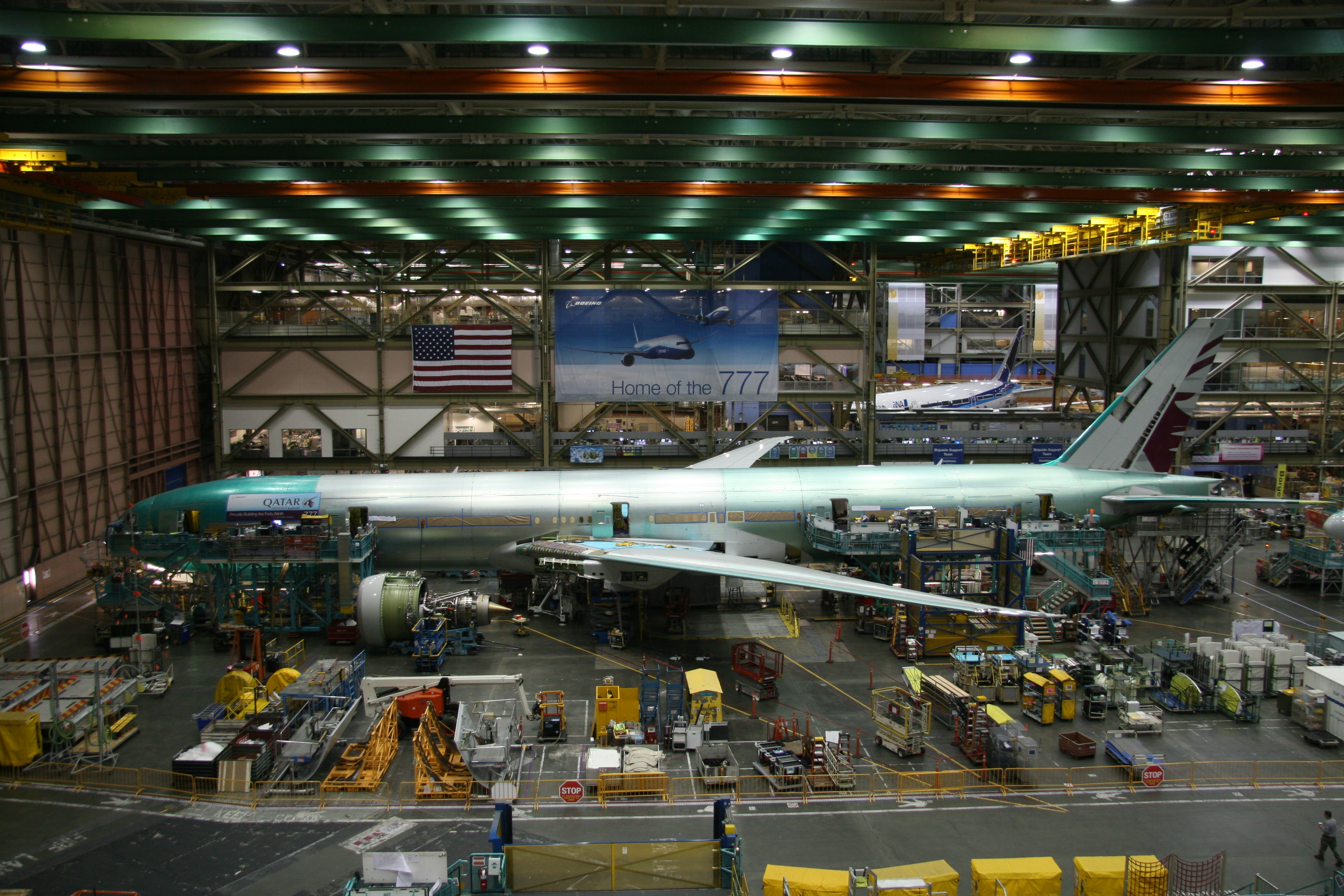
For example, the 777 took its first flight in 1994, while the 737 took its first flight in 1967. Boeing’s first active plane was the 707, which was airborne in 1957.
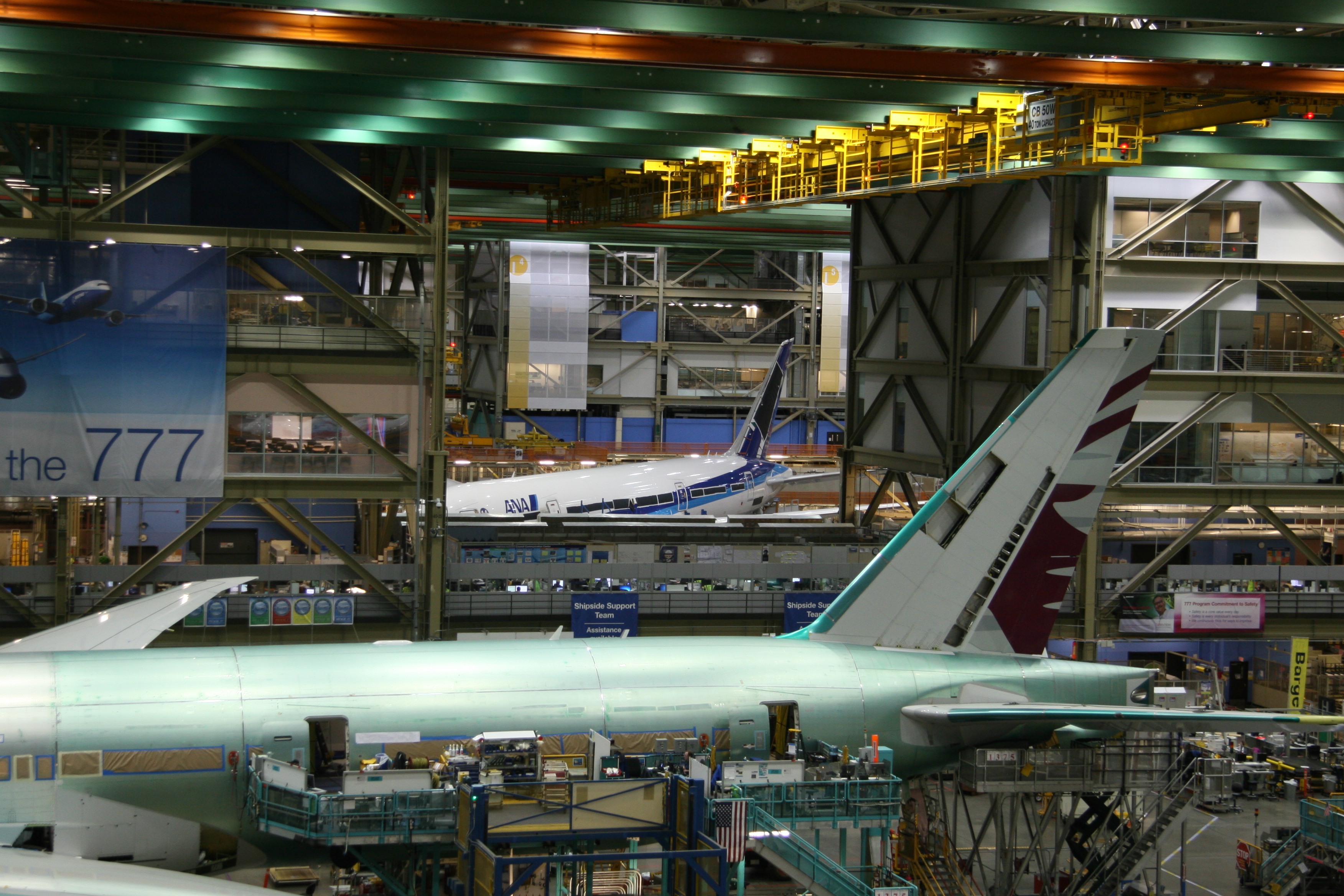
If you look closely at the photo above, you can see there are other rooms filled with multiple planes, as well.
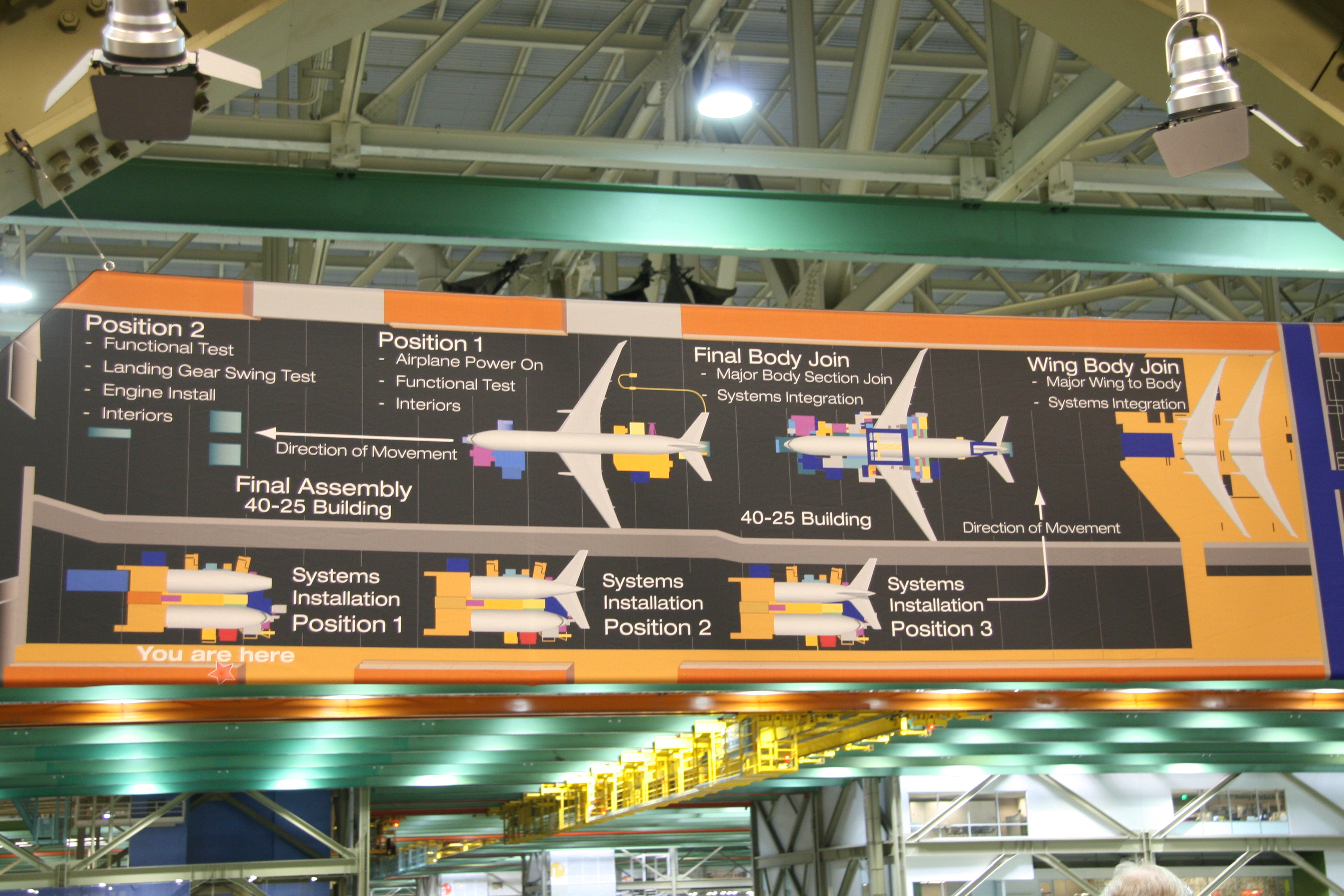
And above is the process the planes undertake while inside the factory.
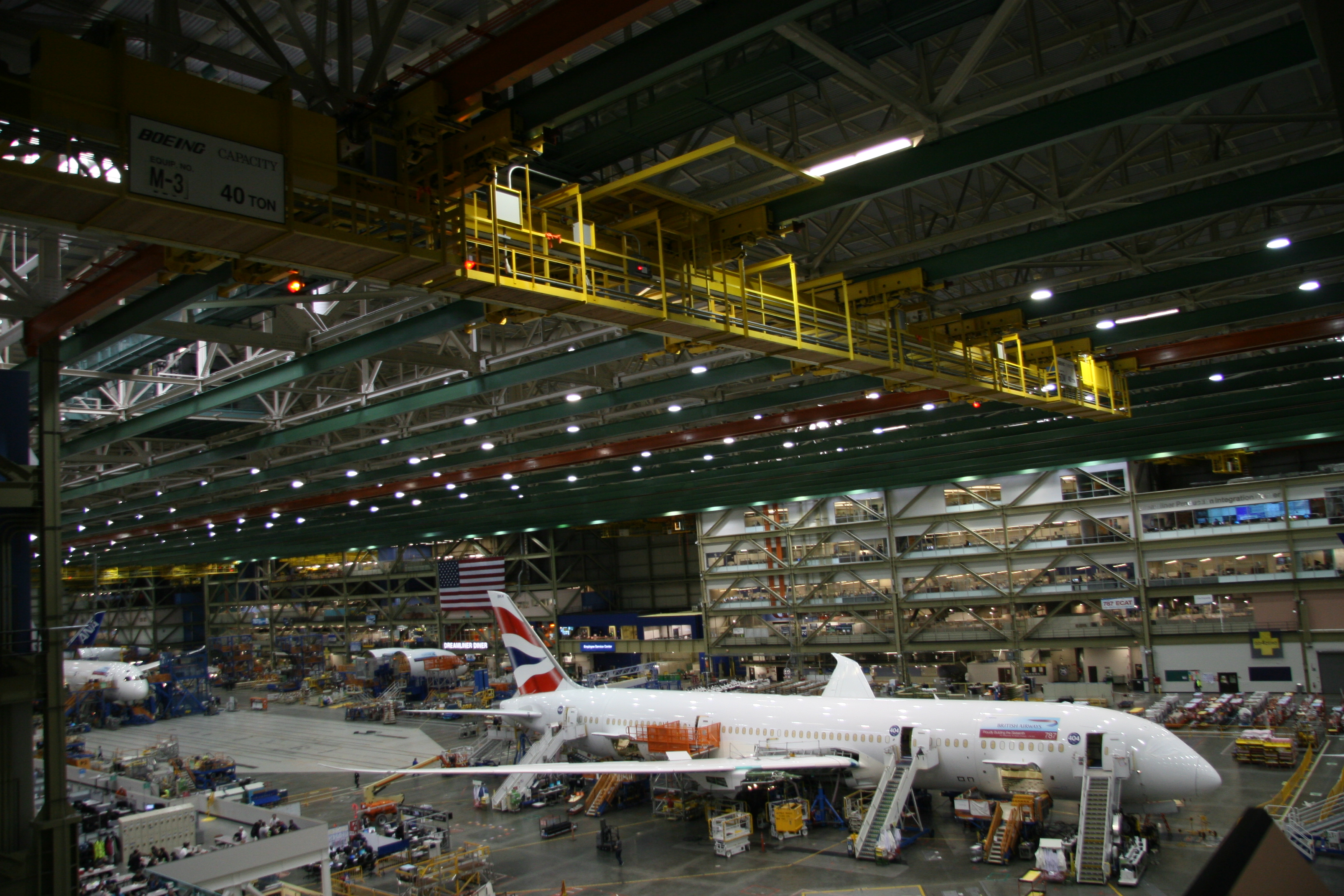
Here’s a look at a plane that’s nearing the end of the “assembly line.” Now, there’s a few interesting things of note in the photo above, so let’s zoom in and look.
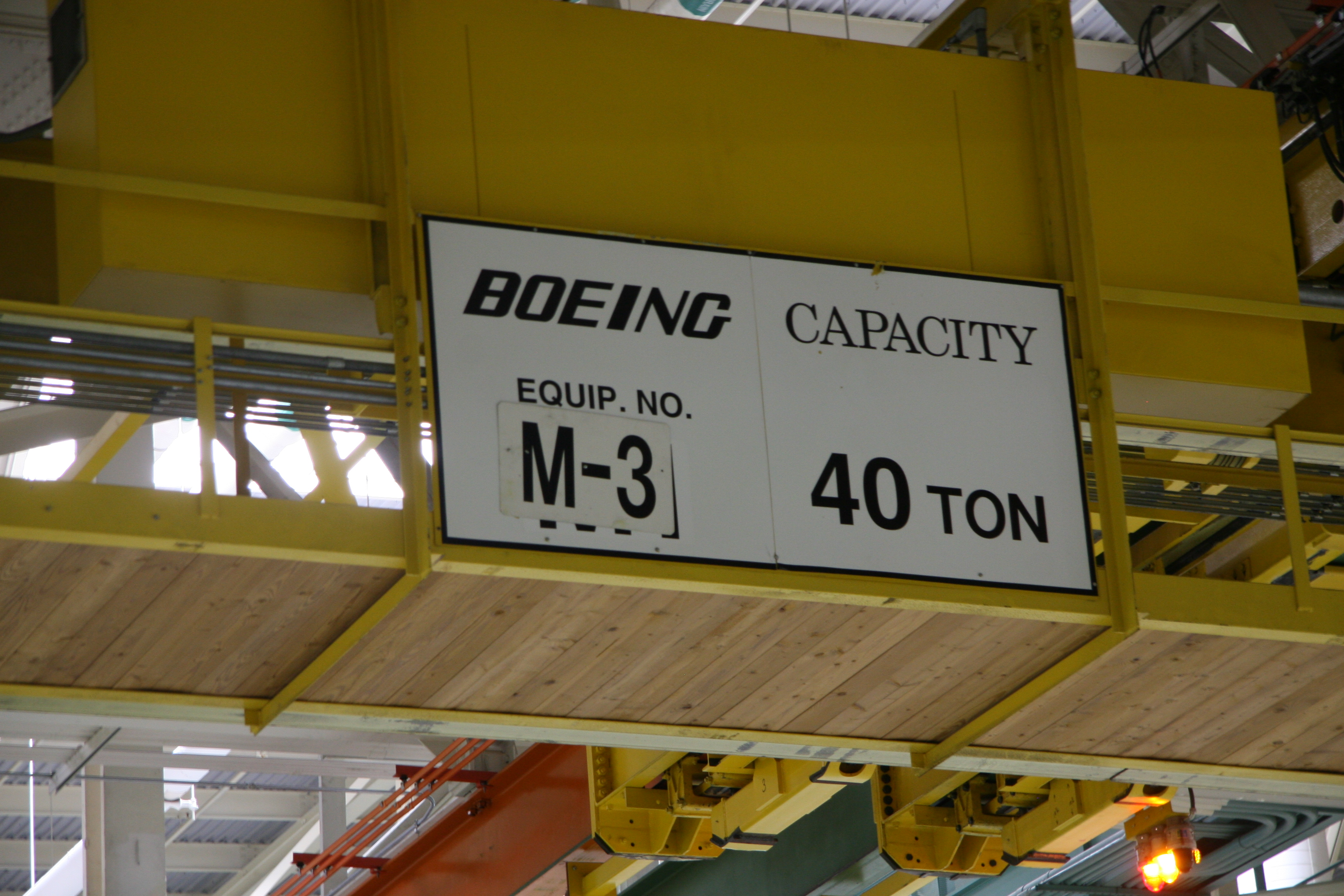 A system of rails that come down from ceiling helps to transport plane parts across the factory, and they’re quite strong. Equipment No. M-3, for instance, has a capacity of 40 tons, or 80,000 pounds.
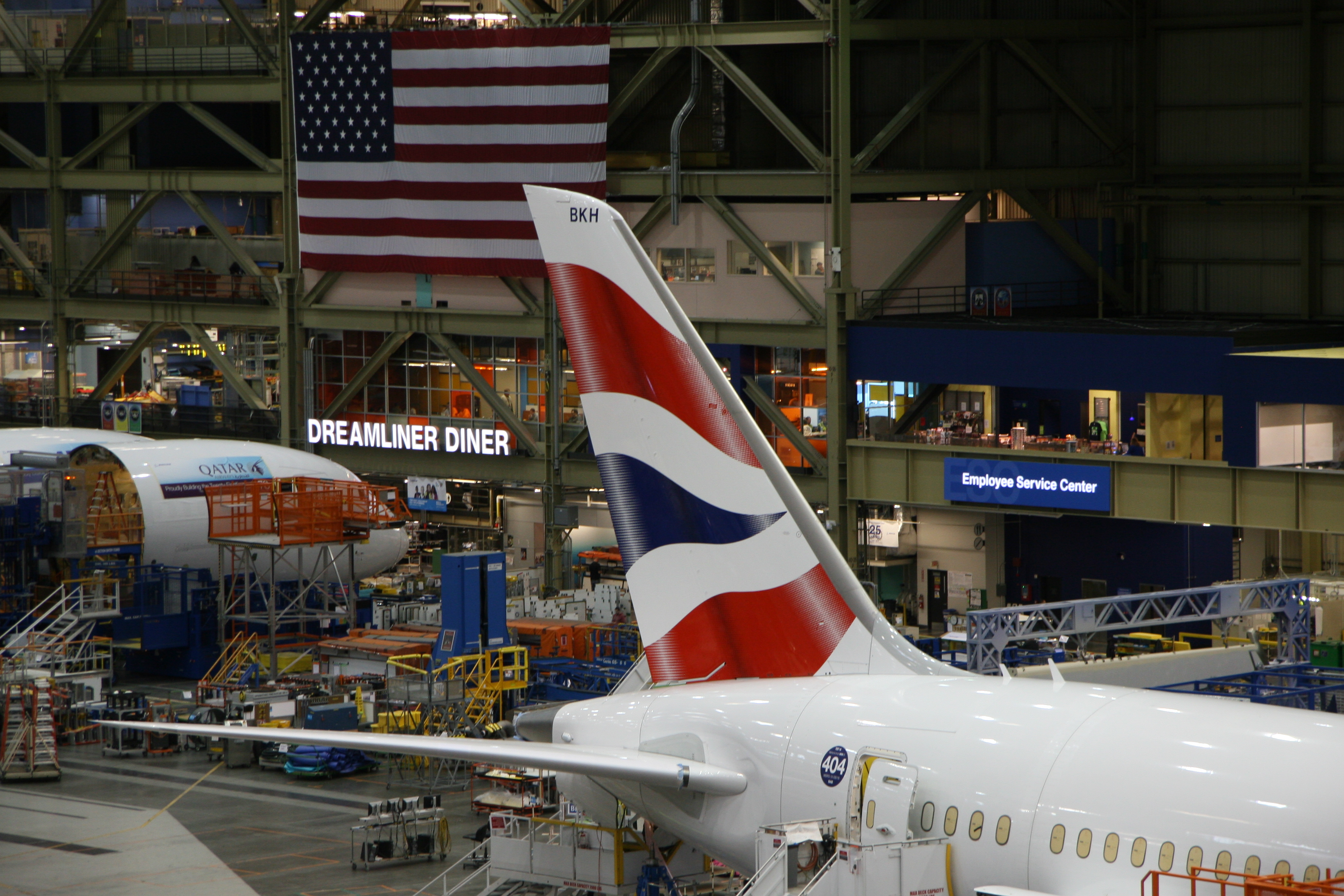
Hungry? There are 40,000+ employees at Boeing in its Seattle location, and they have the eat somewhere. One of the options is called the “Dreamliner Diner,” which is one of six different eateries inside the facility.
There’s also a dry-cleaner, movie rental shops, clothing stores, massage parlors and convenient stores littered throughout the factory. So employees never really need to leave.
The Dreamliner Diner is named after Boeing’s 787 “Dreamliner,” the most fuel-efficient airliner that Boeing produces, according to the company. Surely, it’s the most food-efficient diner at the Boeing Factory.
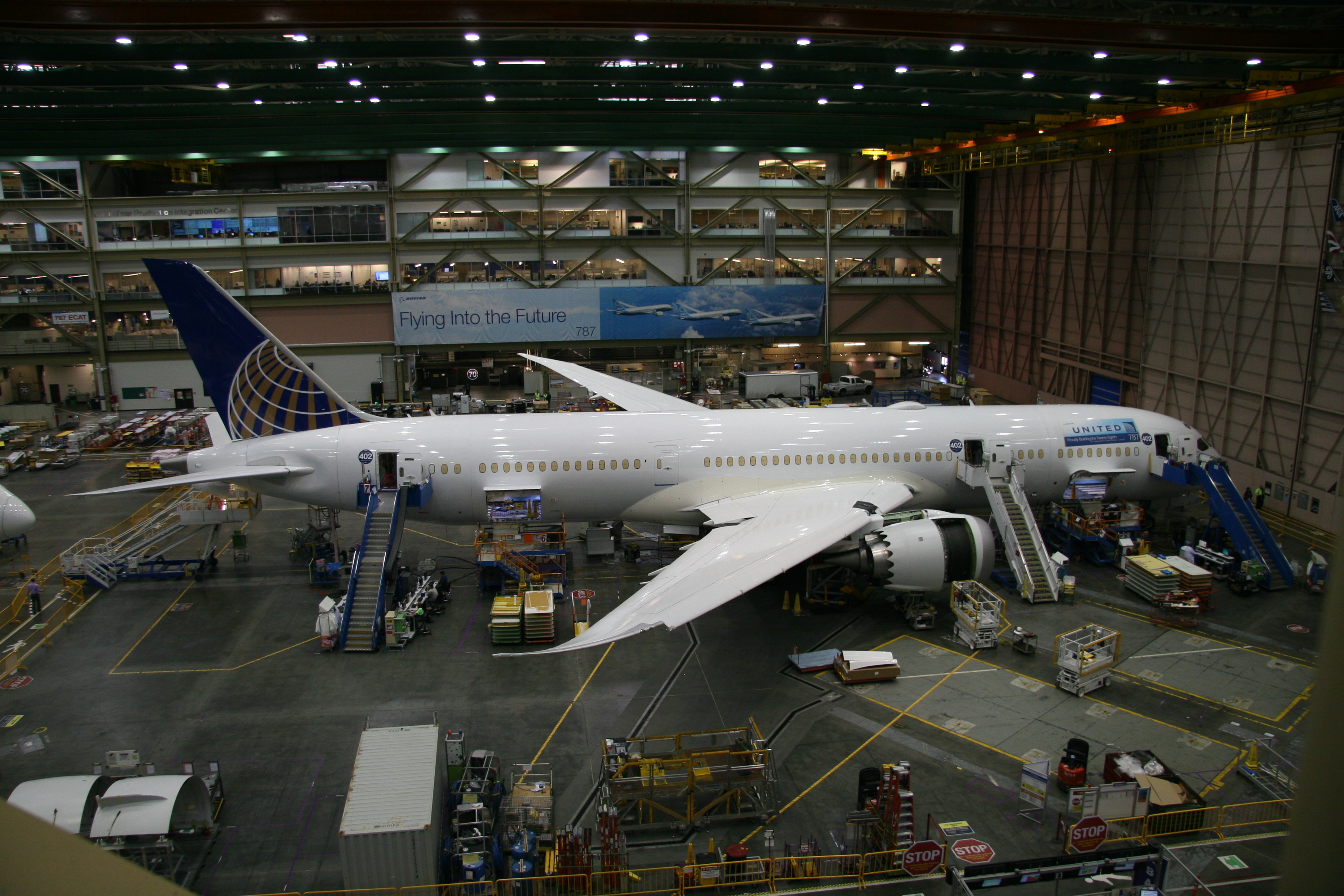
A final look before a plane flies out the door.
Going down
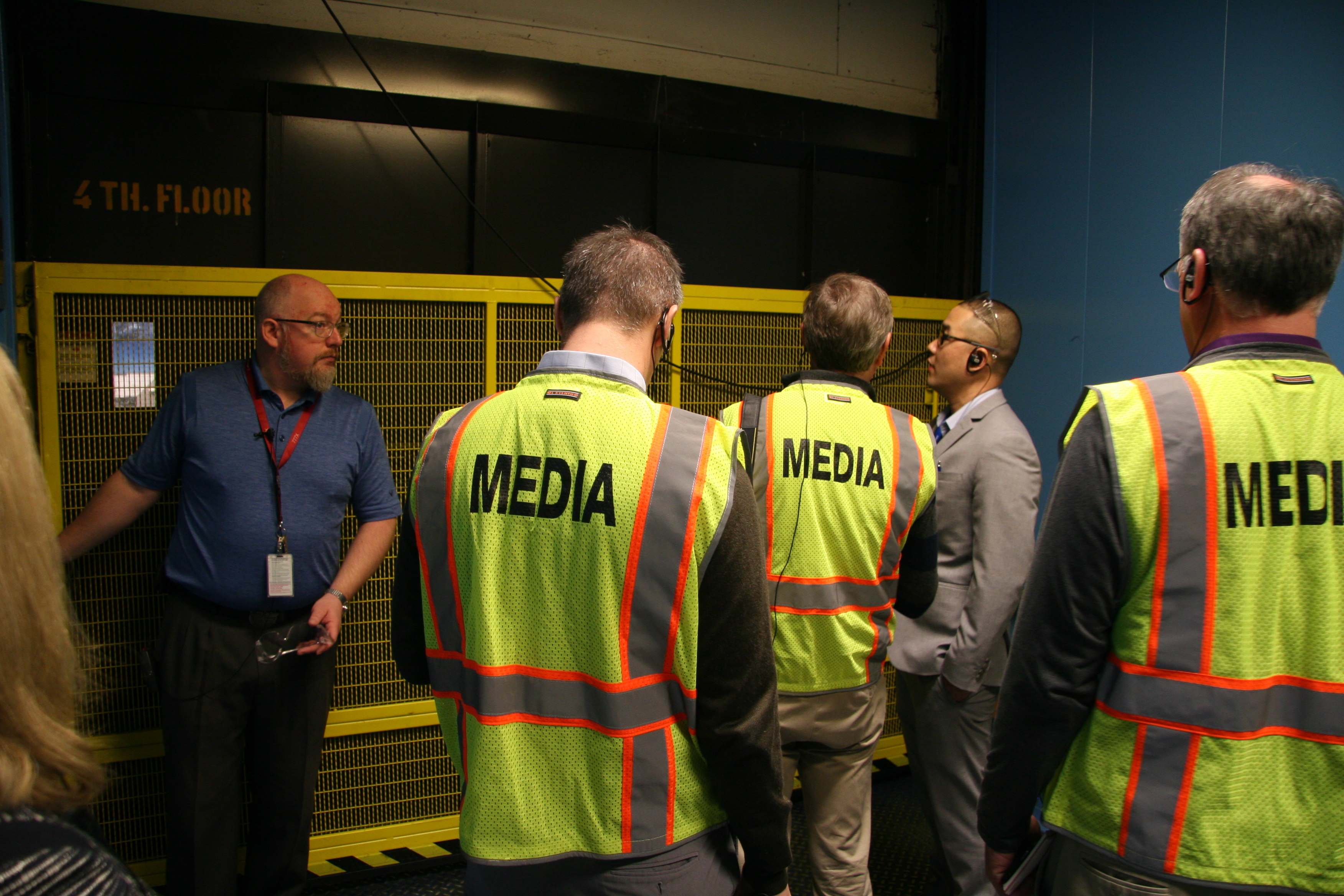
Now, let’s head to the first floor.
From the ground level
You don’t feel truly small at the Boeing Factory until you’re looking up at one of the 747s (Boeing’s biggest models), or really any of the planes during production.
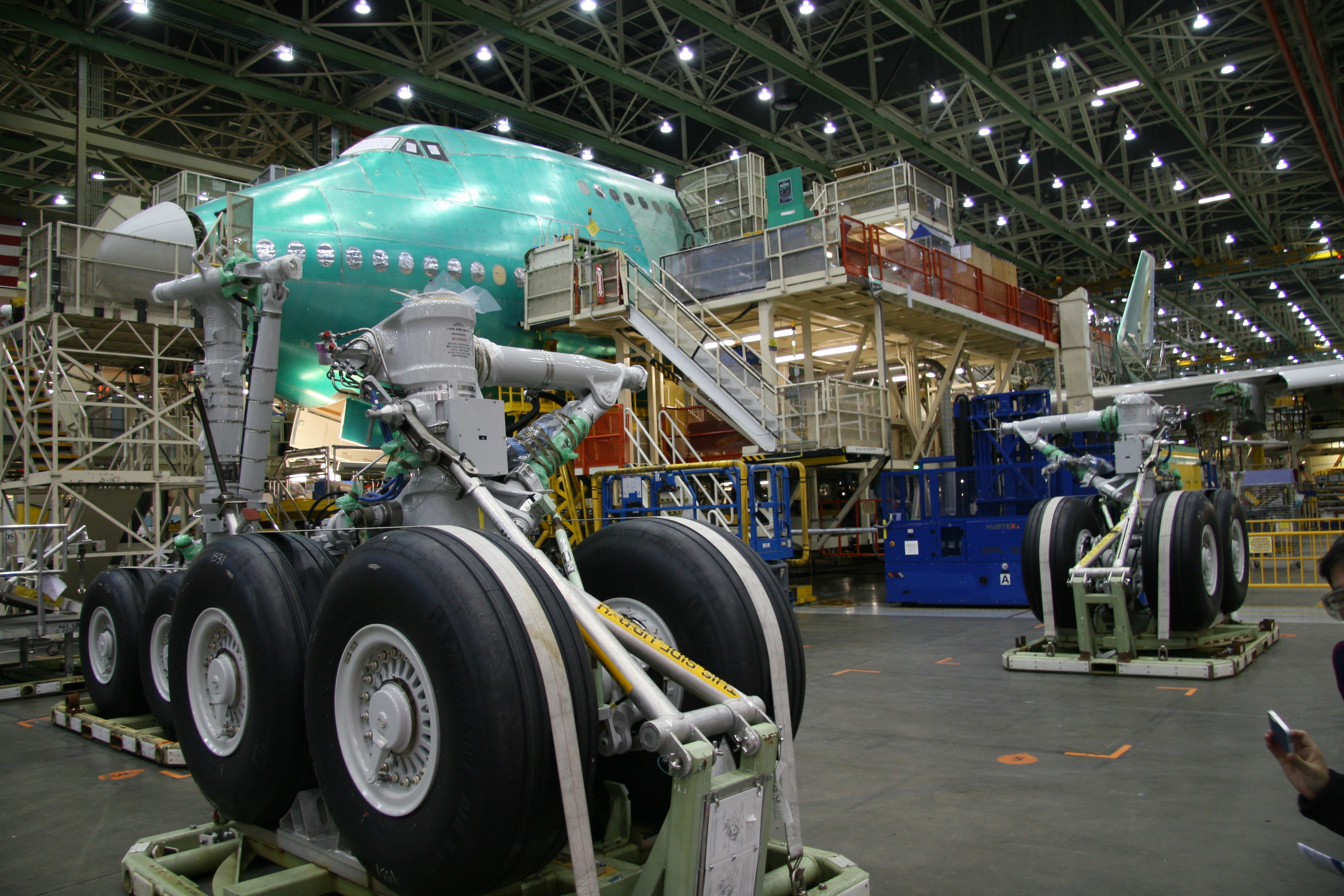
The wheels were almost taller than me. Below is a short gallery of miscellaneous photos taken of planes while on the ground floor of the factory.
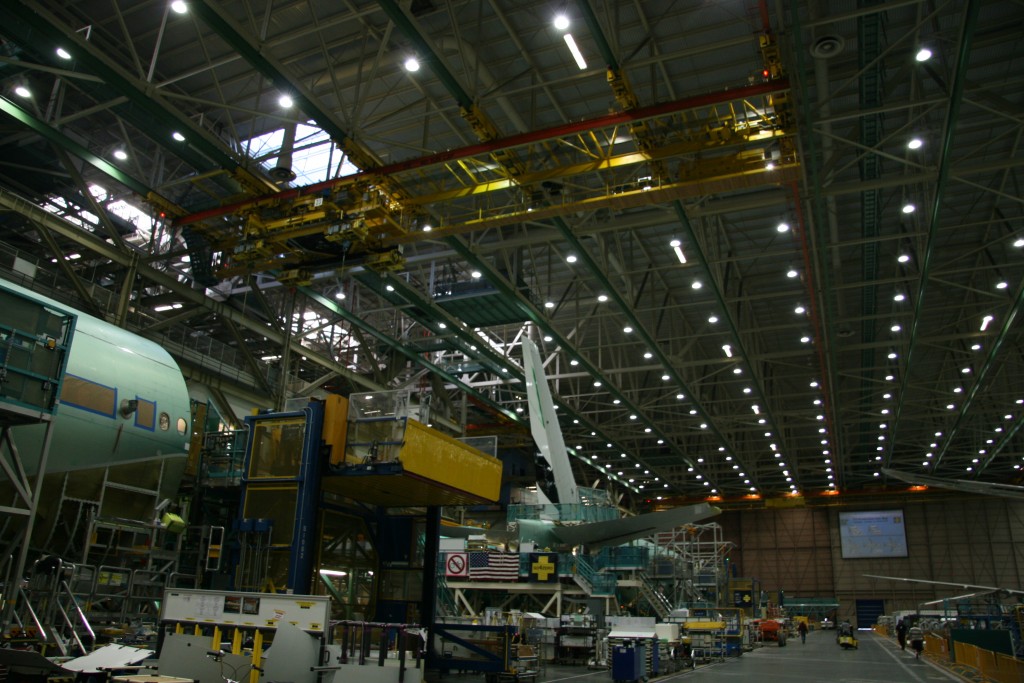
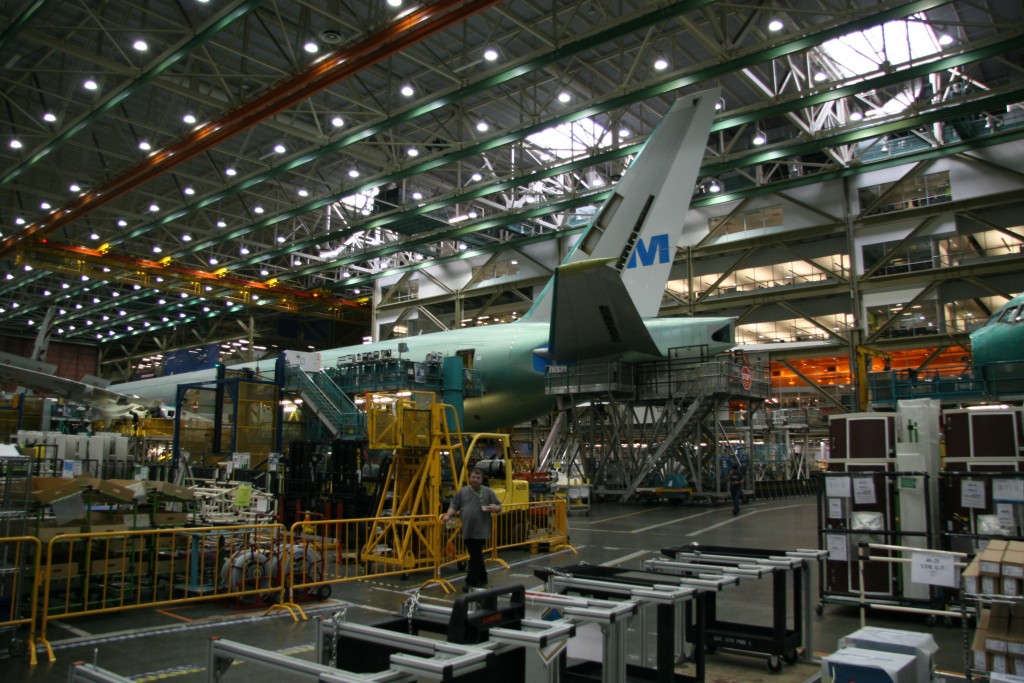

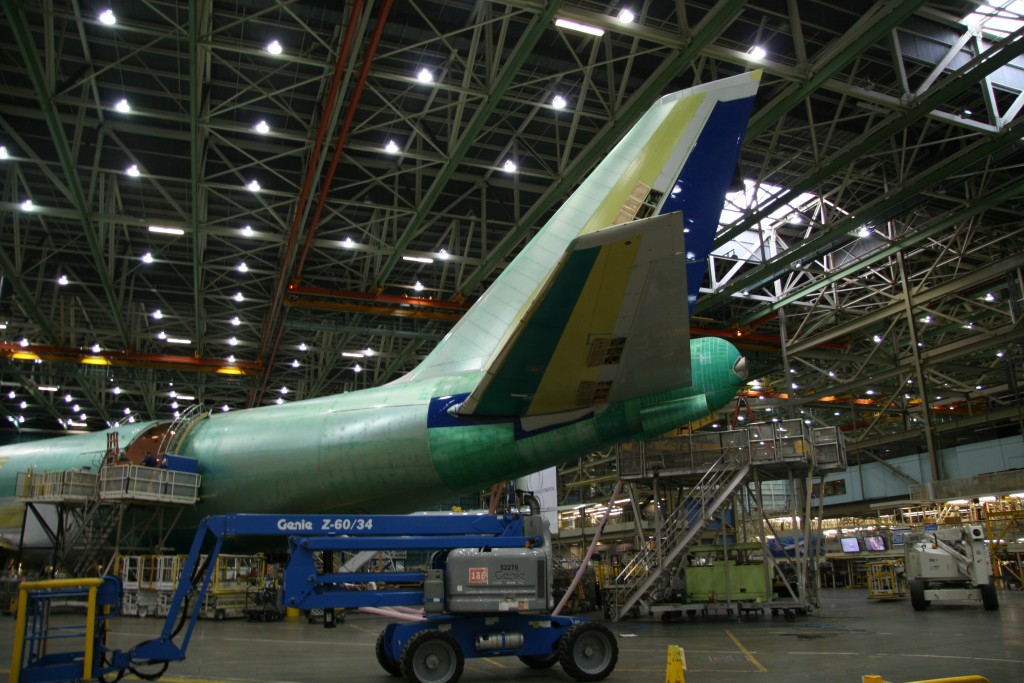
And yes, it’s really weird to see a plane inside of a building.
How do 40,000 people get around a 100-acre building?
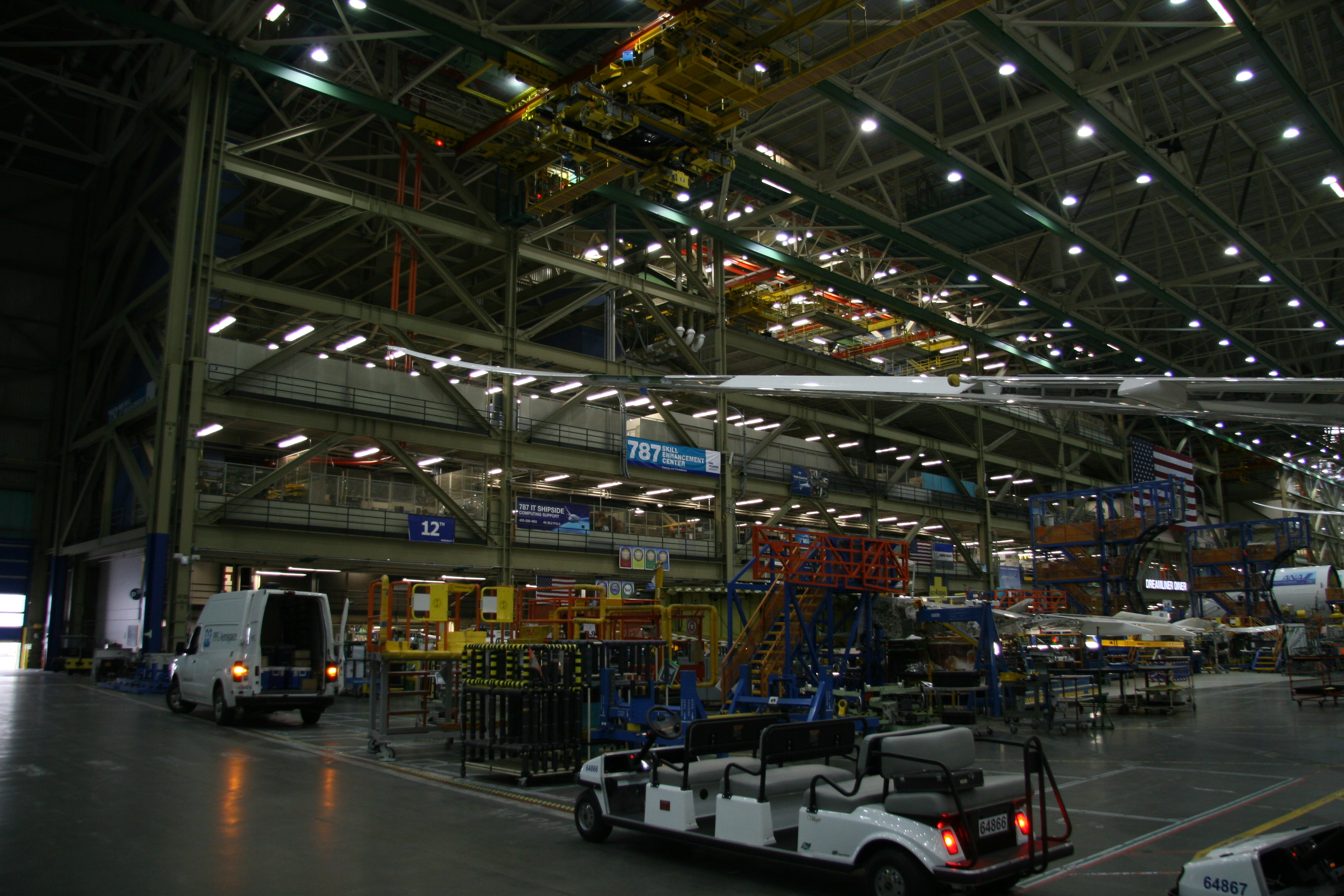
Tractors, cars, vans, golf carts…
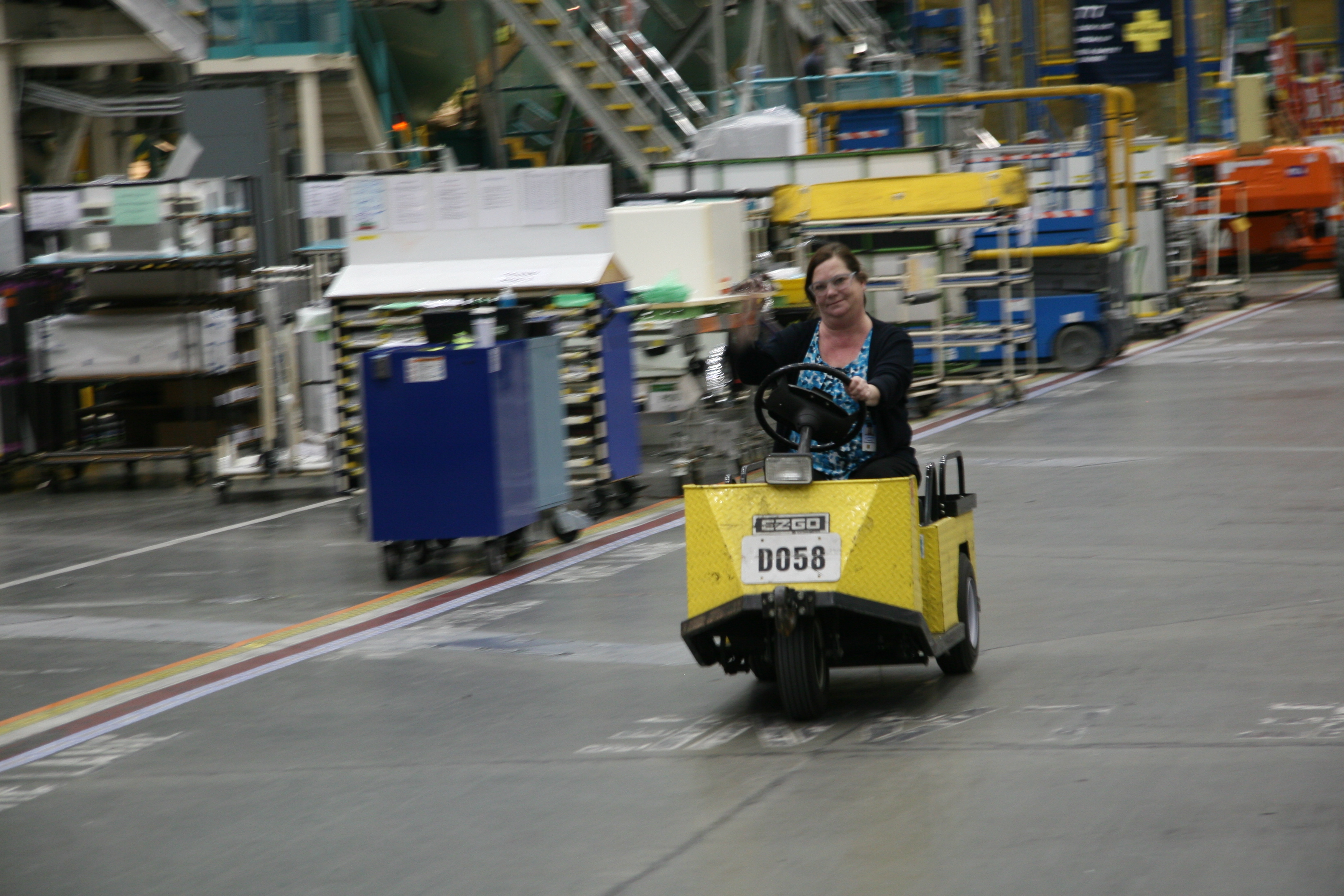
Or one of these weird 3-wheeled trolleys, which were commonly seen as a mode of transportation.
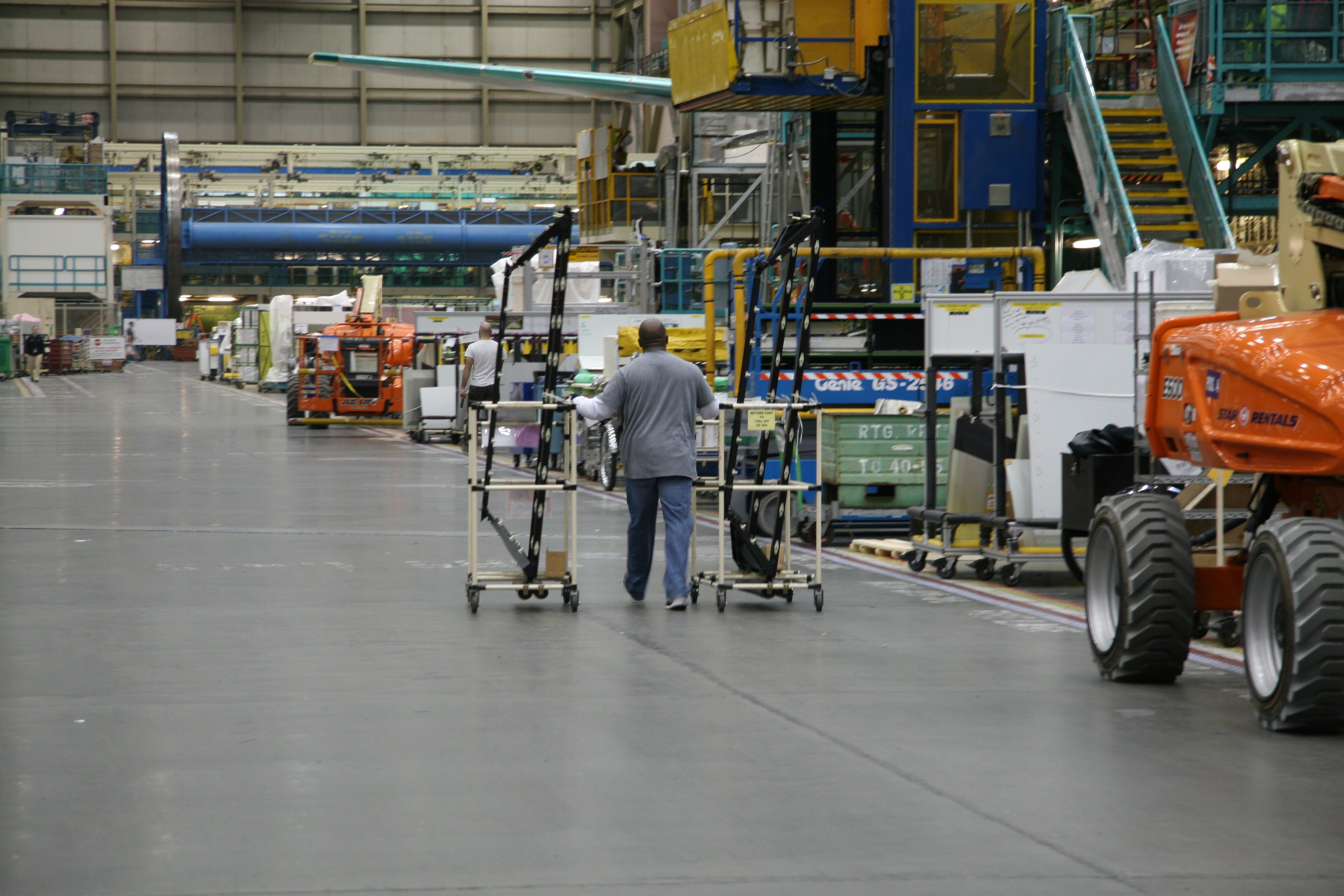 This guy was showing off how to casually stroll the factory with plane parts that stand nearly twice his height.
Off to the Dreamliner Gallery

This is where I learned how much goes into the design of the interior of airplanes. Unfortunately, I’ll never be able to take a flight again without noticing…
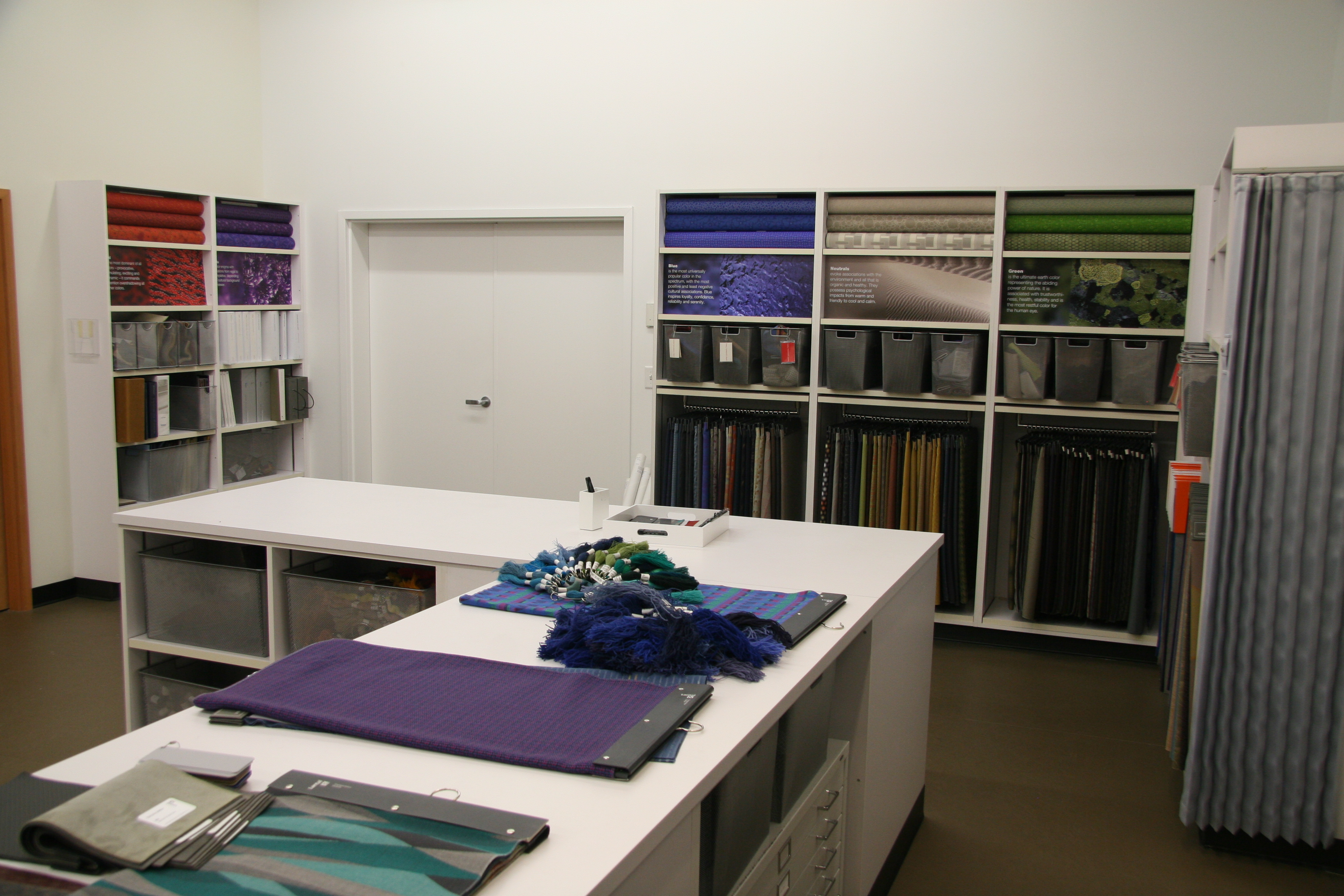
The type of carpeting in the cabin.
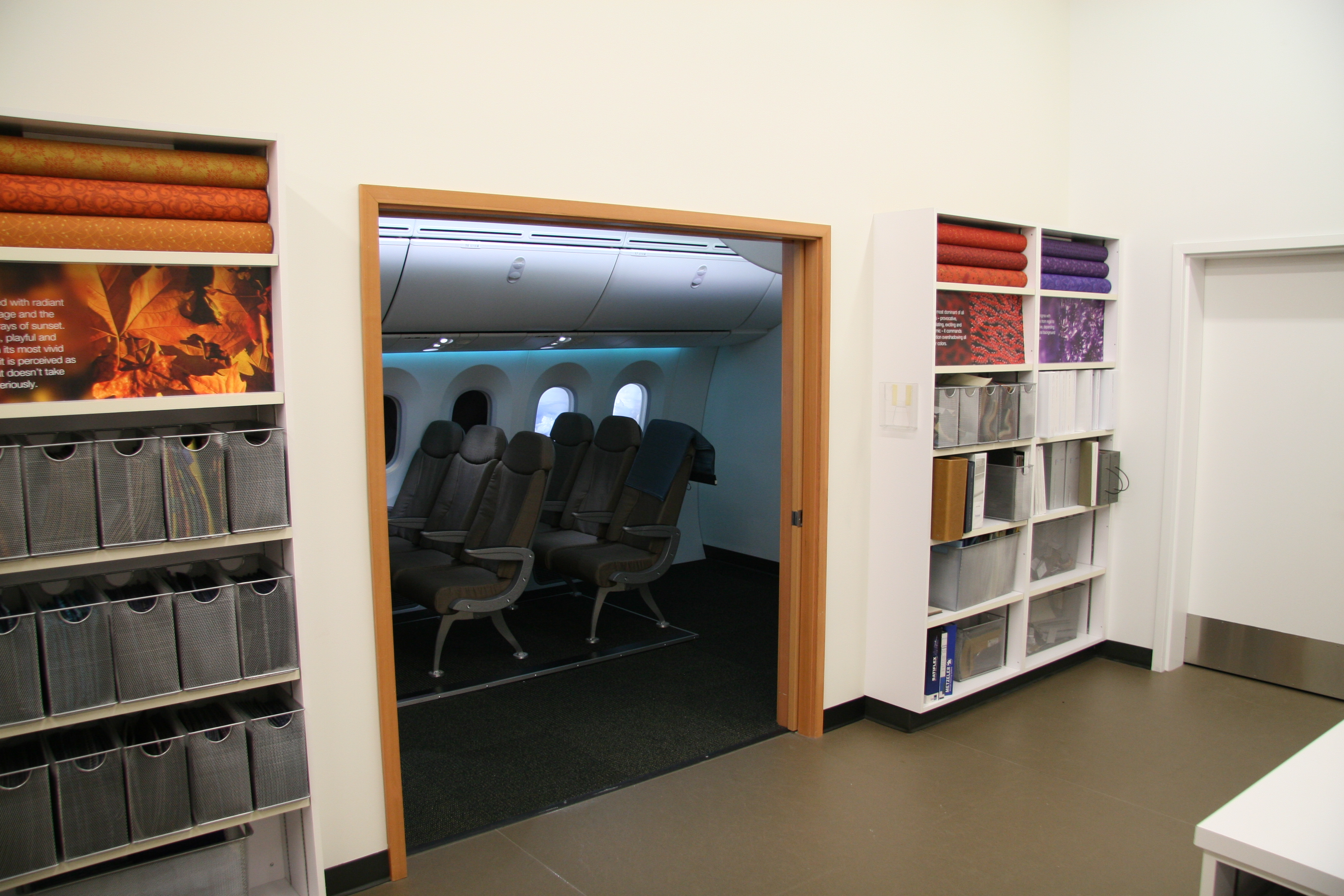
The material on the seats.
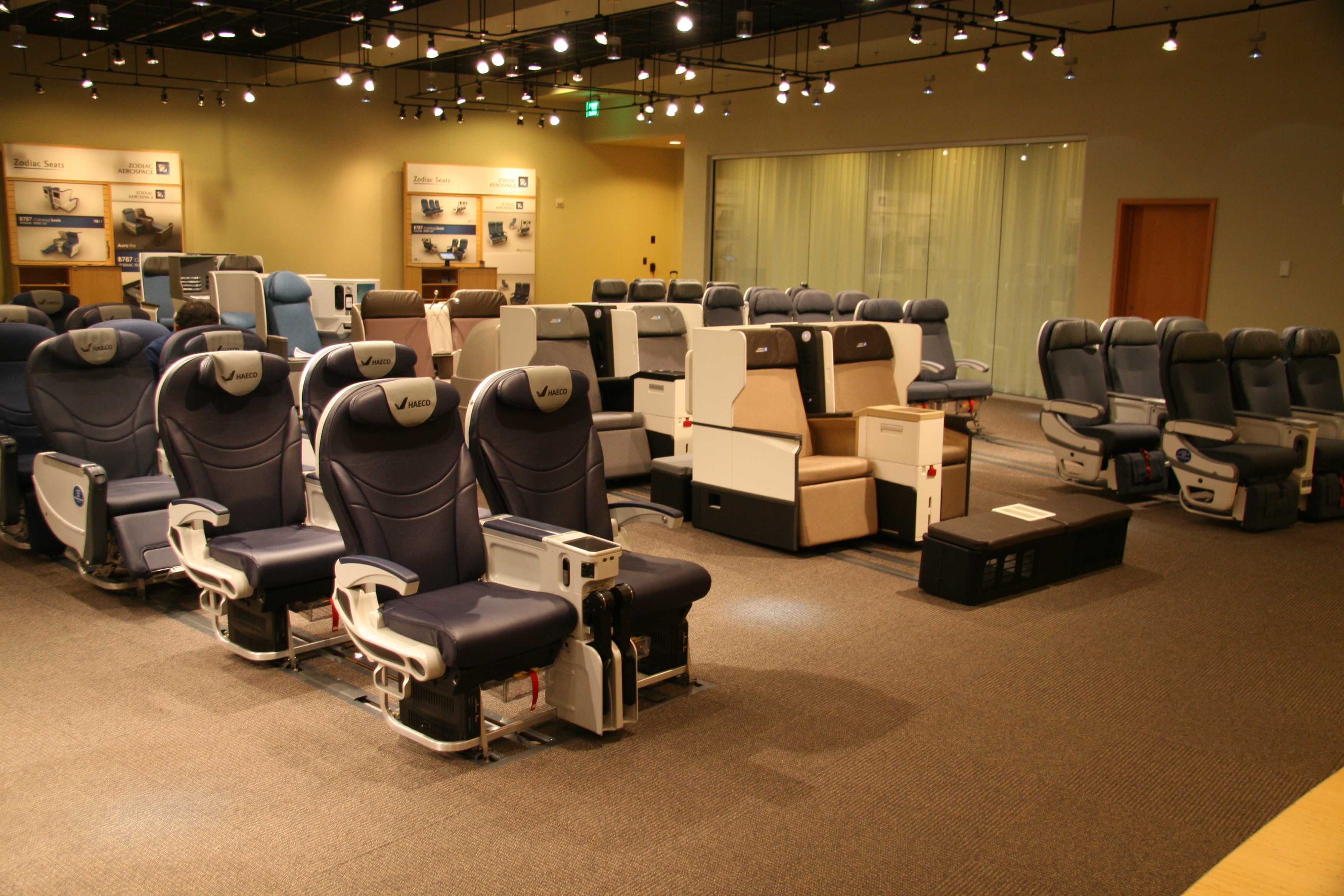
The seat styles.
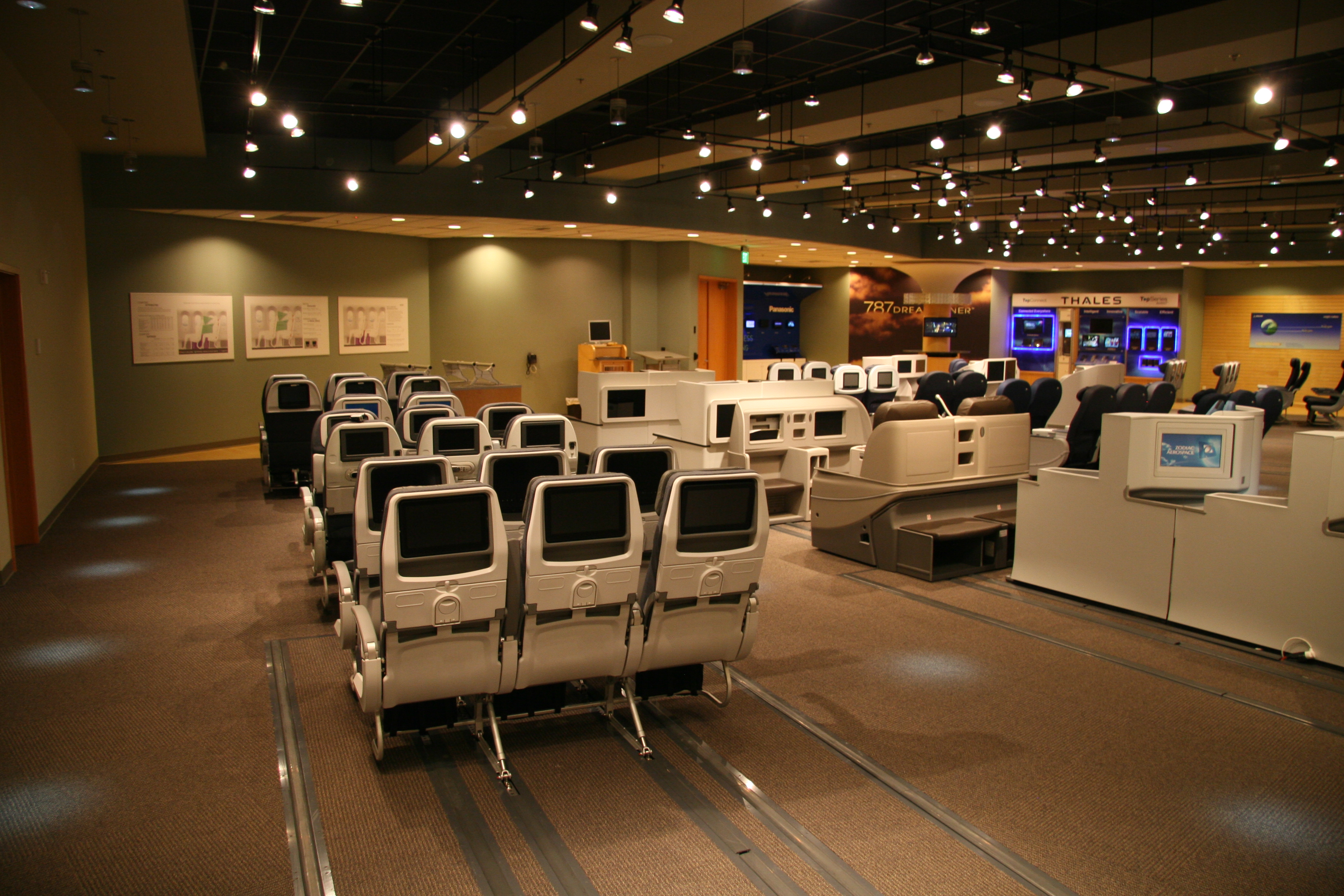
Or the TV models. I will know, however…
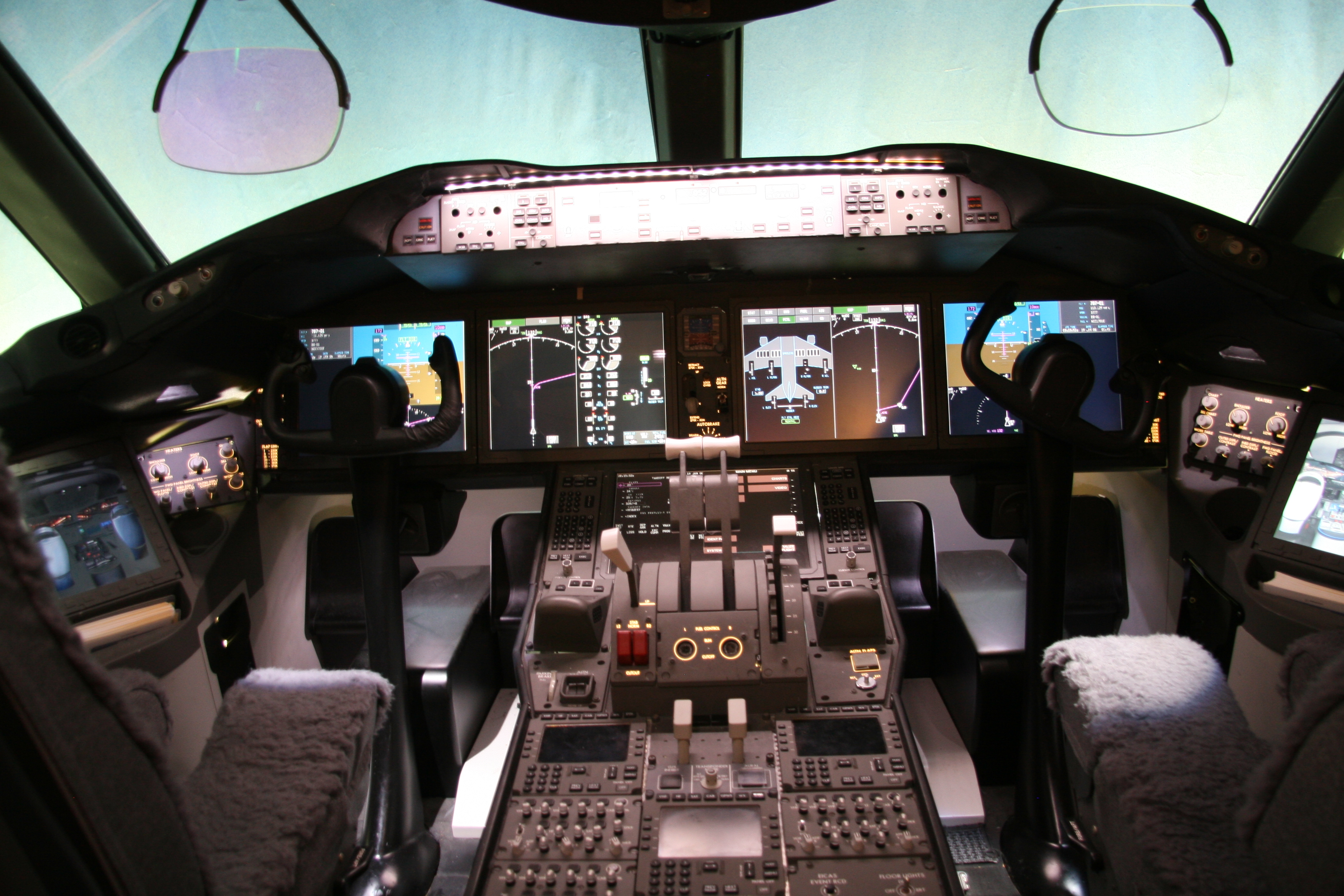
What sitting in a cockpit feels like.
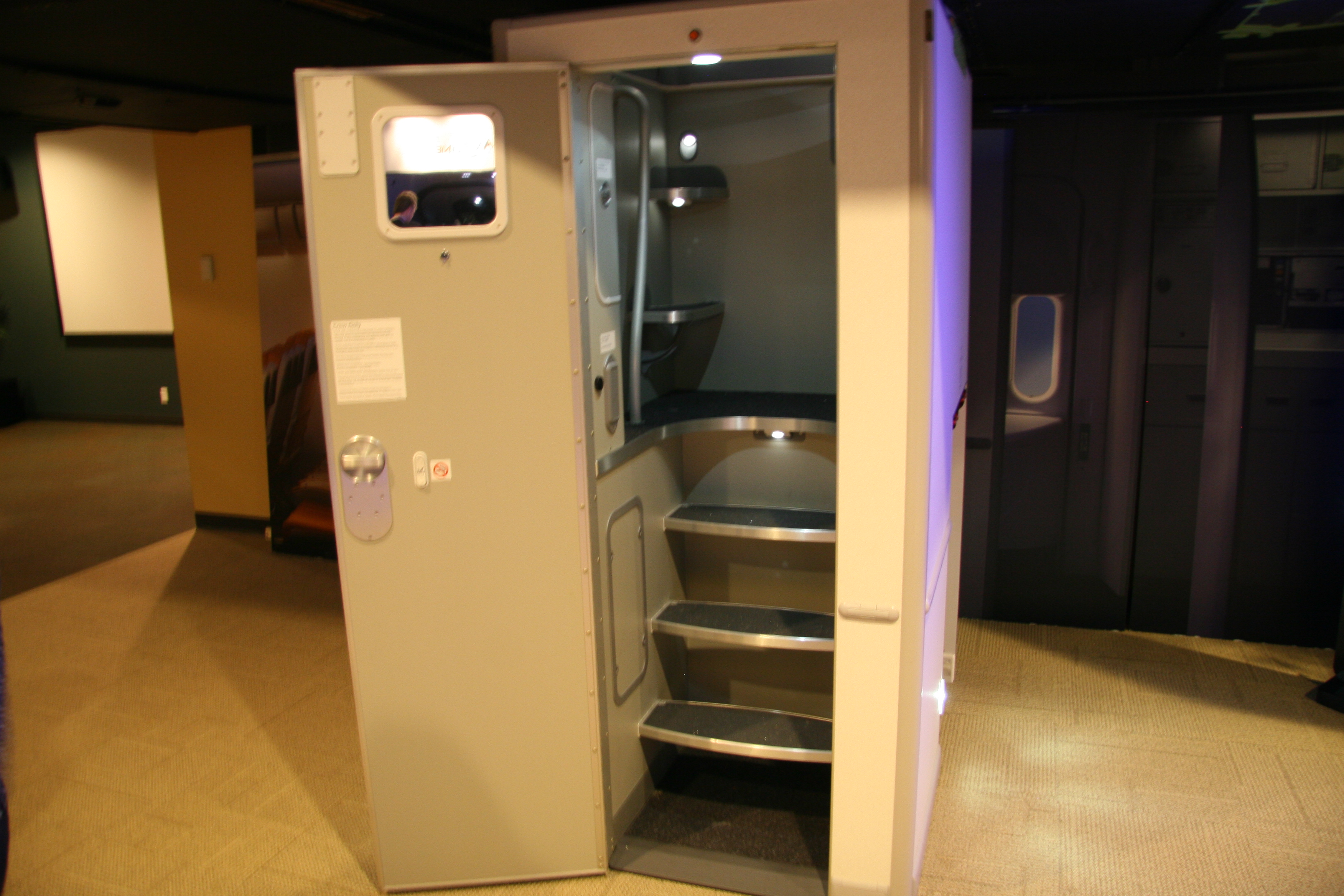
And where the flight attendees sleep on long flights.
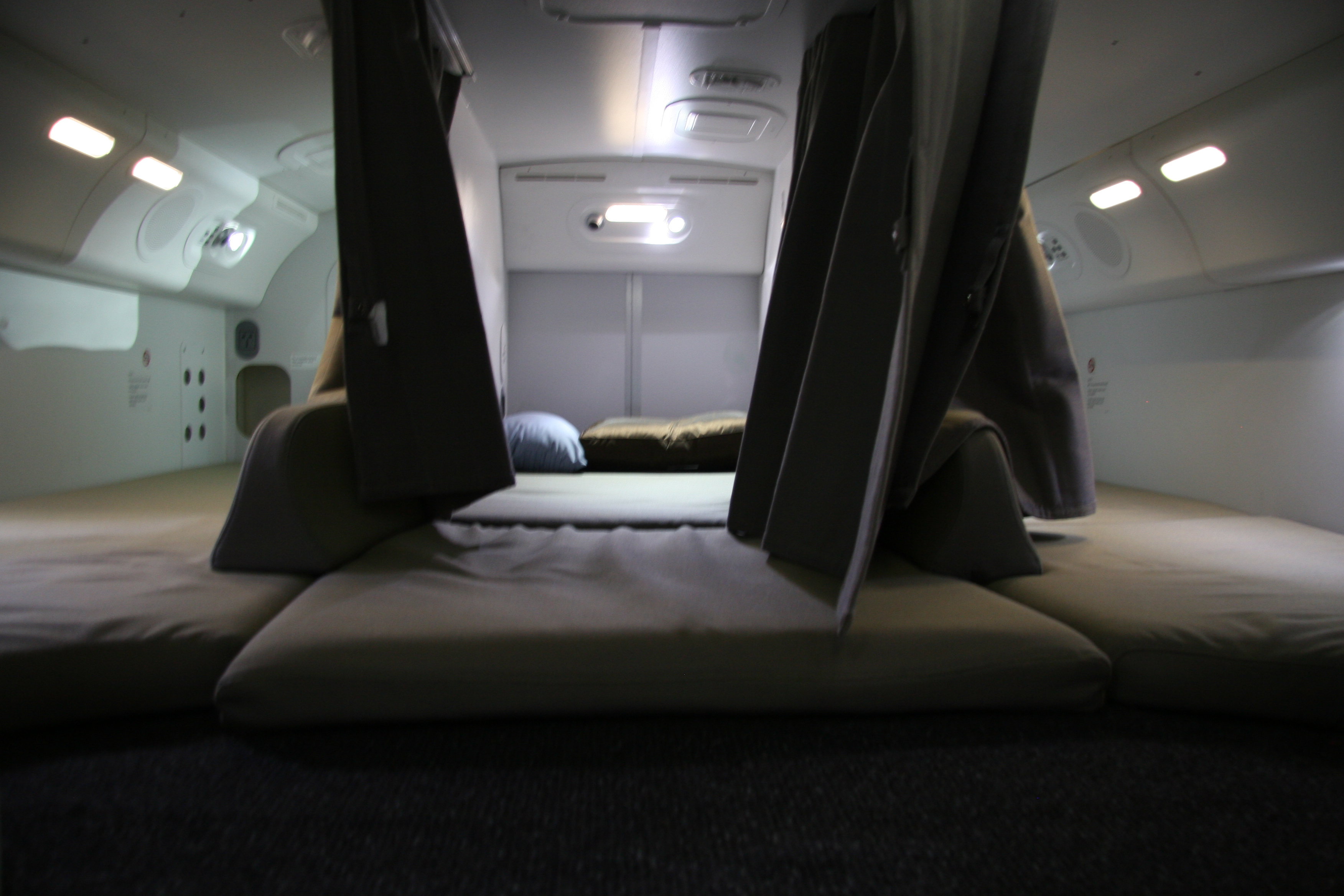 No wonder the flight attendants are always in such good spirits; they get all this leg room while us normal folks are scrunched and miserable in coach. That made the flight back from Seattle even worse, since I knew what I was missing.
Unfortunately, that concludes my tour of Boeing’s Everett Factory.
In the end, how did the final product between Boeing and Callaway stack up against the best drivers currently on the market? Check out our 2016 Gear Trials: Best Drivers Club Test for a full analysis.
Spoiler alert.
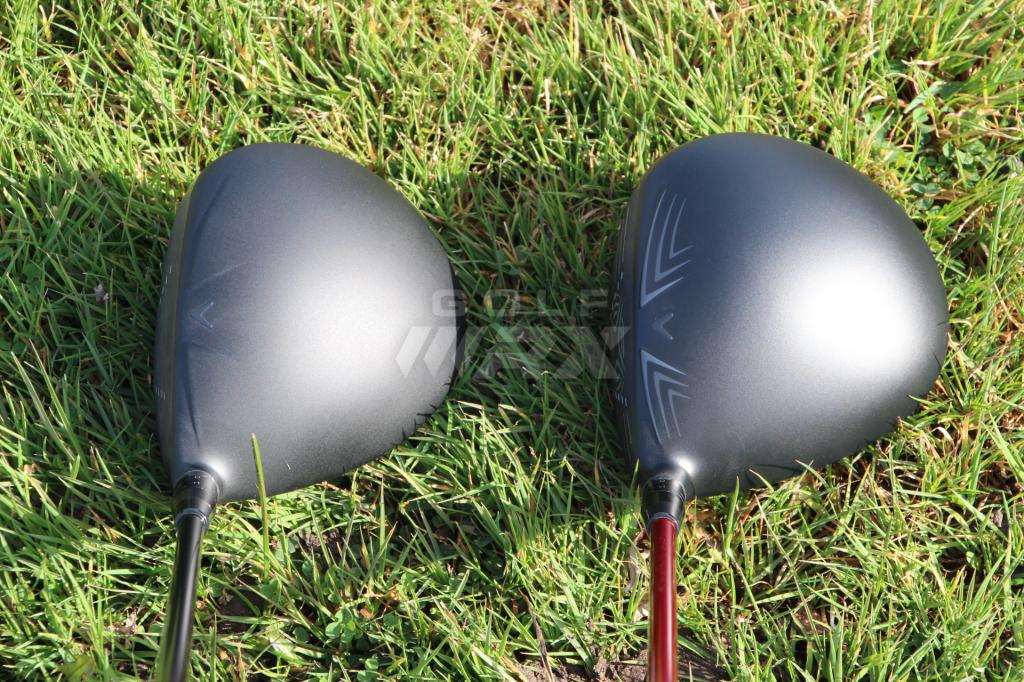
Callaway’s XR 16 Pro (left) and XR 16 Pro drivers.
Callaway’s XR 16 and XR 16 Pro were awarded with 6 total medals (1 Gold Medal, 2 Silver Medals and 3 Bronze Medals), which stacked up nicely against its competitors.






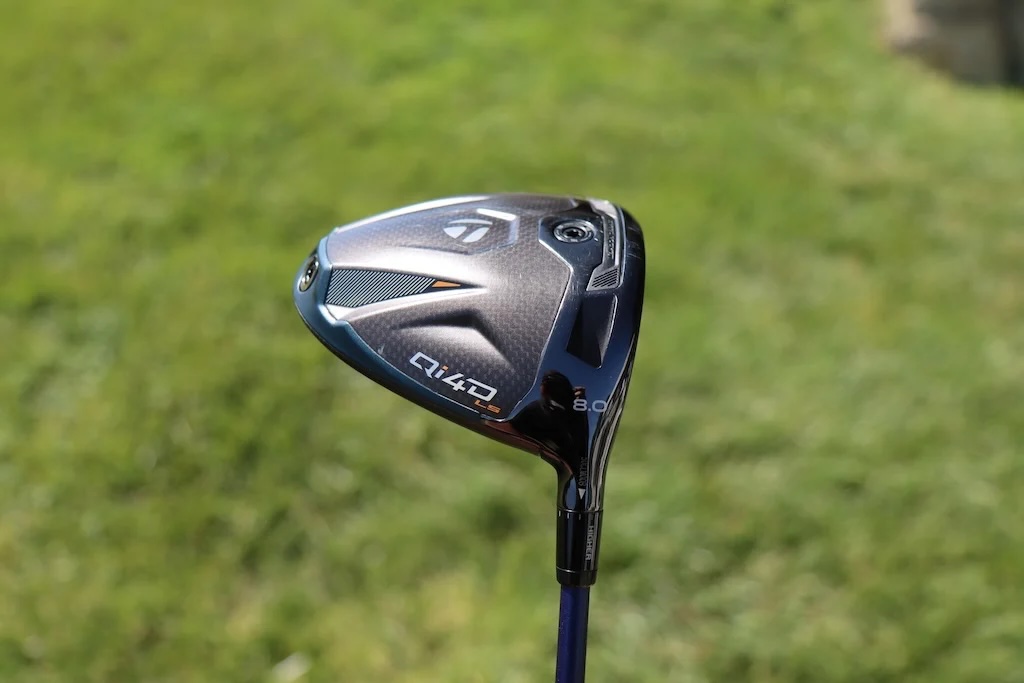
Driver: TaylorMade Qi4D LS (8 degrees)
Shaft: Fujikura Ventus TR Blue 6 X
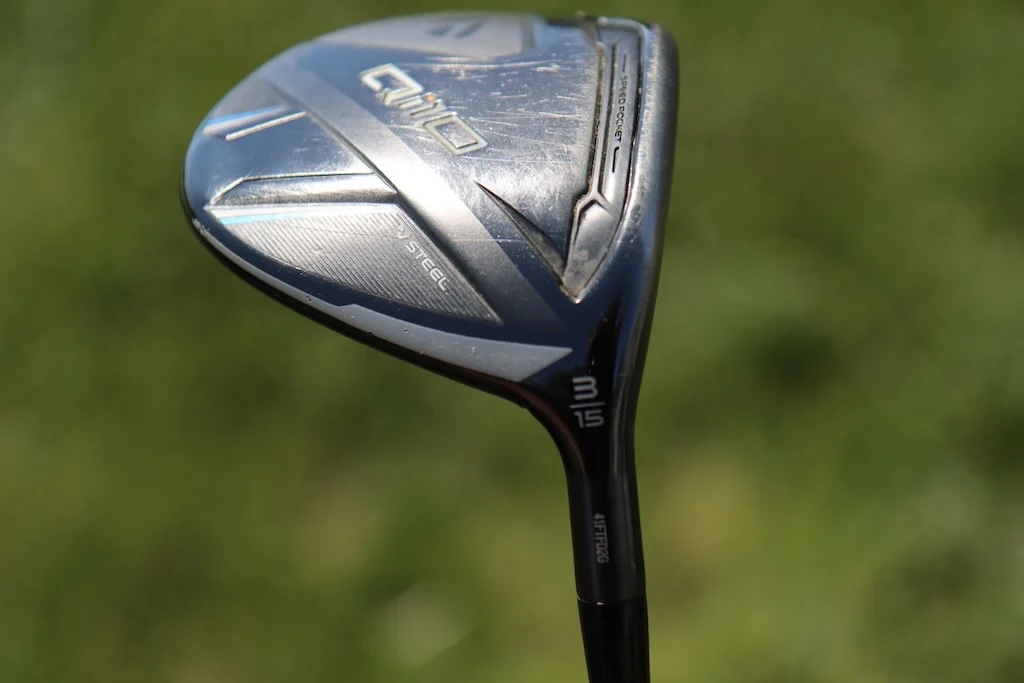
3-wood: TaylorMade Qi10 (15 degrees)
Shaft: Fujikura Ventus Black 9 TX
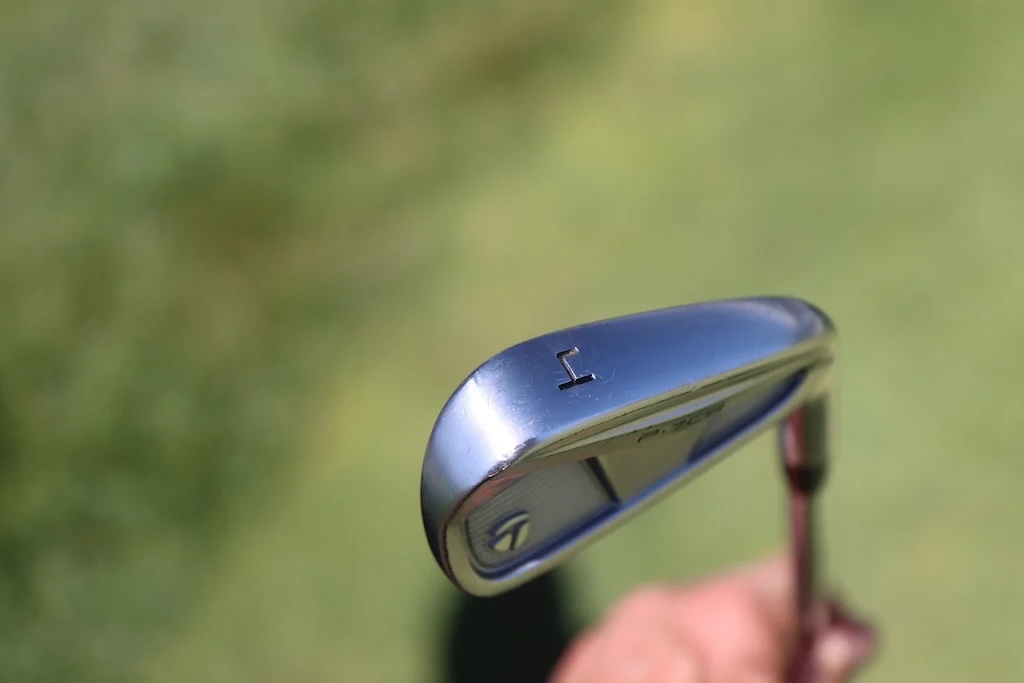
Irons: TaylorMade P770 (3), TaylorMade P7CB (4), TaylorMade P7TW (5-PW)
Shafts: Fujikura Ventus Black HB 10 X, True Temper Dynamic Gold X100
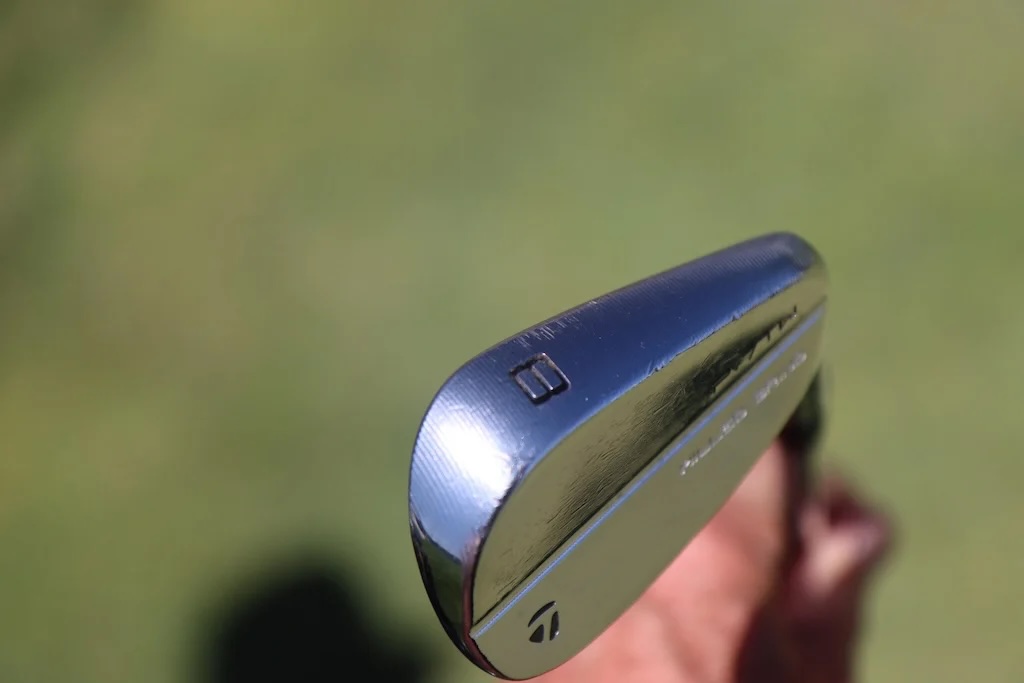
Wedges: TaylorMade Prototype (50-SB09), TaylorMade MG5 (56-HB12, 60-LV07)
Shafts: True Temper Dynamic Gold S400
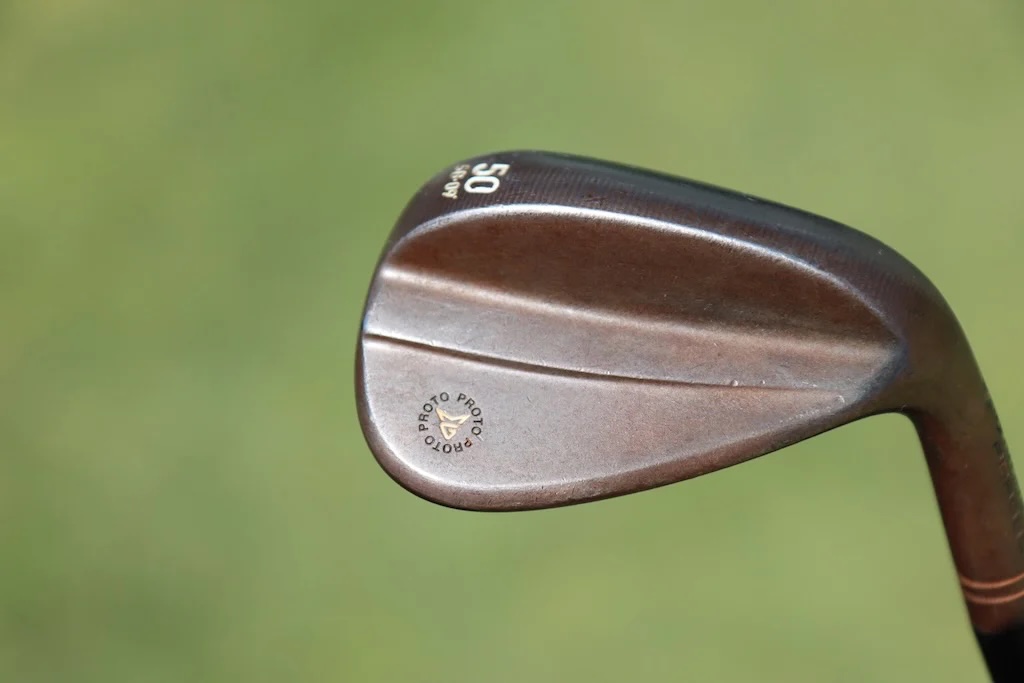
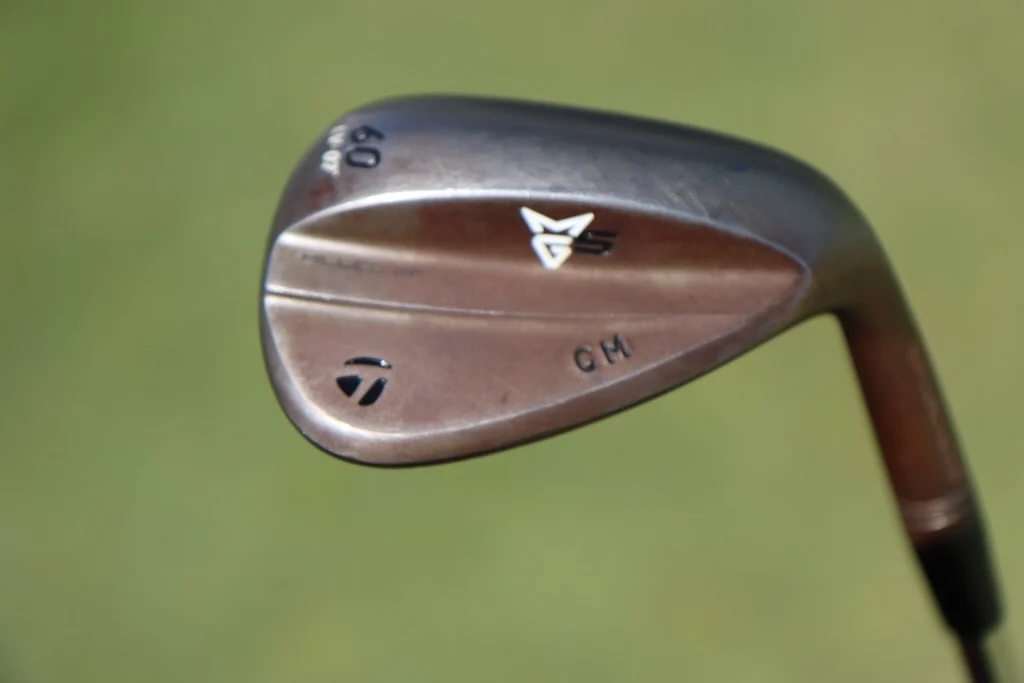
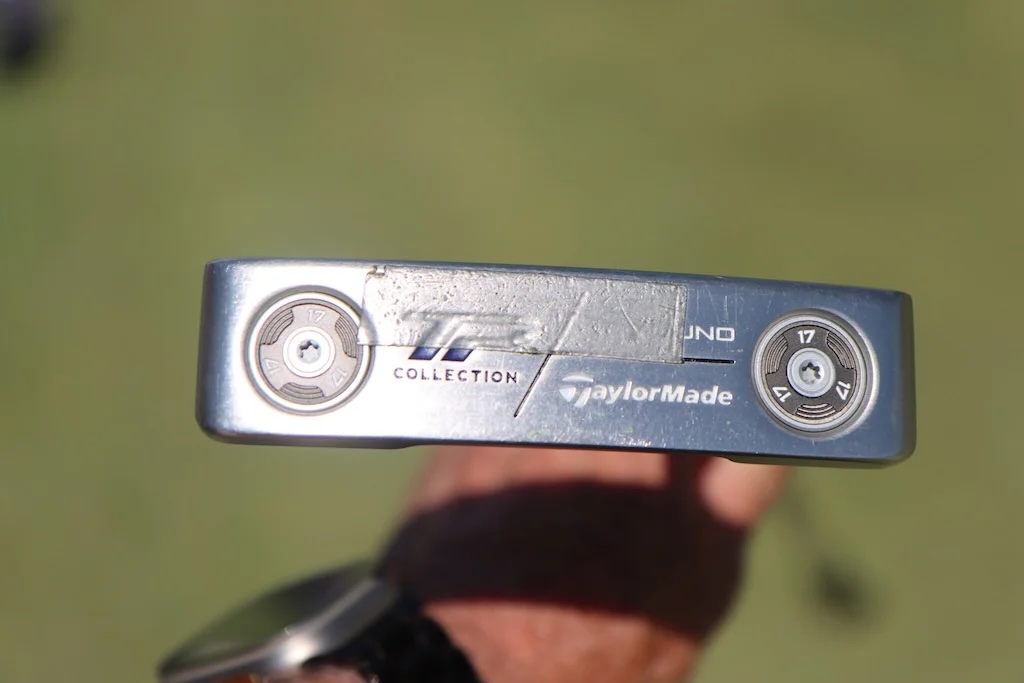
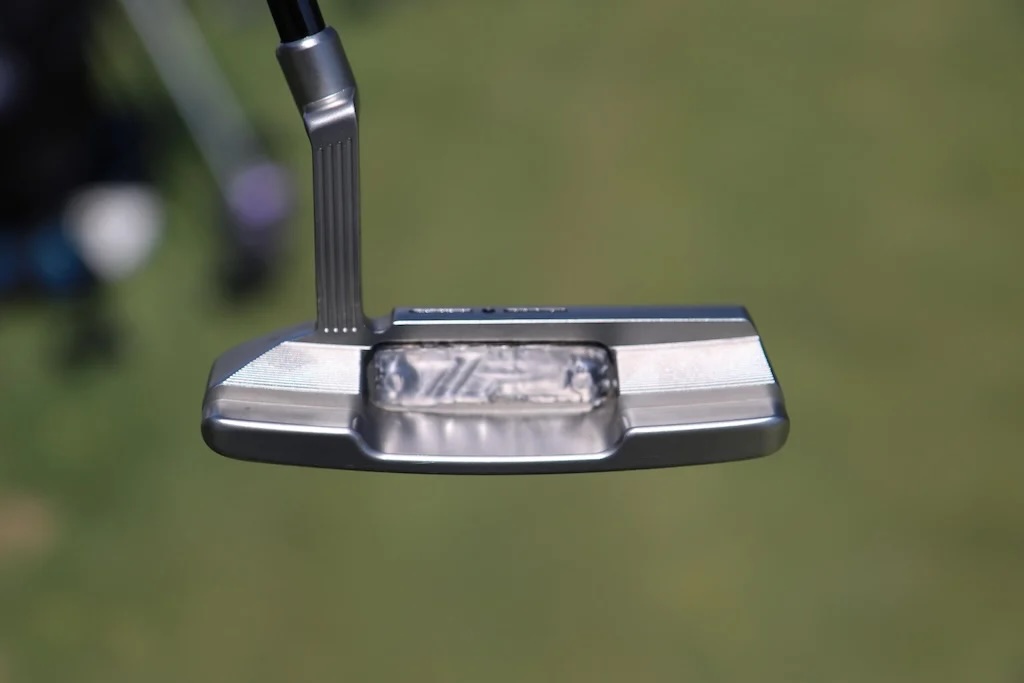
Putter: TaylorMade TP Juno
Ball: Titleist Pro V1x
Grips: Golf Pride Tour Velvet Cord
Check out more in-hand photos of Christiaan Maas’ clubs here.
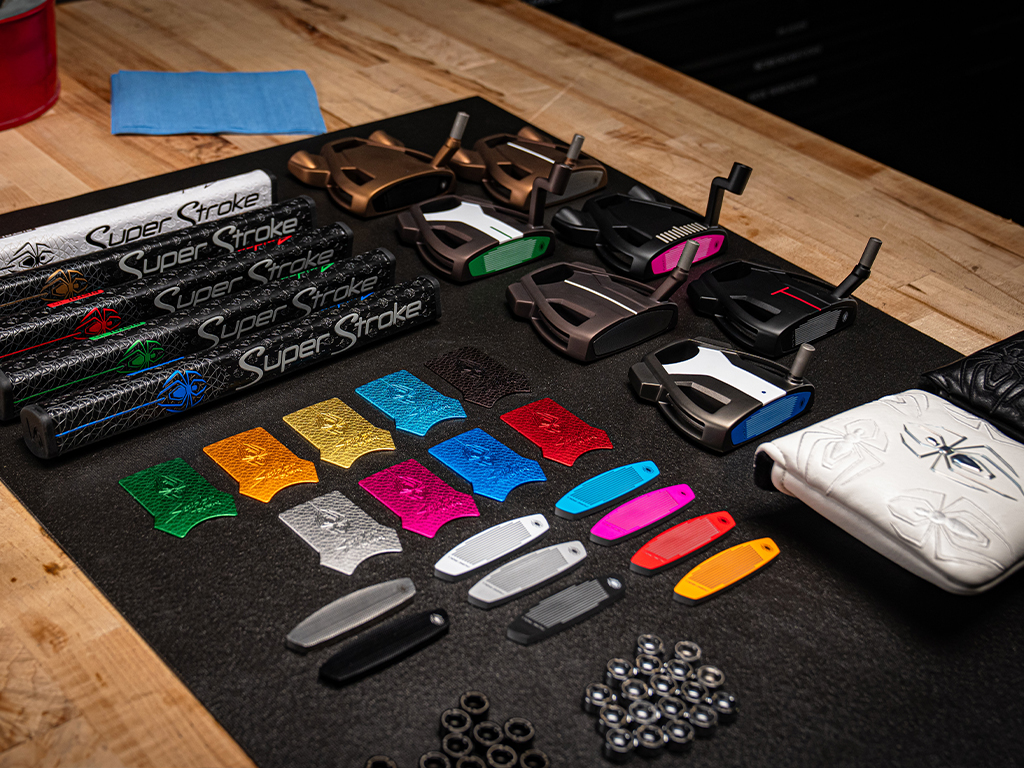
TaylorMade Golf’s MySpider program underwent a substantial overhaul over the last month. Firstly, the company launched the option to customize the Spider ZT model, and now the program has returned with the MySpider Tour and MySpider Tour X.
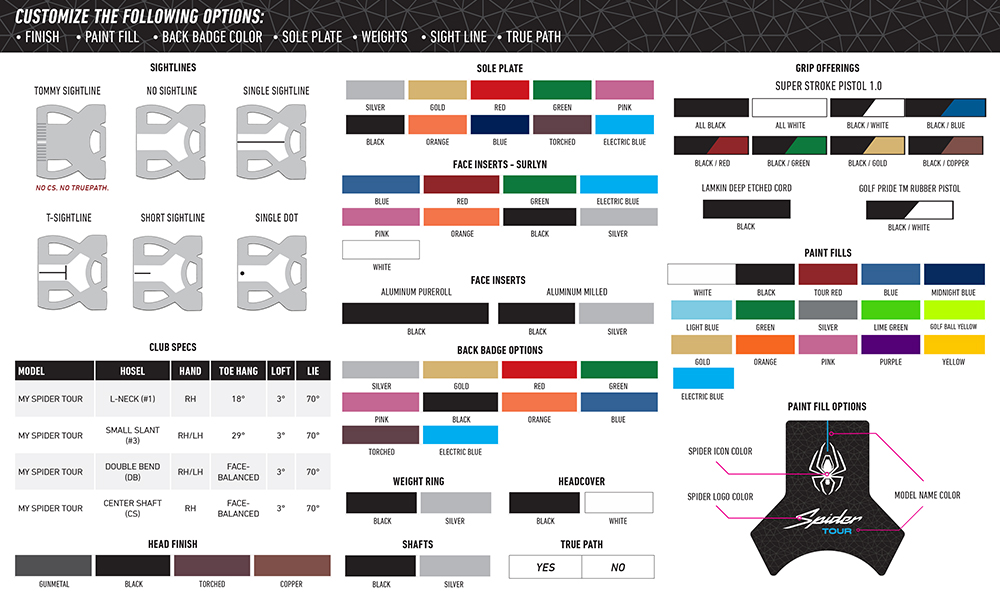
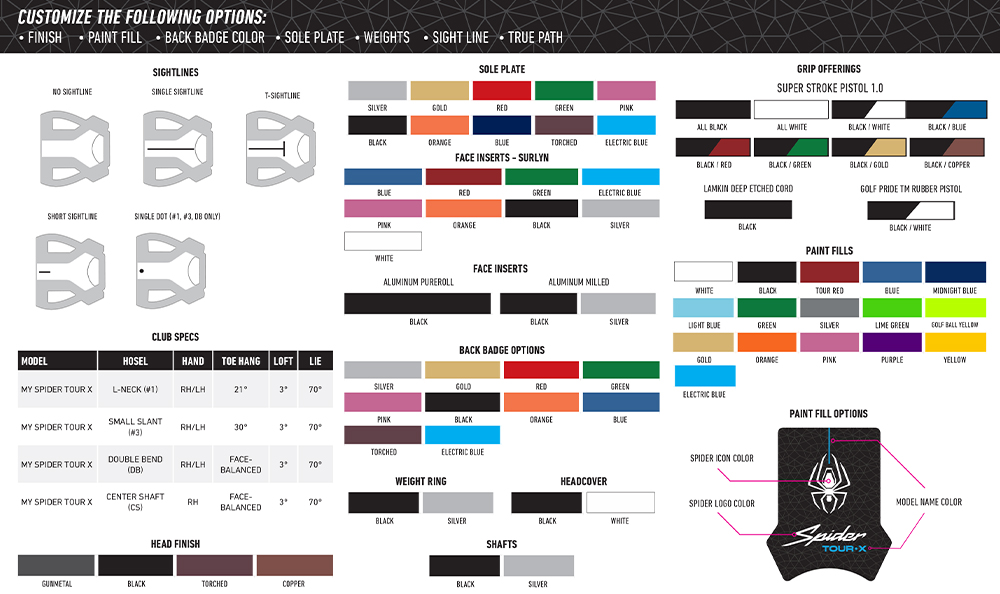
The revamped page now gives golfers complete control over every visual and functional detail of their putter on the popular Tour and Tour X head, with every cosmetic idea thought of. In MySpider Tour, golfers can choose from four head finishes, 16 paint fill colors, nine Surlyn face insert colors, three aluminum insert options, six sightline configurations, and four hosel options — L-neck, small slant, double bend, center shaft. Six sightline options are available in MySpider Tour, including the optically engineered True Path alignment system. MySpider Tour X gives builders the option of four head finishes, four hosel configurations, and five sightline options, also including True Path alignment.
One of the more interesting features of the new MySpider program is the availability of three distinct face insert options. Along with the usual Surlyn Pure Roll insert trusted by Scottie Scheffler and Rory McIlroy, which can be customized from nine colors, golfers can now also select firmer options. Two are offered with the black aluminum Pure Roll insert, slightly firmer than the traditional insert, or for the firmest feel, golfers can choose from two colors of milled aluminum inserts.
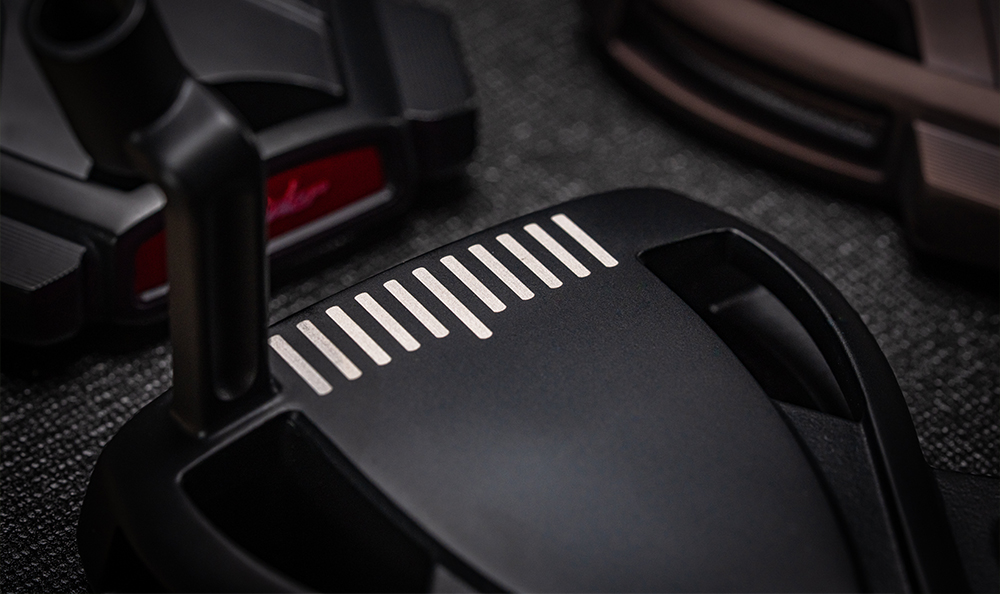
Another fun addition to the MySpider Tour is the ability to use the “Tommy Sightline.” The custom alignment aid design, which was first drawn onto Tommy Fleetwood’s putter by PGA Tour Rep James Holley, is based on the milled sightline on his Spider ZT head. There are five shorter lines on the left and right of a longer central line serving as the traditional short line alignment aid.
See below for the full specifications sheet for MySpider Tour and Tour X:
MySpider Tour
MySpider Tour X
Equipment
Then and now: Comparing Rory McIlroy’s current setup to his record-breaking 2019 Canadian Open victory

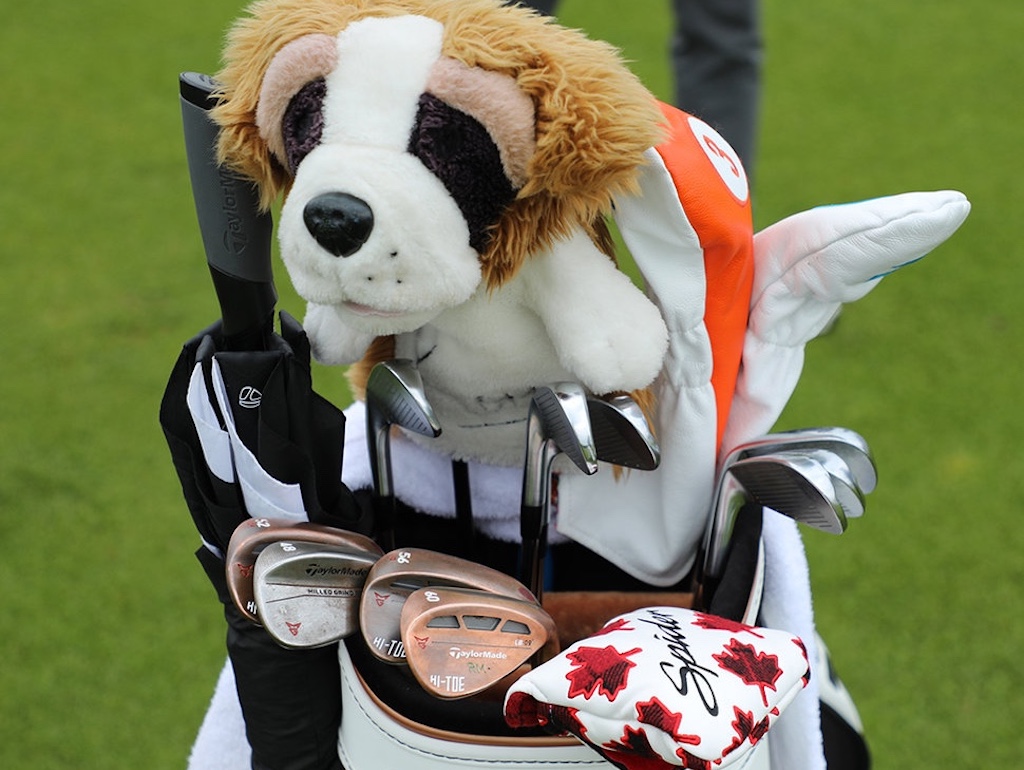
In Rory McIlroy’s first appearance at the 2019 RBC Canadian Open, he crushed the record books to earn his 16th PGA Tour title in dominating fashion, winning by seven shots over Shane Lowry and Webb Simpson.
McIlroy’s score of 22-under-par 258 is the lowest 72-hole score to date at the Canadian Open, and his closing 61 is also the best final-round score in the history of one of golf’s oldest tournaments. Finally, with his win in 2019, McIlroy became only the sixth player to win the career Triple Crown, adding to his victories at the U.S. Open in 2011 and The Open Championship in 2014, joining Tommy Armour, Walter Hagen, Arnold Palmer, Lee Trevino and Tiger Woods in a coveted list.
So, with that, why not compare his current setup to the clubs he used to break all the records?
Driver
2019: TaylorMade M5 (9 degrees), Shaft: Mitsubishi Tensei CK Pro White 70 TX
2026: TaylorMade Qi4D (9 degrees @8), Shaft: Fujikura Ventus Black 7X (45 5/8 inches)
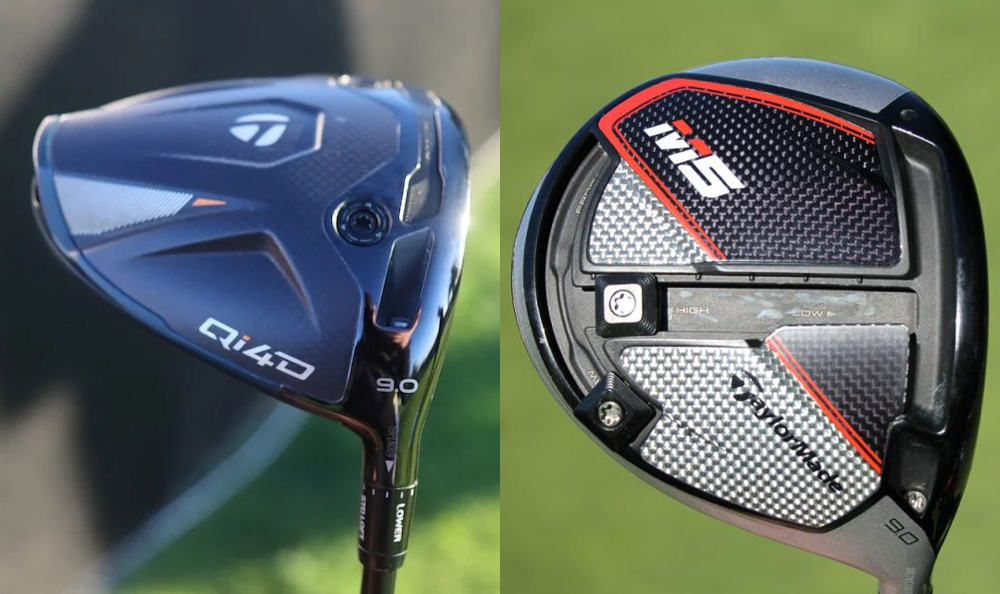
McIroy led the Tour in Strokes Gained: Off-the-Tee in 2019; he’s doing the same in 2026. Between now and then, McIlroy has switched from the Mitsubishi Tensei CK Pro White 70 TX (a shaft with slightly more feeling in the tip) to the original Fujikura Ventus Black 7X, having just made the change to the heavier version from playing the 60X.
What’s interesting about McIlroy’s 2019 setup is that the weighting on his driver is actually set in the high-draw setting, using the T-Track weighting system, whereas in the Qi4D, he’s currently using a heavily rear-weighted setup. (Two 13-gram weights in the rear and only two 4-gram front weights.)
The TaylorMade M5 driver he played in during his Canadian Open win was the company’s first head that they claimed to design to initially exceed the USGA’s COR limit, and then injected with tuning resin to bring it back in bounds.
Fairway woods
2019: TaylorMade M6 3-wood (15 degrees), Shaft: Mitsubishi Tensei CK Pro White 80 TX; TaylorMade M5 5-wood (19 degrees), Shaft: Mitsubishi Tensei CK Pro White 90 TX
2026: TaylorMade Qi4D 3-wood (15 degrees), Shaft: Fujikura Ventus Black 8X; TaylorMade Qi4D 5-wood (18 degrees), Shaft: Fujikura Ventus Black 9X

The TaylorMade M6 fairway wood that McIlroy was using during the 2019 season is still in the bag of some of the best golfers on Tour in 2026. Just check out Justin Rose’s winning setup from the Farmers Insurance Open earlier this year. This year, though, McIlroy has still been searching for his top-end-of-the-bag setup, having played both the new Qi4D and the Qi10, which he won the Masters with.

The same shaft swap can be seen in the fairway woods as the driver, along with slightly less loft on the 5-wood.
Irons
2019: TaylorMade P750 (4) Buy here, TaylorMade P730 (5-9), Shafts: Project X 7.0
2026: TaylorMade P760 (4), TaylorMade Rors Proto (5-9), Shafts: Project X 7.0

The biggest difference between McIlroy’s custom set and the stock P730s is the groove design. While the P730s were constructed with 14 MX-9 grooves on their milled faces, McIlroy’s proto heads instead use the higher-spinning, 16-groove layout of the TW2 grooves. Other big differences between the sets are that McIlroy’s 7- and 8-irons have thinner toplines, are 1 degree stronger in loft, and are 1/4 inch longer than the original P730 builds.
With McIlroy’s 4-iron, the switch from P750 to P760 sees a transition to a two-piece construction with Speed Foam in it, which allows McIlroy to launch the ball slightly higher, with more workability.
Wedges
2019: TaylorMade Milled Grind (48-09SB), TaylorMade MG Hi-Toe (52-09SB, 56-09SB, 60-LB09), Shafts: Project X Rifle 6.5
2026: TaylorMade MG5 (46-09SB, 50-09SB, 54-11SB, 60-08LB @61), Shafts: Project X 6.5 (46-54), Project X 6.5 Wedge (60)

Between 2019 and 2026, McIlroy’s focus on his short game has been much more apparent. It was the reason why he switched back to the TP5 golf ball, to help with launch, spin and control with his wedges leading up to his career Grand Slam victory in 2025. The most apparent changes to McIlroy’s wedge setup are his lofts and bounce. He’s slowly delofted his pitching to a sand wedge, but has increased the loft on the lob wedge, bending his current 60-degree to 61. With that, adding more loft to his lob wedge also slightly increases the bounce and leading-edge sit point, so, as a result, he plays a lower-bounce lob wedge compared to 2019. The MG5 wedges are also softer than the first Milled Grind option from 2019. McIlroy also no longer plays the full-face grooves found on the Hi-Toe.
Putter
2019: TaylorMade Spider X
2026: TaylorMade Spider Tour X
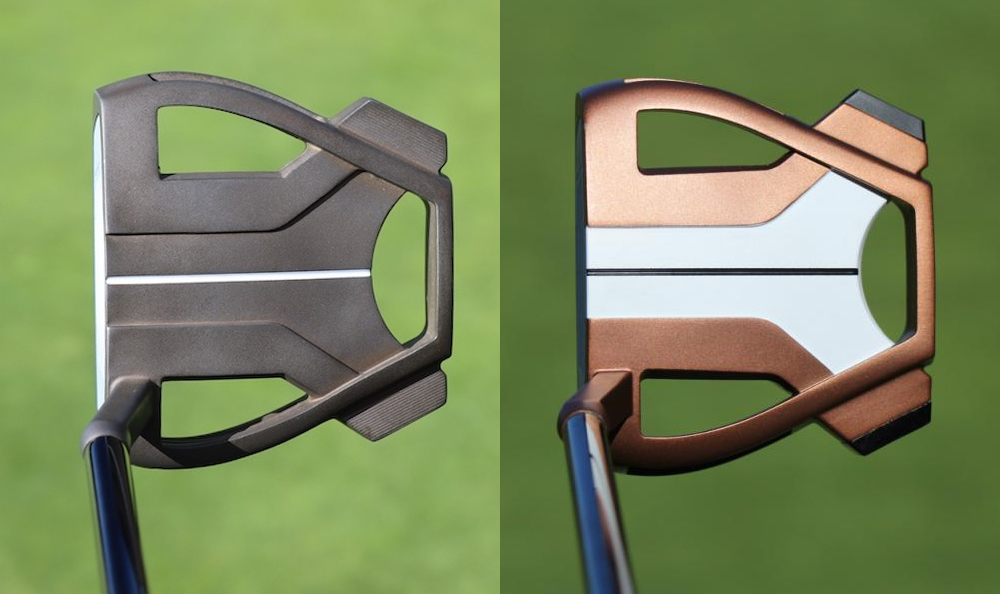
Notice anything similar. Yes, the copper finish on Rory McIlroy’s Spider X putter in 2019 is a slightly more reflective finish than the recently released torched PVD finish. McIlroy was using the True Path alignment system, but now uses only a single white sightline.
Ball
2019: 2019 TaylorMade TP5 (#22)
2026: 2025 TaylorMade TP5 (RORS)
As mentioned above, McIlroy had transitioned from the TP5 to TP5x golf ball since his victory in Canada in 2019, but now is black with the same style of golf ball as his victory at Hamilton Golf & Country Club.
Grips
2019: Golf Pride Tour Velvet Cord
2026: Golf Pride MCC
Interesting, McIlroy actually used Golf Pride’s Tour Velvet Cord grips during his victory in 2019 (it was during a 2+ year switch to the corded TV) as opposed to his usual MCC grips, which he has played for most of his career.

What’s the story behind Webb Simpson’s custom-stamped irons?

Memorial Tournament Tour Report: Rory McIlroy, Cameron Young switch up drivers, and more

Cadillac Championship Tour Report: Spieth’s sizable changes, McLaren Golf launches, and more

Russell Henley’s winning WITB: 2026 Charles Schwab Challenge

Kristoffer Reitan’s winning WITB: 2026 Truist Championship

Best irons 2026: Best irons overall, most forgiving irons, and more

J.T. Poston’s winning WITB: 2026 Memorial Tournament

Aaron Rai’s winning WITB: 2026 PGA Championship

Cameron Young’s winning WITB: 2026 Cadillac Championship

Details on Jason Day’s latest prototype Avoda iron setup


Christiaan Maas WITB 2026 (June)
Driver: TaylorMade Qi4D LS (8 degrees) Shaft: Fujikura Ventus TR Blue 6 X 3-wood: TaylorMade Qi10 (15 degrees) Shaft: Fujikura Ventus Black...


Ryan Palmer WITB 2026 (June)
Driver: Callaway Quantum Triple Diamond (9 degrees) Shaft: Project X HZRDUS Smoke Blue RDX 60 TX 3-wood: TaylorMade Qi10 (15 degrees) Shaft:...


Bud Cauley WITB 2026 (June)
Bud Cauley had >14 clubs in his bag when photographed prior to the Memorial Tournament. Driver: Titleist GTS2 (8 degrees) Shaft: Fujikura...


Hannah Green WITB 2026 (June)
Driver: Titleist GTS3 (10 degrees, D4 SureFit setting) Shaft: Mitsubishi Chemical Diamana RB 53 S 3-wood: Titleist GT3 (15 degrees,...
-
 Equipment7 days ago
Memorial Tournament Tour Report: Rory McIlroy, Cameron Young switch up drivers, and more
-
 News2 weeks ago
Russell Henley’s winning WITB: 2026 Charles Schwab Challenge
-
 Equipment4 days ago
Best irons 2026: Best irons overall, most forgiving irons, and more
-
 Whats in the Bag4 days ago
J.T. Poston’s winning WITB: 2026 Memorial Tournament
-
 Equipment1 week ago
Details on Jason Day’s latest prototype Avoda iron setup
-
 Equipment3 weeks ago
CJ Cup Byron Nelson Tour Report: Koepka and Kim’s newest putters finally get hot
-

 News2 weeks ago
Charles Schwab Challenge Tour Report: MacIntyre, Åberg and Spaun all switch putters, TaylorMade launches new Spider
-
 Equipment2 weeks ago
Details on J.J. Spaun’s surprise putter switch


Lob Wedge
Mar 10, 2016 at 12:38 am
Is the Callaway-Boeing link more of a marketing tool than technology implementation? Yes.
Are the guys hating on this article knuckle dragging trogs? Yes
Expand your horizons kids.. Or don’t read it.
Not like the Title and pictures at the start of the article didn’t give away the subject matter.
scooter
Mar 8, 2016 at 10:17 pm
Thanks for the article Andrew. I’m probably in the minority, but seeing the immenseness of the Boeing factory and all that is required to produce the technological marvel that a modern day jet represents is pretty spectacular. Of course, I’m biased since I’m and avid golfer who also works in the aerospace industry. The modern day driver head, by comparison, is pretty low tech . . . I hope Callaway didn’t pay too much for that fancy CFD streamline picture at the start of the article. As another poster said, the feel and forgiveness is what will sell the driver to the golfing masses.
Birdy
Mar 8, 2016 at 12:20 pm
so which company will get Caterpillar to market the earth moving technology of their wedges or maybe Firestone to market improved traction and roll when it comes to the ball, waterproofing company to lend their support to weatherproof clothes.
add me to the list who think this is just a clever marketing scheme
Peter
Mar 10, 2016 at 12:05 am
hey maybe Bridgestone tires could help Bridgestone golf company make some golf balls. i bet bridgestone tire company knows a thing or two about rubber.
Barry S.
Mar 8, 2016 at 11:22 am
Played TaylorMade and Adams drivers for years and switched to a Callaway Optiforce 440 about 2 years ago because the sound and feel works better for me without giving up any distance. Last year I purchased an Alpha 815 which I promptly sold because it didn’t perform to the level of the Optiforce 440 for me.
The other day a guy showed up at the range with an XR16 driver with a Speeder shaft and I hit 4 or 5 balls with it. Just my opinion but this driver is one of the shortest, worst feeling drivers I’ve hit in the last few years.
Tom
Mar 8, 2016 at 10:46 am
Bunch of negative Nancey’s on here.
Matto
Mar 8, 2016 at 2:10 am
This article should be titled, *A closer look at how PING didn’t need Boeing 2 years ago.
Yaz
Mar 7, 2016 at 8:55 pm
Having worked in that factory for years, Particularly at 747 Final Body Join, (the picture from the ground looking at the 747 with the gear next to it), the pictures BARELY do justice to just exactly how impressive that facility truly is. All the armchair “experts” posting here have ZERO clue about that place or the amazing things that are done there.
ooffa
Mar 8, 2016 at 7:02 am
Ummmm. They build airplanes right. Airplanes are big. They have a big building to build the big airplanes. We get it. I wonder if the airplane hobbyist website is hosting an article on golf club companies seeking publicity today. I doubt they are.
Leon
Mar 7, 2016 at 8:16 pm
Great story and pictures of Boeing. Totally marketing gimmick of Callaway.
John
Mar 7, 2016 at 5:25 pm
For all the article didn’t have too much to do with golf I thoroughly enjoyed it, great insight into the Boeing factory, very interesting.
Ver
Mar 7, 2016 at 4:29 pm
I just flew it on a long distance.
Not too impressed.
Lots of rattles and squeaks like before, with the plastic bits clashing with metals bits that are meant to do that, flex and turn with the body shift. But I would have hoped that they would have somehow minimized it with newer materials but it feels the same inside. No improvement on the armrests, the buttons and latches and locks. The seats weren’t much of an improvement either.
Don’t believe the hype. They put out all this hoopla, yet it’s only slightly improved on the inside for passengers, because they can’t really afford to re-tool everything and create something completely new. I mean Boeing nearly went bust with this plane with all the battery compartment design and window cracking problems anyway.
Yaz
Mar 7, 2016 at 8:53 pm
Seats and seating configuration is the choice of the airliner, not the builder. Boeing puts in the interiors that the airline chooses.
Scott
Mar 8, 2016 at 10:12 am
the XR16? Where did you put your luggage?
Theo Erben
Mar 7, 2016 at 3:39 pm
“Both have to do with laminar and turbulent flow. An airplane wing needs to be streamlined to reduce friction, as does the relatively rotund body of a golf driver head. The solution is very similar.”
Boeing makes great planes. I had the pleasure to fly most of their models.
During my job to help introduce the 737-300 and 747-400 for a renown European airline I learned to know Boeing to use facts and fundamental research to improve the products.
It seems in this “driver drag” case, Boeing just had the marketing guys have a look at the “problem”
I think it is a shame for Boeing that they claim they improved something without quantifying what the improvement really is.
ooffa
Mar 7, 2016 at 12:52 pm
Written like the reports we had to give after our lower school class trips.
There might be an airplane website whose visitors would find this interesting. As a golfer I sure didn’t.
orangeology
Mar 7, 2016 at 12:51 pm
sure you seem to have had a great trip to the B factory. yet i have no idea what it does with the 2 shots of the golf clubs at the end. better yet, why the heck did i need to see this on golfwrx?