
Opinion & Analysis
Two reasons you don’t take your best game to the course


The past week, you went to the driving range you were killing it. You had a baby draw nailed down with the driver and a killer flop shot around the greens that you pulled off 90 percent of the time.
So when Saturday came around, it was time to win some money. That beautiful draw with the driver and the delicate touch around the greens turned out to be things of the past, however. You sliced your drives into the woods and chunked chips that barely made it onto the green.
Why does this happen!?!?!
In this article we’re going to cover two simple (yet fundamental) reasons why, and give you some actions to start taking so you can play better golf and make your practice more effective.
You don’t practice like you play
Picture a typical driving range. Now picture a typical golf course. One consists of millions of potential shots and different problems to solve. The other consists of flat lies and smooth fairway grass. As a result, performance on a driving range and performance on a course tend to to differ greatly.
In order to improve your game, you have to practice in conditions that are similar to what you experience on the course.
PaR (Plan-act-Review)
*PaR golf supports a practice style that more closely resembles actual performance on the course. In doing so, it turns the traditional notion of practice on its head. It concentrates primarily on planning and reviewing a swing during practice, and takes the focus away from the repetition of swinging the club.
Research shows that this approach mimics some of the same information-processing activities players experience on the course, and therefore optimizes learning. In contrast, traditional practice sessions consisting of non-variable repetitive activities (e.g. block practice) that actually minimize information-processing activities.
What You Learn Tends to Be What You Practice
The efficacy of PaR golf lies in the specificity of learning. The concept can basically be boiled down to “what you learn tends to be what you practice.” In other words, practicing on a driving range will help you learn how to hit balls at a range, but it won’t help you play 18 holes on a course.
What to do
Get on the golf course! If you can take your practice onto the golf course that is ideal, but it’s not practical for everyone. So if you are practicing on the driving range, pretend you’re on the course by doing the following:
- Hit different clubs to different targets.
- Try to shape shots differently each time.
- Don’t always fluff up the perfect lie.
- Play games against yourself and simulate pressure (see Trent Wearner’s posts with great practice games).
*PaR (Plan-act-Review) Golf: Motor Learning Research and Improving Golf Skills,
Timothy D. Lee and Richard A. Schmidt
You’re practicing for short-term gains instead of long-term improvement
The primary objective of instruction and practice in any sport is to foster the development of long-term skills in the learner. Not only do these skills have to be durable, but learners must also be able to apply and adapt them to post-practice environments (performance on the golf course).
The tricky part about this process? According to research, long-term improvement often develops even if performance in practice does not improve.
Recent studies have also shown that improvement in practice performance does not necessarily translate into significant learning. What this tells us is how well we perform in practice is not a key indicator of how well we perform on the course.
long-term improvement often develops even if performance in practice does not improve.
No pain, no gain: The concept of the challenge point
The association (or lack thereof) between practice performance and long-term learning is related to another concept: the challenge point. Most learners believe that performing well in practice means they’re learning or mastering new skills. However, under the challenge point concept, excelling in practice is a sign that the learner is not being challenged enough. According to a research paper entitled “Learning Versus Performance” by Nicholas C. Soderstrom and Robert A. Bjork of the University of California, Los Angeles, conditions that induce the most errors during acquisition are often the very conditions that lead to the most learning!
Put simply, if you’re not struggling, you’re not learning.
Selecting the right challenge point is crucial for optimizing learning. For instructors, the goal should be to select a point that the learner finds appropriately challenging, but not so difficult to the point where it is nearly impossible or discouraging. For instance, you wouldn’t expect a novice golfer to hit a flop shot over a bunker to a tucked pin. Likewise, a simple 5-yard chip in the fairway off the green is a challenge point an experienced golfer would find too easy to achieve.
If you want to learn more about challenge point you can listen to the authors of the research here.
If you want to take your best game to course you have to improve your learning environment.
These two concepts of finding the right challenge point and practicing like you play are two cornerstones to start practice for long-term improvement of short-term quick fixes.



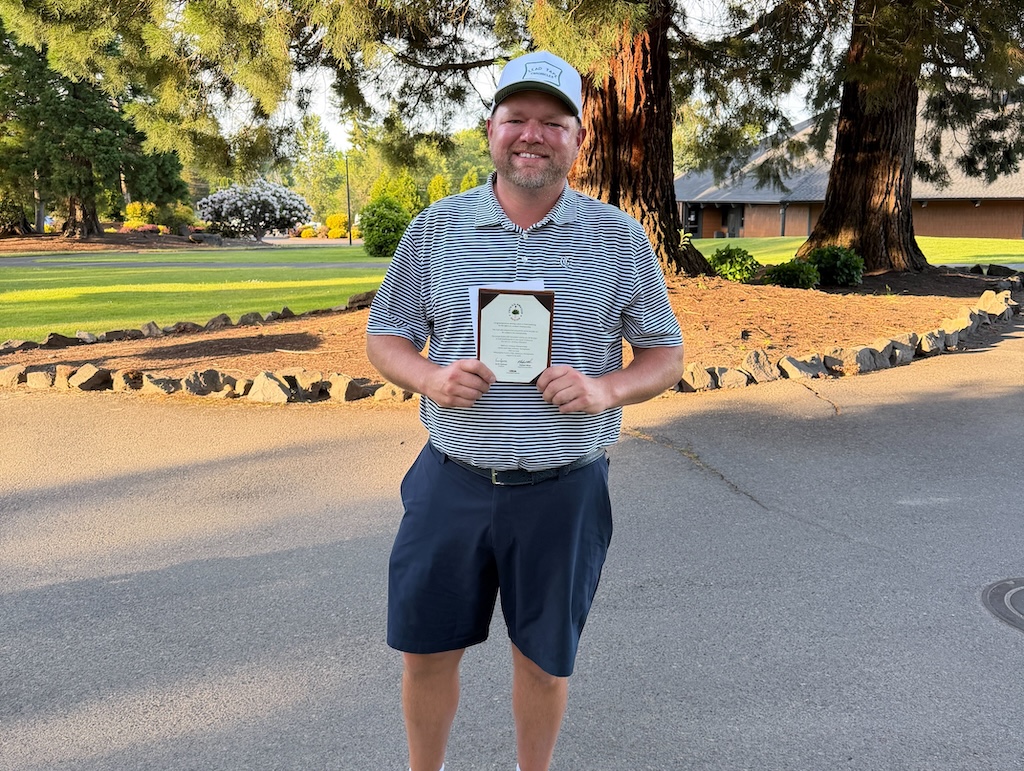
This past Monday, I played in the U.S. Amateur local qualifier at Rock Creek Country Club in Portland, Oregon. A full tee sheet from 7:30 a.m. to 1:55 p.m., the top 11 scores would make it to the U.S. Amateur final qualifying.
I teed off at 10:48 a.m.. With the 7:30 am tee time, you can get a feel for the leaders’ pace, and they were off and running on the challenging setup at Rock Creek.
View this post on Instagram
Getting to the highlight of the round on the par five 17th, a drive up the left side and 212 yards left to the front hole location. I took out a 5-iron with plans of middle of the green. The ball ended up 8 feet left of the hole, pin high. A slight downhill putt dropped in for an eagle 3 on the 17th. With the cut line looking to be anywhere from -2 to even par. This was the boost I had been waiting for all day.
With making par from the trees on 18, it was time to wait for a potential playoff with a posted score of one under par 71.
Three hours later, it was playoff time. 8 players for 6 spots. I made par on the playoff hole, which was good enough to advance to the U.S. Amateur final qualifying in July. USGA qualifiers sure deliver on all of the emotions in golf!
Club Junkie
Building my 2026 gamer WITB: Ranking the contenders and new putter projects – Club Junkie Podcast

The annual What’s In The Bag build is underway, and on this episode of Club Junkie, Brian breaks down the clubs currently leading the race for a spot in his 2026 gamer setup. From drivers and fairway woods to irons, wedges, and shafts, he ranks the equipment that’s performing best and explains what’s separating the front runners from the rest of the field.
Brian also heads into the workshop to discuss several putter projects currently on the bench. From head options and shaft choices to build ideas and testing plans, he shares what he’s working on and which putters could become serious contenders for the bag this season.
If you’re a gear junkie who loves equipment testing, club building, and the never-ending pursuit of the perfect setup, this episode is for you.
Follow Club Junkie:
Instagram: @clubjunkiepod
TikTok: @clubjunkiepod
Threads: @clubjunkiepod
X: @ClubJunkiePod
Club Junkie
Tour Edge Exotics mini driver review + TaylorMade Spider ZT Max first look – Club Junkie

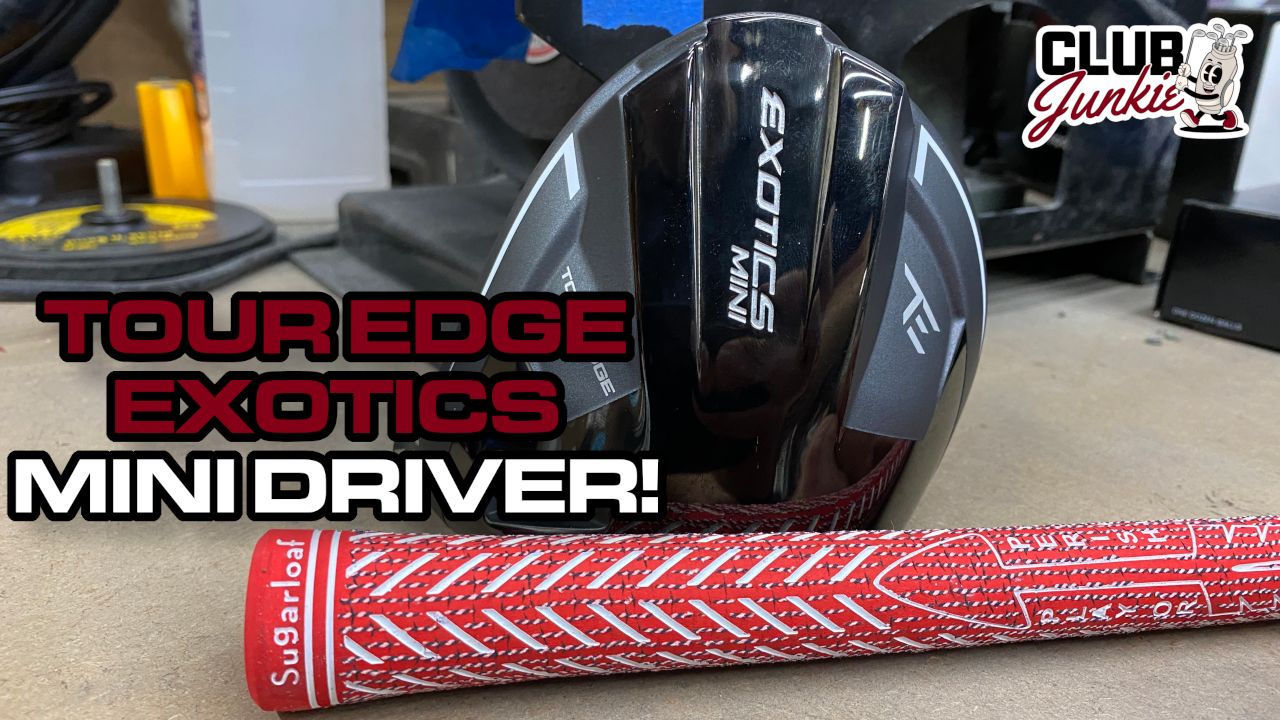
On this episode of Club Junkie, I put the new Tour Edge Exotics Mini Driver to the test and break down the performance, forgiveness, distance, and where it fits compared to a traditional driver or strong fairway wood. If you have been curious about adding a mini driver to the bag, this one is worth a look.
I also dive into the new TaylorMade Spider ZT Max putter that was recently spotted and discuss the growing zero torque putter trend. Plus, there is a closer look at the new Project X Titan Yellow shaft showing up on the PGA Tour and what makes it different from other profiles currently out there.

What’s the story behind Webb Simpson’s custom-stamped irons?

Memorial Tournament Tour Report: Rory McIlroy, Cameron Young switch up drivers, and more

Cadillac Championship Tour Report: Spieth’s sizable changes, McLaren Golf launches, and more

Russell Henley’s winning WITB: 2026 Charles Schwab Challenge

Kristoffer Reitan’s winning WITB: 2026 Truist Championship

Best irons 2026: Best irons overall, most forgiving irons, and more

J.T. Poston’s winning WITB: 2026 Memorial Tournament

Aaron Rai’s winning WITB: 2026 PGA Championship

Cameron Young’s winning WITB: 2026 Cadillac Championship

Details on Jason Day’s latest prototype Avoda iron setup


Christiaan Maas WITB 2026 (June)
Driver: TaylorMade Qi4D LS (8 degrees) Shaft: Fujikura Ventus TR Blue 6 X 3-wood: TaylorMade Qi10 (15 degrees) Shaft: Fujikura Ventus Black...


Ryan Palmer WITB 2026 (June)
Driver: Callaway Quantum Triple Diamond (9 degrees) Shaft: Project X HZRDUS Smoke Blue RDX 60 TX 3-wood: TaylorMade Qi10 (15 degrees) Shaft:...


Bud Cauley WITB 2026 (June)
Bud Cauley had >14 clubs in his bag when photographed prior to the Memorial Tournament. Driver: Titleist GTS2 (8 degrees) Shaft: Fujikura...


Hannah Green WITB 2026 (June)
Driver: Titleist GTS3 (10 degrees, D4 SureFit setting) Shaft: Mitsubishi Chemical Diamana RB 53 S 3-wood: Titleist GT3 (15 degrees,...
-
 Equipment6 days ago
Memorial Tournament Tour Report: Rory McIlroy, Cameron Young switch up drivers, and more
-
 News2 weeks ago
Russell Henley’s winning WITB: 2026 Charles Schwab Challenge
-
 Equipment3 days ago
Best irons 2026: Best irons overall, most forgiving irons, and more
-
 Whats in the Bag4 days ago
J.T. Poston’s winning WITB: 2026 Memorial Tournament
-
 Equipment1 week ago
Details on Jason Day’s latest prototype Avoda iron setup
-
 Equipment3 weeks ago
CJ Cup Byron Nelson Tour Report: Koepka and Kim’s newest putters finally get hot
-

 News2 weeks ago
Charles Schwab Challenge Tour Report: MacIntyre, Åberg and Spaun all switch putters, TaylorMade launches new Spider
-
 Equipment2 weeks ago
Details on J.J. Spaun’s surprise putter switch


Pingback: Two reasons you don’t take your best game to the course - Dan Hansen Golf Instruction
Troy
Feb 6, 2016 at 2:02 am
Great tips,
There’s no question how you practice has a big impact on how you play golf during a round. I also think most golfers spend too much time at the range trying to bomb their drives instead of really practicing with a plan to improve.
Cheers
viking62
Feb 4, 2016 at 12:59 pm
when I practice I typically play a virtual game on a course I know very well. I use targets on the range to represent fairway, rough, water, bunkers etc. If the drive is in play then I estimate roughly what iron I would need and pick a target green. I play the 18 and count how many greens I would have hit. I also hit the shape of shots that would be typically required from the tee or wherever I might have hit the ball.
I have to use some judgement to know if I would be likely to have a real next shot, but the tougher I am on myself the more real pressure I put on myself to hit my target number of greens.
I’ve found when I’ve kept track – my range greens in reg is roughly the same as my real greens in reg.
ders
Feb 5, 2016 at 4:11 pm
I do this too and its very helpful. I use the Swing by Swing app on my phone for the yardages and then pick the appropriate target on the range. The key is to be very hard on yourself – if its questionable, go with worse case scenario (ie if the shot isn’t hit pure, I consider its only gone half as far and off the fairway is a lost ball). I keep score and I’m usually only a few strokes better than I do in real life (if I hit the pin on the approach shot, I score 1 putt, within 10ft is 2, anything greater is 3). Its also helps with the course management skills – I have proven that I have a much better average score by dividing a 350yd par 4 in half and hitting 7irons than going for it with a driver and losing a ball or having a bad lie in the rough. I’m hoping the winter practice will pay off this year
JP K
Feb 4, 2016 at 2:32 am
Great article and it really does work. Any “shanks” out there should either show us their majors or go somewhere else.
Bobby
Feb 3, 2016 at 9:52 pm
It’s psychological 100%. When it matters we think too much and put pressure on ourselves. When it doesn’t matter at the range it’s okay because we have 50 more balls to get it right.
John-Michael Fawley
Feb 3, 2016 at 12:23 pm
Any other places to get information on these two practice philosophies?
kn
Feb 4, 2016 at 7:51 am
Take a look at the book, “The Talent Code,” by Daniel Coyle. Asks what the secret of talent is, and how we unlock it. Discusses the 3 key elements that will allow you to excel at virtually anything: 1) Deep Practice 2) Ignition 3) Master Coaching
Check it out on Amazon.ca. If you click on the book, it’ll give you a nice, one page breakdown of what the book is all about. Fascinating stuff. Here’s the website:
http://www.amazon.ca/gp/product/B0026OR1UK/ref=s9_simh_gw_p351_d19_i1?pf_rd_m=A3DWYIK6Y9EEQB&pf_rd_s=desktop-1&pf_rd_r=0QDTPYDEHED3DWE909MC&pf_rd_t=36701&pf_rd_p=2055621862&pf_rd_i=desktop
John-Michael Fawley
Feb 8, 2016 at 12:37 pm
I picked up the Talent code last week and started reading it. How did you go about applying the information in the book to your golf game?
Andy
Feb 2, 2016 at 10:26 pm
For most , hitting off of mats with range balls is not really practicing under playing conditions