
Opinion & Analysis
3 emerging golf architects discuss the future of course design


The next leaders in golf course architecture, unfiltered. Sounding off on their work, the game, the state of the industry, the future of restoration and new constructions, what needs to change, and what inspires them.
Michael McCartin worked for Tom Doak’s Renaissance Design, assisting in the construction of Old Macdonald, Ballyneal, and Streamsong. He recently completed a unique nine-hole golf course in Sperryville, Virginia: Schoolhouse Nine.
 I grew up playing on a public course…it was dead flat. If you don’t have a good eye for it, it seems devoid of architectural features. After playing there as my reference point and going out to other courses, it piqued my interest to see the differences once you start introducing different elements.
By 12 or 14, I’d read every book out there. I was obsessed with course design. I think I got [Tom Doak’s] Confidential Guide when I was 14 or so, and that really took it to another level.
I studied abroad in St. Andrews, which was the best decision ever. At the time I was there, the links card was 150 pounds for the year to play unlimited golf on all the town’s courses, including the Old Course.
When I was there, I started a correspondence with Tom Doak. I knew he had lived there, and he was nice enough to give me some recommendations. After I graduated, I applied for an internship with Tom. So, for the past 10 years or so, I’ve been working with Renaissance Golf Design.

Streamsong, a project McCartin worked on.
When you look at Schoolhouse Nine, what we’re doing, it hits the buttons. Affordability: the course is going to cost $10. Juniors can get a pass for the summer at a reasonable rate. Pace of play: It’s 9 holes. And maintenance and affordability go hand in hand. We’re only irrigating the greens, so everything else changes according to the season.
There are opportunities where making the course more interesting is going to help on the revenue side. If you’re going to rebuild a bunker, it’s not that much more to build in cool architectural features. There’s no cost in building a new green 20 yards to the right versus rebuilding the same green.
Clients can offer a lot of design ideas as far as what they’re inspired by and you can use that as a starting off point. “How can I incorporate something like that into the design?” You end up with something you might not have come up with on your own. But because you had a nugget of a starting idea, it evolved into something, and you can then point back to the owner and say that it came from his idea.
You get a better product when you have someone who is involved with the design actually doing the building. Coore, Crenshaw, Tom, Gil Hanse, they all spend time on machines or have in the past, and they have a crew of people they work with all the time. I think you get the best results that way.
You’re still going to get owners who want to build Augusta National and some people who are more realistic about it. The projects that aren’t as high profile yield just as much opportunity for great golf architecture, where the course makes the best of the property.
Just because there’s one trend doesn’t mean people aren’t going to be building, like, Bluejack National down in Texas—high-end, charge a bunch of money. But I hope that the portion of the pie that’s allocated to more affordable stuff grows. There are a lot of opportunities to get away from the super exclusionary, super high-end place.
———

Tad King (L) and Rob Collins at Sweetens Cove.
Rob Collins (along with partner Tad King) is the man behind Sweetens Cove, the rebuild of Sequatchie Valley Golf & Country Club that Golf Digest named the best nine-hole course in Tennessee and course architecture fans are raving about.

Sweetens Cove: Hole 1
Right now, I’m looking at two Donald Ross restoration projects. Our phone is definitely starting to ring and we’re seeing a pick-up, but it would be unrealistic to think that in the next 10 to 15 years get back to where we were in the 90s.
We wanted to be able to design and build golf [courses]…in contrast to the typical model that’s used where you have the architect on one side and the contractor on the other. There’s going to be a bigger premium placed on efficiency, cost saving, the construction methods.
The traditional approach…leads to a lot of competition. It can lead to a lower level of quality. It can lead to higher costs. We looked at the guys who we thought were doing the best work in the world…Hanse, Doak, Coore and Crenshaw. They have a design-build mentality where they have control, and that’s how we do it, we design and build.
We like building strategic golf courses that make you think: Wide corridors…contour that creates interest in and around the green complex. We really stress recovery shots around the greens and the ground game.
We’re always trying to enhance the experience a little bit with things you may not notice the first 10 times you play, but you’ll notice it the 20th time. I want the golf course to always be revealing something new.

Sweetens Cove: Hole 3
As an architect, dealing with the contractor, there are little things you’re going to give in on. One or two or three little details aren’t going to make that big of a difference, but if you add up all the details you gave in on the course, if you start chipping away at details, eventually the project is going to be flat. That’s what so many golf courses suffer from: They’re just kind of monochromatic.
We started in 2011…had it [Sweetens Cove] grassed out in the summer of 2012. The family that owns it decided that golf is not part of their core business, so I partnered with Ari Techner of Scratch Golf to take over last May. It opened up last October.
It’s a really special place. As far as golf goes, there’s nothing at all like this anywhere. I said, I really want to do something different here. Nobody’s going to drive to rural Tennessee to play a golf course that looks like Chattanooga Golf and Country Club. We had to do something unique.
We did that with really wide fairways…fairways cut everywhere. Greens are very large…very undulating. We use a lot of contour to create interest and to create playability dilemmas and challenges. It’s very heavily influenced by Pinehurst No. 2…with Maxwell-Mackenzie-Raynor-type greens.
I don’t like 9-hole courses that masquerade as 18-hole courses. Let’s just be content with building nine great holes. Let’s build enough flexibility…that you can leave it up to the golfer. They can play the front tees one time or the back tees or do whatever they want. It’s a more democratic approach.
———

Kyle Franz (C) with Joe Buck (L), Greg Norman (RC)
Kyle Franz restored Donald Ross-designed Mid Pines to much acclaim. Golf magazine named it the best resort renovation of 2013. He also worked with Tom Doak at Pacific Dunes and the Pinehurst No. 2 restoration with Coore & Crenshaw.
 I randomly met [Mid Pines’] owner at a cocktail party one night. Not knowing who he was, I was very candid on what I though the potential was for the golf course, if they ever chose to do the kind of things they were doing on No. 2. I did a bunch of Photoshops of what the golf course would look like. The same things needed to happen that happened at No. 2: Restoring the sandy areas. Restoring the areas around the bunkers to what they were originally like.
All the underbrush had been slowly eradicated over the decades. It was a bit of a mindtrip to put back together that feeling and concept. I added hazards to get the same kind of strategic feel—the blood-pumping shots—it was a very fun restoration: part archeology and part improvisation to get the holes to feel like they originally did.
A lot of things are in play over the next 10 or 15 years. The financial crisis turned even the biggest architects into restoration architects. That is really the direction the business needs to go. Obviously there are a few new courses beginning to be built these days.
There’s so many really good golf courses…classic golf courses…newer courses on really good pieces of ground. It takes a huge chunk out of the equation to deal with a place where you already own the property and turn it into a really good golf course. There’s a lot of those out there. I think that’s going to be big over the next 20 years or so: Taking the golf courses we have and making them a heck of a lot better.
I do think there’s maybe one more golf boom left in the United States. But we’re going to get to the point where we’ve kind of saturated our own market. A new golf course gets built here and there in the UK, but they eventually did that. Nothing new got built for a long, long time.
People like Tom Doak, myself, we’re very, very heavy proponents of walkable golf courses. 6,000- to 6,500-yard gof courses. Places that are comfortable to walk. Every one of those drivers that you buy that’s designed to send your balls 30 yards farther…that comes back to their checkbook…the amount of land required…irrigation…turf…maintenance…construction. Every contractor builds budgets on square footage. That comes back to the golfers at the other end of the line. It’s made it too expensive…and it’s hard to get young guys excited about golf because it takes too long to play.
With Pacific Dunes we all kind of hoped that’d be a line in the sand. One of the highest-rated courses built in the past 10 years, but it’s only 6,600 yards. Tom built the perfect course into that piece of land.
 9-hole courses play into this. For some reason it’s a little bit harder to get people excited about them, but the opportunities are out there to kind of push the ball forward. What would be really cool is to find a section somewhere in the country where’s there’s like four different parcels for nine-hole golf courses within a 20 mile radius.
The holes that really do something for me are the ones that have proven absolutely timeless. Like No. 15 at Pinehurst No. 2. The green is so small and the area over the green is so severe that it’s foolish to attempt any aerial shot. So the percentage is to play short and hope you can trundle it up there. And the Road Hole…that hole will work for ground shots for as long as the game is played.
The philosophy Bill and Ben had 20 years ago was to make the ground game interesting…throw it out to the players and give them options. I look at it in terms of making it a sucker play to put it in the air. Example: No. 5 at Augusta. The aerial game is only…40 percent of the game.
Ever since I’ve known Tom Doak, he’s wanted to do reversible routing; Tom’s finally getting to do that at Forest Dunes. It’s something that I’ve always wanted to do…two for the price of one! Maybe this will be Tom Doak’s Sgt. Pepper’s moment…something completely different than what he’s done that has a huge impact on what everybody else is doing. It’s always been in the back of my mind…but it takes somebody as smart as Tom Doak…to make it work.
That winter I spent at St. Andrews, I joked that I probably walked it backwards as many times as I did forwards, because I was aware that the course had been reversible before. Some of the best holes in the world are on the Old Course going the other direction.



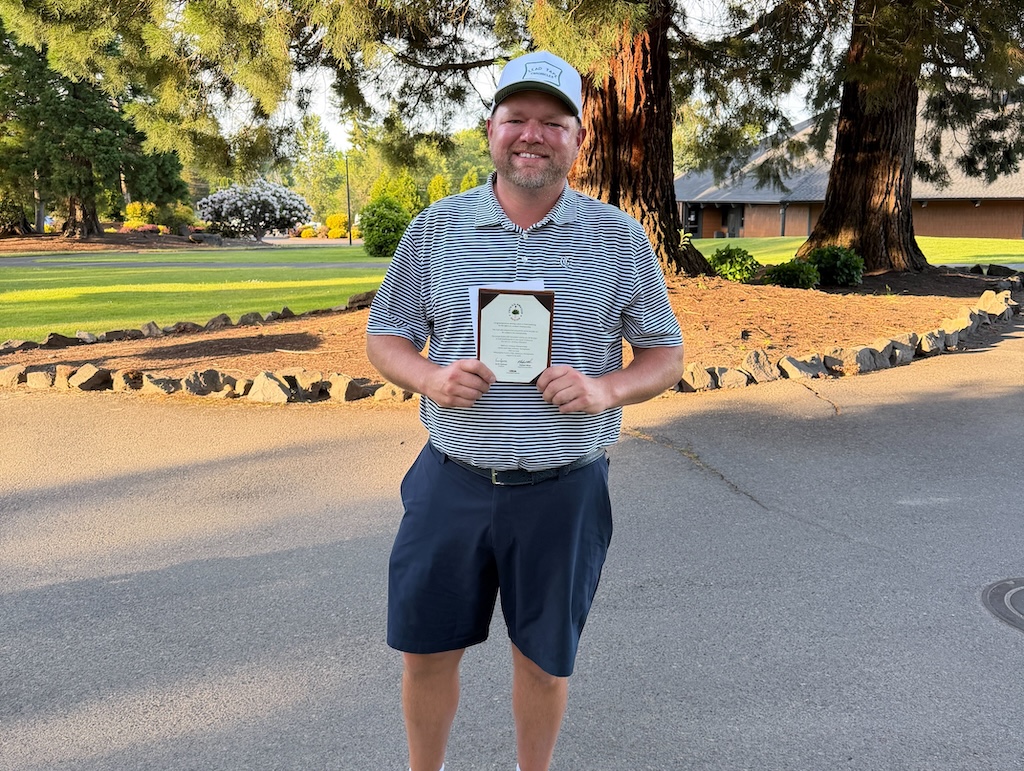
This past Monday, I played in the U.S. Amateur local qualifier at Rock Creek Country Club in Portland, Oregon. A full tee sheet from 7:30 a.m. to 1:55 p.m., the top 11 scores would make it to the U.S. Amateur final qualifying.
I teed off at 10:48 a.m.. With the 7:30 am tee time, you can get a feel for the leaders’ pace, and they were off and running on the challenging setup at Rock Creek.
View this post on Instagram
Getting to the highlight of the round on the par five 17th, a drive up the left side and 212 yards left to the front hole location. I took out a 5-iron with plans of middle of the green. The ball ended up 8 feet left of the hole, pin high. A slight downhill putt dropped in for an eagle 3 on the 17th. With the cut line looking to be anywhere from -2 to even par. This was the boost I had been waiting for all day.
With making par from the trees on 18, it was time to wait for a potential playoff with a posted score of one under par 71.
Three hours later, it was playoff time. 8 players for 6 spots. I made par on the playoff hole, which was good enough to advance to the U.S. Amateur final qualifying in July. USGA qualifiers sure deliver on all of the emotions in golf!
Club Junkie
Building my 2026 gamer WITB: Ranking the contenders and new putter projects – Club Junkie Podcast


The annual What’s In The Bag build is underway, and on this episode of Club Junkie, Brian breaks down the clubs currently leading the race for a spot in his 2026 gamer setup. From drivers and fairway woods to irons, wedges, and shafts, he ranks the equipment that’s performing best and explains what’s separating the front runners from the rest of the field.
Brian also heads into the workshop to discuss several putter projects currently on the bench. From head options and shaft choices to build ideas and testing plans, he shares what he’s working on and which putters could become serious contenders for the bag this season.
If you’re a gear junkie who loves equipment testing, club building, and the never-ending pursuit of the perfect setup, this episode is for you.
Follow Club Junkie:
Instagram: @clubjunkiepod
TikTok: @clubjunkiepod
Threads: @clubjunkiepod
X: @ClubJunkiePod
Club Junkie
Tour Edge Exotics mini driver review + TaylorMade Spider ZT Max first look – Club Junkie


On this episode of Club Junkie, I put the new Tour Edge Exotics Mini Driver to the test and break down the performance, forgiveness, distance, and where it fits compared to a traditional driver or strong fairway wood. If you have been curious about adding a mini driver to the bag, this one is worth a look.
I also dive into the new TaylorMade Spider ZT Max putter that was recently spotted and discuss the growing zero torque putter trend. Plus, there is a closer look at the new Project X Titan Yellow shaft showing up on the PGA Tour and what makes it different from other profiles currently out there.

Justin Rose WITB 2026 (April): Full WITB breakdown with new McLaren irons

What’s the story behind Webb Simpson’s custom-stamped irons?

Memorial Tournament Tour Report: Rory McIlroy, Cameron Young switch up drivers, and more

Cadillac Championship Tour Report: Spieth’s sizable changes, McLaren Golf launches, and more

Russell Henley’s winning WITB: 2026 Charles Schwab Challenge

Kristoffer Reitan’s winning WITB: 2026 Truist Championship

Best irons 2026: Best irons overall, most forgiving irons, and more

J.T. Poston’s winning WITB: 2026 Memorial Tournament

Aaron Rai’s winning WITB: 2026 PGA Championship

Cameron Young’s winning WITB: 2026 Cadillac Championship


Ryan Palmer WITB 2026 (June)
Driver: Callaway Quantum Triple Diamond (9 degrees) Shaft: Project X HZRDUS Smoke Blue RDX 60 TX 3-wood: TaylorMade Qi10 (15 degrees) Shaft:...


Bud Cauley WITB 2026 (June)
Bud Cauley had >14 clubs in his bag when photographed prior to the Memorial Tournament. Driver: Titleist GTS2 (8 degrees) Shaft: Fujikura...


Hannah Green WITB 2026 (June)
Driver: Titleist GTS3 (10 degrees, D4 SureFit setting) Shaft: Mitsubishi Chemical Diamana RB 53 S 3-wood: Titleist GT3 (15 degrees,...


Asterisk Talley WITB 2026 (June)
Driver: TaylorMade Qi4D (9 degrees) Shaft: Fujikura Ventus Blue 6 S 3-wood: TaylorMade Qi4D (16.5 degrees) Shaft: Fujikura Ventus Blue...
-
 Equipment6 days ago
Memorial Tournament Tour Report: Rory McIlroy, Cameron Young switch up drivers, and more
-
 News2 weeks ago
Russell Henley’s winning WITB: 2026 Charles Schwab Challenge
-
 Equipment3 days ago
Best irons 2026: Best irons overall, most forgiving irons, and more
-
 Whats in the Bag4 days ago
J.T. Poston’s winning WITB: 2026 Memorial Tournament
-

 Equipment1 week ago
Details on Jason Day’s latest prototype Avoda iron setup
-

 Equipment3 weeks ago
CJ Cup Byron Nelson Tour Report: Koepka and Kim’s newest putters finally get hot
-

 News2 weeks ago
Charles Schwab Challenge Tour Report: MacIntyre, Åberg and Spaun all switch putters, TaylorMade launches new Spider
-

 Equipment2 weeks ago
Details on J.J. Spaun’s surprise putter switch


Katie Masheter
Jan 25, 2017 at 8:13 am
Some high-end dazzling eye-candy designs but a lot more emphasis on naturalistic, playable, uncluttered golf http://www.scottishdesignmasters.com/biggest-changes-future-trends-golf-course-architecture/
Mark
May 8, 2015 at 2:11 pm
The modern breed of architecture is getting too “clever”…everyone tries to get as many features as possible into a course instead of designing something that suits the local terrain. Mr Doak does some good work but the ultra exclusive and heinously expensive Renaissance Club is a poor relation to other courses and that same coastline and is no more than a pastiche of what a true links is. Scottish Golf is for working men and women and affordable.
As for the rennovation of Pinehurst Number 2…..a school friend of mine lives 5 miles from the course and was almost reduced to tears. He describes the changes as vandalism…
And I’m in rarew agreement with IJP. Chambers Bay is the answer to a question nobody asked. Please go back to great parkland venues like Winged Foot, Baltusrol and Oak Hill….
Eej
May 9, 2015 at 12:20 pm
“Scottish Golf is for working men and women and affordable.”
You couldn’t be farther from the truth.
http://www.standrews.com/Play/Green-Fees
those are in pound sterling, mate. Telling me that’s affordable for the working men and women? Don’t be daft
net
May 10, 2015 at 5:56 pm
Yeah, there’s about 500 courses outside of St. Andrews. The big name courses are expensive, but there’s certainly plenty of working men golf to go around. Some better than the big names.
Greg V
May 8, 2015 at 10:19 am
One of the problems with golf course architects is that they are so close to the subject that they try to outdo each other, creating the next great masterpiece. In reality, the public golfer ends up with courses described above – long forced carries, an overuse of penal bunkers, water in way too many places.
Most of us need a minimum of challenge – hitting the ball straight is challenge enough. We want courses that are in decent shape; green speeds in the moderate range generally provide more fun and more satisfying rounds.
From the pictures that I saw in the article plus others that I saw when exploring on-line, the courses mentioned are over-designed. I would challenge these guys to provide an experience akin to North Berwick – a playable course that has evolved over time, rather than designed as someone’s masterpiece. Throw in one little quirky flair like a short wall in front of a green, and be done with it.
Cysmic
May 7, 2015 at 1:28 pm
Franz: What would be really cool is to find a section somewhere in the country where’s there’s like four different parcels for nine-hole golf courses within a 20 mile radius.
Within a 20 mile radius of my hometown in northwest Iowa there’s 11 different 9 hole courses, not including an additional 9 hole Par 3 course. You want 9 hole courses, come to Iowa.
ken
May 6, 2015 at 9:21 pm
I live in a metro area in NC. During the period 1990 to 1997 11 golf courses were built within a 45 minute drive of my home in the suburbs.
One has closed. Another has gone through several ownership changes. 5 others once owned by the same company are now under the ownership of a few different companies.
The one common denominator is they are all “upscale” semi private or daily fee.
All of these courses were built so they COULD NOT be walked. Why? Golf carts mean revenue.
Another issue….modern courses were designed each to be more difficult than the one three miles down the road. Too many forced carries. Deep fairway bunkers with soft sand and steep faces make it impossible for all but the single digit index players to advance the ball. Greens too large( $$) Dumb. We amateurs don’t want to get beaten up. We want to have fun.
BTW, the one factor as to why a round of golf takes too much time is caused by those who play tees inappropriate for their skill level.
Chuck
May 7, 2015 at 11:50 am
You’ve made some excellent points.
Some of what makes a routing require golf carts is the land itself. Less choices for golf course parcels; more land use regulations and wetlands protection; in some cases there are demands for residential/homesite plans.
This was a real nice job by Ben and his subjects. For those of you who haven’t yet read it, Geoff Shackelford’s “The Future of Golf” is now in paperback and expands on many of these subjects. Geoff is a sometime-architect in his own right, with some similar (9-hole) projects and some very significant consulting work (LACC) to his credit.
Sean
May 6, 2015 at 8:38 pm
Many of the modern courses seem to have been built with the better golfer in mind…forced carries, long, and the like. The vast majority of the golf public struggle on these kinds of venues. Allowing people to play the ball on the ground, reasonable yardages, and the like, may keep people from getting frustrated and leaving the game.
Jordan
May 6, 2015 at 9:58 am
I wish there was more 9-hole golf available near me (Brooklyn, NY). I’d play a lot more if I could be done in 2-3 hours. It’s nearly impossible to get out for 18 with both my wife and I working full-time and a 4-month old at home. Right now, the only option is to get up at 4:30am and get one of the first tee times at one of the local munis as that is the only time they offer 9-hole rates.
John
May 5, 2015 at 9:57 pm
I took to the game at the age of 10 playing a 9 hole public course, Caznovia Park, in Buffalo. It was affordable and I would play it two or three times a day. It sits on a beautiful piece of land and could be a gem if someone put some money into it. As I grew older, got married and had children, 9 hole golf became the norm for me three or four times a week because it took less than 2 hours. I believe there is a place for nine hole golf courses that are affordable, not frustrating but fun to play, and can be played quickly. The U.S. needs to get out of the “bigger is better” mentality in alot areas, including playing golf!
other paul
May 5, 2015 at 9:13 pm
The closest golf course to my house is a 9 hole course that I usually played a few times every summer. It was to easy, and to short, 2700yards. Last year there was rumors of it bring developed into something else. So it was barely maintained. Some bunkers are over grown with weeds and they barely seem to even cut the grass. I dont even want to know if they are opened this year because last year they were an embarrassment to golf course management everywhere. How ever, if someone built a nice course in its place I would go there all the time like I used to.
duckjr78
May 5, 2015 at 4:57 pm
Please, more articles like this! Excellent job.
HoldTheLag
May 5, 2015 at 2:41 pm
Wow to play a course like that for $10 is a steal and a half…really wish we get more like that built around here.
Brody
May 5, 2015 at 1:33 pm
Nice job, Ben! Good read
Daniel
May 5, 2015 at 1:08 pm
This is a great article that gets me excited about the future of golf. The two main complaints about golf are that it is too expensive and it takes too long to play. The really well designed 9 hole course would solve both problems. Right now most goers think that if you don’t play 18 it doesn’t count as a real round, but if there were more 9 hole courses around it would become more acceptable. Sweetens Cove looks amazing, I’d love to play that someday. If there was a course like that around me, I’d play a lot more golf.