
Opinion & Analysis
10 Players Who Will Rise (or Fall) in 2015

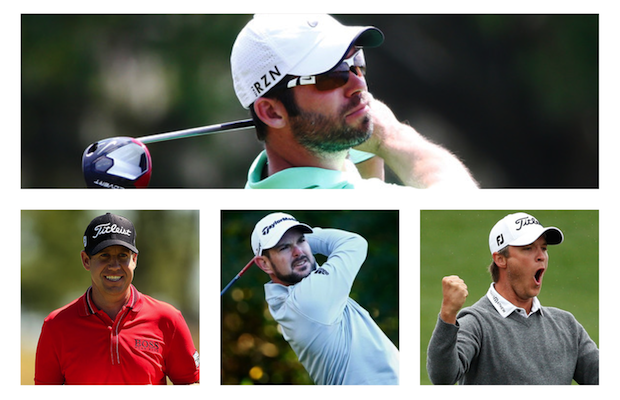
Before last season, I ran through the players that were projected to rise and decline in the 2013-2014 season. With the start of the 2014-2015 season coming this week, I wanted to go through the projections. The rankings in the tables below are based out of 177 players.
PLAYERS ON THE RISE

BILLY HURLEY III
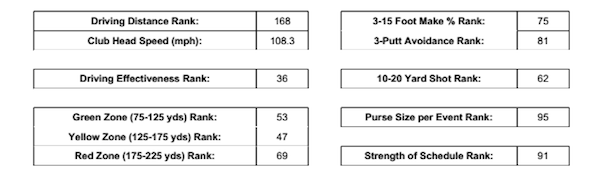
One of the things I established a few years ago with my research was the idea of what I call The Four Cornerstones of the game. Recently, I altered the 4 cornerstones of the game just slightly:
- Driving Effectiveness
- Red Zone play (shots from 175-225 yards)
- Shots from 10-20 yards
- Make Percentage from 3-15 feet
Hurley achieved all of those 4 cornerstones of the game. Not only do the 4 cornerstones have a strong correlation to success on Tour, but they also have correlated strongly to getting a Tour victory, soon. Ben Curtis achieved the 4 cornerstones in 2011 despite only finishing 133rd on the Money List went on to win the next season at the Valero Texas Open. Matt Jones accomplished the 4 cornerstones in 2013 and finished 48th on the Money List and then went on to win at Houston this past season.
Hurley accomplished all of the 4 cornerstones last season and finished 91st on the Money List. He does not hit it that far and that may hold him back a little, along with having a below average Purse Size per Event played.

BRIAN STUARD
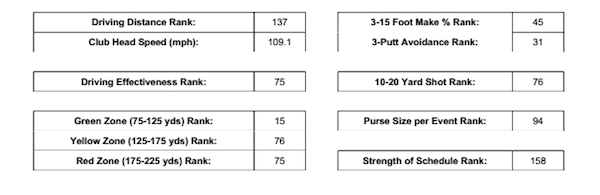
Stuard is much like Hurley in that he accomplished the 4 cornerstones last season and does not hit it far. However, he is a much better birdie maker (41st) than Hurley (157th), but has gotten off to slow starts in rounds 1 and 2. If he can improve his play in rounds 1 and 2, he is projected to have a great season.
TROY MERRITT
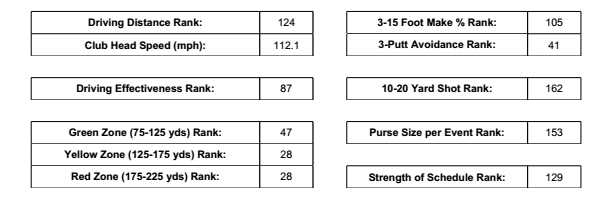
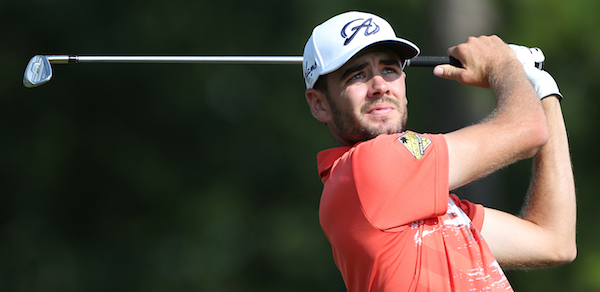
Merritt’s ball striking metrics were very impressive, but he struggled a bit from 10-20 yards and on putts outside 15 feet. The putting from outside 15 feet should progress toward the mean according to PGA Tour trends.
PAUL CASEY
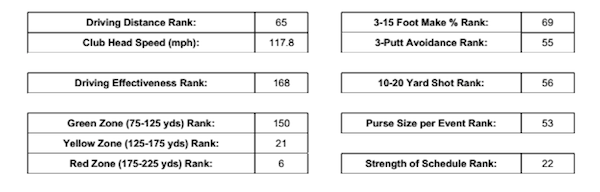
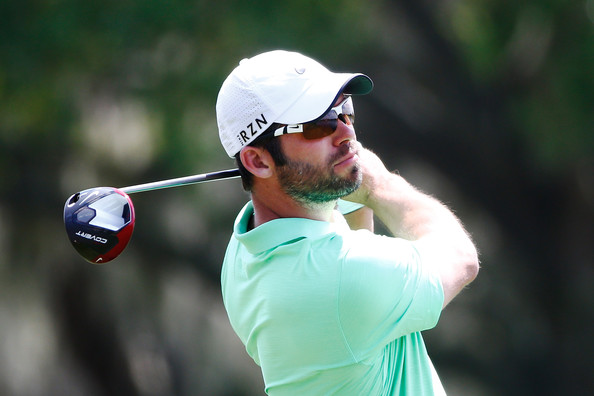
Casey started to make a comeback after numerous injuries. He was actually an even better putter prior to his injuries than he is now, which is still pretty good. The big issue for Casey is his driving, but I could see him winning an event where the course is pretty wide open and receptive to very errant tee shots.
RUSSELL KNOX
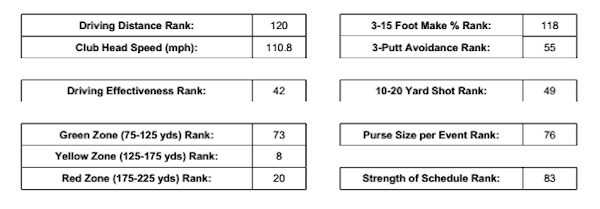
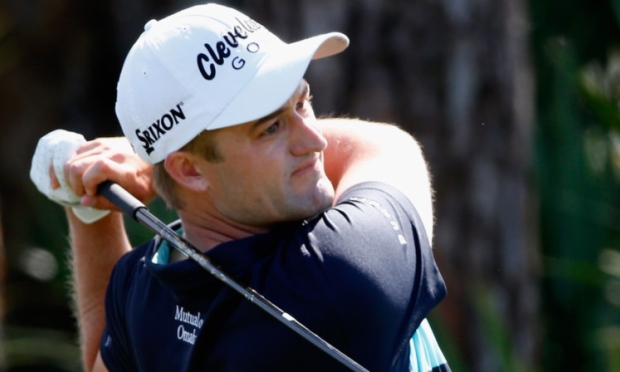
The strength of Knox’s game in his short career has been his ballstriking and that allowed him to rank 28th in Adjusted Par-4 Scoring Average and 5th in Bogey Avoidance, which are the two key scoring metrics. He was also very good in rounds before the cut, ranking 40th in Adjusted Round 1 and 12th in Adjusted Round 2 Scoring Averages.
He now is now very good on Short Game shots from 10-to-20 yards. The only thing that is lagging behind is his putting. But, Knox is an AimPoint user and the trend with AimPoint users on Tour is that they typically see major improvements in their putting statistics after 3-to-12 months of using the green reading methodology.
Honorable Mention: Robert Garrigus, Brooks Koepka, Robert Streb, Jhonattan Vegas and Nick Watney
PLAYERS ON THE DECLINE

JONAS BLIXT
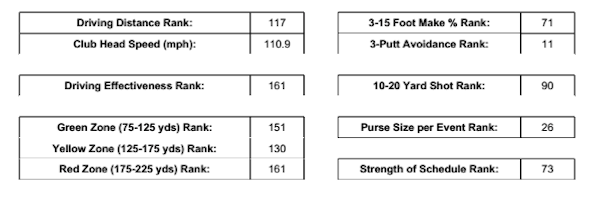
I picked Blixt last season and outside of a 2nd place finish at the Masters he did not record any other top-10 finishes. That will earn him a second invite to Augusta, but his exemption to Doral and Firestone will run out and I don’t believe he will be eligible for the Accenture Match Play.
His putting regressed a bit as I projected last year as he finished 33rd in Strokes Gained – Putting, but a large part of finishing even that well in Strokes Gained – Putting came from his ability to make putts from longer than 15 feet. The definitive trend on Tour is for a player that makes a lot of putts outside 15 feet to eventually regress toward the mean and that should affect his effectiveness on the greens. His short game also regressed this past season, but those are of secondary importance if he cannot improve his ball striking to a serviceable level.

RORY SABBATINI
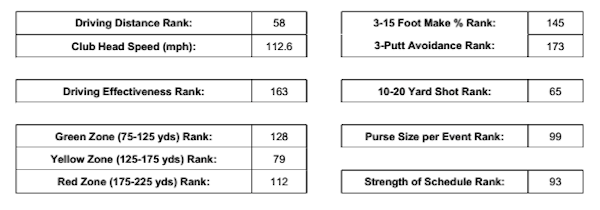
Sabbatini’s strengths of his game over the years has been his Yellow Zone play and Short Game play. Strong players from the Yellow Zone tend to make more Birdies on the par-4’s, and the short game play typically cleans up any mistakes and can save par. That is how Sabbatini has been so successful over the years.
Scoring wise he ranked 151st in Adjusted Par-4 Scoring Average and 153rd in Bogey Rate which are two critical scoring metrics on Tour. While he is still better than average from the Yellow Zone and on shots from 10-to-20 yards, his performance in those categories has taken a noticeable dip as of late. He is also seeing a dip in his club head speed of about 2 mph. That may not sound like much, but on Tour the dip in club head speed does not have to be very much for it to have a strong trend toward a regression in the player’s performance.
MATT JONES
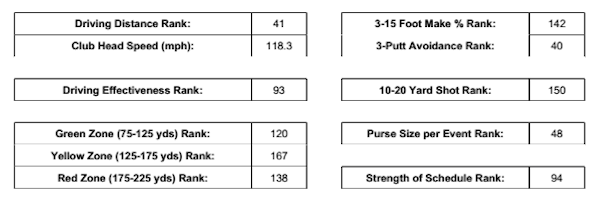
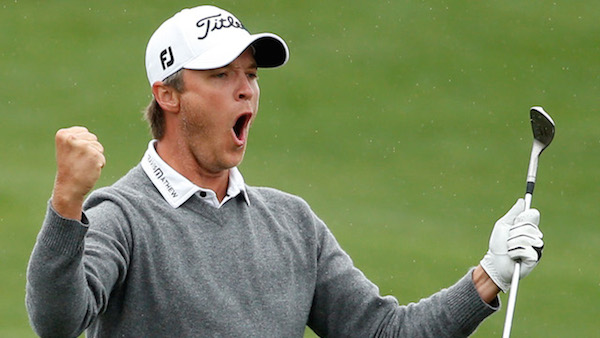
Last season I had Jones as my projected players to rise and he ended up winning at Houston. The best indicator of a player’s iron skill are shots from the fairway/tee box. Jones fell from 96th to 150th in 2014, so his iron play completely fell apart and his play from 10-to-20 yards regressed as well going from 19th in 2013 to 150th in 2013-2014.
If a player cannot find greens and cannot save pars when they miss greens, it’s a recipe for disaster. Furthermore, he gained a large portion of his strokes on the green from his putting outside 15 feet. That should regress towards the mean in 2014-2015, which means a regression in his total Strokes Gained – Putting metric.
Jones benefited from the favorable schedule last season where he was playing a much higher Purse Size per Event than Strength of Schedule. His Purse Size per Event should still be fairly high coming off the victory at Houston, but the strength of schedule should get more difficult as well and he will have a more difficult time making cuts if he continues to perform at the same rate.

BRENDON TODD
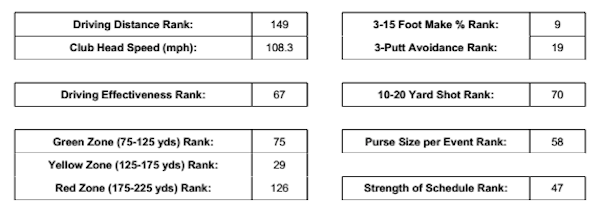
Todd had a fantastic season in 2013-2014. He was an adept putter of the ball that performed well from the Yellow Zone. Typically, good Yellow Zone performers make more birdies regardless of their putting skill. They are hitting the ball closer to the cup on the major of approach shots on the par-4’s and increasing their likelihood of making their putts. However, Todd was more of a grinder as he ranked 21st in Bogey Avoidance while ranking 70th in Birdie Rate. There is a downward trend in performance for players like Todd that fail to make a lot of birdies despite performing well from the Yellow Zone and with the putter.
We can also see Todd’s performance in 2013-2014 from the Red Zone and with the putter. The Red Zone performance declined over time while the Putter caught fire as the season progressed:
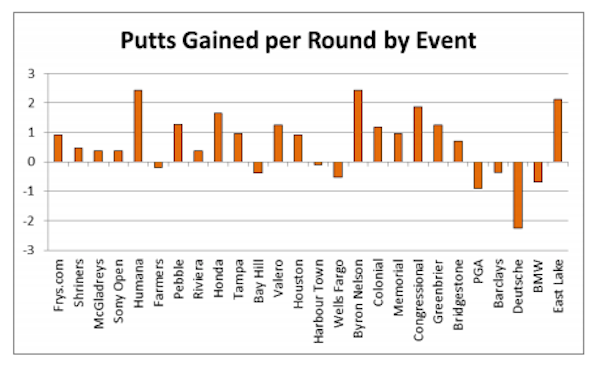
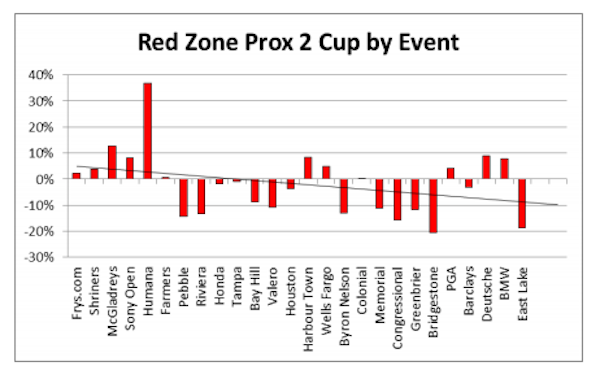
For the most part, Todd’s play from the Red Zone regressed significantly. The black slanted line is the ‘trend line’ which shows that Todd’s performance from the Red Zone was on a fairly steep decline. Meanwhile, his putting caught fire outside of the stretch of four events towards the end of his career. The past data of players that regress with their Red Zone play and catch fire with the putter is to regress significantly in the following season.
Todd will be exempt from every event this season outside of the Accenture Match Play. That will provide him a very favorable schedule where he is playing in large purse events and that should be enough for him to stay well within the top-125 on the Money List, but the trend shows that his Adjusted Scoring Average should get significantly worse and could lead to a lackluster season.
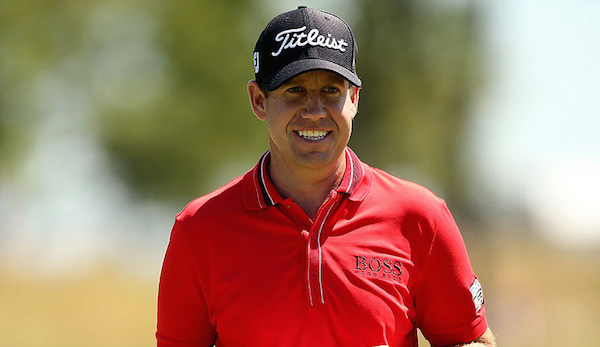
ERIK COMPTON
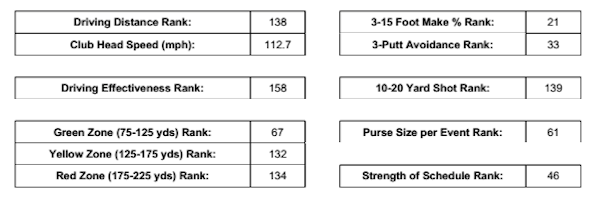
Normally, 80 percent of a Tour player’s earnings come from 20 percent of their events. Compton saw 87.4 percent of his earnings come from 20 percent of his events this past season. When the earnings percentage gets to 90 percent it indicates that the player did not play very well outside of one event which is what happened for Compton at Pinehurst.
The good news for Compton is that he did rank 90th in Adjusted Scoring Average, and he will continue to have a better than average Purse Size per Event as he is exempt from both the U.S. Open and the Masters. His struggles striking the ball and his drop in club head speed by about 2 mph, however, it is right in line with traditional regressions in performance on Tour.
Honorable Mention: K.J. Choi, Matt Every, Russell Henley, Charles Howell III and Scott Stallings




This past Monday, I played in the U.S. Amateur local qualifier at Rock Creek Country Club in Portland, Oregon. A full tee sheet from 7:30 a.m. to 1:55 p.m., the top 11 scores would make it to the U.S. Amateur final qualifying.
I teed off at 10:48 a.m.. With the 7:30 am tee time, you can get a feel for the leaders’ pace, and they were off and running on the challenging setup at Rock Creek.
View this post on Instagram
Getting to the highlight of the round on the par five 17th, a drive up the left side and 212 yards left to the front hole location. I took out a 5-iron with plans of middle of the green. The ball ended up 8 feet left of the hole, pin high. A slight downhill putt dropped in for an eagle 3 on the 17th. With the cut line looking to be anywhere from -2 to even par. This was the boost I had been waiting for all day.
With making par from the trees on 18, it was time to wait for a potential playoff with a posted score of one under par 71.
Three hours later, it was playoff time. 8 players for 6 spots. I made par on the playoff hole, which was good enough to advance to the U.S. Amateur final qualifying in July. USGA qualifiers sure deliver on all of the emotions in golf!
Club Junkie
Building my 2026 gamer WITB: Ranking the contenders and new putter projects – Club Junkie Podcast

The annual What’s In The Bag build is underway, and on this episode of Club Junkie, Brian breaks down the clubs currently leading the race for a spot in his 2026 gamer setup. From drivers and fairway woods to irons, wedges, and shafts, he ranks the equipment that’s performing best and explains what’s separating the front runners from the rest of the field.
Brian also heads into the workshop to discuss several putter projects currently on the bench. From head options and shaft choices to build ideas and testing plans, he shares what he’s working on and which putters could become serious contenders for the bag this season.
If you’re a gear junkie who loves equipment testing, club building, and the never-ending pursuit of the perfect setup, this episode is for you.
Follow Club Junkie:
Instagram: @clubjunkiepod
TikTok: @clubjunkiepod
Threads: @clubjunkiepod
X: @ClubJunkiePod
Club Junkie
Tour Edge Exotics mini driver review + TaylorMade Spider ZT Max first look – Club Junkie

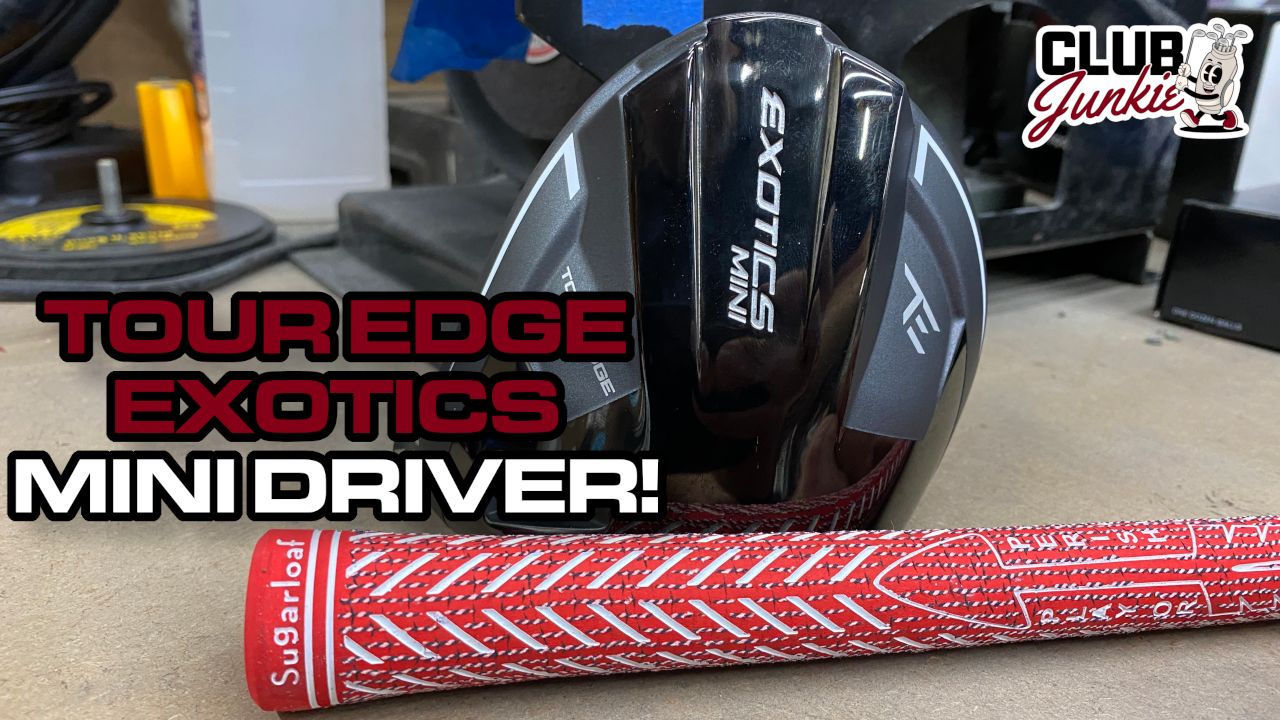
On this episode of Club Junkie, I put the new Tour Edge Exotics Mini Driver to the test and break down the performance, forgiveness, distance, and where it fits compared to a traditional driver or strong fairway wood. If you have been curious about adding a mini driver to the bag, this one is worth a look.
I also dive into the new TaylorMade Spider ZT Max putter that was recently spotted and discuss the growing zero torque putter trend. Plus, there is a closer look at the new Project X Titan Yellow shaft showing up on the PGA Tour and what makes it different from other profiles currently out there.

Justin Rose WITB 2026 (April): Full WITB breakdown with new McLaren irons

What’s the story behind Webb Simpson’s custom-stamped irons?

Memorial Tournament Tour Report: Rory McIlroy, Cameron Young switch up drivers, and more

Cadillac Championship Tour Report: Spieth’s sizable changes, McLaren Golf launches, and more

Russell Henley’s winning WITB: 2026 Charles Schwab Challenge

Kristoffer Reitan’s winning WITB: 2026 Truist Championship

Aaron Rai’s winning WITB: 2026 PGA Championship

J.T. Poston’s winning WITB: 2026 Memorial Tournament

Cameron Young’s winning WITB: 2026 Cadillac Championship

Best irons 2026: Best irons overall, most forgiving irons, and more


Bud Cauley WITB 2026 (June)
Bud Cauley had >14 clubs in his bag when photographed prior to the Memorial Tournament. Driver: Titleist GTS2 (8 degrees) Shaft: Fujikura...


Hannah Green WITB 2026 (June)
Driver: Titleist GTS3 (10 degrees, D4 SureFit setting) Shaft: Mitsubishi Chemical Diamana RB 53 S 3-wood: Titleist GT3 (15 degrees,...


Asterisk Talley WITB 2026 (June)
Driver: TaylorMade Qi4D (9 degrees) Shaft: Fujikura Ventus Blue 6 S 3-wood: TaylorMade Qi4D (16.5 degrees) Shaft: Fujikura Ventus Blue...


Brianna Do WITB 2026 (June)
Driver: Callaway Quantum Triple Diamond (9 degrees) Shaft: KBS PGW 3-wood: Callaway Elyte Titanium (15 degrees) Shaft: KBS PGW 5-wood:...
-
 Equipment6 days ago
Memorial Tournament Tour Report: Rory McIlroy, Cameron Young switch up drivers, and more
-
 News1 week ago
Russell Henley’s winning WITB: 2026 Charles Schwab Challenge
-
 Whats in the Bag3 days ago
J.T. Poston’s winning WITB: 2026 Memorial Tournament
-
 Equipment3 days ago
Best irons 2026: Best irons overall, most forgiving irons, and more
-

 Equipment1 week ago
Details on Jason Day’s latest prototype Avoda iron setup
-
 Equipment3 weeks ago
CJ Cup Byron Nelson Tour Report: Koepka and Kim’s newest putters finally get hot
-

 News2 weeks ago
Charles Schwab Challenge Tour Report: MacIntyre, Åberg and Spaun all switch putters, TaylorMade launches new Spider
-
 Equipment2 weeks ago
Details on J.J. Spaun’s surprise putter switch


peaty
Oct 27, 2014 at 2:24 am
Streb was a very good shout. Are you likely to add comments for the other honourable mentions?Thanks
peaty
Oct 12, 2014 at 4:41 pm
Really interesting analysis, enjoyed it. Can I ask are your Driving Effectiveness stats derived from a personal formula or something we could access/calculate say via the pgatour stats. Also re M Jones – what is the best way to analyse their level of iron play off fairway/tee if once again looking at say stats on pgatour? Thanks.
ur mom
Oct 19, 2014 at 5:02 pm
uuuuuuuuuurrrrrrrrrrrrrrmom
Pingback: 10 Players Who Will Rise (or Fall) in 2015 | Golf Gear Select
paul
Oct 8, 2014 at 6:54 pm
I would like to hear about how aim point users see big performance gains after using it for a while…. As I am also considering taking up aim point.
Hellstorm
Oct 8, 2014 at 8:48 pm
I have thought about it too. There was a clinic about an hour from my house in August but I didn’t make it out. I will hit it up next year for sure.
Richie Hunt
Oct 9, 2014 at 10:49 am
Using the Strokes Gained – Putting metric, the majority of AimPoint users that stick with it have seen a big improvement in that metric after using it for 3-12 months. Scott McCarron was the first Tour player to use it and went from being in the top-1/3rd in putting to being in the top-10th percentile. Bo Van Pelt went from being an average to below average putter to ranking 11th in Strokes Gained – Putting after about a year. Daniel Summerhays went from being a below average putter to ranking in the top half after 6 months and then climbing to 9th in Putts Gained after a year of using AimPoint. Those are just a few examples.
RobG
Oct 8, 2014 at 4:56 pm
Driving Effectiveness is the combination of Distance + Percentage of Fairways Hit + Distance to the edge of the fairway, correct? Does this stat apply to when a player hits only driver or does this stat take into account the tee shot (regardless of club selection) on every par 4 and par 5?
Richie Hunt
Oct 8, 2014 at 5:34 pm
It’s on every shot regardless of what they hit off the tee.
nick hanson
Oct 8, 2014 at 2:14 pm
Hey Rich and Golfwrx. I think you did this last year. I’d love to see a comparison of the prior year’s results and where they came out.
Nick
Zak Kozuchowski
Oct 8, 2014 at 2:21 pm
You can read last year’s list here: http://www.golfwrx.com/163945/pga-tour-players-who-will-rise-and-fall-in-2014/
Rich Hunt
Oct 8, 2014 at 2:33 pm
Yes, I did this last year as Zak showed in the link.
Charles Howell finished 45th in earnings while making 24 out of 29 cuts. His driving effectiveness improved to 111th.
Matt Jones got his first victory and John Senden got his first victory on the PGA Tour since 2006.
John Merrick finished 145th on the Money List, Derek Ernst 170th. Mahan’s Adjusted Scoring Average fell to 50th and he didn’t win until the playoffs. I already talked about Blixt and the big miss for me was on Stroud who finished 53rd in earnings and 44th in Adjusted Scoring Average. Josh Teater was the big miss on the players I had improving as he finished 137th in Adjusted Scoring Average.
However, on my board I did have Brian Harman improving and he got his first win and finished and finished 34th in Earnings.
Edub
Oct 8, 2014 at 5:00 pm
Seems like you’re picking the numbers that worked for you last year Rich. I’d say Hunter had a pretty decent year all in all. Predicting an individuals performance a year ahead is a wast of time. The players make the numbers, not the numbers make the player… I know, it’s tough for a statistician to comprehend.
Edub
Oct 8, 2014 at 5:05 pm
Almost forgot… you lead with Colsaerts last year, his 2014 was worse than 2013. Great pick on that one.
Richie Hunt
Oct 8, 2014 at 5:39 pm
I don’t expect to roll 6’s each time. Colsaerts hardly played that much in 2013-2014 because of an injury and I can’t predict injuries.
Teater and Stroud were clear misses which I mentioned before. But hitting on Jones, Senden, Merrick, Blixt and pushing on Howell (who still had a nice year) isn’t bad. I would probably label Hunter Mahan’s performance as a push as well as he did win, but it was one of his weaker seasons in recent memory.