
Opinion & Analysis
How to play long par-4’s and par-5’s effectively

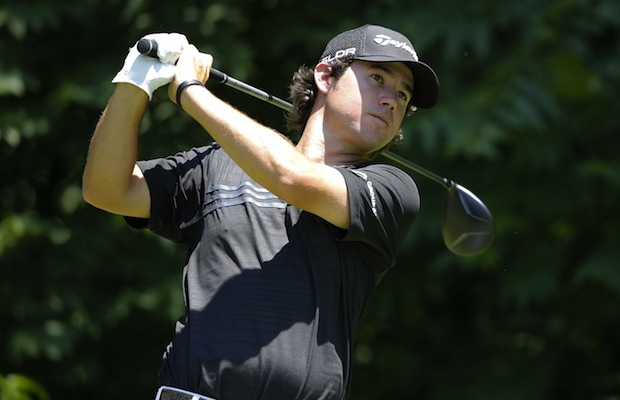
This past week, Brian Harman won the John Deere Classic. Harman has been one of my favorite players to follow from a statistical approach because he is one of the most aggressive tee shot players on Tour, meaning his numbers show that he is less likely to lay-up off the tee and continue to hit his driver. Here are the top-10 most aggressive drivers on Tour from the 2013 season:
- Ian Poulter
- Ben Curtis
- Brandt Snedeker
- Phil Mickelson
- Brian Harman
- Graeme McDowell
- Tim Clark
- Robert Castro
- Steve Sticker
- Matt Kuchar
The statistical research in the game has repeatedly shown that golfers are better off utilizing an offensive strategy versus a defensive strategy. It will not work every time, but golfers who utilizes an offensive strategy usually putting the odds in their favor. The question then becomes, “When is the point of being too aggressive?”
The general rule of thumb in golf statistics is that the closer the ball is to the hole, the more likely the golfer will hit the next shot closer to the hole. The type of lie a player has, however, plays a large factor in this as well.
The chart below shows the 2013 PGA Tour averages in proximity to the club. It illustrates how getting the ball closer to the hole is generally better, but it clearly helps to get the ball in the short grass as well:
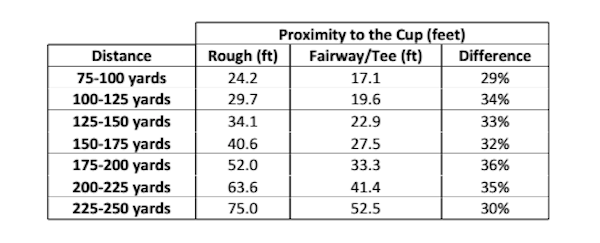
Something that is often overlooked by golfers is that this is just measuring the Proximity to the Cup. While important, it does not assume that each shot lands on the green. In fact, the ShotLink data will measure any shot that is within 30 yards of the edge of the green. And we know that the farther the distance the ball is away from the cup, the more likely the ball will not be on the green.
I have found the threshold on modern Tour courses is about 50 feet. Once the shot gets to roughly 50 feet from the hole, golfers are more likely to be off the green than be on the green. Obviously, today’s greens can hold plenty of shots that are more than 50 feet away from the hole. But, the majority of the time Tour players are trying to hit their approach shot as close to the hole as they can instead of aiming for the middle of the green. If they start missing by more than 50 feet that is more or less with the intent of trying to get that ball as close as they can to the cup.
So, when we look at that chart of Proximity to the Cup from different distances, we see that 50-foot threshold starts with shots from the rough from 175-to-200 yards. It gets to 63.5 feet on rough shots from 200-to-225 yards. It’s not until 225-to-250 yards that the average shot from the fairway has a proximity to the cup greater than 50-feet. Last year, however PGA Tour players only averaged 0.77 shot attempts from 225-to-250 yards per round, regardless if they were from the fairway or the rough. Not many shots come from 225-to-250 yards on Tour, so therefore it is largely a non-factor in most PGA Tour events.
One of the goals I strongly urge my Tour clients to look to achieve is to get 85 percent or more of their Red Zone shots (shots from 175-225 yards) to come from the fairway/tee box. This way, the golfer can perform much better from the Red Zone without actually having to improve their skill and/or change their technique.
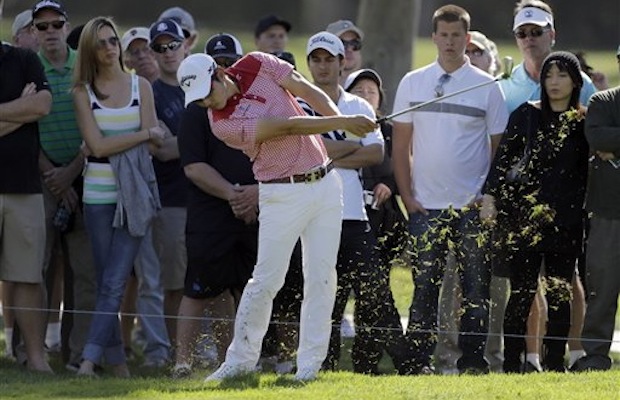
For example, last year Sang-Moon Bae finished 126th on Tour from the Red Zone. His adjusted proximity to the cup from 175-to-225 yards was 43.5 feet. However, he only hit 76.8 percent of those shots from the fairway/tee box.
If his performance from the fairway and the rough from those distances did not change and all he did differently was have 85 percent of those shots coming from the fairway/tee box, his adjusted proximity to the cup would have dropped to 41.8 feet. That would have moved him from 126th from the Red Zone to 87th and would be roughly worth 0.2 to 0.25 strokes per round. While that may not seem like much, that is worth roughly 25 spots on the Money List and likely prevented him from qualifying for the Tour Championship at East Lake.
My Own Folly
When I first started doing statistical research I came across the undeniable fact that the “Go For It Percentage” on Par-5’s has a very strong statistical correlation to Par-5 Scoring Average. Furthermore, I saw that the PGA Tour determined a “Go For It” to be anytime golfers got the ball within 30 yards of the edge of the green. Therefore, golfers with a 300-yard shot who can only hit their 3-wood 250 yards could theoretically achieve a “Go For It” as long as they got the ball within 30 yards of the edge of the green.
This initially led me to believe that golfers should generally try to hit it as long as they can on the par-5’s. I was also led to believe this because my logic was that if they didn’t hit a good tee shot, they still had four more shots to save par.
What I discovered was that this theory was severely flawed. And that is because it wrongly places too much value on the tee shot and not enough value on the second shot. Another thing I didn’t consider is that even Tour players do not like hitting 3-woods out of the rough and for good reason; they are not very good at it.
For instance, if a par-5 requires golfers to hit their first two shots 540 yards in order to “Go For It” and they hit their drive 280 yards off the tee, that will leave them with 260 yards to the “Go For It” range. Given that they only hit their driver 280 yards, hitting their 3-wood off the deck 260 yards is going to be a tall order. And they will need as easy of a shot as possible to hit the 3-wood 260 yards. However, if they only hit it 250 yards, they should still be in pretty good position.
What we often see from Tour players is that if they are in the rough on the par-5’s, they will usually lay up and only hit their lay-up shot about 180-to-210 yards. So, trying to swing for the fences on par-5’s may give golfers 20 more yards if they make good contact. But the odds of finding the rough are greater and that means the possible 20 more yards off the tee is negated by them preferring to lay-up because they are in the rough.
Here is a table of one of my own Tour clients. In 2012, we discussed going for par-5’s in two shots and not being afraid to try and bomb the ball off the tee. He was not going for par-5’s in two shots as much as he should, but he actually felt that was ultra-aggressive in going for them whenever it was feasible. I soon discovered the issue with trying to bomb it off the tee so we then focused on him taking his stock swing with the driver and focusing on making good contact and finding the fairway in 2013.

The client is actually able to go for more Par-5’s in two shots despite not trying to bomb the ball off the tee. In fact, he has lost a sizeable amount of distance off the tee this year and is going for more Par-5’s in two shots than ever. His distance loss is not due to laying-up off the tee as he rarely lays-up off the tee. Yet, he FEELS that he is no more aggressive than he was in 2012. The difference is that he now finds the fairway and gives himself more feasible opportunities to go for the green in two shots.
This is why I’m not a fan of the “bomb-n-gouge” mentality. Finding the fairway provides a sizeable advantage to the golfer. But I’m also not a fan of defensive golf either, because losing distance can have an adverse effect on your expected scores. The best of both worlds is to be unafraid of hitting your driver off the tee, even if it is into a narrow fairway. However, take your stock swing and focus on making good contact and finding the fairway; even if the hole is long and the fairway is wide.
A rule I stress to all golfers
If you are very likely to have a 5-iron or longer on your next shot, whether it is on a par-4 or a par-5, focus on taking your stock swing, making good contact and finding the fairway. Do not try to hit it as hard as you possibly can in hopes of gaining extra yards off the tee. The ability to hit the following shot long enough and accurately enough has a greater influence on your score on the hole.
This is not meant to be a giant revelation, but golfers can swing too hard for their own good. There appears to be a growing sentiment that a golfer has to swing out of their shoes in order to have an “athletic looking swing,” but I grew up playing golf where the common instruction was to have effortless power, not powerful effort.
The idea should be to improve your stock swing so you can hit it long and straight time after time. The data indicates that trying to hit it as hard as you can with little or no regard to accuracy is just not a better path to shooting lower scores. And like Brian Harman, one can make up for a lack of club head speed by adopting a more aggressive strategy rather than trying to make a more aggressive golf swing.



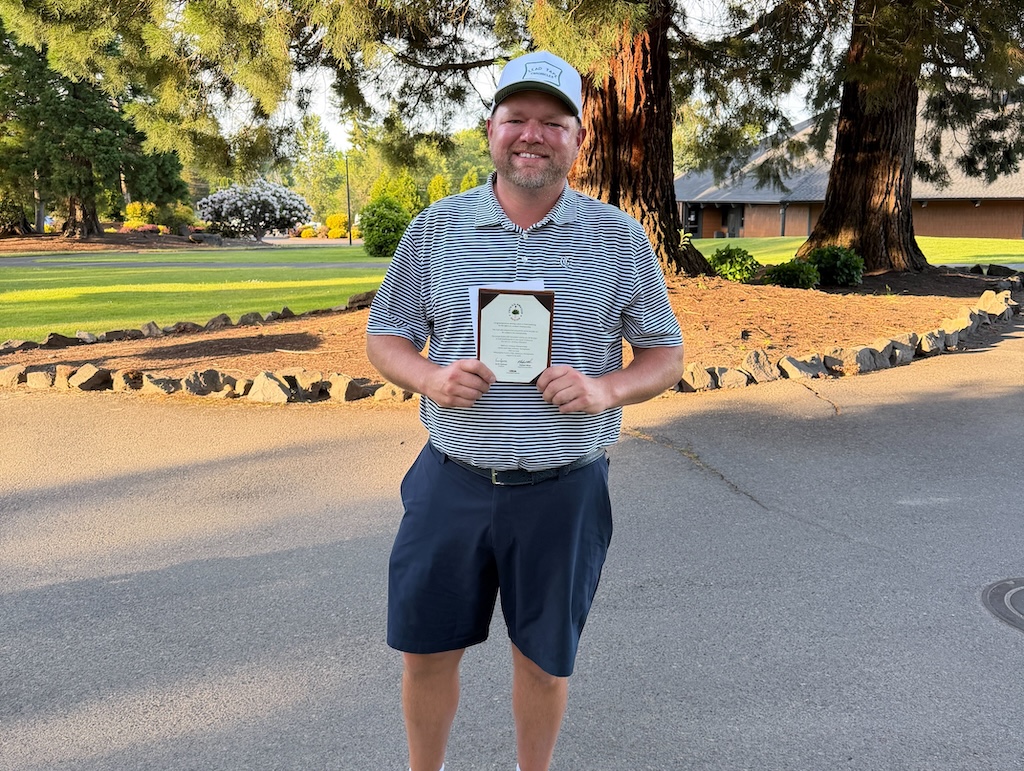
This past Monday, I played in the U.S. Amateur local qualifier at Rock Creek Country Club in Portland, Oregon. A full tee sheet from 7:30 a.m. to 1:55 p.m., the top 11 scores would make it to the U.S. Amateur final qualifying.
I teed off at 10:48 a.m.. With the 7:30 am tee time, you can get a feel for the leaders’ pace, and they were off and running on the challenging setup at Rock Creek.
View this post on Instagram
Getting to the highlight of the round on the par five 17th, a drive up the left side and 212 yards left to the front hole location. I took out a 5-iron with plans of middle of the green. The ball ended up 8 feet left of the hole, pin high. A slight downhill putt dropped in for an eagle 3 on the 17th. With the cut line looking to be anywhere from -2 to even par. This was the boost I had been waiting for all day.
With making par from the trees on 18, it was time to wait for a potential playoff with a posted score of one under par 71.
Three hours later, it was playoff time. 8 players for 6 spots. I made par on the playoff hole, which was good enough to advance to the U.S. Amateur final qualifying in July. USGA qualifiers sure deliver on all of the emotions in golf!
Club Junkie
Building my 2026 gamer WITB: Ranking the contenders and new putter projects – Club Junkie Podcast

The annual What’s In The Bag build is underway, and on this episode of Club Junkie, Brian breaks down the clubs currently leading the race for a spot in his 2026 gamer setup. From drivers and fairway woods to irons, wedges, and shafts, he ranks the equipment that’s performing best and explains what’s separating the front runners from the rest of the field.
Brian also heads into the workshop to discuss several putter projects currently on the bench. From head options and shaft choices to build ideas and testing plans, he shares what he’s working on and which putters could become serious contenders for the bag this season.
If you’re a gear junkie who loves equipment testing, club building, and the never-ending pursuit of the perfect setup, this episode is for you.
Follow Club Junkie:
Instagram: @clubjunkiepod
TikTok: @clubjunkiepod
Threads: @clubjunkiepod
X: @ClubJunkiePod
Club Junkie
Tour Edge Exotics mini driver review + TaylorMade Spider ZT Max first look – Club Junkie

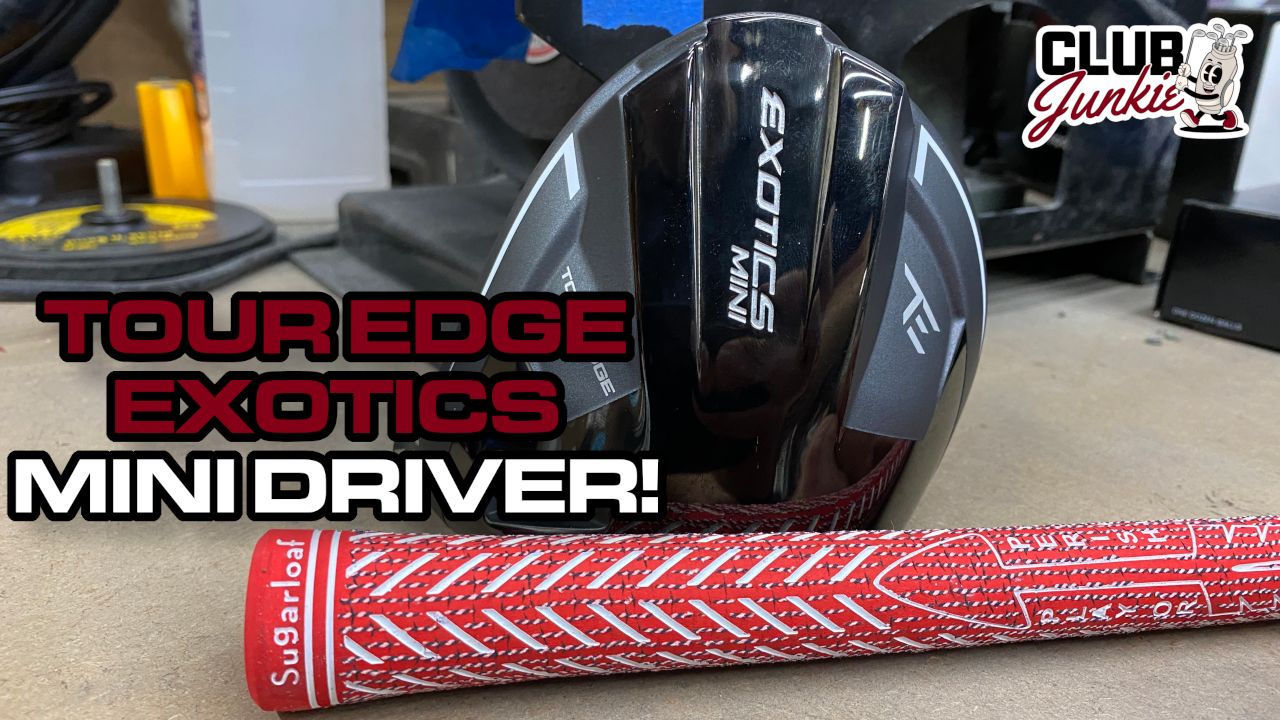
On this episode of Club Junkie, I put the new Tour Edge Exotics Mini Driver to the test and break down the performance, forgiveness, distance, and where it fits compared to a traditional driver or strong fairway wood. If you have been curious about adding a mini driver to the bag, this one is worth a look.
I also dive into the new TaylorMade Spider ZT Max putter that was recently spotted and discuss the growing zero torque putter trend. Plus, there is a closer look at the new Project X Titan Yellow shaft showing up on the PGA Tour and what makes it different from other profiles currently out there.

Justin Rose WITB 2026 (April): Full WITB breakdown with new McLaren irons

What’s the story behind Webb Simpson’s custom-stamped irons?

Memorial Tournament Tour Report: Rory McIlroy, Cameron Young switch up drivers, and more

Cadillac Championship Tour Report: Spieth’s sizable changes, McLaren Golf launches, and more

Russell Henley’s winning WITB: 2026 Charles Schwab Challenge

Kristoffer Reitan’s winning WITB: 2026 Truist Championship

Best irons 2026: Best irons overall, most forgiving irons, and more

J.T. Poston’s winning WITB: 2026 Memorial Tournament

Aaron Rai’s winning WITB: 2026 PGA Championship

Cameron Young’s winning WITB: 2026 Cadillac Championship


Ryan Palmer WITB 2026 (June)
Driver: Callaway Quantum Triple Diamond (9 degrees) Shaft: Project X HZRDUS Smoke Blue RDX 60 TX 3-wood: TaylorMade Qi10 (15 degrees) Shaft:...


Bud Cauley WITB 2026 (June)
Bud Cauley had >14 clubs in his bag when photographed prior to the Memorial Tournament. Driver: Titleist GTS2 (8 degrees) Shaft: Fujikura...


Hannah Green WITB 2026 (June)
Driver: Titleist GTS3 (10 degrees, D4 SureFit setting) Shaft: Mitsubishi Chemical Diamana RB 53 S 3-wood: Titleist GT3 (15 degrees,...


Asterisk Talley WITB 2026 (June)
Driver: TaylorMade Qi4D (9 degrees) Shaft: Fujikura Ventus Blue 6 S 3-wood: TaylorMade Qi4D (16.5 degrees) Shaft: Fujikura Ventus Blue...
-
 Equipment6 days ago
Memorial Tournament Tour Report: Rory McIlroy, Cameron Young switch up drivers, and more
-
 News2 weeks ago
Russell Henley’s winning WITB: 2026 Charles Schwab Challenge
-
 Equipment3 days ago
Best irons 2026: Best irons overall, most forgiving irons, and more
-
 Whats in the Bag4 days ago
J.T. Poston’s winning WITB: 2026 Memorial Tournament
-

 Equipment1 week ago
Details on Jason Day’s latest prototype Avoda iron setup
-
 Equipment3 weeks ago
CJ Cup Byron Nelson Tour Report: Koepka and Kim’s newest putters finally get hot
-

 News2 weeks ago
Charles Schwab Challenge Tour Report: MacIntyre, Åberg and Spaun all switch putters, TaylorMade launches new Spider
-
 Equipment2 weeks ago
Details on J.J. Spaun’s surprise putter switch


Kevin
Jul 15, 2014 at 2:29 pm
Bottom line, the better your lie is on your second shot on par 5’s, the more aggressively you can play them.
bradford
Jul 15, 2014 at 7:56 am
This just doesn’t apply to beginner or even mid-level (90-105ish) players. Does it factor in the woods on the right they hit with that 3W 40% of the time from the fairway? The bunker that they can’t get out of? The whiff from trying to kill it? I’ll agree with these numbers only on the tour, or low hcp players…for others it’s just simply false.
Sky
Jul 14, 2014 at 10:36 pm
How was Phil one of the most likely to hit driver off the tee if he didn’t carry a driver for most of 2013? Did they count the phrankenwood as a driver?
Brian
Jul 14, 2014 at 9:50 pm
I think the huge thing to consider when going after it as an amateur is the opportunity cost of going for it. If you go by the logic as I have this season (to try and go for it if you can get within 30 yards”) you have to consider what you are giving up. One do the big things is a free 170ish yards. If I lay up on every par 5 I would only have about a wedge in to maybe a 9 iron, but it would be pretty automatic.
If I decide to go for it, the logic of getting within 30 yards weighs extremely heavy on the presumption that you actually hit a good shot or more importantly actually make solid contact (as I have found out the hard way). If you duff it, you are now 200+ yards out hitting 3 aka “jail”. If you hit a shot that slices way right or hooks left, you have the possibly of ending up behind a tree or blocked out.
I think weighing the cost of a duffed wood vs a conservative 150 or 170 yards has to be factored in when deciding to go for it
Richie Hunt
Jul 14, 2014 at 11:54 pm
A major issue with laying up off the tee is that just because you lay-up, there is no guarantee that you will find the fairway. Conversely, just because you hit driver that does not guarantee you will find the rough. And where the real killer is statistically is when players lay-up and miss the fairway. That puts the golfer well behind the 8-ball.
I typically run into the same argument when it comes to getting a short approach closer to the hole. The 13th hole at Bay Hill is that way. The numbers say to get the ball within 110 yards, regardless if the ball finds the fairway or the rough.
Instead, they will come back and say ‘well, all I have to do is lay-up and I will have a 9-iron or PW into the hole.’ But, just because they have a 9-iron or PW doesn’t mean that they will find the green. It’s an easy shot, but getting it inside 110 yards is far easier. And the ods of sticking the <110 yard shot close are much better and his odds of not missing the green is also far better.
It's really common sense…getting the ball closer to the hole generally means that you're expected score will be better. For Tour players, we start to see the difference at around 20 yards (i.e. 130 yard shot will have a noticeably better expected score than a 150 yard shot). But for amateurs we start to see a difference around 10-12 yards (a 140 yard shot vs. a 150 yard shot).
mhendon
Jul 14, 2014 at 6:41 pm
I think its also fair to point out 9 of the top ten guys on the aggressive list would be considered short hitters on the PGA tour.
Rich
Jul 15, 2014 at 9:34 am
You beat me to this point. 9 of those 10 guys have to hit driver because they are short. Phil is the only truely aggressive player on that list. Don’t know where that leaves the article………..
MHendon
Jul 15, 2014 at 11:39 am
It’s like an attorney trying to leave out all the facts to make his case stick.
OhioGolfDude
Jul 15, 2014 at 1:02 pm
I think this is a very fair point. Every player on this list is ranked 70th or below in terms of 2014 driving distance – Mickelson being the only one to crack the Top 100. That being said, because these players are required to hit driver on virtually every hole, I’d like to compare their “go for it” strategy with the fairways hit and GIR stats.
Pingback: How to play long par-4?s and par-5?s effectively | Spacetimeandi.com
webbstar
Jul 14, 2014 at 5:47 pm
thank you for a bit of sanity, it seems that all we hear about is distance is more important than accurate no matter what the situation. The fact is the only time i’m as accurate from the the rough as the fairway is from 125 yards and in but even then i’d rather be in the fairway.
nikkyd
Jul 14, 2014 at 4:38 pm
Does anyone know if there is an average rough height across the board? Shots out of the rough on the pga tour (4″deep grass) sounds demanding, but most municipalities have shorter rough (from what i have seen anyhow) bomb and gouge is a way of life for some of us regardless of rough or not. Its the woods one must be weary of. Sometimes id rather be in the rough because my homecourse fairways and aprons are like concrete!
Jeff Trigger
Jul 14, 2014 at 7:01 pm
Yours too? My course is either drive to the hardpan or hit the 3 inch Bermuda rough.
Dan P
Jul 14, 2014 at 2:06 pm
Another great article from Richie. Keep them coming!
Jedidiah
Jul 14, 2014 at 1:11 pm
Mmm you’ve own me over richie