
Opinion & Analysis
Which major crowns golf’s greatest champions?


This month marks the 40th anniversary of the “Massacre at Winged Foot,” the 1974 U.S. Open won by Hale Irwin at 7-over par. When senior USGA official Sandy Tatum was asked about the difficulty of the course setup, a setup at which not a single player broke par in the first round, he famously responded:
“We’re not trying to embarrass the best players in the world, we’re trying to identify them.”
With the U.S. Open at Pinehurst days away and golf’s two final majors of the year following in July and August, it’s good to recall Tatum’s memorable line and ask:
- How well does the U.S. Open or any major do at identifying golf’s greatest champions?
- Is there one that crowns the best golfers on a more consistent basis than the others?
- How would you go about proving that, or provide compelling evidence to support it, if that were the case?
To many readers, it might seem The Masters is an obvious choice for the best major at identifying golf’s greatest champions with six victories by Jack Nicklaus, four by Tiger Woods and Arnold Palmer and three each by Phil Mickelson, Gary Player and Nick Faldo. But green jackets have also been won by Gay Brewer, Charles Coody and other players whose careers do not rank with the all-time greats. What about the U.S. Open, with four victories by Bobby Jones, Ben Hogan and Nicklaus, three by Tiger and Irwin and two by Lee Trevino, Billy Casper and Ernie Els? This article outlines an approach for determining what majors have done the best at identifying golf’s greatest champions an approach that consists of a few main steps:
- Identify all major championship winners in a given period. Starting with 1960, there have been 110 individual winners of golf’s majors in 216 tournaments (54 years, four majors per year). The year 1960 is a good starting point for two reasons: first, the U.S. Open won that year by Arnold Palmer at Cherry Hills outside Denver is widely viewed as a crossroads between the modern game of Palmer and Nicklaus and the post-WWII era of Hogan and Snead. Second, in 1958, the PGA Championship shifted from match play to stroke play, so starting earlier than 1960 and still including the PGA Championship would pose an apples-to-oranges problem in comparing all four majors because we would not have comparable data for a full decade pre-1960 as we do for the 1960s, ’70s, etc.
- Rank 110 major champions since 1960 based on a quantitative method that gives “champion points” for victories in the majors and for other tour wins across their career (e.g., PGA Tour, European Tour, etc). Note: If a major champion’s career accomplishments preceded 1960 — such as major victories by Arnold Palmer (1958 Masters), Gary Player (1959 Open Championship), Julius Boros (1952 U.S. Open) and a few others — these accomplishments are still counted in their “champion point” totals.
- Based on the rankings in No. 2, group all 110 major winners into smaller and more manageable “champion tiers” and then apply these tiers to each of the four majors from 1960-to-2013 based on the champion who won the major that year. By adding the “champion tier” points (1-to-15 with 15 being the highest) during a given time period for all four majors — e.g. since 1960, a decade like the 1970s, etc. — the major with the highest number of champion points can readily be identified and compared to the others.
While this approach is straightforward in concept, subjective judgments still have to be made. For example, all non-major wins on the PGA Tour are treated the same, such as Davis Love III’s two stirring victories in the Players Championship (1992 and 2003) and his one-stroke win against Tommy Gainey in the Children’s Miracle Network Classic (2008). All three are each given the same number of “champion points” in step No. 2 above, as is every win on the European Tour. What about a player’s victories on senior tours, Asian and other pro tours, his amateur record, or performance in the Ryder Cup or President’s Cup? Answers to these and other questions are found in the accompanying box on methodology and assumptions. Obviously readers will have differing views on the approach used. There clearly are many ways to quantify a major champion’s accomplishments and slight changes in methodology can lead to significantly different results. The approach proposed here is by no means definitive, but hopefully provides a reasonable starting point that can be refined and improved in time with your input.
Methodology/Assumptions
- What is counted and not counted in establishing a major champion’s record?
- How are champion points accumulated?
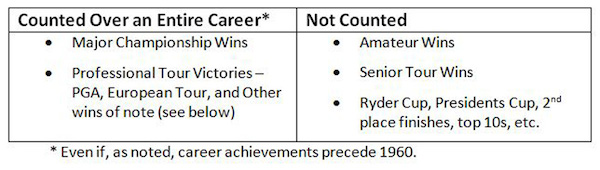
Major Championship Wins
- 10 champion points for each major victory.
- +5 points for winning two legs of the Grand Slam.
- +5 more points for winning three legs of the Grand Slam.
- +10 more points for winning all four majors — the Grand Slam.
So if a golfer were to win all four majors, he would be credited with 60 total champion points consisting of: 10 for each major (40), plus 20 more for winning the Grand Slam (5+5+10). If a golfer were to win only the Masters or only the U.S. Open twice, they would be credited with 20 champion points — 10 for each major, whereas a golfer winning two different legs of the Grand Slam, say the U.S. Open and PGA Championship like Rory McIlroy has done, he would be credited with 25 champion points, +5 points for winning two legs of the Grand Slam.
- PGA and European tour wins: One point awarded for each win on the PGA or European tours, regardless of the prestige of the event, quality of field, etc.
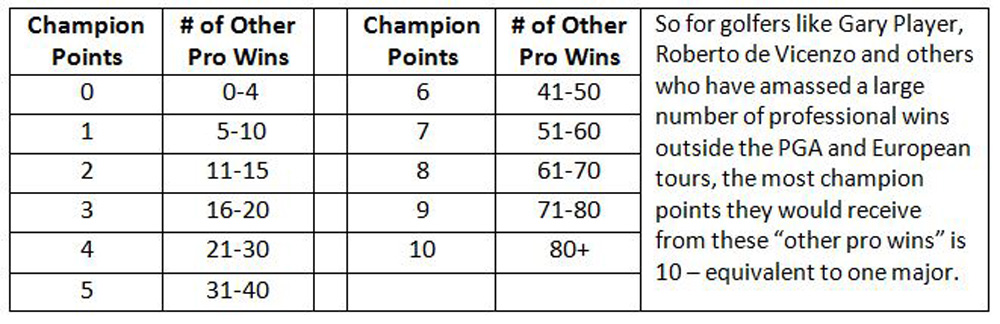
- Other professional wins: For tours in Asia, Africa, Latin America, Web.com and other professional wins, the following scale has been developed.
- A snapshot in time, year-end 2013: No attempt is made to project a current player’s career beyond his accomplishments at the end of 2013. As a player’s record grows, results can readily be updated.
Key Findings
The resulting data is a veritable gold mine of information that can yield many interesting findings about golf’s four majors and the 110 players who have won them from 1960 to 2013. Here are a few highlights: Since 1960, the past 54 years:
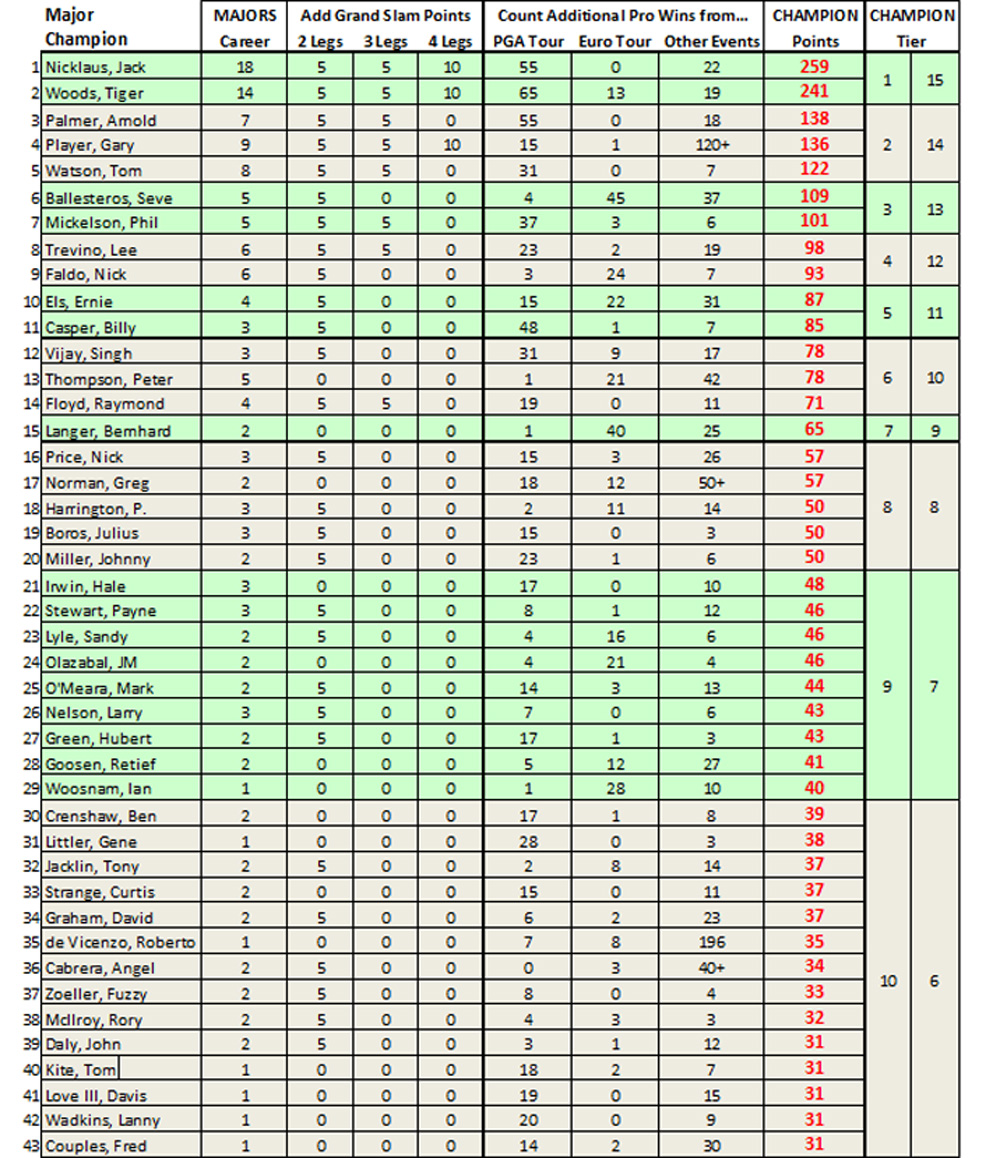
- The Masters is the major with the highest number of champion points. The resulting data has the Masters with 516 champion points, an average of 9.6 points per year. This is equivalent to the winner of the Masters since 1960 being a champion ranked between Nos. 12 and 15 on average in terms of career accomplishments out of all 120 major champion winners. This is truly elite status (see Top 40+ Golfers chart).
- The Open Championship (British Open) is a close No. 2 to the Masters. The Open Championship is credited with 492 champion points, just 24 points below the Masters during the 54 years. This works out to an average of 9.1 champion points per year, equivalent to the average winner of the British Open being a champion ranked No. 15 in terms of career accomplishments out of all 120 major winners since 1960 (see Top 40+ Golfers chart).
- The U.S. Open and PGA Championship are nearly tied with the fewest champion points. The U.S. Open and the PGA Championship have very similar results with 407 and 400 champion points respectively. Both are more than 100 points below the Masters. This works out to 7.5 champion points per year, which is equivalent to the average winner of these two majors being a champion ranked between Nos. 16 and 29 in terms of career accomplishments out of all 120 major champion winners since 1960 (again, see Top 40+ Golfers chart).
Winning Major by Decade, 1960s to 2000s
- The Masters recorded the highest number of champion points in three of the five decades evaluated, the 1960s, ’90s and 2000s. The British Open won the 1970s and ’80s. The Masters never finished below second in champion points in any of the five decades evaluated.
- The U.S. Open finished as high as second in just two decades, the 1960s and ’90s, and finished last in champion points in the 1970s and 2000s.
Best Decade for Major Winners, the 1970s
- Both the British Open and PGA Championship had their highest number of champion points in the 1970s, more than any of the five decades evaluated.
- This contributed to the 1970s being a golden era for major winners. With 392 points spread among 40 majors, the average major champion ranked in the No. 12 to 15 range out of all 120 major champions since 1960 (see Top 40 +Golfers chart). The next best decade was the 1960s with 367 champion points.
1990s Recorded Fewest Champion Points of Any Decade
- The average number of champion points recorded in each decade, other than the 1990s, was about 360 points (362.5). This average is 77 points higher than the total number of champion points recorded in the 1990s — just 285.
- The average winner of a major in the 1990s was a champion ranked in the No. 21 to 30 range of all 120 major winners since 1960 (see Top 40+ Golfers chart).
Can a Non-Major Winner Still be Ranked Among the Greats?
- This is a controversial topic, but some insight can be offered through the method proposed here. For example, if we were to look at the record of Colin Montgomerie, he would have 32 champion points based on 31 Euro Tour wins and nine “other wins” worth one point.
- This would place him solidly in champion tier No. 6 alongside such players as multiple major winners Fuzzy Zoeller, John Daly and Rory McIloroy (each with two majors) and other players such as Tom Kite and Davis Love (see Top 40+ Golfers chart).
- Since Monty did not win a major, however, he is not included in this evaluation.
So given the USGA’s/Sandy Tatum’s stated goal of “identifying the best golfers in the world,” how well has the U.S. Open done?
The U.S. Open has had its share of highly accomplished champions since 1960 with multiple winners that include Jack, Tiger, Irwin, Casper, Trevino and others. But by most reasonable measures, and the methodology presented here, it is clear our national open often crowns champions whose career records are well below the all-time greats. Here are the U.S. Open victors since 1960 who amassed the fewest champion points in this evaluation, starting with the most recent:
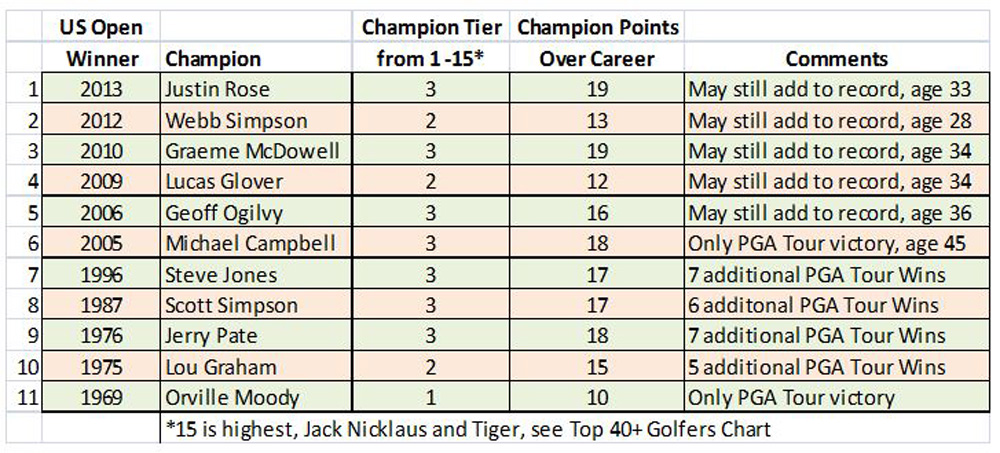
Of course, we can expect some of the active players listed will add to their career accomplishments, taking them to a higher champion tier, but at a minimum the data shows that the U.S. Open crowns a “surprise champion” at least once a decade, or 1 in 9 on average (six in the past 54 years). This could go to 15 percent, nearly 1 in 6, if two of the five active players below age 40 don’t move up significantly in time and another surprise champion is crowned the next few years.
This is actually a more favorable percentage for the U.S. Open than it had in the 1950s, which saw three surprise champions: Ed Furgol, 1954 (five other PGA Tour wins), Jack Fleck, 1955 (two other PGA Tour wins) and Dick Mayer, 1957 (six other PGA Tour wins). It’s hard to go back further than the 1950s because the national open wasn’t played during World War II (1942-45), and pro golf tours were still in the early stages, so there were far fewer opportunities for a player to build his career accomplishments.
The facts are that the U.S. Open has long produced surprising winners starting with Francis Ouimet’s victory in 1913 that shocked the sporting world. It has also produced disappointments, even heartbreaks, with all-time greats like Sam Snead failing to capture the title and Phil’s six runner-up finishes to date.
This month golf fans are already focusing their attention on Pinehurst and asking if Phil will finally break through, will some other big name add to his career achievements, or will our national open crown another surprise champion? Whatever the outcome, the U.S. Open will again have identified the “best player in the world.” Maybe not the best over a full career, but certainly the best of the week just as it has many times before.



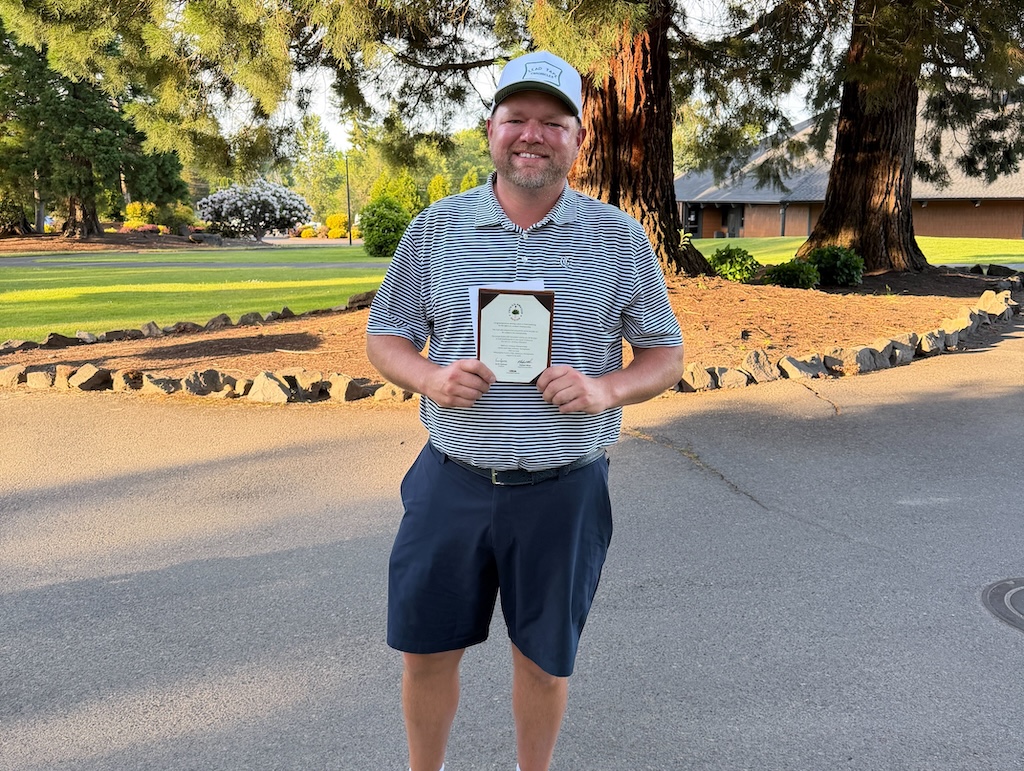
This past Monday, I played in the U.S. Amateur local qualifier at Rock Creek Country Club in Portland, Oregon. A full tee sheet from 7:30 a.m. to 1:55 p.m., the top 11 scores would make it to the U.S. Amateur final qualifying.
I teed off at 10:48 a.m.. With the 7:30 am tee time, you can get a feel for the leaders’ pace, and they were off and running on the challenging setup at Rock Creek.
View this post on Instagram
Getting to the highlight of the round on the par five 17th, a drive up the left side and 212 yards left to the front hole location. I took out a 5-iron with plans of middle of the green. The ball ended up 8 feet left of the hole, pin high. A slight downhill putt dropped in for an eagle 3 on the 17th. With the cut line looking to be anywhere from -2 to even par. This was the boost I had been waiting for all day.
With making par from the trees on 18, it was time to wait for a potential playoff with a posted score of one under par 71.
Three hours later, it was playoff time. 8 players for 6 spots. I made par on the playoff hole, which was good enough to advance to the U.S. Amateur final qualifying in July. USGA qualifiers sure deliver on all of the emotions in golf!
Club Junkie
Building my 2026 gamer WITB: Ranking the contenders and new putter projects – Club Junkie Podcast


The annual What’s In The Bag build is underway, and on this episode of Club Junkie, Brian breaks down the clubs currently leading the race for a spot in his 2026 gamer setup. From drivers and fairway woods to irons, wedges, and shafts, he ranks the equipment that’s performing best and explains what’s separating the front runners from the rest of the field.
Brian also heads into the workshop to discuss several putter projects currently on the bench. From head options and shaft choices to build ideas and testing plans, he shares what he’s working on and which putters could become serious contenders for the bag this season.
If you’re a gear junkie who loves equipment testing, club building, and the never-ending pursuit of the perfect setup, this episode is for you.
Follow Club Junkie:
Instagram: @clubjunkiepod
TikTok: @clubjunkiepod
Threads: @clubjunkiepod
X: @ClubJunkiePod
Club Junkie
Tour Edge Exotics mini driver review + TaylorMade Spider ZT Max first look – Club Junkie


On this episode of Club Junkie, I put the new Tour Edge Exotics Mini Driver to the test and break down the performance, forgiveness, distance, and where it fits compared to a traditional driver or strong fairway wood. If you have been curious about adding a mini driver to the bag, this one is worth a look.
I also dive into the new TaylorMade Spider ZT Max putter that was recently spotted and discuss the growing zero torque putter trend. Plus, there is a closer look at the new Project X Titan Yellow shaft showing up on the PGA Tour and what makes it different from other profiles currently out there.

Justin Rose WITB 2026 (April): Full WITB breakdown with new McLaren irons

What’s the story behind Webb Simpson’s custom-stamped irons?

Memorial Tournament Tour Report: Rory McIlroy, Cameron Young switch up drivers, and more

Cadillac Championship Tour Report: Spieth’s sizable changes, McLaren Golf launches, and more

Russell Henley’s winning WITB: 2026 Charles Schwab Challenge

Kristoffer Reitan’s winning WITB: 2026 Truist Championship

Aaron Rai’s winning WITB: 2026 PGA Championship

J.T. Poston’s winning WITB: 2026 Memorial Tournament

Best irons 2026: Best irons overall, most forgiving irons, and more

Cameron Young’s winning WITB: 2026 Cadillac Championship


Bud Cauley WITB 2026 (June)
Bud Cauley had >14 clubs in his bag when photographed prior to the Memorial Tournament. Driver: Titleist GTS2 (8 degrees) Shaft: Fujikura...


Hannah Green WITB 2026 (June)
Driver: Titleist GTS3 (10 degrees, D4 SureFit setting) Shaft: Mitsubishi Chemical Diamana RB 53 S 3-wood: Titleist GT3 (15 degrees,...


Asterisk Talley WITB 2026 (June)
Driver: TaylorMade Qi4D (9 degrees) Shaft: Fujikura Ventus Blue 6 S 3-wood: TaylorMade Qi4D (16.5 degrees) Shaft: Fujikura Ventus Blue...


Brianna Do WITB 2026 (June)
Driver: Callaway Quantum Triple Diamond (9 degrees) Shaft: KBS PGW 3-wood: Callaway Elyte Titanium (15 degrees) Shaft: KBS PGW 5-wood:...
-
 Equipment6 days ago
Memorial Tournament Tour Report: Rory McIlroy, Cameron Young switch up drivers, and more
-
 News1 week ago
Russell Henley’s winning WITB: 2026 Charles Schwab Challenge
-
 Whats in the Bag3 days ago
J.T. Poston’s winning WITB: 2026 Memorial Tournament
-
 Equipment3 days ago
Best irons 2026: Best irons overall, most forgiving irons, and more
-

 Equipment1 week ago
Details on Jason Day’s latest prototype Avoda iron setup
-
 Equipment3 weeks ago
CJ Cup Byron Nelson Tour Report: Koepka and Kim’s newest putters finally get hot
-

 News2 weeks ago
Charles Schwab Challenge Tour Report: MacIntyre, Åberg and Spaun all switch putters, TaylorMade launches new Spider
-

 Equipment2 weeks ago
Details on J.J. Spaun’s surprise putter switch


Sean
Jun 14, 2014 at 7:28 am
I think the Masters is the “easiest” major to win since it has the smallest field, i.e., amateurs, past champions well past their prime, etc. So the odds of winning it increase, as opposed to the other majors. In addition, the course isn’t as difficult as, for example, the US Open. In my opinion the US Open identifies the best player simply because the set-up of the tournament is the most difficult year in and year out. The Open Championship can be, but is weather dependent.
ben
Jun 10, 2014 at 4:28 am
I think this is an excellent report. Well researched and with plenty of valid and interesting data. And what I glean from it all is that The Open Championship (British open) is the premier event for identifying the best player. It may be a close second to the Masters but the Masters has pretty much a full field of, well, ‘masters’ hence why it usually produces a ‘master’ as a champion. The fact that The British Open ranks so highy on the list despite being the world’s Open and having a huge portion of it’s field come from qualifiers around the world I think that proves it is the best Championship for producing the best champion. . This then raises another interesting point: are links courses the best courses for finding out the best golfer? I’d suggest they are and they do. .
Gerald Nagler
Jun 11, 2014 at 6:00 pm
Thanks for everyone’s comments. I think Ben really has this right. After evaluating the last 50+ years of majors, The Masters comes out on top in terms of crowning golf’ greatest champions but only by a slight margin. The British Open is close behind with full fields, changing venues, bad weather, quirky bounces, etc. In fact during the 1970s, the only golfer to win the Open Championship not in the Hall of Fame is Tom Weiskopf, and he’s hardly chopped liver. The Masters, as some point out, benefits from its smaller fields, same course, favorable springtime conditions and the like, but all these taken together only give it a slight edge over the British Open. As for the US Open, I would like to hear why readers think it crowns so many surprise champions. One “what if” scenario worth noting about the US Open – it would have finished even lower in the evaluation IF Hale Irwin in the 1990 US Open at Medinah hadn’t holed a 45 foot birdie putt on the 72nd hole to get into a playoff with Mike Donald that Irwin won the next day on the 19th hole. If Donald had won, and he came mighty close more than once to pulling it off, the US Open would have nearly the same number of champion points as the PGA Championship (assuming Donald, following his US Open victory, didn’t dramatically add to his record of one other PGA Tour win the year before). I expect there many are other “what ifs” we can play with each major but the question stands, why doesn’t the cream rise to the top in the US Open as it does with the British Open?
Steve
Jun 9, 2014 at 9:59 am
Dumb. First of all the Masters as an invitational has a clear advantage. It is also on the same course each year so it would appear that the best have a greater chance to figure it out and win. The US Open is just that, an Open championship that creates a higher diversity of player and course opportunity each year. Frankly those who win multiple opens on different courses have my greater respect. Otherwise who cares. They are all tests and fun to watch.
Rich
Jun 9, 2014 at 2:03 am
It would appear that the more words you write and the more data you give, increases your chances of being published on Golfwrx, no matter how bad your article is. What a load of rubbish. Let’s just watch the majors and enjoy them. Bring on the US open! Good luck all you qualifiers!
Dan
Jun 9, 2014 at 12:53 am
It would be interesting to see how me champions points the players gets. See how it would rank as the 5th major. Would it be in 5th place or higher up?
Jm
Jun 8, 2014 at 8:43 pm
I think the more relevant question is which tournament, major or not, does the best job of identifying the best player that week. And even that question is fraught with endless analysis.
cash banister
Jun 8, 2014 at 8:08 pm
“Which major crowns golf’s greatest champions?”
—————————————————
That is one of the most poorly constructed sentences that I have ever seen. A better question is “WTF ever happened to professionalism in journalism?”
Jim Zimmerman
Jun 8, 2014 at 7:44 pm
This methodology is absurd and the Masters entrance criteria is a tautology that gives the event a fake air of identifying the best champions. The Masters field has many past champions and amateurs who pose no threat to the limited field of elites. Even if a past champion has a crazy lucky week as a past champion it just adds to his “luster” as a major champion and doesn’t affect the status other than to actually increase it. On the other hand OPEN events that allow ALL of the players in who could reasonably contend are by far the best way to identify the best players. Look at how two time major champion Daly was seldom able to even compete at Augusta, never mind that it was being played on a long and open course that suited his game to a tee. The Masters by its entrance criteria seeks to guarantee that a long shot can never win since for the most part he won’t even get to tee it up.
Jm
Jun 8, 2014 at 8:37 pm
Exactly. The masters will never have too many “scrubs” as champions because they simply are not invited to play.
And that is exactly one of the many reasons i love the Masters.
The US Open is designed to identify the best player for that particular week which it usually does based on the USGA definition of what a good player plays like.
This article has a good premise but poor execution and insufficient analysis.
It is way more complicated to figure out than what is laid out in this article in my opinion
Jim Zimmerman
Jun 9, 2014 at 11:07 am
@Jm what do you have against good golfers who qualify for open championships but aren’t invited to tournaments like the Masters. To tweak John Daly a little bit yesterday I watched an 11 hole sudden death playoff for the Cleveland Open on the web.com tour where the guy who won it had played 36 holes that week to qualify for next week’s US Open. THAT is the type of player I want to see in the Masters! As someone else mentioned another factor is the Masters LOCAL knowledge affect the course is so different on the green complexes that once again the already qualified STAR has a huge advantage. Look at how Lee Trevino analyzes the game and HATED the Masters, starting out he was BETTER than Ray Floyd but NOT in the Masters, it took a US Open or two for Lee’s game to be ALLOWED to shine, shame on the Masters and its idiotic entrance criteria!
Rich
Jun 9, 2014 at 6:03 pm
It might be going a bit far to call it idiotic. It’s just different.