
Opinion & Analysis
The data behind Keegan Bradley’s coaching change

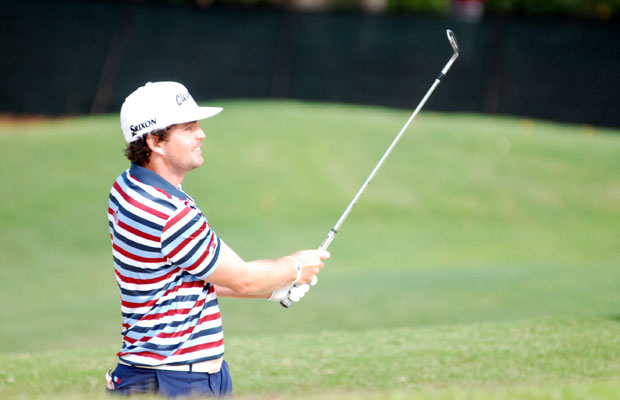
Keegan Bradley has reportedly left long-time swing coach Jim McLean for Chuck Cook, who teaches Bradley’s good friend Jason Dufner and Luke Donald. That gives Cook one of the most formidable list of clients in the golf world, as Bradley is ranked No. 20 in the Official World Golf Rankings, Dufner is ranked No. 15 and Donald is ranked No. 17.
I wanted to take a look at the numbers behind Bradley’s game and to see why he may have decided to change instructors. According to Bradley, the change was prompted by his familiarily with the instructor.
“I’ve been around Chuck Cook for a few years now, playing practice rounds with Dufner,” Bradley told Back9Network’s Ahmad Rashad. “I’m excited to get working with Chuck and get another opinion of how he thinks I can improve my golf game. He’s been around for a long time and I know he has several ways he can help me win.”
Bradley did not record a victory last season, but still finished No. 11 on the money list. When I look at a golfer’s game, I like to first analyze his or her scoring data. This helps me formulate some sort of idea of as to what went on with the golfer and provide a profile of the player’s game as far as his or her strengths and weaknesses go.
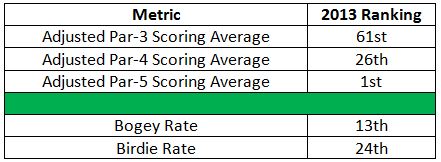
Bradley ranked No. 10 in Total Adjusted Scoring Average. Taking that into account and his rankings in the metrics in the table above, he still had a great season despite not coming away with a victory. I feel with these metrics that Bradley should be striving toward being the No. 1-ranked golfer in the world. He does not have a glaring weakness, and is instead trying to take his great game to the next level.
If Bradley is going to contend for the No. 1 spot, he will need to get inside the top 10 in Adjusted Par-4 Scoring Average. Par-4 play has the strongest correlation to Tour success of the metrics listed above. This is partially due to the number of par-4’s played per round (the Tour average is roughly 11 played per round), and the par-4’s require a more complete game to play them well. Bradley did a fine job in 2013 on the par-4’s. However, in order to contend for the No. 1 ranking in the world that will have to step up.
The biggest “weakness” we see with Bradley’s game is his play on the par-3’s. While par-3 play is important, it has the lowest correlation to success on Tour of the metrics listed. With that said, par-3 play is one part iron play, one part short game and one part long putting (putts longer than 15 feet). While Bradley was still an above-average player on the par-3’s, given that it was his weakest metric, I can start to develop an idea of what some of his issues in 2013 were.
Lastly, he had a fantastic year at avoiding bogies. Avoiding bogies has a stronger correlation to success on Tour than making birdies. He also made a high percentage of birdies. But, for him to contend for the No. 1 ranking in the world, he needs to get into the top 10 in both Birdie and Bogey rates. Furthermore, I find it a bit peculiar that the No. 1-ranked player on par-5’s ranked 24th in Birdie Rate. In all, I can start to envision a profile for Bradley’s game.
DRIVING DATA
I utilize an algorithm based on historical driving data on Tour dating back to 2007 to determine a golfer’s effectiveness off the tee. This is called Driving Effectiveness which utilizes the following metrics:
- Distance
- Fairway Percentage
- Average Distance to Edge of Fairway (on drives that miss the fairway)
- Fairway Bunker Percent
- Missed Fairway – Other Percent (shots that end up in a hazard, O.B. rescue shots, etc)
Here is Bradley’s data for 2013
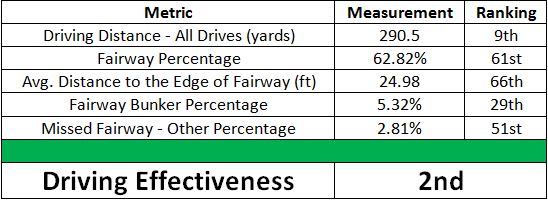
As we can see, driving was rarely a problem for Bradley in 2013, as he was the second most effective driver of the ball (only Henrik Stenson was more effective). Bradley hits the ball a long way and hits a lot of fairways. And when he missed the fairway, he did not miss by much and did a fine job at avoiding fairway bunkers and other trouble. He has been one of the premier drivers on Tour since he earned his card.
PUTTING AND SHORT GAME DATA
Often times, putting and short game play can be over-valued by golfers. However, nothing can prevent a golfer from winning a tournament like poor putting. In fact, nearly 70 percent of the winners on Tour this year finished in the top 10 in Putts Gained (also called Strokes Gained-Putting) for that tournament.
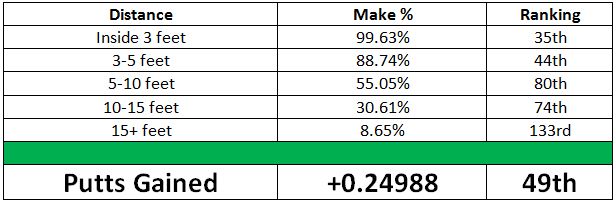
Bradley putted very well in 2013 from most distances. As I have mentioned in the past, the putts from 3-to-15 feet are the most important putts to make when it comes to affecting a player’s performance versus the field. Outside of 15 feet, the make percentage for Tour players becomes very volatile. What I mean is that golfers on Tour, regardless of overall putting skill, tend to be very inconsistent when it comes to make percentage outside of 15 feet. One year they can make a lot of putts from outside 15 feet, and the next year they struggle to make those same putts.
This would explain some of the issues that Bradley had on the par-3’s. Tour players are not likely to have a lot of close birdie putts on the par-3’s, and that is why par-3 performance is dependent on the golfer’s ability to make putts outside of 15 feet. However, Bradley’s make percentage on putts outside of 15 feet is likely to progress toward the mean. Therefore, his performance on the par-3’s is likely to progress in 2014.
Sometimes the problem with good overall putters on Tour is that they were inconsistent with their putting. When they were off, they were well off. And when they were on, they were making a lot of putts. And if they putt poorly in too many tournaments, they reduce their odds of winning those events. Here’s a chart looking at Bradley’s putts gained by event.
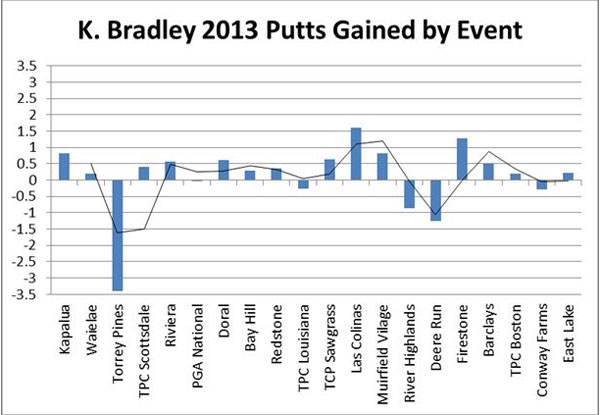
Out of the 20 events that recorded putts gained, Bradley was only losing strokes to the field on six of those events.
Here is a look at Bradley’s short game play:
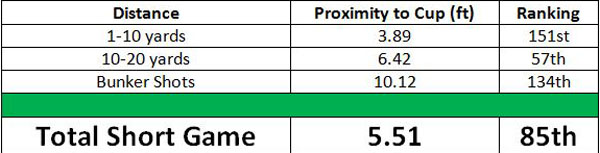
Bradley was an average short game player in 2013. But he did perform well from the most important part of the short game, longer pitch shots from 10-to-20 yards. This could also explain why he was better at avoiding bogies than making birdies. The 10-to-20 yard shots are usually more reserved for when the player needs to save par. The 1-to-10 yard shots are more makeable chip shots.
After looking at the data I see no reason why Bradley cannot contend for the No.1 spot in the world ranking based off his driving, putting and short game data. This only leaves approach shots.
APPROACH SHOT DATA
Here is Bradley’s approach shot data for 2013:
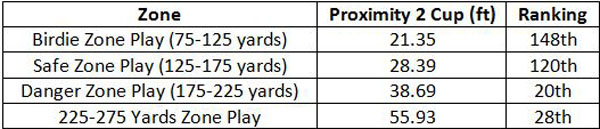
The good news is that the area that correlates strongest to success on Tour, the Danger Zone, is where Bradley was his strongest. Shorter shots, particular wedge play, are vastly overrated by the golfing community. This is why Bradley still had a fantastic year. His long game, both driving and Danger Zone play, was superb. This is where a golfer can gain the most strokes against the field over time.
Here’s a look at Bradley’s rankings from the various zones since he made the Tour:

We can see that Bradley has had issues with his iron play since he has made the Tour. His play from the Danger Zone has improved dramatically, and that has helped propel him into superstar status. But the play from the Birdie and Safe zones is what is holding him back. We also have to remember that his Safe Zone play is even worse than the ranking indicates because he was such an exceptional driver of the ball, which means he should have been in great position to hit a lot of Safe Zone shots closer to the hole.
His struggles from 75 to 175 yards would be part of the reason why he lagged a little behind on the par-3’s. It would also explain why his Birdie Rate was not better, as most birdies on the par-4’s come from Safe Zone and Birdie Zone approach shots.
All of these “issues” are nice issues for a player to have. I would expect that most of Bradley’s work with Cook will focus on improving his iron play from inside 175 yards. The key for him to take his game to the next level will be keeping his effectiveness off the tee and his skill on and around the greens while improving his iron play.





This past Monday, I played in the U.S. Amateur local qualifier at Rock Creek Country Club in Portland, Oregon. A full tee sheet from 7:30 a.m. to 1:55 p.m., the top 11 scores would make it to the U.S. Amateur final qualifying.
I teed off at 10:48 a.m.. With the 7:30 am tee time, you can get a feel for the leaders’ pace, and they were off and running on the challenging setup at Rock Creek.
View this post on Instagram
Getting to the highlight of the round on the par five 17th, a drive up the left side and 212 yards left to the front hole location. I took out a 5-iron with plans of middle of the green. The ball ended up 8 feet left of the hole, pin high. A slight downhill putt dropped in for an eagle 3 on the 17th. With the cut line looking to be anywhere from -2 to even par. This was the boost I had been waiting for all day.
With making par from the trees on 18, it was time to wait for a potential playoff with a posted score of one under par 71.
Three hours later, it was playoff time. 8 players for 6 spots. I made par on the playoff hole, which was good enough to advance to the U.S. Amateur final qualifying in July. USGA qualifiers sure deliver on all of the emotions in golf!
Club Junkie
Building my 2026 gamer WITB: Ranking the contenders and new putter projects – Club Junkie Podcast

The annual What’s In The Bag build is underway, and on this episode of Club Junkie, Brian breaks down the clubs currently leading the race for a spot in his 2026 gamer setup. From drivers and fairway woods to irons, wedges, and shafts, he ranks the equipment that’s performing best and explains what’s separating the front runners from the rest of the field.
Brian also heads into the workshop to discuss several putter projects currently on the bench. From head options and shaft choices to build ideas and testing plans, he shares what he’s working on and which putters could become serious contenders for the bag this season.
If you’re a gear junkie who loves equipment testing, club building, and the never-ending pursuit of the perfect setup, this episode is for you.
Follow Club Junkie:
Instagram: @clubjunkiepod
TikTok: @clubjunkiepod
Threads: @clubjunkiepod
X: @ClubJunkiePod
Club Junkie
Tour Edge Exotics mini driver review + TaylorMade Spider ZT Max first look – Club Junkie

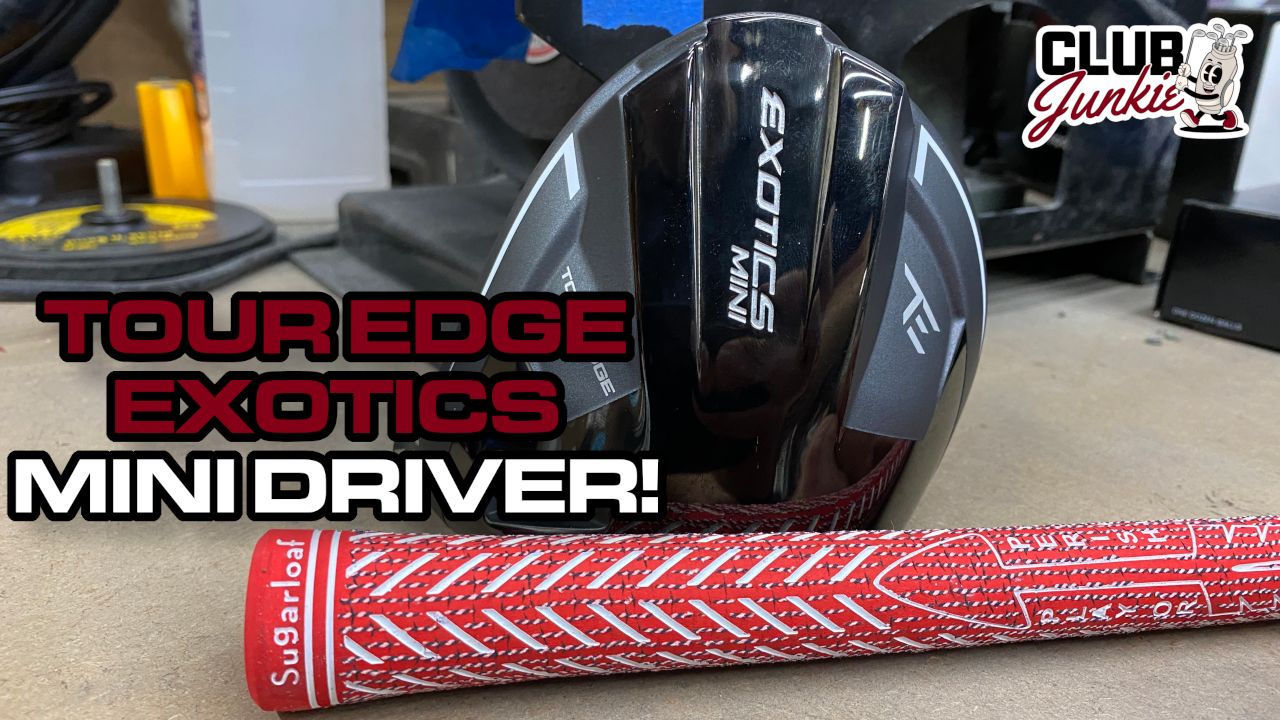
On this episode of Club Junkie, I put the new Tour Edge Exotics Mini Driver to the test and break down the performance, forgiveness, distance, and where it fits compared to a traditional driver or strong fairway wood. If you have been curious about adding a mini driver to the bag, this one is worth a look.
I also dive into the new TaylorMade Spider ZT Max putter that was recently spotted and discuss the growing zero torque putter trend. Plus, there is a closer look at the new Project X Titan Yellow shaft showing up on the PGA Tour and what makes it different from other profiles currently out there.

Justin Rose WITB 2026 (April): Full WITB breakdown with new McLaren irons

What’s the story behind Webb Simpson’s custom-stamped irons?

Memorial Tournament Tour Report: Rory McIlroy, Cameron Young switch up drivers, and more

Cadillac Championship Tour Report: Spieth’s sizable changes, McLaren Golf launches, and more

Russell Henley’s winning WITB: 2026 Charles Schwab Challenge

Kristoffer Reitan’s winning WITB: 2026 Truist Championship

Aaron Rai’s winning WITB: 2026 PGA Championship

Cameron Young’s winning WITB: 2026 Cadillac Championship

J.T. Poston’s winning WITB: 2026 Memorial Tournament

Best irons 2026: Best irons overall, most forgiving irons, and more


Bud Cauley WITB 2026 (June)
Bud Cauley had >14 clubs in his bag when photographed prior to the Memorial Tournament. Driver: Titleist GTS2 (8 degrees) Shaft: Fujikura...


Hannah Green WITB 2026 (June)
Driver: Titleist GTS3 (10 degrees, D4 SureFit setting) Shaft: Mitsubishi Chemical Diamana RB 53 S 3-wood: Titleist GT3 (15 degrees,...


Asterisk Talley WITB 2026 (June)
Driver: TaylorMade Qi4D (9 degrees) Shaft: Fujikura Ventus Blue 6 S 3-wood: TaylorMade Qi4D (16.5 degrees) Shaft: Fujikura Ventus Blue...

Brianna Do WITB 2026 (June)
Driver: Callaway Quantum Triple Diamond (9 degrees) Shaft: KBS PGW 3-wood: Callaway Elyte Titanium (15 degrees) Shaft: KBS PGW 5-wood:...
-
 Equipment6 days ago
Memorial Tournament Tour Report: Rory McIlroy, Cameron Young switch up drivers, and more
-
 News1 week ago
Russell Henley’s winning WITB: 2026 Charles Schwab Challenge
-
 Whats in the Bag3 days ago
J.T. Poston’s winning WITB: 2026 Memorial Tournament
-
 Equipment3 days ago
Best irons 2026: Best irons overall, most forgiving irons, and more
-

 Equipment1 week ago
Details on Jason Day’s latest prototype Avoda iron setup
-
 Equipment3 weeks ago
CJ Cup Byron Nelson Tour Report: Koepka and Kim’s newest putters finally get hot
-

 News2 weeks ago
Charles Schwab Challenge Tour Report: MacIntyre, Åberg and Spaun all switch putters, TaylorMade launches new Spider
-
 Equipment2 weeks ago
Details on J.J. Spaun’s surprise putter switch


LY
Jan 1, 2014 at 12:12 pm
Rich:
What a great article! Do you do stat work with the LPGA tour and if so how do their numbers compare to the PGA tour?
LiveWire
Dec 30, 2013 at 5:28 pm
Great Data, I hope KB does better in 2014. I think he does a great job on the course. He has staying power for years to come. Hopefully he’ll win again before the Bo Sox do……
bsoudi
Dec 30, 2013 at 2:59 pm
Interesting analysis. Though it triggers 2 thoughts with me:
1) How important is the “standard deviation” of these stats? I guess I picture that as his consistency.
2) Could insight be gleaned from a comparison of all these attributes – say, could you see that on a great day driving, a player’s putting could be crap, etc.? That way players can get insights to get “all the pieces in place” more often?
Jadon
Dec 30, 2013 at 10:43 am
Wow, very interesting read. I’d like to see the same stats on Zach Johnson, a guy who is on the opposite end of the spectrum; doesn’t hit it a mile but relies on his wedges and short irons to “score” and get the job done. Goes to show you that you don’t have to be a bomber to succeed, what an odd and fun game we play.
Richie Hunt
Dec 30, 2013 at 11:11 am
Jadon, you would be shocked at how Zach got it done this year. He doesn’t hit it long, but his long approach shots (Danger Zone) is where he hit it the best from.
Mark Wells
Dec 30, 2013 at 1:57 am
Wonder why he feels he can’t work on the birdie and safe zone improvement with McClean? Solid and showing improvement otherwise. Time will tell
naflack
Dec 29, 2013 at 10:37 pm
i can see that little move off the ball that keegan does with his head being an issue on those short iron shots. im guessing chuck will want to address that…
Troy Vayanos
Dec 29, 2013 at 5:04 pm
Great post Rich,
Just shows how tough the tour is these days when a guy like Keegan can produce such impressive stats and still not come away with a victory.
Cheers
Richie Hunt
Dec 30, 2013 at 11:12 am
The bigger one is to look at Bo Van Pelt’s metrics from 2012. Outstanding ballstriker and was 11th in Putts Gained. Didn’t record 1 win. I almost found that impossible, but any given week somebody can sneak in and take it away from him.
Juan
Dec 29, 2013 at 12:11 pm
Rich, I really appreciate the great work you do with statistics!! It helps me understand the players you analyze AND a way of thinking about analyzing and improving my own game. BTW, I really like your website. THANKS again for the great work!!
Mike
Dec 29, 2013 at 11:26 am
Rich, great work. I love seeing data like this and a good thorough analysis. I look forward to reading more of your work.
Martin
Dec 29, 2013 at 9:45 am
Cool analysis, I also wonder what will happen when he switches putters.
I played with the same putter Keegan uses and gave it up because it wasn’t good enough on long putts to make up for the bit better it was on short ones. The stats seem to make the same case for Keegan.
Rob
Dec 29, 2013 at 8:16 am
Rich, interesting article, well done. I’m curious if anyone has studied “feel players” that use statistics heavily to engineer changes and what the results have been.
Rich
Dec 30, 2013 at 3:53 am
Could you really classify them as a true feel player if they looked at stats?
Rich
Dec 29, 2013 at 7:34 am
Yes I’m sure Keegan Bradley took all this into consideration when he decided to switch coaches. Actually, perhaps he’s not aware. You should drop him a line to let him know……..
Pingback: Desde el tee: semana 52/2013 | colombiaDeportes.co
Kenny Thomson
Dec 29, 2013 at 5:28 am
Another good article. How does an amateur collect such data without slowing up play? Enjoyed the book.
Kenny Thomson
Dec 29, 2013 at 5:26 am
Good article, but how does an amateur ( reasonably low handicap) capture similar data without slowing up play?
Enjoyed your book
Id
Dec 29, 2013 at 2:55 am
No glaring weakness??? What’s he going to do when he has to quit the belly putter?
Trey Hayden
Dec 29, 2013 at 5:02 am
It’s impossible to predict the future, but Bradley did win most of his college tournaments with a short putter. He switched for the same reason most guys in his generation switched: If they’re gonna let us cheat, we shall cheat.
Rob
Dec 29, 2013 at 8:05 am
You should understand the rules before making stupid comments, He doesn’t have to “quit the belly putter”
Id
Dec 29, 2013 at 10:35 am
He has to quit anchoring into the belly, therefore he has to quit that stroke. He can keep the same length putter, for sure, and use it un-anchored, therefore not calling it a non-belly putter but a putter at 43 inches or whatever – but he has to quit the belly putter. You should understand the comments before trying to sound intelligent.
Richie Hunt
Dec 30, 2013 at 11:14 am
I think I didn’t clarify what I meant by ‘glaring weakness’ anyway. What I meant is when you look at his *scoring* data (par-3’s, par-4’s, par-5’s, bogey rate and birdie rate) there was no glaring weakness there. Obviously he has a glaring weakness in his game…shots from inside 175 yards. As far as the putter goes, we will wait and see how that pans outs.
Sean
Dec 28, 2013 at 9:22 pm
Nice analysis. That right there should tell KB what he needs to work on.
Tom Stickney
Dec 28, 2013 at 7:04 pm
Great analysis Rich. Big fan of your work!
A
Dec 28, 2013 at 5:59 pm
I knew he was an idiot the moment I saw him
Homer Simpson
Dec 28, 2013 at 4:23 pm
“Facts are stubborn things, but statistics are more pliable.”
? Mark Twain
Roger
Dec 28, 2013 at 1:35 pm
Rich, thanks for another Great Article.
I see Luke Donald also moved to Chuck Cook due to his wish to
hit more par 4’s . Did a search of online videos of Chuck Cook
so thanks for the Xmas Present! I’m still young enough to Listen!
From 185 to the Pin is my problem area!
Have a great 2013 Rich.
Richie Hunt
Dec 28, 2013 at 8:46 pm
Thanks for the kind words