
Opinion & Analysis
The data behind Luke Donald’s decision to change instructors

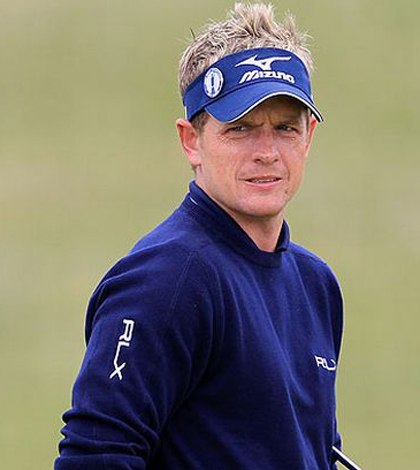
Luke Donald recently made an instructor change to Texas-based swing coach Chuck Cook.
Back in 2011, Donald had an epic season. He finished first on the PGA Tour money list and the European Tour’s Order of Merit. He also became the No. 1-ranked golfer in the world. So the next obvious step for Donald was to win a major championship. But the fine play he exhibited in 2011 rarely resurfaced in 2012. He regained some of his old magic in 2013, but not enough to leave him satisfied.
So, what has happened to Donald’s game to make him switch instructors? First, let’s take a look at some basic scoring analysis, comparing his 2011 season versus his 2013 season.
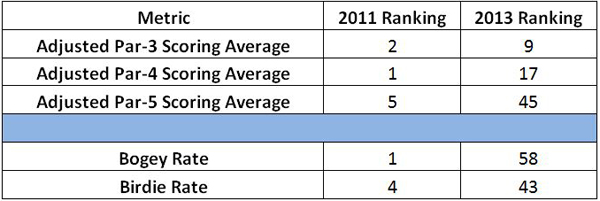
The order of importance of these metrics when it comes to mathematically correlating to success on Tour is as follows:
- Par-4 Scoring Average
- Bogey Rate
- Par-5 Scoring Average
- Birdie Rate
- Par-3 Scoring Average
So, the major drop-offs were in metrics Nos. 2, 3 and 4.
Bogey Rate is the most important metric here. Having a low Bogey Rate is about two aspects of the game:
- Being able to save par.
- Being able to hit your approach shots close to the hole, where it greatly decreases the odds of making bogey.
The latter is what many golfers do not understand about why Bogey Rate is more important (from a mathematical standpoint) than Birdie Rate. The best way to avoid bogeys is to not put yourself in position to make them. Even the worst putters in the world are not going to make bogeys if they hit 16 or more greens per round and have an average birdie putt of less than 20 feet.
With that said, let’s take a look at Donald’s key performance metrics of 2011 versus 2013:
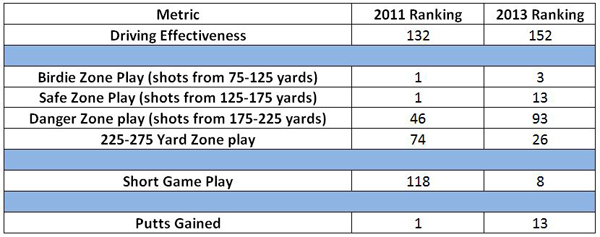
First, we should acknowledge that Luke’s 2011 season could very well never be replicated again. He ranked No. 1 on shots from 75 to 125 yards and shots from 125 to 175 yards. He also ranked first in Putts Gained. It is no small wonder why he played so brilliantly in 2011; if he had an approach shot from 175 yards or less he was by far the best player in the world. And if he was farther than 175 yards away from the hole, he was very good.
With that said, we start to see a noticeable difference in his play on the longer approach shots. When we examine it more closely we start to see a fairly large regression. Here are Donald’s rankings on long approach shots from the fairway/tee box in 2011 versus 2012.
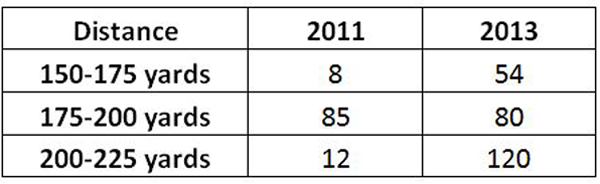
This would explain the increase in Bogey Rate. Longer approach shots, particularly those from the Danger Zone, is where golfers tend to put themselves in position to make a bogey or a double bogey. Donald has seen a fairly large drop off on shots from 150 to 175 yards, but a massive drop off on shots from 200 to 225 yards.
Donald has never been very effective off the tee since he has been on Tour. In fact, his 2011 season (where he finished 132nd in Driving Effectiveness) was his best year with the driver on Tour. I believe that is what has held him back from winning a major, and why a course like Augusta National ends up fitting him the best out of all of the majors championship venues. It is very much an approach-shot-oriented course, and one where putting is extremely important. The other majors often require more precise and effective driving of the ball. The drawback is that Augusta also favors long hitters, which hurts Donald’s odds of winning a major there.
I would imagine that part of the change to a new instructor was that Donald hoped he could improve his tee play. At his club-head speed and distance off the tee, he needs to be able to hit about at least 68 percent of his fairways and get his Average Distance to the Edge of the Fairway to around 22 feet or less. Here is Donald’s data in these metrics during the past four years:
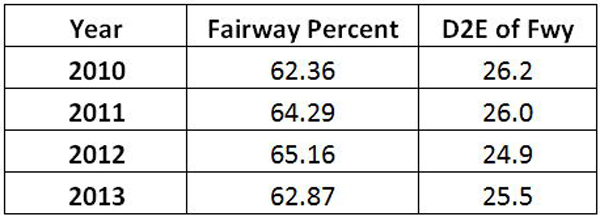
While Donald is not very far away from hitting 68 percent plus of his fairways and having an average Distance to the Edge of the Fairway of 22 feet or less, it goes to show that the slightest discrepancy can be the difference between being forecasted to win a major or two and having yet to win a major.
What I find interesting about Donald’s driving is in the radar data. Last year, there was a launch monitor report circulating on the web of Donald’s impact data. The launch monitor had Donald with a 2.5-degree downward attack angle with the driver. However, if you look at his radar metrics for this year on Tour there are some things that do not quite add up.
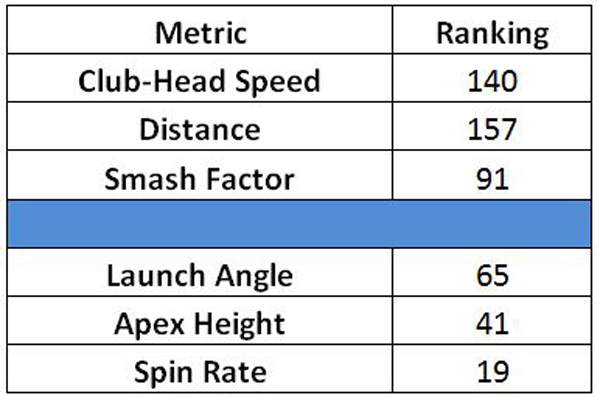
What we know about downward attack angles with the driver is that they result in golfers not hitting the ball as high or as far as they normally would with a “flat” attack angle or an upward attack angle. Furthermore, the downward attack angle will produce a higher spin rate.
What we see is that Donald’s distance ranking is noticeably worse than his ranking in clubhead speed. That is part of what we would logically assume given his downward attack angle. Furthermore, he has the 19th highest Spin Rate on Tour (2,922 RPMs). This is also in line with a golfer that hits the ball with a downward attack angle with the driver.
However, there are some contradictory metrics. His launch angle is fairly high (11.25 degrees), and he has the 41st highest ball flight on Tour. And as we know, higher clubhead speed players will generally hit the ball higher as well. Donald is a lower clubhead speed player who has a high ball flight. He is also doing it with a fairly high launch angle, but the spin rate is high.
I think the key piece to this is his ranking in Smash Factor (91st). And I believe what is happening for Donald is that he is hitting above the “sweet spot” on his driver. Tom Wishon has discussed how hitting above the “sweet spot” affects the ball’s flight with this diagram.
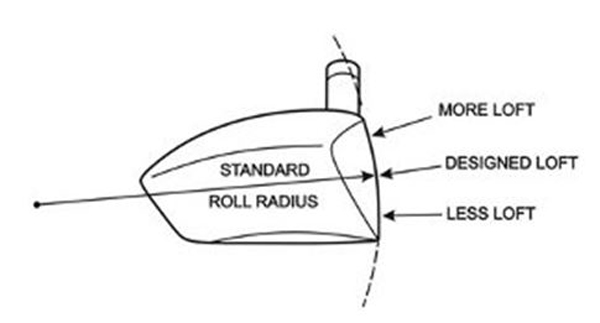
Drivers are not designed to have a perfectly flat face. They have something called “vertical face roll,” which means that the face of the driver has a bulging design and the bulge runs horizontally (face bulged) and vertically (face roll).
With the larger 460cc drivers, this produces a club where if the golfer hits below the “sweet spot,” there is less loft. Conversely, if the golfer hits above the sweet spot, there is more loft. From there, the horizontal gear effect comes into play and if the golfer hits the ball above the sweet spot, that means the gear effect will reduce the spin on the ball.
Here are Donald’s radar metrics during the past four years.
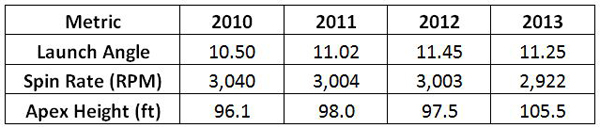
Perhaps changes in equipment are a reason behind Donald’s unorthodox radar numbers given his 2.5-degree downward attack angle. But, his spin rate has lowered while his trajectory has gotten higher. And he still has an issue with getting his distance off the tee to match his club-head speed.
Donald will have his work cut out for him. But if he can get his long approach shot play back to his 2011 performance he will be very close to his old form. And if he can figure out his driving woes on top of it, he can be even better than he once was.





This past Monday, I played in the U.S. Amateur local qualifier at Rock Creek Country Club in Portland, Oregon. A full tee sheet from 7:30 a.m. to 1:55 p.m., the top 11 scores would make it to the U.S. Amateur final qualifying.
I teed off at 10:48 a.m.. With the 7:30 am tee time, you can get a feel for the leaders’ pace, and they were off and running on the challenging setup at Rock Creek.
View this post on Instagram
Getting to the highlight of the round on the par five 17th, a drive up the left side and 212 yards left to the front hole location. I took out a 5-iron with plans of middle of the green. The ball ended up 8 feet left of the hole, pin high. A slight downhill putt dropped in for an eagle 3 on the 17th. With the cut line looking to be anywhere from -2 to even par. This was the boost I had been waiting for all day.
With making par from the trees on 18, it was time to wait for a potential playoff with a posted score of one under par 71.
Three hours later, it was playoff time. 8 players for 6 spots. I made par on the playoff hole, which was good enough to advance to the U.S. Amateur final qualifying in July. USGA qualifiers sure deliver on all of the emotions in golf!
Club Junkie
Building my 2026 gamer WITB: Ranking the contenders and new putter projects – Club Junkie Podcast

The annual What’s In The Bag build is underway, and on this episode of Club Junkie, Brian breaks down the clubs currently leading the race for a spot in his 2026 gamer setup. From drivers and fairway woods to irons, wedges, and shafts, he ranks the equipment that’s performing best and explains what’s separating the front runners from the rest of the field.
Brian also heads into the workshop to discuss several putter projects currently on the bench. From head options and shaft choices to build ideas and testing plans, he shares what he’s working on and which putters could become serious contenders for the bag this season.
If you’re a gear junkie who loves equipment testing, club building, and the never-ending pursuit of the perfect setup, this episode is for you.
Follow Club Junkie:
Instagram: @clubjunkiepod
TikTok: @clubjunkiepod
Threads: @clubjunkiepod
X: @ClubJunkiePod
Club Junkie
Tour Edge Exotics mini driver review + TaylorMade Spider ZT Max first look – Club Junkie

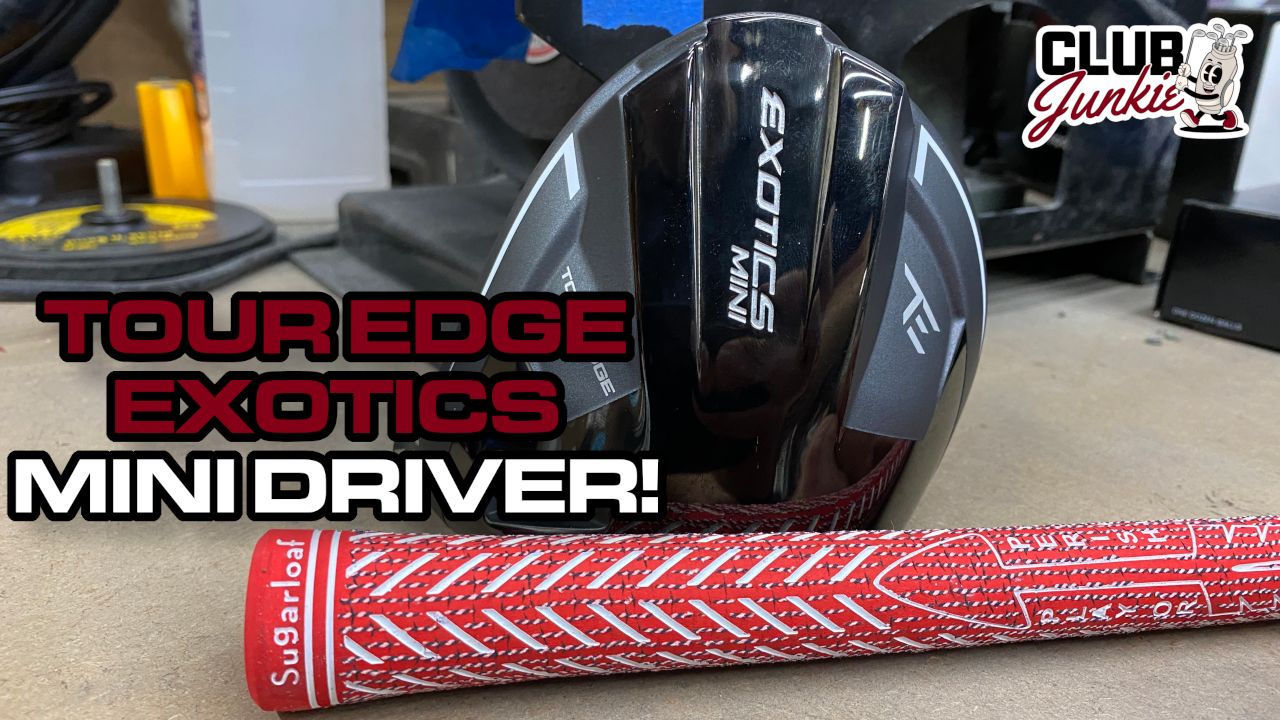
On this episode of Club Junkie, I put the new Tour Edge Exotics Mini Driver to the test and break down the performance, forgiveness, distance, and where it fits compared to a traditional driver or strong fairway wood. If you have been curious about adding a mini driver to the bag, this one is worth a look.
I also dive into the new TaylorMade Spider ZT Max putter that was recently spotted and discuss the growing zero torque putter trend. Plus, there is a closer look at the new Project X Titan Yellow shaft showing up on the PGA Tour and what makes it different from other profiles currently out there.

Justin Rose WITB 2026 (April): Full WITB breakdown with new McLaren irons

What’s the story behind Webb Simpson’s custom-stamped irons?

Memorial Tournament Tour Report: Rory McIlroy, Cameron Young switch up drivers, and more

Cadillac Championship Tour Report: Spieth’s sizable changes, McLaren Golf launches, and more

Russell Henley’s winning WITB: 2026 Charles Schwab Challenge

Kristoffer Reitan’s winning WITB: 2026 Truist Championship

Aaron Rai’s winning WITB: 2026 PGA Championship

Cameron Young’s winning WITB: 2026 Cadillac Championship

J.T. Poston’s winning WITB: 2026 Memorial Tournament

Best irons 2026: Best irons overall, most forgiving irons, and more


Bud Cauley WITB 2026 (June)
Bud Cauley had >14 clubs in his bag when photographed prior to the Memorial Tournament. Driver: Titleist GTS2 (8 degrees) Shaft: Fujikura...


Hannah Green WITB 2026 (June)
Driver: Titleist GTS3 (10 degrees, D4 SureFit setting) Shaft: Mitsubishi Chemical Diamana RB 53 S 3-wood: Titleist GT3 (15 degrees,...


Asterisk Talley WITB 2026 (June)
Driver: TaylorMade Qi4D (9 degrees) Shaft: Fujikura Ventus Blue 6 S 3-wood: TaylorMade Qi4D (16.5 degrees) Shaft: Fujikura Ventus Blue...


Brianna Do WITB 2026 (June)
Driver: Callaway Quantum Triple Diamond (9 degrees) Shaft: KBS PGW 3-wood: Callaway Elyte Titanium (15 degrees) Shaft: KBS PGW 5-wood:...
-
 Equipment5 days ago
Memorial Tournament Tour Report: Rory McIlroy, Cameron Young switch up drivers, and more
-
 News1 week ago
Russell Henley’s winning WITB: 2026 Charles Schwab Challenge
-
 Whats in the Bag3 days ago
J.T. Poston’s winning WITB: 2026 Memorial Tournament
-
 Equipment3 days ago
Best irons 2026: Best irons overall, most forgiving irons, and more
-

 Equipment1 week ago
Details on Jason Day’s latest prototype Avoda iron setup
-
 Equipment3 weeks ago
CJ Cup Byron Nelson Tour Report: Koepka and Kim’s newest putters finally get hot
-

 News2 weeks ago
Charles Schwab Challenge Tour Report: MacIntyre, Åberg and Spaun all switch putters, TaylorMade launches new Spider
-
 Equipment2 weeks ago
Details on J.J. Spaun’s surprise putter switch


MartyMouse
Oct 12, 2013 at 8:02 am
Enough about dynamic Loft!! Luke still has all the tools to get right back on top. Very interesting and well written! Thank you Richie!
timmy
Oct 11, 2013 at 5:57 pm
whats the significance of distance to edge data?
isn’t it possible, if not probable, that these pros intended to land the ball on certain spots of the fairway?
middle of the fairway is not always the best spot for second shot
Richie Hunt
Oct 14, 2013 at 3:08 pm
Distance to the Edge of the fairway is based on shots that *miss* the fairway. The significance is it helps measure how large a player’s misses are.
Andrew Cooper
Oct 4, 2013 at 7:09 pm
No disrespect, he’s a very decent player, but how he got to world no.1 beats me..
rdred
Oct 10, 2013 at 7:07 am
What part of it aren’t you understanding? This article has the stats right there, infront of your eyes…Did you read the article before typing your embarrassing comment?
Best from the birdie zone.
Best from the safe zone.
Most Putts Gained.
Best scoring average on par 4s
What part of this are you struggling to understand?
Andrew Cooper
Oct 13, 2013 at 8:33 am
No argument Donald is a very good player-but he’s not a great player. He has strengths, but he also has big weaknesses (162nd in ball striking in 2013).
The key stats are 251 PGA Tour starts, 5 wins, 0 Majors-a very nice career but not World no.1 material…
Roger
Oct 4, 2013 at 2:10 pm
Richie,
Really appreciate the analysis of the info!
The huge drop in 150/175 and 200/225 accuracy is easy to see.
Looks like the 2011 Irons are worth going back too……..
I got into a negative impact around 2 degrees around xmas
after being a +- Zero degrees hitter…took a while to fix!
Keep up the Very Interesting Articles please!
You know you can’t win over all the viewers in todays Instant Expert
World……………………………………………………………………………………
naflack
Oct 5, 2013 at 3:53 am
passive aggressive and snarky, yes. subtle, no.
FS
Oct 3, 2013 at 11:23 am
Very interesting!
Did he also change balls during this same period? Has the change in the ball affected the numbers that much?
The driver change obviously has affected it, for sure, but I wonder about the ball itself too. I wish there was some kind of machine that could tell us bit more about compression data of balls at impact besides just the Trackman smash factor data.
How about the shaft? Did he change shaft when he changed the head?
We all know that he also struggled with the change from the MP-62 to the 64.
Obviously if his proximity to the hole suffers he has to work harder on the greens so the putting suffers and it shows.
Nothing wrong with having a new set of eyes take a look at you. I hope he makes a good comeback next year.
Richie Hunt
Oct 3, 2013 at 2:07 pm
I don’t know if he changed golf balls or shaft, etc. That’s why I stated that perhaps the equipment causes his unorthodox radar numbers with the driver.
Putts Gained is based on putts made percentage, BUT with relation to the field. And it’s where the golfer putts from. So not hitting your irons as well is technically separate from Putts Gained because it’s basing it on your ability to make putts from certain distances. If you’re leaving yourself with 20 foot putts instead of 10 foot putts, obviously…you’ll make less putts. But, that doesn’t matter in putts gained because it’s testing how well you can make those 20 foot putts (in this example) versus how well the field does from 20 feet.
naflack
Oct 3, 2013 at 8:43 am
If you already know that…why are stating the hitting down creates backspin when you clearly know that it doesn’t?
naflack
Oct 3, 2013 at 8:55 am
Sorry but that makes no sense…
I watched the maestro explain the entire thing.
I’ll trust his explanation over yours, it’s makes more sense.
Besides the fact that trackman data tells us that hitting down does not create spin by itself. Otherwise guys who hit down with their drivers would need less loft not more.
I don’t understand with your knowledge how you draw such a conclusion that the player exhibited alone disputes?
Eric
Oct 3, 2013 at 10:10 am
https://www.google.com/url?sa=t&rct=j&q=&esrc=s&source=web&cd=2&cad=rja&ved=0CDUQFjAB&url=http%3A%2F%2Ftrackmangolf.com%2Fmedia%2F5bf8af87-1695-42f4-9bab-7235dff40c5c%2F-366222283%2FPDF%2F3.%2520Newsletter%2Fnewsletter7.pdf&ei=FXpNUqWRBaLbyQGUr4GICw&usg=AFQjCNH1hgUOtwI3ycrzx71h-aRqhw-kXA&sig2=55oagnKooa6ICoqpsr7bdQ&bvm=bv.53537100,d.aWc
If by “hitting down” you mean increasing downward angle of attach while also tilting the club face down by the same amount, you’re right, no change in spin rate. But if your angle of attack is increased downward while the clubfaces remains the same, result is higher spin rate.
So, if Donald knows he should have a launch angle with a driver of about 11-12 degrees, and is changing the driver static loft to achieve it while using a -2.5 deg AoA, the spin will increase. He should do the opposite to increase distance…raise AoA, but use loft that continues to get about 11 degrees of launch angle.
naflack
Oct 3, 2013 at 11:13 pm
i wonder how many golfers understand the subtext involved, im guessing not many…
Richie Hunt
Oct 3, 2013 at 10:34 am
I can guarantee you that Trackman Maestro would agree with me that dynamic loft by itself (as well as attack angle) will not increase the spin rate. It’s the increase in the difference between AoA and dynamic loft, otherwise known as Spin Loft, that increases or decreases spin rate.
naflack
Oct 3, 2013 at 11:08 pm
im sure he would agree with the above premise…
i dont however believe he would agree with the statement in the article that downward angle of attack increases spin rate.
ive watched his videos, he states over and over again that the statement “hitting down increases spin” in and of itself is a myth. the distinction is important because the average golfer doesnt understand the difference between hitting down and spin loft. they see hitting down increases spin when unless they know how to do it properly it oly hurts their game.
perhaps im the idiot and all the readers know the distinction, either way i felt the need to comment and appreciate your responses none the less.
Richie Hunt
Oct 4, 2013 at 8:58 am
I think we typically see golfers generating more spin when they hit down because their spin loft is *likely* to increase. They may bring their dynamic loft down with it, but generally not enough to keep the spin loft consistent (at least IMO).
The real point of that portion of the article was to explore Donald’s struggles with the driver over his career. I don’t know his average dynamic loft, but I did know his average attack angle. What I found interesting was his launch angle would increase and he had very unorthodox numbers when we look at his club head speed, spin rate, max height, distance, etc.
It could be an equipment thing, but it could be where he is hitting the ball. And I’ve worked with a couple of clients that changed how high they tee the ball up and that has affected their radar metrics and subsequently their driving off the tee.
I usually try to tie these articles in with what the average amateur could possibly learn. There’s a popular myth that hitting above the sweet spot on the modern driver is a ‘hot spot’ on the driver. It’s actually not and I was trying to bring that to the attention of the reader and show a possible case of where this may be detrimental to a player like Luke Donald.
naflack
Oct 3, 2013 at 4:03 am
downward angle of attack DOES NOT produce a higher spin rate, more dynamic loft produces a higher spin rate.
the fact that he is as high as 19 in spin rate indicates that hitting down with the driver isnt increasing his spin rate.
dont believe me…google “track man maestro” then watch him on youtube.
Richie Hunt
Oct 3, 2013 at 7:59 am
Sorry, but that’s incorrect. Dynamic loft by itself does NOT produce a higher spin rate. It’s about Spin Loft which is the difference between the Dynamic Loft and the Attack Angle. So all things being equal, if the attack angle gets steeper the spin loft increases and thus the spin rate increases. Conversely, all things being equal…if the dynamic loft increases the spin loft increases which means the spin will increase.
td
Oct 2, 2013 at 8:59 pm
“The best way to avoid bogeys is to not put yourself in position to make them.”
Haha…I swear this guy is Tim Mccarver’s prodigy.
Lawrie Montague
Oct 2, 2013 at 8:39 pm
Rich thank you for sharing your analysis of Luke Donald’s current challenges with his game.
With the wealth of statistical data available to us it is fortunate that we have people like yourself who can drill down into the data and present it in a way that makes sense.
I wonder whether Luke Donald will be able to change his game enough to improve the numbers you suggest if he has to change some aspect of his golf swing.
I imagine that someone as knowledgeable and experienced as Chuck Cook will guide him carefully, but as someone who works with tour players and elite amateurs helping them to improve their numbers in key areas of their game it’s indeed a slippery slope.
Get it wrong and even great golfers are lost to the golf swing change wilderness, but get it right and Luke Donald might be able to bag himself a major or two.
Only time will tell. Thanks again for an insightful article.