
Opinion & Analysis
The Dan Plan: Keep your gear in line with your skill set


My last post was about my experience at Titleist’s Oceanside Test Facility, and what it means to get fit by some of the best in the industry. The fitting process was very informative and positive, so I was excited to get my new custom-fit clubs. I couldn’t wait to break them in, get some launch monitor data and see how they matched up to my old gamers.
I was sold on the performance of the clubs at Oceanside, but I still wondered how much the fitting would affect my ball striking numbers at my home course. I was especially curious because my previous clubs were only a year old. But then again, I’d come a long way in that one year.
When I was last fit, I had never broken 80 and never played in a tournament. Since then, I have put in one third of my 4,200 practice hours, shot rounds of 73 and played in 12 tournament rounds with a low score of 80 on a couple occasions. It’s been a growing year and so much has changed.
After hitting each new stick five times (to get a general average of how they performed) and comparing the results to a similar test I had done a few months ago, I was pretty surprised at some of the differences.
Although my old clubs were from Nike and my new ones are from Titleist, this post is not about comparing two different club manufacturers. It’s an eye-opener about how important it is for golfers to keep their gear in line with their skill set.
Below is a chart that gives my launch monitor numbers for my previous sticks:
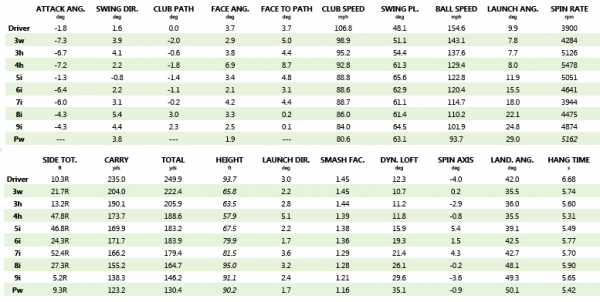
Launch monitor numbers were gathered using Trackman and range balls from a grass range and with the data “normalized” for ideal conditions.
One of the largest areas of concern with my old clubs was that I didn’t have very good gapping in my distances with some of the clubs. In particular, my 6 iron, 5 iron and 4 hybrid were scary close in profile, and I had a rather large gap between my 9 and 8 irons. I never quite understood the reason for that, and I am still not 100 percent sure why that was occurring. I had my clubs checked, and all of them had the correct lofts and lengths.
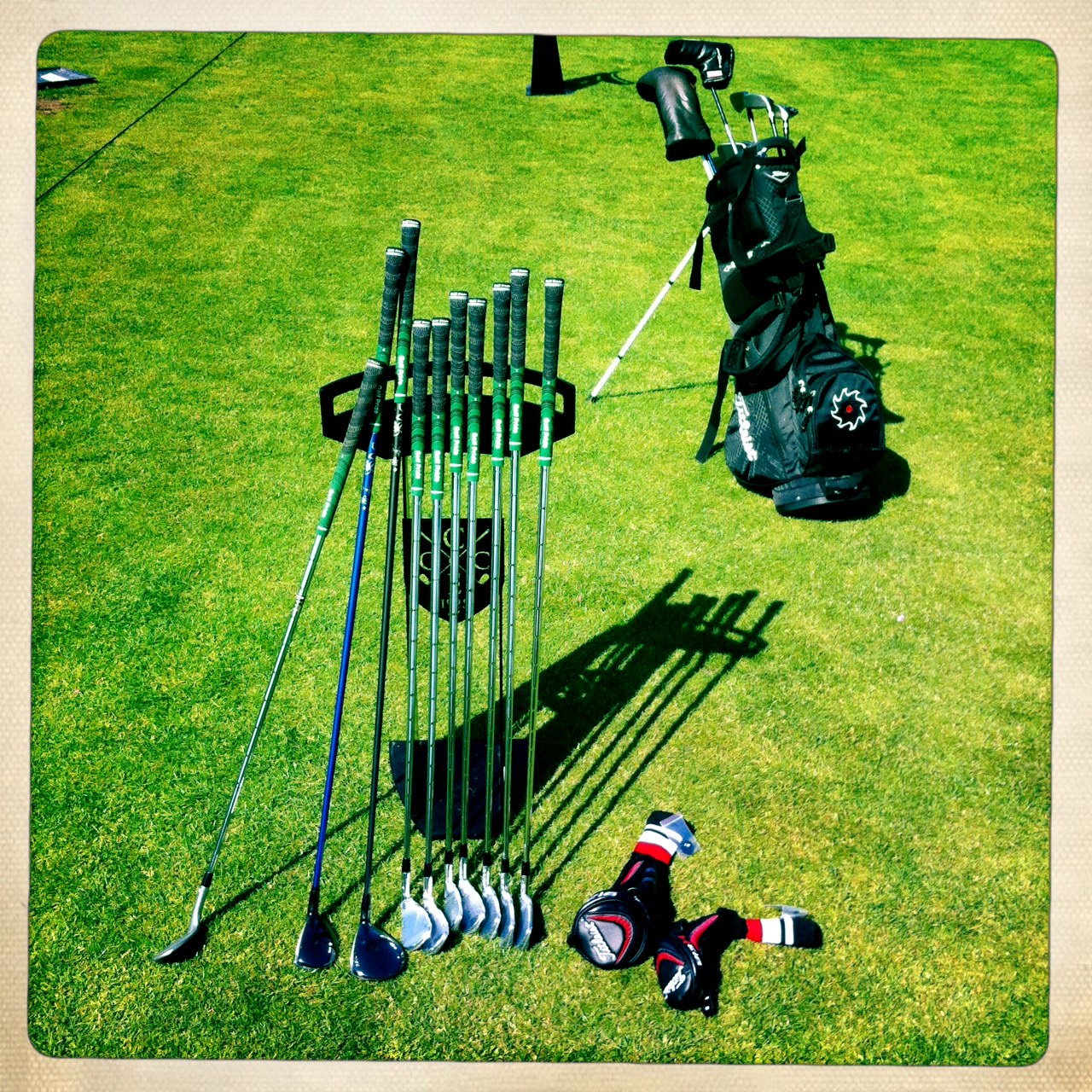
Also, I didn’t feel like my mid-iron swing was as bad as it was on paper, and with the amount that I practiced with them I was mystified as to why the overlap and lack of distance was happening. For some reason, though, I was not delivering those clubs to the ball well.
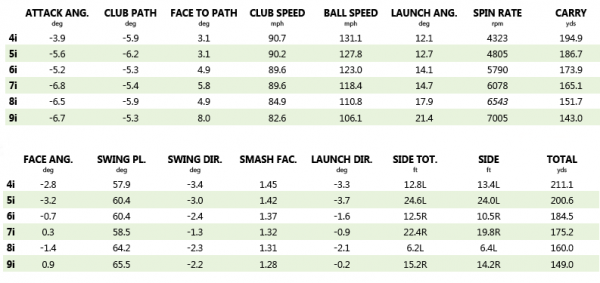
A large part of me assumed that it was 100 percent my swing that was causing the numbers to be a bit off, but I was still curious what new gear could do for my game. When the clubs arrived, I didn’t know if things would be the exact same or if some differences would appear in the data. After hitting the irons (they arrived first) for two days, I got the launch monitor out and gathered some numbers in the same fashion that I had with my previous clubs. Here are the new iron numbers — again I hit each club five times to get an average look at what they now do:
For a full write up of what’s in the new bag, please check out this article: http://www.golfwrx.com/91497/who-knows-how-to-fit-better-than-the-source/
To be honest, I’m not a pro at analyzing this data right now. That said, I am attending a TrackMan University class in Seattle this week and will know a ton more about what all of this actually means soon. For the time being, though, there are a few numbers that stand out to me immediately.
First off, my ball speed with the 9, 8, 7 and 6 irons are all somewhat similar from the old to the new, although the new clubs have more consistent steps between each iron. The distances are all fairly similar as was, but again the new clubs have better gaps.
The 5 iron is where it gets intriguing. My old 5 iron carried about the same as my 6 (I can attest it was the same on the course as the range) and my old 4 hybrid seemed to be roughly similar in flight distance. The new 5 and 4 irons are a different story. The consistent gapping goes through those irons and now I have sticks that carry about 185 and 194 yards. My new irons have nice gaps and have full-swing carries of everywhere between 140 and 195 yards. That’s a lot of distances covered.
Next comes the new hybrid, wood and driver. The old clubs carried 190, 204 and 235 respectively, and had decent gaps in ball speed between each club. The replacements came just a few days ago and I finally got the sticks on TrackMan yesterday. Here are the results:
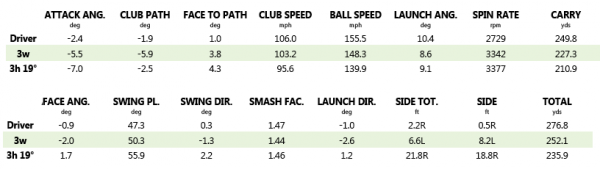
The carry distances are now 210, 227 and 250. Granted, the hybrid is two degrees stronger than the old one. Regardless, it’s not the carry distance that matters, but having more distance is usually a good thing, especially when you are 5-foot-9 inches tall. The ball speeds are very similar between the old and new clubs, but the spin rates with the new sticks have gone way down, which is a testament to a successful club fitting. In fact, the spin rates with all of the new clubs are much more in line with PGA Tour averages, as are the launch angles.
There is a ton of data here to delve into and I hope to know more about it this week during the TrackMan University class. For now, I think that the differences between the new and the old clubs is significant and more than enough reason to make the switch. It will definitely provide a boost to my distances and confidence heading into this tournament season.
My goal now is to optimize my new clubs through better understanding this TrackMan data and by putting in hundreds (or thousands) of hours of practice with these new sticks. Titleist did its job and it did it well — now it’s my time to get to work.






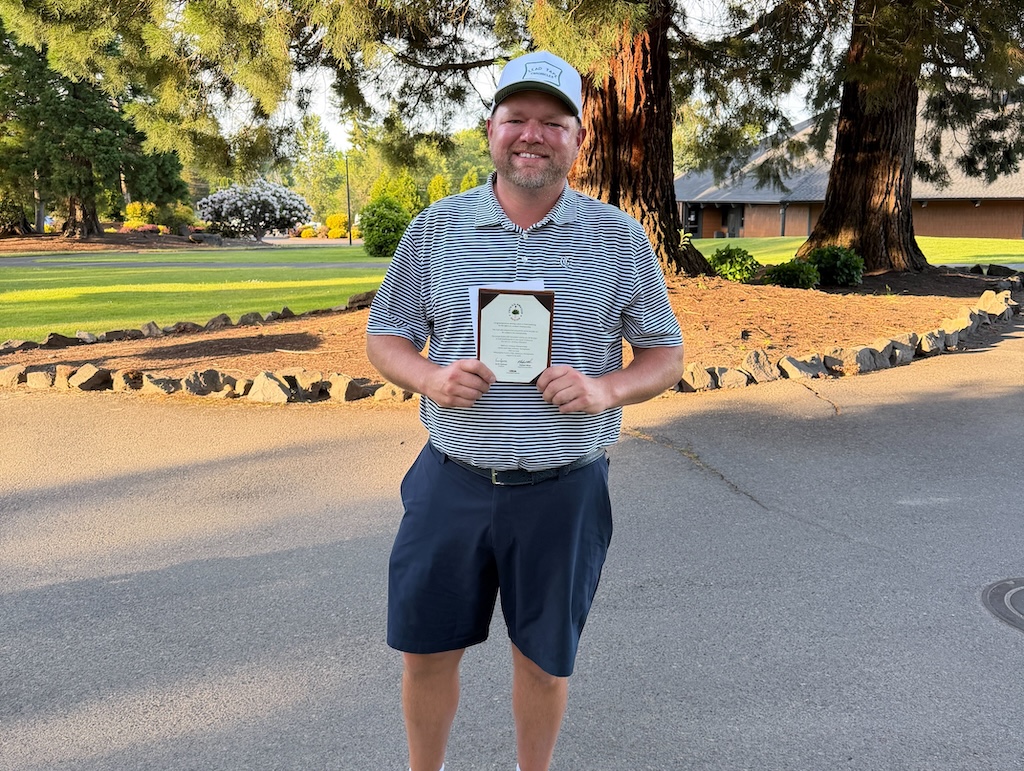
This past Monday, I played in the U.S. Amateur local qualifier at Rock Creek Country Club in Portland, Oregon. A full tee sheet from 7:30 a.m. to 1:55 p.m., the top 11 scores would make it to the U.S. Amateur final qualifying.
I teed off at 10:48 a.m.. With the 7:30 am tee time, you can get a feel for the leaders’ pace, and they were off and running on the challenging setup at Rock Creek.
View this post on Instagram
Getting to the highlight of the round on the par five 17th, a drive up the left side and 212 yards left to the front hole location. I took out a 5-iron with plans of middle of the green. The ball ended up 8 feet left of the hole, pin high. A slight downhill putt dropped in for an eagle 3 on the 17th. With the cut line looking to be anywhere from -2 to even par. This was the boost I had been waiting for all day.
With making par from the trees on 18, it was time to wait for a potential playoff with a posted score of one under par 71.
Three hours later, it was playoff time. 8 players for 6 spots. I made par on the playoff hole, which was good enough to advance to the U.S. Amateur final qualifying in July. USGA qualifiers sure deliver on all of the emotions in golf!
Club Junkie
Building my 2026 gamer WITB: Ranking the contenders and new putter projects – Club Junkie Podcast

The annual What’s In The Bag build is underway, and on this episode of Club Junkie, Brian breaks down the clubs currently leading the race for a spot in his 2026 gamer setup. From drivers and fairway woods to irons, wedges, and shafts, he ranks the equipment that’s performing best and explains what’s separating the front runners from the rest of the field.
Brian also heads into the workshop to discuss several putter projects currently on the bench. From head options and shaft choices to build ideas and testing plans, he shares what he’s working on and which putters could become serious contenders for the bag this season.
If you’re a gear junkie who loves equipment testing, club building, and the never-ending pursuit of the perfect setup, this episode is for you.
Follow Club Junkie:
Instagram: @clubjunkiepod
TikTok: @clubjunkiepod
Threads: @clubjunkiepod
X: @ClubJunkiePod
Club Junkie
Tour Edge Exotics mini driver review + TaylorMade Spider ZT Max first look – Club Junkie

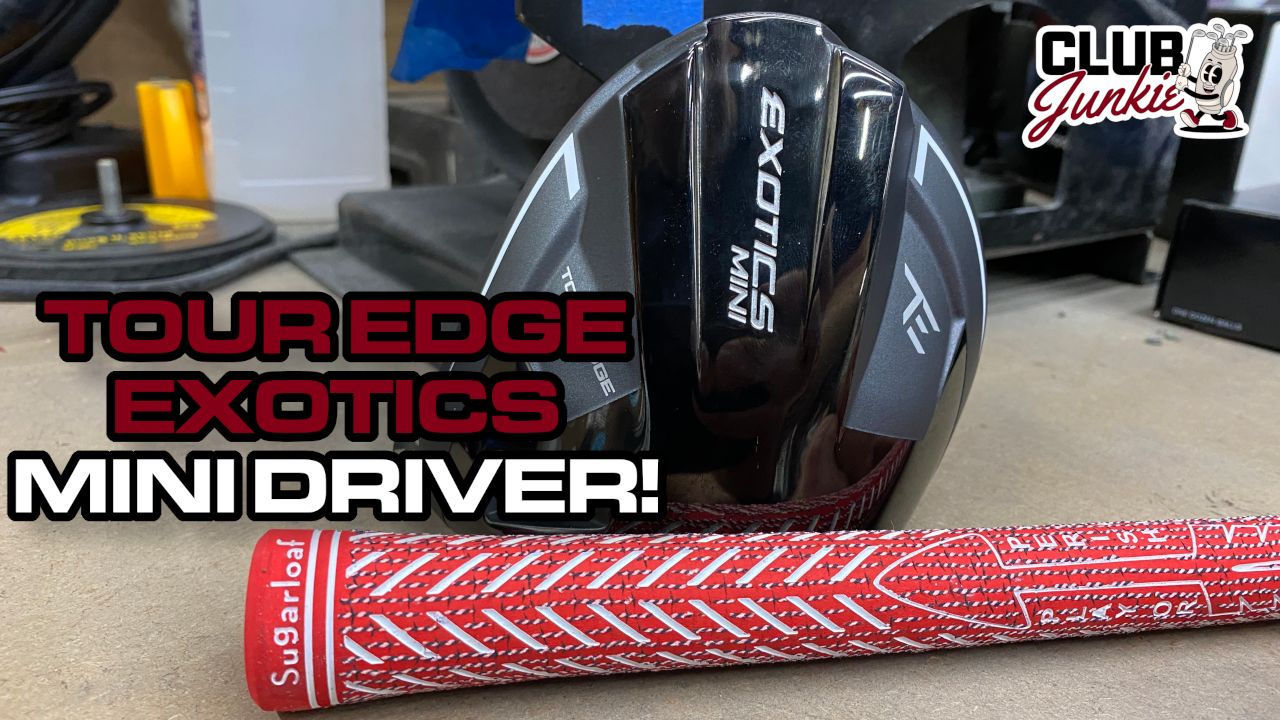
On this episode of Club Junkie, I put the new Tour Edge Exotics Mini Driver to the test and break down the performance, forgiveness, distance, and where it fits compared to a traditional driver or strong fairway wood. If you have been curious about adding a mini driver to the bag, this one is worth a look.
I also dive into the new TaylorMade Spider ZT Max putter that was recently spotted and discuss the growing zero torque putter trend. Plus, there is a closer look at the new Project X Titan Yellow shaft showing up on the PGA Tour and what makes it different from other profiles currently out there.

Justin Rose WITB 2026 (April): Full WITB breakdown with new McLaren irons

What’s the story behind Webb Simpson’s custom-stamped irons?

Memorial Tournament Tour Report: Rory McIlroy, Cameron Young switch up drivers, and more

Cadillac Championship Tour Report: Spieth’s sizable changes, McLaren Golf launches, and more

Russell Henley’s winning WITB: 2026 Charles Schwab Challenge

Kristoffer Reitan’s winning WITB: 2026 Truist Championship

Aaron Rai’s winning WITB: 2026 PGA Championship

J.T. Poston’s winning WITB: 2026 Memorial Tournament

Cameron Young’s winning WITB: 2026 Cadillac Championship

Best irons 2026: Best irons overall, most forgiving irons, and more


Bud Cauley WITB 2026 (June)
Bud Cauley had >14 clubs in his bag when photographed prior to the Memorial Tournament. Driver: Titleist GTS2 (8 degrees) Shaft: Fujikura...


Hannah Green WITB 2026 (June)
Driver: Titleist GTS3 (10 degrees, D4 SureFit setting) Shaft: Mitsubishi Chemical Diamana RB 53 S 3-wood: Titleist GT3 (15 degrees,...


Asterisk Talley WITB 2026 (June)
Driver: TaylorMade Qi4D (9 degrees) Shaft: Fujikura Ventus Blue 6 S 3-wood: TaylorMade Qi4D (16.5 degrees) Shaft: Fujikura Ventus Blue...

Brianna Do WITB 2026 (June)
Driver: Callaway Quantum Triple Diamond (9 degrees) Shaft: KBS PGW 3-wood: Callaway Elyte Titanium (15 degrees) Shaft: KBS PGW 5-wood:...
-
 Equipment6 days ago
Memorial Tournament Tour Report: Rory McIlroy, Cameron Young switch up drivers, and more
-
 News1 week ago
Russell Henley’s winning WITB: 2026 Charles Schwab Challenge
-
 Whats in the Bag3 days ago
J.T. Poston’s winning WITB: 2026 Memorial Tournament
-
 Equipment3 days ago
Best irons 2026: Best irons overall, most forgiving irons, and more
-

 Equipment1 week ago
Details on Jason Day’s latest prototype Avoda iron setup
-
 Equipment3 weeks ago
CJ Cup Byron Nelson Tour Report: Koepka and Kim’s newest putters finally get hot
-

 News2 weeks ago
Charles Schwab Challenge Tour Report: MacIntyre, Åberg and Spaun all switch putters, TaylorMade launches new Spider
-
 Equipment2 weeks ago
Details on J.J. Spaun’s surprise putter switch

