
Opinion & Analysis
Wedge Guy: Do irons really need to go longer?


I’m going to admit right up front that today’s post is an update of one I wrote almost 10 years ago, but the subject is just as relevant to all golfers today, if not even more so, in my opinion. Back then, it was interesting to me that the two most “aggressive” marketers of irons that year began touting how long they are, because up until then, the “distance war” had been mostly limited to drivers.
Until then, we had been through almost 40 years of drivers being sold by touting that they are longer, and that kind of makes sense. Then this “longer, faster, meaner” claim worked its way into the fairway woods category, and even the hybrids. Even that makes a little sense.
But what advantage does it give you if your irons’ specifications are “jacked up” so that the new ones go further than the old ones?
While I will admit that golf club technologies have certainly advanced, the main pathway to making new irons longer – on a number-by-number basis – is to lower the center of mass, decrease the loft and maybe make the shaft longer. Essentially, what is today’s “8-iron” for example, has almost the same loft and length as an historic 6-iron. Of course, it goes further.
As a comparison, I was revisiting an old set of Reid Lockhart RL Blades that I designed in the mid-1990s. The pitching wedge had 48 degrees of loft and the 7-iron was 36 degrees in loft. In looking at specs for many of the modern iron sets, many 9-irons have almost that same loft.
So, for fun I got out the launch monitor and hit balls with both the RL Blade 7-iron and a modern 9-iron that was just 2 degrees weaker. What I found was that carry distance was really not all that different at my strength profile, about 140 yards. But the RL Blade launched considerably lower, delivered significantly more spin and was much easier to flight up and down to adapt to varying conditions, particularly wind.
What I also found was that the once-piece design of the RL Blades made “dialing in” those shorter distances much more reliable.
But back to what a jacked up set of irons does for your game . . . what happens if all your irons go further than your last set? Does that really help you hit more greens?
There was an old adage of golf club design called “the 24/38 rule”. What that meant is that only skilled players could proficiently handle an iron with 24 degrees of loft or less, and 38 inches in length or more. I’ll admit that modern iron designs have made the loft limitation a bit outdated, but the longer a club is, the more accurate you are likely to be, both in delivery of the clubhead to the ball and keeping the face angle and path tighter.
But here is what I find really interesting. In many of the major brands’ iron line-ups, they have their “tour” or “pro” model . . . which are typically up to two degrees weaker in loft and ¼ to 3/8 inch shorter in length than the ones they are trying to sell you. How much sense does that make? The tour player, who’s bigger and stronger than you, plays a club that is shorter and easier to control than the one they are selling you. Hmmmmm. Gotcha.
But let’s tie this back to drivers. On Iron Byron, the 46” driver always goes further than the 45, because Iron Byron doesn’t have any swing flaws. So, that’s what the stores are full of. But tour bags are full of drivers at 45”. So, if the tour player only hits 55-60% of his fairways with a 45” driver, how many are you going to hit with a 46?
Same goes with longer irons.
I’m just sayin’…





This past Monday, I played in the U.S. Amateur local qualifier at Rock Creek Country Club in Portland, Oregon. A full tee sheet from 7:30 a.m. to 1:55 p.m., the top 11 scores would make it to the U.S. Amateur final qualifying.
I teed off at 10:48 a.m.. With the 7:30 am tee time, you can get a feel for the leaders’ pace, and they were off and running on the challenging setup at Rock Creek.
View this post on Instagram
Getting to the highlight of the round on the par five 17th, a drive up the left side and 212 yards left to the front hole location. I took out a 5-iron with plans of middle of the green. The ball ended up 8 feet left of the hole, pin high. A slight downhill putt dropped in for an eagle 3 on the 17th. With the cut line looking to be anywhere from -2 to even par. This was the boost I had been waiting for all day.
With making par from the trees on 18, it was time to wait for a potential playoff with a posted score of one under par 71.
Three hours later, it was playoff time. 8 players for 6 spots. I made par on the playoff hole, which was good enough to advance to the U.S. Amateur final qualifying in July. USGA qualifiers sure deliver on all of the emotions in golf!
Club Junkie
Building my 2026 gamer WITB: Ranking the contenders and new putter projects – Club Junkie Podcast

The annual What’s In The Bag build is underway, and on this episode of Club Junkie, Brian breaks down the clubs currently leading the race for a spot in his 2026 gamer setup. From drivers and fairway woods to irons, wedges, and shafts, he ranks the equipment that’s performing best and explains what’s separating the front runners from the rest of the field.
Brian also heads into the workshop to discuss several putter projects currently on the bench. From head options and shaft choices to build ideas and testing plans, he shares what he’s working on and which putters could become serious contenders for the bag this season.
If you’re a gear junkie who loves equipment testing, club building, and the never-ending pursuit of the perfect setup, this episode is for you.
Follow Club Junkie:
Instagram: @clubjunkiepod
TikTok: @clubjunkiepod
Threads: @clubjunkiepod
X: @ClubJunkiePod
Club Junkie
Tour Edge Exotics mini driver review + TaylorMade Spider ZT Max first look – Club Junkie

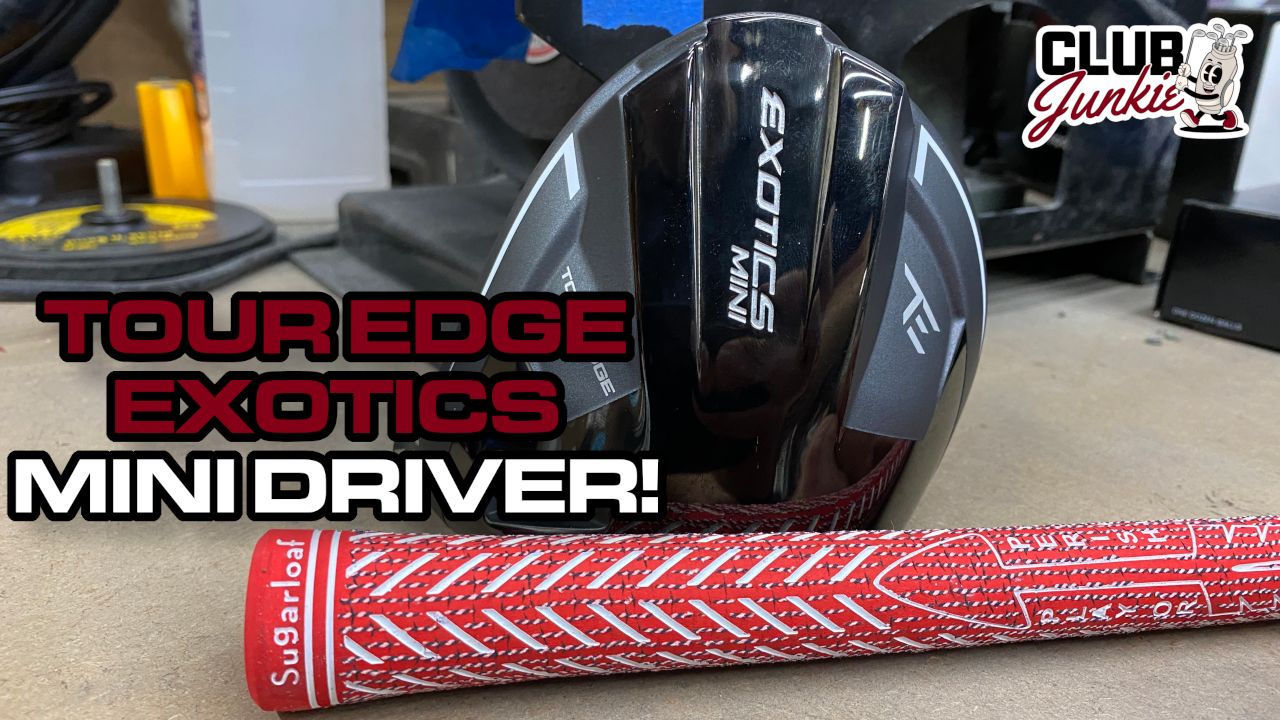
On this episode of Club Junkie, I put the new Tour Edge Exotics Mini Driver to the test and break down the performance, forgiveness, distance, and where it fits compared to a traditional driver or strong fairway wood. If you have been curious about adding a mini driver to the bag, this one is worth a look.
I also dive into the new TaylorMade Spider ZT Max putter that was recently spotted and discuss the growing zero torque putter trend. Plus, there is a closer look at the new Project X Titan Yellow shaft showing up on the PGA Tour and what makes it different from other profiles currently out there.

What’s the story behind Webb Simpson’s custom-stamped irons?

Memorial Tournament Tour Report: Rory McIlroy, Cameron Young switch up drivers, and more

Cadillac Championship Tour Report: Spieth’s sizable changes, McLaren Golf launches, and more

Russell Henley’s winning WITB: 2026 Charles Schwab Challenge

Kristoffer Reitan’s winning WITB: 2026 Truist Championship

Best irons 2026: Best irons overall, most forgiving irons, and more

J.T. Poston’s winning WITB: 2026 Memorial Tournament

Aaron Rai’s winning WITB: 2026 PGA Championship

Cameron Young’s winning WITB: 2026 Cadillac Championship

Details on Jason Day’s latest prototype Avoda iron setup


Christiaan Maas WITB 2026 (June)
Driver: TaylorMade Qi4D LS (8 degrees) Shaft: Fujikura Ventus TR Blue 6 X 3-wood: TaylorMade Qi10 (15 degrees) Shaft: Fujikura Ventus Black...


Ryan Palmer WITB 2026 (June)
Driver: Callaway Quantum Triple Diamond (9 degrees) Shaft: Project X HZRDUS Smoke Blue RDX 60 TX 3-wood: TaylorMade Qi10 (15 degrees) Shaft:...


Bud Cauley WITB 2026 (June)
Bud Cauley had >14 clubs in his bag when photographed prior to the Memorial Tournament. Driver: Titleist GTS2 (8 degrees) Shaft: Fujikura...


Hannah Green WITB 2026 (June)
Driver: Titleist GTS3 (10 degrees, D4 SureFit setting) Shaft: Mitsubishi Chemical Diamana RB 53 S 3-wood: Titleist GT3 (15 degrees,...
-
 Equipment6 days ago
Memorial Tournament Tour Report: Rory McIlroy, Cameron Young switch up drivers, and more
-
 News2 weeks ago
Russell Henley’s winning WITB: 2026 Charles Schwab Challenge
-
 Equipment3 days ago
Best irons 2026: Best irons overall, most forgiving irons, and more
-
 Whats in the Bag4 days ago
J.T. Poston’s winning WITB: 2026 Memorial Tournament
-
 Equipment1 week ago
Details on Jason Day’s latest prototype Avoda iron setup
-

 Equipment3 weeks ago
CJ Cup Byron Nelson Tour Report: Koepka and Kim’s newest putters finally get hot
-

 News2 weeks ago
Charles Schwab Challenge Tour Report: MacIntyre, Åberg and Spaun all switch putters, TaylorMade launches new Spider
-

 Equipment2 weeks ago
Details on J.J. Spaun’s surprise putter switch


Dennis Kovit
Mar 1, 2025 at 4:45 pm
I have a full set of Reid Lockhart irons and still use them often as nothing feels as good as hitting a forged blade pure. I’m looking for a Reid Lockhart 56 degree QB Sole wedge if anyone has one for sale.
Golfer
Jan 20, 2023 at 9:27 am
I’m curious about Wishon’s 24/38 rule. Does that still apply given today’s more forgiving, hotter iron heads? I’m curious as to the timing of when this rule came out and then also what he/we define as “average” golfer. What handicap is that? Anything above 10?
Curious as to thoughts here….
Steve
Oct 30, 2022 at 9:11 pm
This is such a silly look at this issue. One of the biggest differences between better players and average players, the average players do NOT know how to deloft irons at impact. In fact, many amateur players are actually adding loft at impact. As a result, to get ball launch conditions into an ideal window without changing a swing, the iron lofts get stronger. And that really does HELP that player who can’t deloft at impact. And, it increases launch ball speed and efficiency. For the first time, that amateur is seeing a launch window closer to an ideal for each iron number. That’s not a bad thing. Yes, Maybe they should take hours and hours to rebuild and learn a new swing, but many just don’t have that much time and don’t care, it’s a leisure activity not a profession for most! If stronger lofts don’t work for you, great, select one of the more standard lofted iron choices. But it doesn’t mean there isn’t a true market for stronger lofted irons, because they work for many amateur players!
Blaiser
Oct 29, 2022 at 5:28 pm
Distance (and ego) is a thing in golf. Has been, and will be forever.
I get how having jacked lofts can make a golfer happier, and I see nothing wrong with that. If it makes them enjoy the game more, then I’m all for it.
But yes, it’s doing them a disservice if their gapping is messed up. But it looks like OEMs do a good job of providing gap wedges to combat this.
All in all, it’s just a number on the button of the club and it really doesn’t matter “what is a 7 iron ‘supposed’ to be”
My take is it would be easier to just have the loft stamped on the club. But that would probably be a bit too confusing for the new or casual golfer.
Ned
Oct 29, 2022 at 5:55 am
Easy to say but wait to you get to be my age “79”. You will be looking to get all the distance you can get so you can play a reasonable round of golf. I don’t really care how much they jack the lofts if it gets that added distance. The new tech makes the launch angle almost the same as the older lofted clubs. The number in the bottom is meaningless it is all about gaping.
Jay
Oct 28, 2022 at 1:33 pm
Have never understood the distance obsession with irons. The point of an iron is to hit a ball a particular distance, not to hit it as far as humanly possible.
Fred
Oct 28, 2022 at 10:55 am
You mention lower COG’s. Clubs seem designed now to get in the air by the force applied to them rather than spin, which plays into the unfortunate tendency of most golfers to hit up on the ball.
That is to say, many modern clubs seem designed to groove a bad swing.
Rich Douglas
Oct 27, 2022 at 4:24 pm
I’ve played single-length irons for 6+ years. Wishon–first Sterling now EQ1-NX. I’m way more accurate throughout the set. You’d expect to be more accurate with the 4-7–they’re set at an 8-iron length. But the 9-SW are more accurate, too. That’s because I’m putting the exact same swing on every ball throughout the set, and every club in the set feels exactly the same. Same length, weight, swing weight, shaft, offset, lie angle, and MOI. The only difference you can see or feel is loft. (CG is a big player, too.)
I carry an 8-iron 157 with 87mph swing speed. I don’t need it to go farther. If I do, I can reach for a 7-iron (ore more) that will feel exactly the same. What I really need is accuracy, and the single-length set certainly provides it.
Jeff B
Oct 27, 2022 at 8:35 am
You are right this is still very relevant. The issue for most amateurs is the long iron lofts all getting crammed together and then having 5-6 degree gaps in their scoring irons and wedges. They often can’t hit a long iron consistent distances anyway. It would be much better for their game to have smaller gaps in the short irons and wedges.
But that doesn’t “sell” apparently when you’re hitting 7-irons on the monitor and just want the longest one. You often see tour pros testing new clubs and saying the opposite, i.e. “This one goes too far, not enough spin, don’t like it.”
Bob
Oct 27, 2022 at 12:43 am
No. Irons need to be spaced, non-redundant, predictable, reduce distance and direction volatility, perform on mishits, and fill all the gaps between woods and wedges. Take care of these and it’s amazing how much better they look.
Paul Runyan
Oct 26, 2022 at 10:15 pm
Or my old set of Haigs with the PW loft of 50 degrees!
I’m looking at a new set of irons for next year. Standard old lofts of 27 degrees for a 5 iron, 46 degrees on the PW. Works well on my 919Tours. And a Ping TiTec 7 wood from with an A flex shaft for height and distance I’ve had for 20 years or so. Tiny head too! What’s wrong with that!?
Considering a new set from TXG with Mizuno MP 20’s or MMC’s.
Some 6 irons are now 4 irons with a length of a 5 wood.
Why don’t we just have a 6 iron contest and forget about playing golf?!
Just take another club, I say.
Rory
Oct 26, 2022 at 10:06 pm
You have a 3 wood and a lob wedge and typically 10 clubs to fill that gap. Does not really matter what they are called as long as the gapping is good
MICHAEL
Oct 26, 2022 at 8:15 pm
With iron lofts getting stronger every year, I’m already planning for my new iron set in 2030. The eight irons I will carry w/b a 7 iron @ 24 deg, an 8 @ 27 deg, a 9 @ 31 deg, a PW @ 35 deg & 4 Gap wedges to make up the rest of my bag up to my sand wedge.
Why doesn’t the usga require that ‘lofts #’s’ & not just useless club #’s are stamped on every iron? Then comparisons can be meaningful.
Martien
Oct 26, 2022 at 4:14 pm
The road leads to single length irons .
Steve
Oct 26, 2022 at 11:53 am
Terry, what is your take on the newer iron design with respect to handling the in between distances on iron shots? I find that a choked down 9 iron or wedge goes almost the exact same distance as a regular shot. How does the current iron design affect the ability to adjust the distance you can hit an iron?
Bobby G
Oct 26, 2022 at 11:24 am
It’s fun to hit the ball a mile. But scoring is best when you know your distances inside 150. If you have four clubs that you take a full swing and know it will go 150, 135, 120 or 105, that’s more valuable for amateurs than hitting your shortest wedge 150. If your irons are longer then you have to make up for the short yards with less than full swings. Takes a lot of practice to develop that touch.