
Opinion & Analysis
The Wedge Guy: A Tale of Two Misses


It seems like I somewhat “touched a nerve” with last week’s post ‘A Defense of Blades’, based on the scoring you all gave my take on that controversial topic.
I do appreciate it when you take the time to score your reaction to my work, as it keeps me tuned in to what you really want me to pontificate about. Before I get into today’s topic, I request that any of you who have a subject you’d like me to address please drop me an email at [email protected], OK?
So, in somewhat of a follow-up to last week, let’s talk today about misses. Those too frequent shots that move your scores in the wrong direction.
Early in my life, I was always part of “the group” of low-handicap players who had various kinds of “money games”, but that put me in touch only with other low-handicap players who were highly competitive. Just as I was getting fully engaged in the golf equipment industry in the early 1980s, I was blessed to be a part of a group at my club called “The Grinders”. We had standing tee times every day…so if you could get away, you played. There were about 35-40 of us who might show up, with as many as 6-7 groups going off on Fridays and Saturdays.
These guys sported handicaps from scratch to 20, and we threw up balls to see how we were paired, so for twenty years, I had up close and personal observation of a variety of “lab rats.”
This let me observe and study how many different ways there were to approach the game and how many different kinds of mishits could happen in a round of golf. As a golf industry marketer and club designer, I couldn’t have planned it any better.
So back to a continuation of the topic of last week, the type of irons you choose to play should reflect the kinds of misses you are hoping to help. And the cold, hard truth is this:
We as golf club designers, engineers and fitters, can only do so much to help the outcome of any given shot.
Generally, mishits will fall into two categories – the “swing miss” and the “impact miss”.
Let’s start with the former, as it is a vast category of possibilities.
The “swing miss” occurs when the swing you made never had a chance of producing the golf shot you had hoped to see. The clubhead was not on a good path through impact, and/or the clubface was not at all square to the target line. This can produce any number of outcomes that are wildly wrong, such as a cold skull of the ball, laying the sod over it, hard block to the right (for a right-hand player), smother hook…I think you get the point.
The smaller swing misses might be a draw that turns over a bit too much because you rotated through impact a bit aggressively or a planned draw that doesn’t turn over at all because you didn’t. Or it could be the shot that flies a bit too high because you released the club a bit early…or much too low because you had your hands excessively ahead of the clubhead through impact.
The swing miss could be simply that you made a pretty darn good swing, but your alignment was not good, or the ball position was a bit too far forward in your swing…or too far back. Basically, the possible variations of a “swing miss” are practically endless and affect tour pros and recreational golfers alike.
The cruel fact is that most recreational golfers do not have solid enough swing mechanics or playing disciplines to deliver the clubhead to the ball in a consistent manner. It starts with a fundamentally sound hold on the club. From there, the only solution is to make a commitment to learn more about the golf swing and your golf swing and embark on a journey to become a more consistent striker of the golf ball. I would suggest that this is one of the most fascinating aspects of the game and encourage anyone who loves golf to go down this path.
But today’s post is about “mishits”, so let’s move on the other and much smaller category of misses…the “impact miss”. As a 40-year golf club designer, this is the world in which I function and, unfortunately, to which I am limited.
The “impact miss” is when most of the elements of the swing pretty much fall into place, so that the club is delivered pretty accurately to the ball…on the right path…face square to the target line at impact…but you miss the sweet spot of the club by just a bit.
Finding ways of getting better results out of those mishits is the singular goal of the entire golf club industry.
Big drivers of today are so much more forgiving of a 1/8 to ½ inch miss than even drivers of a decade ago, it’s crazy. Center strikes are better, of course, with our fast faces and Star Wars technology, but the biggest value of these big drivers is that your mishits fly much more like a perfect hit than ever before. In my own launch monitor testing of my current model driver to an old Reid Lockhart persimmon driver of the mid-1990s, I see that dead center hits are 20-25 yards different, but mishits can be as far as 75-80 yards apart, the advantage obviously going to the modern driver.
The difference is not nearly as striking with game improvement irons versus a pure forged one-piece blade. If the lofts and other specs are the same, the distance a pure strike travels is only a few yards more with the game improvement design, but a slight mishit can see that differential increase to 12-15 yards. But, as I noted in last week’s article, this difference tends to reduce as the lofts increase. Blades and GI irons are much less different in the 8- and 9-irons than in the lower lofts.
This has gotten a bit longer than usual, so how about I wrap up this topic next week with “A Tale of Two Misses – Part 2”? I promise to share some robotic testing insights that might surprise you.










This past Monday, I played in the U.S. Amateur local qualifier at Rock Creek Country Club in Portland, Oregon. A full tee sheet from 7:30 a.m. to 1:55 p.m., the top 11 scores would make it to the U.S. Amateur final qualifying.
I teed off at 10:48 a.m.. With the 7:30 am tee time, you can get a feel for the leaders’ pace, and they were off and running on the challenging setup at Rock Creek.
View this post on Instagram
Getting to the highlight of the round on the par five 17th, a drive up the left side and 212 yards left to the front hole location. I took out a 5-iron with plans of middle of the green. The ball ended up 8 feet left of the hole, pin high. A slight downhill putt dropped in for an eagle 3 on the 17th. With the cut line looking to be anywhere from -2 to even par. This was the boost I had been waiting for all day.
With making par from the trees on 18, it was time to wait for a potential playoff with a posted score of one under par 71.
Three hours later, it was playoff time. 8 players for 6 spots. I made par on the playoff hole, which was good enough to advance to the U.S. Amateur final qualifying in July. USGA qualifiers sure deliver on all of the emotions in golf!
Club Junkie
Building my 2026 gamer WITB: Ranking the contenders and new putter projects – Club Junkie Podcast

The annual What’s In The Bag build is underway, and on this episode of Club Junkie, Brian breaks down the clubs currently leading the race for a spot in his 2026 gamer setup. From drivers and fairway woods to irons, wedges, and shafts, he ranks the equipment that’s performing best and explains what’s separating the front runners from the rest of the field.
Brian also heads into the workshop to discuss several putter projects currently on the bench. From head options and shaft choices to build ideas and testing plans, he shares what he’s working on and which putters could become serious contenders for the bag this season.
If you’re a gear junkie who loves equipment testing, club building, and the never-ending pursuit of the perfect setup, this episode is for you.
Follow Club Junkie:
Instagram: @clubjunkiepod
TikTok: @clubjunkiepod
Threads: @clubjunkiepod
X: @ClubJunkiePod
Club Junkie
Tour Edge Exotics mini driver review + TaylorMade Spider ZT Max first look – Club Junkie

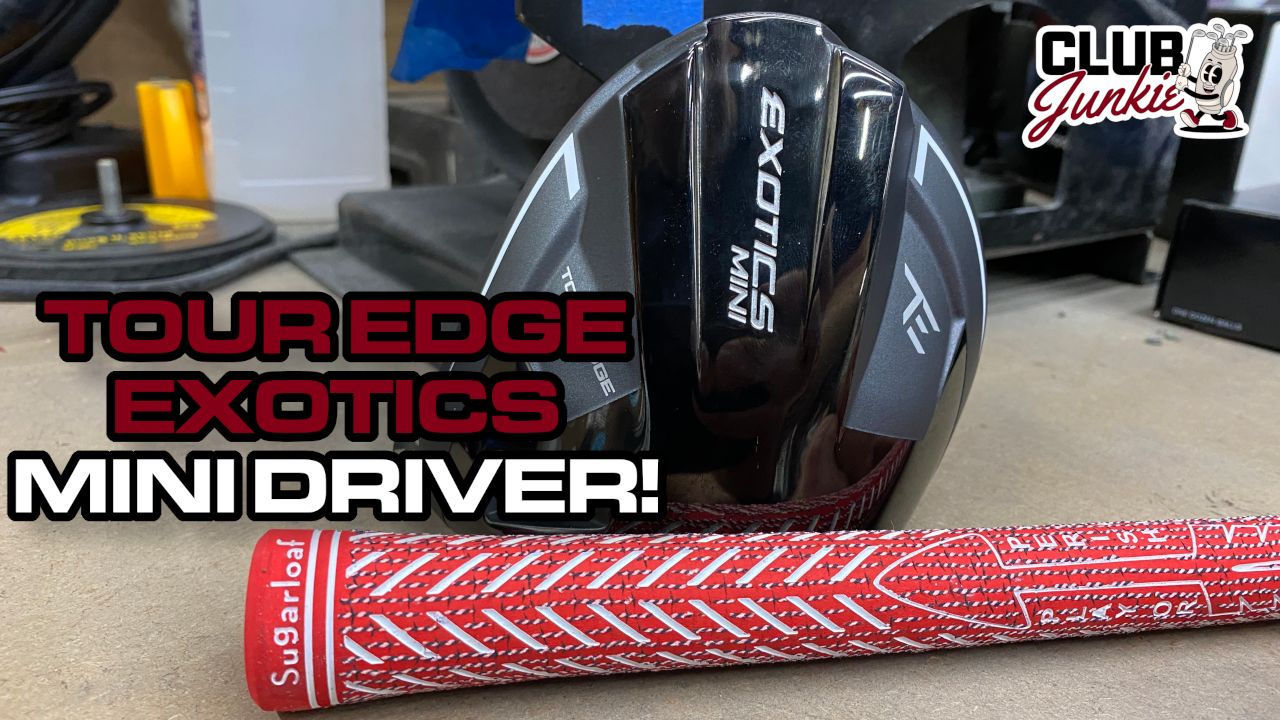
On this episode of Club Junkie, I put the new Tour Edge Exotics Mini Driver to the test and break down the performance, forgiveness, distance, and where it fits compared to a traditional driver or strong fairway wood. If you have been curious about adding a mini driver to the bag, this one is worth a look.
I also dive into the new TaylorMade Spider ZT Max putter that was recently spotted and discuss the growing zero torque putter trend. Plus, there is a closer look at the new Project X Titan Yellow shaft showing up on the PGA Tour and what makes it different from other profiles currently out there.

Justin Rose WITB 2026 (April): Full WITB breakdown with new McLaren irons

What’s the story behind Webb Simpson’s custom-stamped irons?

Memorial Tournament Tour Report: Rory McIlroy, Cameron Young switch up drivers, and more

Cadillac Championship Tour Report: Spieth’s sizable changes, McLaren Golf launches, and more

Russell Henley’s winning WITB: 2026 Charles Schwab Challenge

Kristoffer Reitan’s winning WITB: 2026 Truist Championship

Aaron Rai’s winning WITB: 2026 PGA Championship

J.T. Poston’s winning WITB: 2026 Memorial Tournament

Cameron Young’s winning WITB: 2026 Cadillac Championship

Best irons 2026: Best irons overall, most forgiving irons, and more


Bud Cauley WITB 2026 (June)
Bud Cauley had >14 clubs in his bag when photographed prior to the Memorial Tournament. Driver: Titleist GTS2 (8 degrees) Shaft: Fujikura...


Hannah Green WITB 2026 (June)
Driver: Titleist GTS3 (10 degrees, D4 SureFit setting) Shaft: Mitsubishi Chemical Diamana RB 53 S 3-wood: Titleist GT3 (15 degrees,...


Asterisk Talley WITB 2026 (June)
Driver: TaylorMade Qi4D (9 degrees) Shaft: Fujikura Ventus Blue 6 S 3-wood: TaylorMade Qi4D (16.5 degrees) Shaft: Fujikura Ventus Blue...

Brianna Do WITB 2026 (June)
Driver: Callaway Quantum Triple Diamond (9 degrees) Shaft: KBS PGW 3-wood: Callaway Elyte Titanium (15 degrees) Shaft: KBS PGW 5-wood:...
-
 Equipment6 days ago
Memorial Tournament Tour Report: Rory McIlroy, Cameron Young switch up drivers, and more
-
 News1 week ago
Russell Henley’s winning WITB: 2026 Charles Schwab Challenge
-
 Whats in the Bag3 days ago
J.T. Poston’s winning WITB: 2026 Memorial Tournament
-
 Equipment3 days ago
Best irons 2026: Best irons overall, most forgiving irons, and more
-

 Equipment1 week ago
Details on Jason Day’s latest prototype Avoda iron setup
-
 Equipment3 weeks ago
CJ Cup Byron Nelson Tour Report: Koepka and Kim’s newest putters finally get hot
-

 News2 weeks ago
Charles Schwab Challenge Tour Report: MacIntyre, Åberg and Spaun all switch putters, TaylorMade launches new Spider
-
 Equipment2 weeks ago
Details on J.J. Spaun’s surprise putter switch


Pingback: The Wedge Guy: Power vs. accuracy – GolfWRX