
Opinion & Analysis
Brian Gay and the search for power


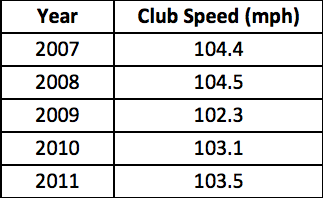
Last year, Brian Gay changed swing instructors. At the time, I imagined that he likely had some concerns about his shrinking distance off the tee and his clubhead speed getting slower. This drew some question marks from some people close to Brian since he had such a successful period from 2008-2010 with an instructor he started working with in 2007. In fact Gay’s caddy, Kip Henley, tweeted how he had some doubts about the switch this past fall until Gay had a successful Fall Series.
While roughly 1 to 2 mph of clubhead speed may not seem like much, it is a big deal on Tour. The historical data of players losing and gaining clubhead speed shows this. My guess is that part of it is an indicator of swing mechanics and the other part is that it will require the golfer to hit more club on their approach shots.
Let’s look at Gay’s clubhead speed over the past few years:
The shorter a golfer hits the ball on Tour, particularly if it’s mostly due to a lack of clubhead speed, the better they will have putt in order to be successful. I believe that this is mostly due to the fact that shorter hitters, particularly with lower clubhead speed, cannot go for par 5’s in two shots nearly as often as longer hitters. Thus, they are likely to have longer birdie putts on the par-5’s and in order to make more birdies, so they will have to do a better job putting to compete. That’s why all of the great players that were short off the tee were usually good putters. That does not take away from their pure ball striking, but the lack of distance in players like Jim Furyk, Zach Johnson or Brian Gay requires that they make up for it with the flat stick.
Where I believe Gay had good reason to be concerned about his lower clubhead speed is the lack of success on Tour of players whose clubhead speed was under 104 mph over the past few years. Here is a list of all of the players that finished under 104 mph of clubhead speed from 2007 to 2012 and their ranking on the Money List:
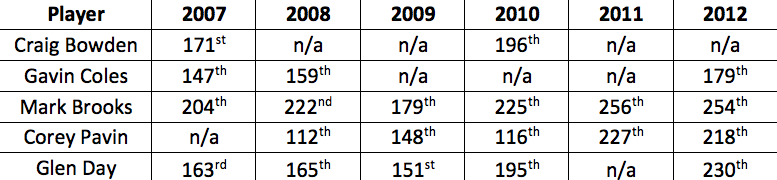
Obviously, Pavin played in select events. But, other than Gay, no player with under 104 mph of clubhead speed fared well on Tour.
For Gay, the lack of clubhead speed was taking a toll on the two most important ballstriking metrics on Tour, what I call Driving Effectiveness and Danger Zone play (shots from 175-225 yards). Here’s a look at those metrics for Gay over the years.
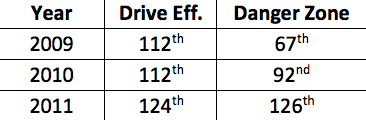
So, Gay ended up looking for new instruction with a focus on improving clubhead speed and distance off the tee. But, the learning curve hurt his ball striking.
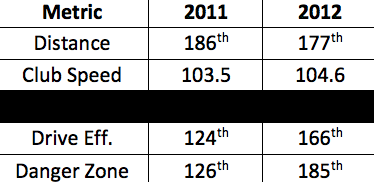
As I wrote in my e-book 2012 Pro Golf Synopsis, Gay was able to accomplish his main goals of improving distance and clubhead speed. While it hurt his ballstriking in 2012, he was able to survive that season by finishing 103rd on the Money List.
It is something that so many amateur golfers face. Working on their swing and dealing with the short term negative effects for the potentially bigger reward down the road. Gay was able to stick it out despite the naysayers thinking he made a big mistake. And now, with his win at the Humana Challenge, he is the one getting the last laugh.
Click here for more discussion in the “Tour Talk” forum.




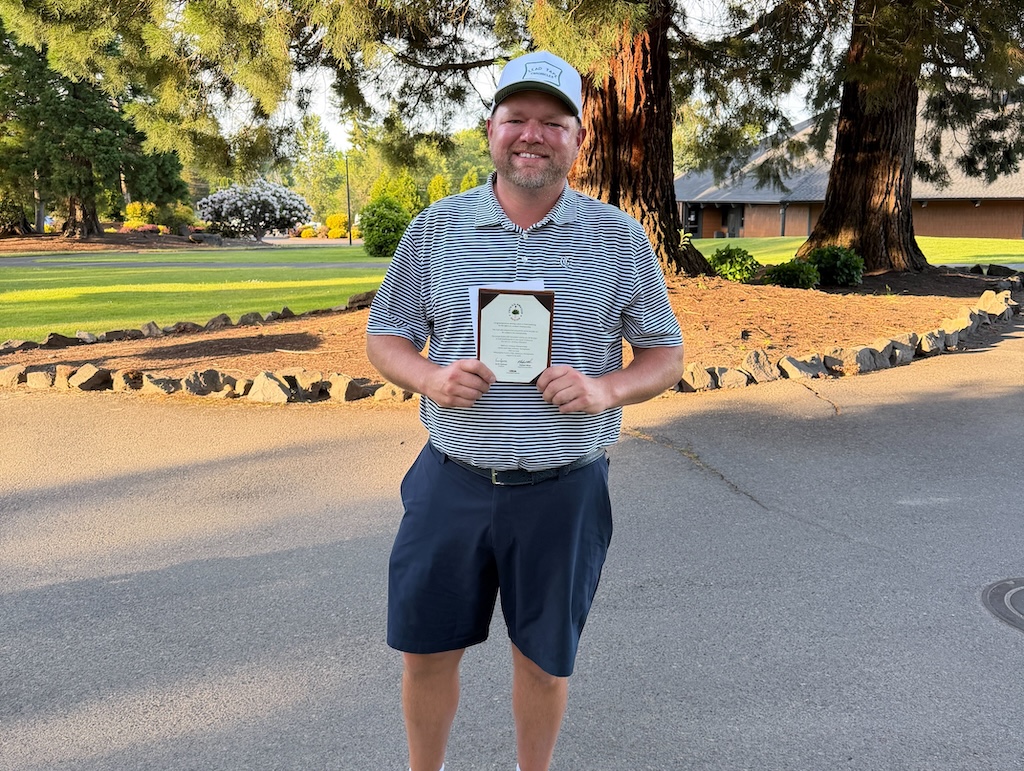
This past Monday, I played in the U.S. Amateur local qualifier at Rock Creek Country Club in Portland, Oregon. A full tee sheet from 7:30 a.m. to 1:55 p.m., the top 11 scores would make it to the U.S. Amateur final qualifying.
I teed off at 10:48 a.m.. With the 7:30 am tee time, you can get a feel for the leaders’ pace, and they were off and running on the challenging setup at Rock Creek.
View this post on Instagram
Getting to the highlight of the round on the par five 17th, a drive up the left side and 212 yards left to the front hole location. I took out a 5-iron with plans of middle of the green. The ball ended up 8 feet left of the hole, pin high. A slight downhill putt dropped in for an eagle 3 on the 17th. With the cut line looking to be anywhere from -2 to even par. This was the boost I had been waiting for all day.
With making par from the trees on 18, it was time to wait for a potential playoff with a posted score of one under par 71.
Three hours later, it was playoff time. 8 players for 6 spots. I made par on the playoff hole, which was good enough to advance to the U.S. Amateur final qualifying in July. USGA qualifiers sure deliver on all of the emotions in golf!
Club Junkie
Building my 2026 gamer WITB: Ranking the contenders and new putter projects – Club Junkie Podcast

The annual What’s In The Bag build is underway, and on this episode of Club Junkie, Brian breaks down the clubs currently leading the race for a spot in his 2026 gamer setup. From drivers and fairway woods to irons, wedges, and shafts, he ranks the equipment that’s performing best and explains what’s separating the front runners from the rest of the field.
Brian also heads into the workshop to discuss several putter projects currently on the bench. From head options and shaft choices to build ideas and testing plans, he shares what he’s working on and which putters could become serious contenders for the bag this season.
If you’re a gear junkie who loves equipment testing, club building, and the never-ending pursuit of the perfect setup, this episode is for you.
Follow Club Junkie:
Instagram: @clubjunkiepod
TikTok: @clubjunkiepod
Threads: @clubjunkiepod
X: @ClubJunkiePod
Club Junkie
Tour Edge Exotics mini driver review + TaylorMade Spider ZT Max first look – Club Junkie

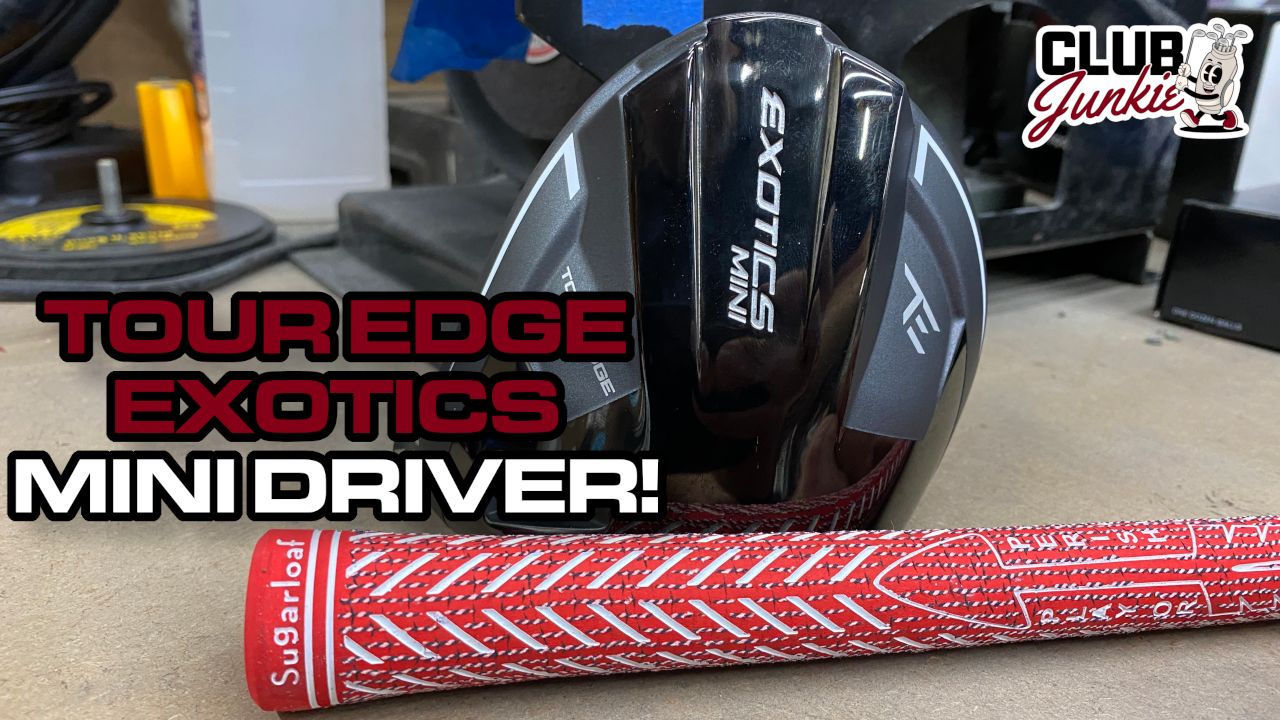
On this episode of Club Junkie, I put the new Tour Edge Exotics Mini Driver to the test and break down the performance, forgiveness, distance, and where it fits compared to a traditional driver or strong fairway wood. If you have been curious about adding a mini driver to the bag, this one is worth a look.
I also dive into the new TaylorMade Spider ZT Max putter that was recently spotted and discuss the growing zero torque putter trend. Plus, there is a closer look at the new Project X Titan Yellow shaft showing up on the PGA Tour and what makes it different from other profiles currently out there.

Justin Rose WITB 2026 (April): Full WITB breakdown with new McLaren irons

What’s the story behind Webb Simpson’s custom-stamped irons?

Memorial Tournament Tour Report: Rory McIlroy, Cameron Young switch up drivers, and more

Cadillac Championship Tour Report: Spieth’s sizable changes, McLaren Golf launches, and more

Russell Henley’s winning WITB: 2026 Charles Schwab Challenge

Kristoffer Reitan’s winning WITB: 2026 Truist Championship

Best irons 2026: Best irons overall, most forgiving irons, and more

J.T. Poston’s winning WITB: 2026 Memorial Tournament

Aaron Rai’s winning WITB: 2026 PGA Championship

Cameron Young’s winning WITB: 2026 Cadillac Championship


Bud Cauley WITB 2026 (June)
Bud Cauley had >14 clubs in his bag when photographed prior to the Memorial Tournament. Driver: Titleist GTS2 (8 degrees) Shaft: Fujikura...


Hannah Green WITB 2026 (June)
Driver: Titleist GTS3 (10 degrees, D4 SureFit setting) Shaft: Mitsubishi Chemical Diamana RB 53 S 3-wood: Titleist GT3 (15 degrees,...


Asterisk Talley WITB 2026 (June)
Driver: TaylorMade Qi4D (9 degrees) Shaft: Fujikura Ventus Blue 6 S 3-wood: TaylorMade Qi4D (16.5 degrees) Shaft: Fujikura Ventus Blue...
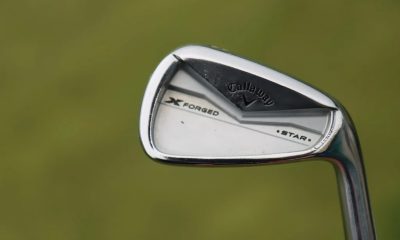

Brianna Do WITB 2026 (June)
Driver: Callaway Quantum Triple Diamond (9 degrees) Shaft: KBS PGW 3-wood: Callaway Elyte Titanium (15 degrees) Shaft: KBS PGW 5-wood:...
-
 Equipment6 days ago
Memorial Tournament Tour Report: Rory McIlroy, Cameron Young switch up drivers, and more
-
 News2 weeks ago
Russell Henley’s winning WITB: 2026 Charles Schwab Challenge
-
 Equipment3 days ago
Best irons 2026: Best irons overall, most forgiving irons, and more
-
 Whats in the Bag4 days ago
J.T. Poston’s winning WITB: 2026 Memorial Tournament
-

 Equipment1 week ago
Details on Jason Day’s latest prototype Avoda iron setup
-
 Equipment3 weeks ago
CJ Cup Byron Nelson Tour Report: Koepka and Kim’s newest putters finally get hot
-

 News2 weeks ago
Charles Schwab Challenge Tour Report: MacIntyre, Åberg and Spaun all switch putters, TaylorMade launches new Spider
-
 Equipment2 weeks ago
Details on J.J. Spaun’s surprise putter switch


Richie Hunt
Jan 22, 2013 at 8:46 am
Glad to hear, Robert. If you have any questions on it, just shoot me an e-mail.
Robert Hebert
Jan 21, 2013 at 8:42 pm
I purchased 2012 Pro Golf Synopsis; the Moneyball Approach to the Game of Golf.
Thanks to Richie and to Mark Broadie, I am changing my equipment, and focusing my practice on driving and fairway woods.
Richie Hunt
Jan 21, 2013 at 4:12 pm
Long hitters do NOT dominate the Tour. Long hitters who have good amount of consistency off the tee, who can hit long approach shots close to the hole and are not the worst putters tend to do best on Tour.
I think it is fairly obvious, the shorter you hit it the more fairways you need to find. I think what is not so obvious is the shorter a golfer hits it, the better they have to putt to be successful on Tour.
Power is a nice advantage to have, but I think there is a big fallacy in thinking that bomb-n-gouge players automatically play well on Tour. If that was the case, Martin Flores would be a top-10 player in the world.
Brian Cass
Jan 22, 2013 at 9:12 am
Agree…same with Jonathan Vegas. Hits it 9 miles but you don’t see him dominating. So easy to ordain these guys after 1 win. Wasn’t Harris English supposed to dominate? Extremely hard to dominate over the best golfers in the world. I’ll take slightly below avg PGA Tour distance and better all around game (LUKE DONALD).
Troy Vayanos
Jan 21, 2013 at 2:26 pm
Nice post Rich,
It’s interesting reading about domination of the longer hitters on tour. I think most people believe distance is an advantage and stats like this back it up.
I’ve always been fortunate enough to get plenty of power off the tee. However, that won’t last forever and when the time comes my short game is going to have to improve.
I’m pleased with Brian Gay who stuck it out and came out on top at the other end. Many another player would have quit and gone back to their old ways. It just shows the importance of distance off the tee!