
Opinion & Analysis
Should you switch to a softer shaft if you’ve lost clubhead speed?


The search for more clubhead speed drives many golfers in to see us for fittings. Many of these golfers walk in considering moving to a more flexible shaft as they’re getting older and think it will help them regain some of their lost yards. It’s at this point we usually interject and summarize what their goals are, but ask them to keep an open mind as to what shaft flex we end up in.
There are multiple reasons we do this: The first being that clubhead speed isn’t the only thing that matters when it comes to maximizing distance. Ball speed, launch angle, spin rates all play a bigger role than simple clubhead speed. The second is that by going to a softer shaft, you may not be getting more clubhead speed but may, in fact, be lowering it.
To start, I must give a little background of what the shaft does during the swing and compare it to a theoretical shaft that’s infinitely strong and stays perfectly straight during a swing. This theoretical shaft is shown in yellow on the captures below. Gears measures this relative clubhead speed with a metric called “kick.”
During the swing the shaft will cycle between lead and lag deflection. The shaft reaches its maximum lag deflection shortly after the start of the downswing as the golfer starts to apply downward force and the mass of the clubhead lags behind. Currently, the clubhead is moving slower than our theoretical shaft. That potential speed isn’t lost however, it’s stored in the shaft.

Picture at start of downswing showing deflection and negative kick
As the hands and club continue to move towards the ball, the shaft starts to release its stored energy and return to a neutral, straight position. As with any object that is flexed, the shaft passes the neutral, straight position and moves into lead deflection. It’s during this phase of releasing its stored energy that the clubhead is moving faster than the infinitely strong and perfectly straight shaft.

Picture around half-way down, showing lead deflection and positive kick
For the flex of a shaft to contribute to the clubhead speed, the clubhead needs to hit the ball when that shaft is somewhere between maximum lag deflection and maximum lead deflection, so it has a positive “kick.” Timing is incredibly important on this!

Impact showing lead deflection with negative kick
What does this mean for you as a golfer? Unfortunately, there isn’t a simple “yes/no” answer if going to a more flexible shaft will help you pick up clubhead speed.
The first video shows a golfer swinging two different shafts. The shaft on the left (gold avatar) is an Accra FX 2.0 140 M1 and the one on the right (blue avatar) is an Accra FX 2.0 270 M4. The 270 M4 is a “stiff” flex, shaft weighing 70 grams, and the FX 2.0 140 is a 40-gram “ladies” flex. As you can see from the video there isn’t a significant difference in clubhead speed.
From the enlarged graph of the “kick” metric below, you can see there is some difference in the amount of speed the shaft is contributing to the clubhead and the M1 shaft is contributing 2.19 mph more to the clubhead than the stiffer M4. It’s just that other variables are negating this slight advantage, so the result is that the two shafts are basically even in terms of clubhead speed at impact.

Expanded Kick Graph
This isn’t to say that a more flexible shaft will never help you pick up clubhead speed. The M1 shaft contributed over 3 mph more than the M4 did for this golfer.
The takeaway in all of this is that there are many variables that go into creating clubhead speed and how any shaft reacts to your swing may be very different than how it reacts to others. I strongly suggest, that you test multiple shaft options and keep an open mind as to what shaft works the best for you. We’ve had several cases where putting a stiffer flex shaft is the right choice to help a golfer pick up distance, even if their clubhead speed doesn’t indicate it.
Additionally, it’s not all about clubhead speed! When recommending shafts, we focus first on face mapping — or reducing the impact area grouping of where you hit the ball on the face. This leads to better launch angles, spin, ball speed and most importantly, dispersion.




This past Monday, I played in the U.S. Amateur local qualifier at Rock Creek Country Club in Portland, Oregon. A full tee sheet from 7:30 a.m. to 1:55 p.m., the top 11 scores would make it to the U.S. Amateur final qualifying.
I teed off at 10:48 a.m.. With the 7:30 am tee time, you can get a feel for the leaders’ pace, and they were off and running on the challenging setup at Rock Creek.
View this post on Instagram
Getting to the highlight of the round on the par five 17th, a drive up the left side and 212 yards left to the front hole location. I took out a 5-iron with plans of middle of the green. The ball ended up 8 feet left of the hole, pin high. A slight downhill putt dropped in for an eagle 3 on the 17th. With the cut line looking to be anywhere from -2 to even par. This was the boost I had been waiting for all day.
With making par from the trees on 18, it was time to wait for a potential playoff with a posted score of one under par 71.
Three hours later, it was playoff time. 8 players for 6 spots. I made par on the playoff hole, which was good enough to advance to the U.S. Amateur final qualifying in July. USGA qualifiers sure deliver on all of the emotions in golf!
Club Junkie
Building my 2026 gamer WITB: Ranking the contenders and new putter projects – Club Junkie Podcast

The annual What’s In The Bag build is underway, and on this episode of Club Junkie, Brian breaks down the clubs currently leading the race for a spot in his 2026 gamer setup. From drivers and fairway woods to irons, wedges, and shafts, he ranks the equipment that’s performing best and explains what’s separating the front runners from the rest of the field.
Brian also heads into the workshop to discuss several putter projects currently on the bench. From head options and shaft choices to build ideas and testing plans, he shares what he’s working on and which putters could become serious contenders for the bag this season.
If you’re a gear junkie who loves equipment testing, club building, and the never-ending pursuit of the perfect setup, this episode is for you.
Follow Club Junkie:
Instagram: @clubjunkiepod
TikTok: @clubjunkiepod
Threads: @clubjunkiepod
X: @ClubJunkiePod
Club Junkie
Tour Edge Exotics mini driver review + TaylorMade Spider ZT Max first look – Club Junkie

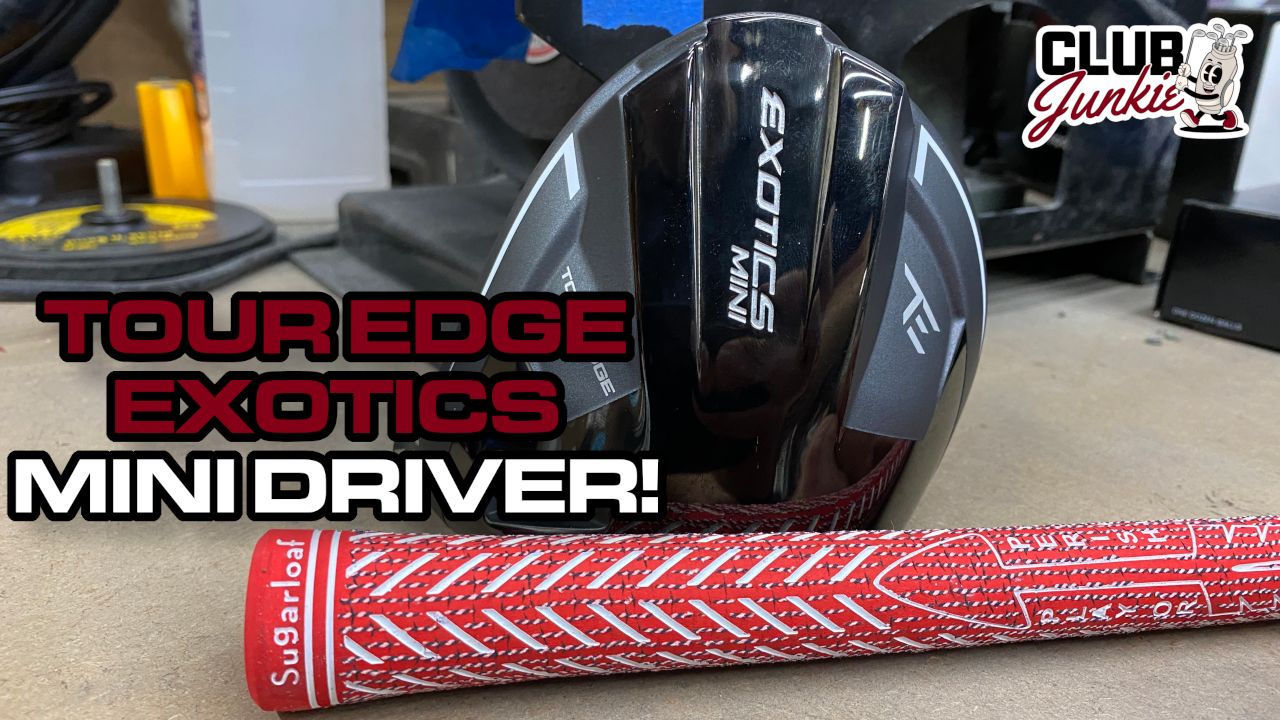
On this episode of Club Junkie, I put the new Tour Edge Exotics Mini Driver to the test and break down the performance, forgiveness, distance, and where it fits compared to a traditional driver or strong fairway wood. If you have been curious about adding a mini driver to the bag, this one is worth a look.
I also dive into the new TaylorMade Spider ZT Max putter that was recently spotted and discuss the growing zero torque putter trend. Plus, there is a closer look at the new Project X Titan Yellow shaft showing up on the PGA Tour and what makes it different from other profiles currently out there.

What’s the story behind Webb Simpson’s custom-stamped irons?

Memorial Tournament Tour Report: Rory McIlroy, Cameron Young switch up drivers, and more

Cadillac Championship Tour Report: Spieth’s sizable changes, McLaren Golf launches, and more

Russell Henley’s winning WITB: 2026 Charles Schwab Challenge

Kristoffer Reitan’s winning WITB: 2026 Truist Championship

Best irons 2026: Best irons overall, most forgiving irons, and more

J.T. Poston’s winning WITB: 2026 Memorial Tournament

Aaron Rai’s winning WITB: 2026 PGA Championship

Cameron Young’s winning WITB: 2026 Cadillac Championship

Details on Jason Day’s latest prototype Avoda iron setup


Christiaan Maas WITB 2026 (June)
Driver: TaylorMade Qi4D LS (8 degrees) Shaft: Fujikura Ventus TR Blue 6 X 3-wood: TaylorMade Qi10 (15 degrees) Shaft: Fujikura Ventus Black...


Ryan Palmer WITB 2026 (June)
Driver: Callaway Quantum Triple Diamond (9 degrees) Shaft: Project X HZRDUS Smoke Blue RDX 60 TX 3-wood: TaylorMade Qi10 (15 degrees) Shaft:...


Bud Cauley WITB 2026 (June)
Bud Cauley had >14 clubs in his bag when photographed prior to the Memorial Tournament. Driver: Titleist GTS2 (8 degrees) Shaft: Fujikura...


Hannah Green WITB 2026 (June)
Driver: Titleist GTS3 (10 degrees, D4 SureFit setting) Shaft: Mitsubishi Chemical Diamana RB 53 S 3-wood: Titleist GT3 (15 degrees,...
-
 Equipment7 days ago
Memorial Tournament Tour Report: Rory McIlroy, Cameron Young switch up drivers, and more
-
 News2 weeks ago
Russell Henley’s winning WITB: 2026 Charles Schwab Challenge
-
 Equipment4 days ago
Best irons 2026: Best irons overall, most forgiving irons, and more
-
 Whats in the Bag4 days ago
J.T. Poston’s winning WITB: 2026 Memorial Tournament
-
 Equipment1 week ago
Details on Jason Day’s latest prototype Avoda iron setup
-

 Equipment3 weeks ago
CJ Cup Byron Nelson Tour Report: Koepka and Kim’s newest putters finally get hot
-

 News2 weeks ago
Charles Schwab Challenge Tour Report: MacIntyre, Åberg and Spaun all switch putters, TaylorMade launches new Spider
-

 Equipment2 weeks ago
Details on J.J. Spaun’s surprise putter switch


Dan
Jun 15, 2019 at 3:53 am
It’s incorrect common knowledge that more flex adds speed. Different flexes affect direction but mostly launch angle and spin. The biggest non swing factor for speed is shaft weight. A slower swinger would benefit from a 50 gram stiff over a 70 gram regular, even neither is optimal. Go lighter and shorter in the shaft settup to maximize speed and contact. It’s the better starting point in ones search for the right driver. But always default to the “whatever works” philosophy.
Lane Holt
Jun 13, 2019 at 7:50 am
Great article. Actually some truth about golf shafts. I am sure if given more print you could explain how shaft deflection / deceleration at impact greatly affects distance and direction.
That Guy
Jun 13, 2019 at 8:40 am
There is no such thing as deceleration…. its negative acceleration. Physics 101
Chris Wycoff
Jun 13, 2019 at 10:07 am
Hi Lane – Thanks for the feedback and you’re correct. We have found that the shaft flex rarely changes club head speed significantly, but it can have a significant impact on distance and dispersion. This is primarily through smash factor, dispersion and spin. We’ll get more in depth on that topic in a future article.
Mike Wiland
Jun 12, 2019 at 10:54 pm
Like to stop in and see you.Did my PGA under Cary Corbett at HT in late 80’s. Where are you located?
Chris Wycoff
Jun 13, 2019 at 9:57 am
Hi Mike – We’d love to have you stop by. We’re located on the Robert Trent Jones course in Palmetto Dunes.