
Opinion & Analysis
What separates your good rounds from your bad ones?


I have had the privilege of working with some of the best golfers in the world, including those that have won major championships. Before I teach them my Fluid Motion Factor program, I have this kind of conversation with them.
Let’s say this player just had the best ball-striking day he has had in the past six months and someone comes up to him after the round and asks him why he hit the ball so well today. Could he answer, on a fundamental level, why he played so well?
If I ask them enough questions, eventually they say they are too sure. Everything just clicked. The swing felt great.
And then I ask this same player that if he went out the next day and had a poor ball-striking day and someone walked up to him and asked him why he played so poorly, could he answer, on a fundamental level why he played so poorly. He would probably say he was not sure, because he thought he was doing the same thing he did yesterday but had the opposite results.
So we have some of the best ball strikers in the world and they are not too sure what happens when they play well and not too sure what happens when they didn’t play well. Could there be anything more wrong with this picture?
Well, fortunately, there is an answer to why accomplished golfers swing well one day and poorly the next. It is not my answer; it is nature’s answer. Golf is about motion, motion is about the muscles, so one has to look at the operating system of the muscles to understand why a swing is synced correctly one day and not the next.
We are not talking about sports psychology here. We are dialing down to the motherboard of the swing; the processes in the mind that are responsible for timing, for making adjustments in the swing, for ball control, for literally everything.
This is probably an arena you are not familiar with, but it should be an arena you should be very familiar with as it controls every element of the swing.
All the information I about to tell you comes from Dr. Fred Travis, a world-renowned neuroscientist that has worked with two Olympic teams and written numerous books on the brain and zone experiences.
In order to generate motion, any motion, you have to generate an intention, a signal in the brain. There are two parts of the brain I will talk about here; the prefrontal cortex, (the discriminating intellect, also called the CEO of the brain) and the motor system. When someone generates a fluid, well-timed swing, the signal bypasses the PFC and goes directly to the motor system. It is the motor system that communicates with the body to produce motion.
The problem occurs and it is a major problem, especially if you are a professional golfer when the PFC intercepts that signal and delays it in getting to the motor system. Then during the swing, the body is looking for direction from the mind, there are too many processes going on and that is when the bulkier, core muscles tend to dominate the motion.
This good process, when the PFC does not interfere with the signal and goes straight to the motor system, I have labeled as the Fluid Motion Factor program. It is not my process; it is everybody’s process. This process HAS to be accessed to produce a fluid, well-timed swing. It also explains that when golfers play well, they are not thinking that much. Thinking involves getting the PFC too involved in the swing.
So back to our initial conversation with our top-notch golfer. The main reason why he played well one day and not the next is on the good-ball striking day he accessed the Fluid Motion Factor consistently and the day he didn’t strike the ball well, he didn’t. Could it be that simple? Yes. If someone took videos on both days, of course, they would see differences in the swing. That would be obvious because something had to adversely happen during the swing on the second day.
But the question is why did it happen? One has to file down to where the swing originated to fundamentally answer that question. In the next series of articles, I will write about more aspects of the Fluid Motion Factor and how to access it more consistently.




This past Monday, I played in the U.S. Amateur local qualifier at Rock Creek Country Club in Portland, Oregon. A full tee sheet from 7:30 a.m. to 1:55 p.m., the top 11 scores would make it to the U.S. Amateur final qualifying.
I teed off at 10:48 a.m.. With the 7:30 am tee time, you can get a feel for the leaders’ pace, and they were off and running on the challenging setup at Rock Creek.
View this post on Instagram
Getting to the highlight of the round on the par five 17th, a drive up the left side and 212 yards left to the front hole location. I took out a 5-iron with plans of middle of the green. The ball ended up 8 feet left of the hole, pin high. A slight downhill putt dropped in for an eagle 3 on the 17th. With the cut line looking to be anywhere from -2 to even par. This was the boost I had been waiting for all day.
With making par from the trees on 18, it was time to wait for a potential playoff with a posted score of one under par 71.
Three hours later, it was playoff time. 8 players for 6 spots. I made par on the playoff hole, which was good enough to advance to the U.S. Amateur final qualifying in July. USGA qualifiers sure deliver on all of the emotions in golf!
Club Junkie
Building my 2026 gamer WITB: Ranking the contenders and new putter projects – Club Junkie Podcast

The annual What’s In The Bag build is underway, and on this episode of Club Junkie, Brian breaks down the clubs currently leading the race for a spot in his 2026 gamer setup. From drivers and fairway woods to irons, wedges, and shafts, he ranks the equipment that’s performing best and explains what’s separating the front runners from the rest of the field.
Brian also heads into the workshop to discuss several putter projects currently on the bench. From head options and shaft choices to build ideas and testing plans, he shares what he’s working on and which putters could become serious contenders for the bag this season.
If you’re a gear junkie who loves equipment testing, club building, and the never-ending pursuit of the perfect setup, this episode is for you.
Follow Club Junkie:
Instagram: @clubjunkiepod
TikTok: @clubjunkiepod
Threads: @clubjunkiepod
X: @ClubJunkiePod
Club Junkie
Tour Edge Exotics mini driver review + TaylorMade Spider ZT Max first look – Club Junkie

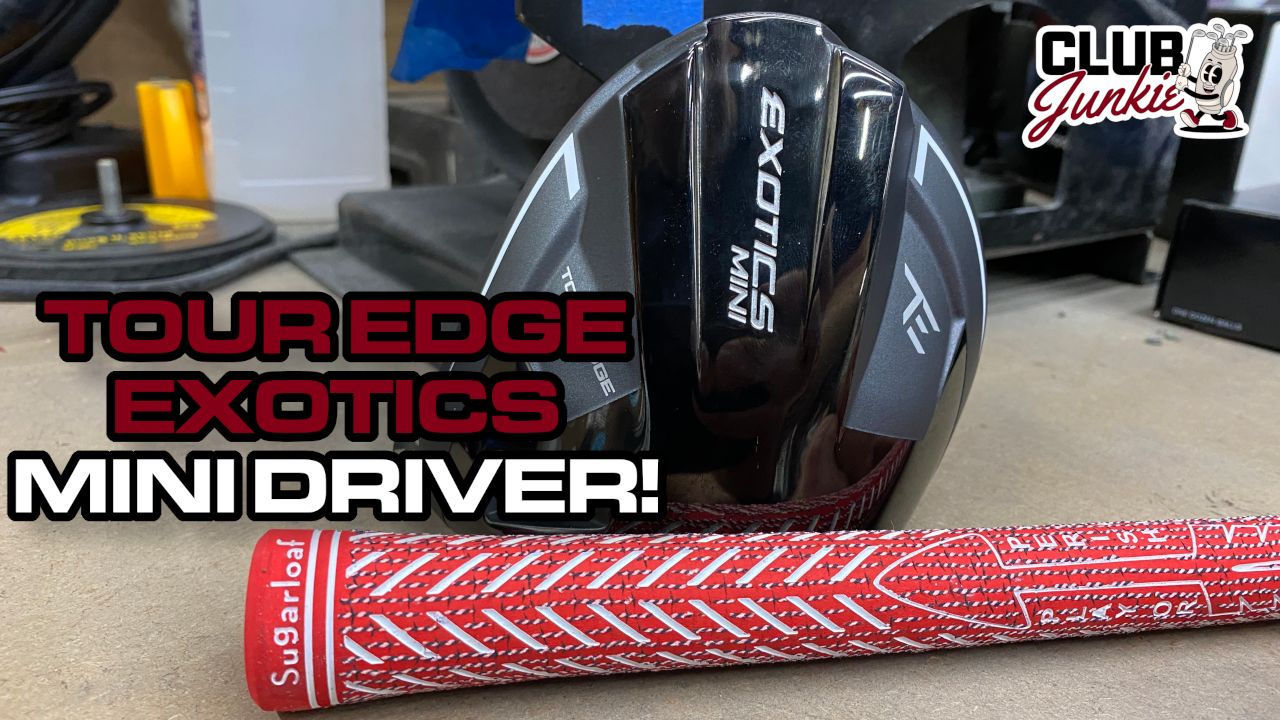
On this episode of Club Junkie, I put the new Tour Edge Exotics Mini Driver to the test and break down the performance, forgiveness, distance, and where it fits compared to a traditional driver or strong fairway wood. If you have been curious about adding a mini driver to the bag, this one is worth a look.
I also dive into the new TaylorMade Spider ZT Max putter that was recently spotted and discuss the growing zero torque putter trend. Plus, there is a closer look at the new Project X Titan Yellow shaft showing up on the PGA Tour and what makes it different from other profiles currently out there.

What’s the story behind Webb Simpson’s custom-stamped irons?

Memorial Tournament Tour Report: Rory McIlroy, Cameron Young switch up drivers, and more

Cadillac Championship Tour Report: Spieth’s sizable changes, McLaren Golf launches, and more

Russell Henley’s winning WITB: 2026 Charles Schwab Challenge

Kristoffer Reitan’s winning WITB: 2026 Truist Championship

Best irons 2026: Best irons overall, most forgiving irons, and more

J.T. Poston’s winning WITB: 2026 Memorial Tournament

Aaron Rai’s winning WITB: 2026 PGA Championship

Cameron Young’s winning WITB: 2026 Cadillac Championship

Details on Jason Day’s latest prototype Avoda iron setup


Ryan Palmer WITB 2026 (June)
Driver: Callaway Quantum Triple Diamond (9 degrees) Shaft: Project X HZRDUS Smoke Blue RDX 60 TX 3-wood: TaylorMade Qi10 (15 degrees) Shaft:...


Bud Cauley WITB 2026 (June)
Bud Cauley had >14 clubs in his bag when photographed prior to the Memorial Tournament. Driver: Titleist GTS2 (8 degrees) Shaft: Fujikura...


Hannah Green WITB 2026 (June)
Driver: Titleist GTS3 (10 degrees, D4 SureFit setting) Shaft: Mitsubishi Chemical Diamana RB 53 S 3-wood: Titleist GT3 (15 degrees,...


Asterisk Talley WITB 2026 (June)
Driver: TaylorMade Qi4D (9 degrees) Shaft: Fujikura Ventus Blue 6 S 3-wood: TaylorMade Qi4D (16.5 degrees) Shaft: Fujikura Ventus Blue...
-
 Equipment6 days ago
Memorial Tournament Tour Report: Rory McIlroy, Cameron Young switch up drivers, and more
-
 News2 weeks ago
Russell Henley’s winning WITB: 2026 Charles Schwab Challenge
-
 Equipment3 days ago
Best irons 2026: Best irons overall, most forgiving irons, and more
-
 Whats in the Bag4 days ago
J.T. Poston’s winning WITB: 2026 Memorial Tournament
-
 Equipment1 week ago
Details on Jason Day’s latest prototype Avoda iron setup
-

 Equipment3 weeks ago
CJ Cup Byron Nelson Tour Report: Koepka and Kim’s newest putters finally get hot
-

 News2 weeks ago
Charles Schwab Challenge Tour Report: MacIntyre, Åberg and Spaun all switch putters, TaylorMade launches new Spider
-

 Equipment2 weeks ago
Details on J.J. Spaun’s surprise putter switch


Scoot
Jul 10, 2019 at 9:18 am
Typos on typos in this article.
Mike
Jul 7, 2019 at 9:07 am
Let’s see…keeping it in the fairway, decent approach shots & short game on point (esp putting). Don’t need a scientist to analyze it any further than that.
Tom
Jul 8, 2019 at 6:00 am
This is literally just an add for the authors product.