
Opinion & Analysis
WRX Rules Refresher: It’s OK to measure with your putter when taking relief (plus 4 other Rules tricks)


The new Rules of Golf are in effect. And we love them. Or at least some people love them. And a lot of people (still) hate them.
Sometimes, you will be told that you are in breach of the Rules, when you are not. Below I will tell you about a few of these situations so that you can avoid accepting other people saying that you are in breach. And you might even want to do some of the things it purposely to try to shake an opponent in match play.
1. Use your putter to measure with
When taking relief, it is perfectly OK to use your putter to measure with. I repeat: It is perfectly OK to use your putter to measure with.
“That is incorrect,” you might want to respond. But it is not. One club-length in the Rules is defined as the length of the longest club you have brought, other that your putter. So the length is defined…. but not what you must use to measure with. Thus you can measure with whatever club you want. or even … It is perfectly OK to measure a relief area with your putter… as long as you drop within the correct relief area (the size of which depends on the length of your longest club, not being a putter).
Therefore next time you are taking relief, use your putter. Well, no, sorry, a correction: Before you do it, state very loud to your fellow player that you intend to measure with your PUTTER, and maybe even show to him (and tell him!), how long it is. Then measure with the putter, and drop your ball (remember to drop it inside the correct relief area).
I will assure you that you will get some kind of reaction from him/her. But you have done nothing wrong under the Rules of Golf.
2. Drop farther away than two-club-lengths
You could also do the opposite (than taking a long putter). Next time you are measuring (e.g. two club-lengths) when taking relief, use a short club, e.g. a wedge. When you are done measuring, state loudly to your playing partner: “I don’t think two club-lengths is enough, so I will drop a ball a bit farther away than that!” Then drop a ball clearly farther away than the two wedge-lengths.
That is perfectly OK…of course presupposing that you drop within two club-lengths, i.e. typically within two driver-lengths.
Again: I am sure you will get some kind of reaction from your fellow player.
3. Play a provisional without saying “provisional”
Did you know that you can actually play a provisional ball without saying the word “provisional.” The rule states, that you must either a) say the word or b) in another way make it clear, that you are playing a provisional.
Another way could be this:
– “I’m playing a ball under Rule 18.3.”
– “I’m going to play another just in case.”
Thus, next time you are playing a provisional ball, tell your fellow player that you play a ball under Rule 18.3. He will probably think you are nuts. But you are not (at least not because of this). You did fine played perfectly in accordance with the Rules.
4. Drop right next to the “line”
When you take “back on the line relief,” there is a new procedure in 2019, e.g. when you played from the fairway or rough. You don’t have to drop exactly on the “line” anymore (the line = the extension away from the hole of the line between the hole and the point e.g. where the unplayable ball lies).
Example: You play from the semi-rough, and your ball ends out of bounds. Your club does not have the new Local Rule in operation (allowing players to drop ahead with two penalty strokes), and thus you play a ball with a one-stroke penalty. You then must drop a ball in a relief area that is one club-length from a point on the “line,” that you chose (not closer to the hole). If you are so lucky that this one club-length area is partly on the fairway, it is perfectly Ok for you to drop on the fairway!
That is important to know. One “club-length” is typically a bit more than 1 yard, and therefore the area is typically more than two yards from one end to the other. And you are free to choose the best spot available within that area — also if you thereby come from the semi-rough to the fairway (as in the example).
5. Mis-hit in the teeing area: Just put it back up on the tee again!
Have you ever mis-hit the ball from the teeing area? You know, one of these strokes, where the ball merely falls down from the tee? Of course you haven’t! But I have. Well, guess what: I have some good news for you. you just put the ball back up on the tee again without penalty (remember that the stroke counts, so it will be your second stroke).
But this is only possible if, after the mis-hit, the ball was still lying inside the teeing area (two club-lengths). Therefore when you play bad, I will encourage you to play really bad! Thus, if the ball in a mis-hit rolls three yards forward, you don’t have the option to put the ball back up on the tee again without penalty (you must then a) play it as it lies or b) with a one-stroke penalty play again from the teeing ground i.e. stroke number three).




This past Monday, I played in the U.S. Amateur local qualifier at Rock Creek Country Club in Portland, Oregon. A full tee sheet from 7:30 a.m. to 1:55 p.m., the top 11 scores would make it to the U.S. Amateur final qualifying.
I teed off at 10:48 a.m.. With the 7:30 am tee time, you can get a feel for the leaders’ pace, and they were off and running on the challenging setup at Rock Creek.
View this post on Instagram
Getting to the highlight of the round on the par five 17th, a drive up the left side and 212 yards left to the front hole location. I took out a 5-iron with plans of middle of the green. The ball ended up 8 feet left of the hole, pin high. A slight downhill putt dropped in for an eagle 3 on the 17th. With the cut line looking to be anywhere from -2 to even par. This was the boost I had been waiting for all day.
With making par from the trees on 18, it was time to wait for a potential playoff with a posted score of one under par 71.
Three hours later, it was playoff time. 8 players for 6 spots. I made par on the playoff hole, which was good enough to advance to the U.S. Amateur final qualifying in July. USGA qualifiers sure deliver on all of the emotions in golf!
Club Junkie
Building my 2026 gamer WITB: Ranking the contenders and new putter projects – Club Junkie Podcast

The annual What’s In The Bag build is underway, and on this episode of Club Junkie, Brian breaks down the clubs currently leading the race for a spot in his 2026 gamer setup. From drivers and fairway woods to irons, wedges, and shafts, he ranks the equipment that’s performing best and explains what’s separating the front runners from the rest of the field.
Brian also heads into the workshop to discuss several putter projects currently on the bench. From head options and shaft choices to build ideas and testing plans, he shares what he’s working on and which putters could become serious contenders for the bag this season.
If you’re a gear junkie who loves equipment testing, club building, and the never-ending pursuit of the perfect setup, this episode is for you.
Follow Club Junkie:
Instagram: @clubjunkiepod
TikTok: @clubjunkiepod
Threads: @clubjunkiepod
X: @ClubJunkiePod
Club Junkie
Tour Edge Exotics mini driver review + TaylorMade Spider ZT Max first look – Club Junkie

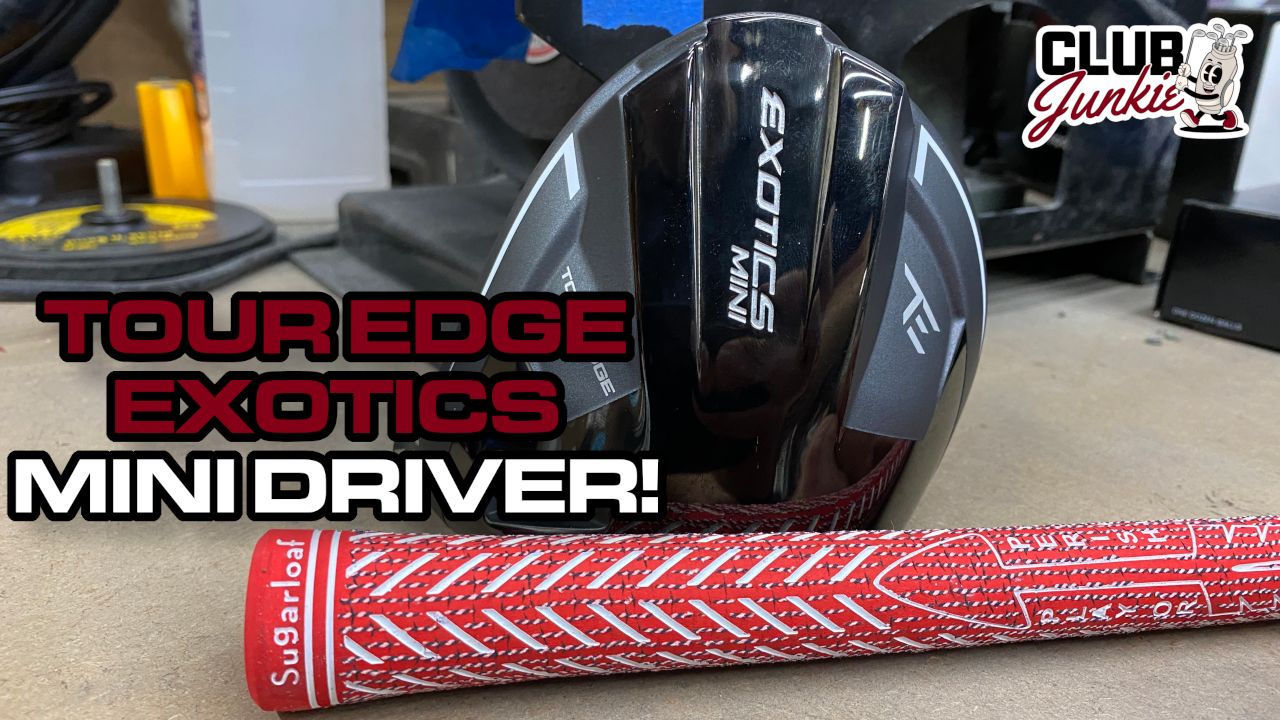
On this episode of Club Junkie, I put the new Tour Edge Exotics Mini Driver to the test and break down the performance, forgiveness, distance, and where it fits compared to a traditional driver or strong fairway wood. If you have been curious about adding a mini driver to the bag, this one is worth a look.
I also dive into the new TaylorMade Spider ZT Max putter that was recently spotted and discuss the growing zero torque putter trend. Plus, there is a closer look at the new Project X Titan Yellow shaft showing up on the PGA Tour and what makes it different from other profiles currently out there.

Justin Rose WITB 2026 (April): Full WITB breakdown with new McLaren irons

What’s the story behind Webb Simpson’s custom-stamped irons?

Memorial Tournament Tour Report: Rory McIlroy, Cameron Young switch up drivers, and more

Cadillac Championship Tour Report: Spieth’s sizable changes, McLaren Golf launches, and more

Russell Henley’s winning WITB: 2026 Charles Schwab Challenge

Kristoffer Reitan’s winning WITB: 2026 Truist Championship

Best irons 2026: Best irons overall, most forgiving irons, and more

J.T. Poston’s winning WITB: 2026 Memorial Tournament

Aaron Rai’s winning WITB: 2026 PGA Championship

Cameron Young’s winning WITB: 2026 Cadillac Championship


Ryan Palmer WITB 2026 (June)
Driver: Callaway Quantum Triple Diamond (9 degrees) Shaft: Project X HZRDUS Smoke Blue RDX 60 TX 3-wood: TaylorMade Qi10 (15 degrees) Shaft:...


Bud Cauley WITB 2026 (June)
Bud Cauley had >14 clubs in his bag when photographed prior to the Memorial Tournament. Driver: Titleist GTS2 (8 degrees) Shaft: Fujikura...


Hannah Green WITB 2026 (June)
Driver: Titleist GTS3 (10 degrees, D4 SureFit setting) Shaft: Mitsubishi Chemical Diamana RB 53 S 3-wood: Titleist GT3 (15 degrees,...


Asterisk Talley WITB 2026 (June)
Driver: TaylorMade Qi4D (9 degrees) Shaft: Fujikura Ventus Blue 6 S 3-wood: TaylorMade Qi4D (16.5 degrees) Shaft: Fujikura Ventus Blue...
-
 Equipment6 days ago
Memorial Tournament Tour Report: Rory McIlroy, Cameron Young switch up drivers, and more
-
 News2 weeks ago
Russell Henley’s winning WITB: 2026 Charles Schwab Challenge
-
 Equipment3 days ago
Best irons 2026: Best irons overall, most forgiving irons, and more
-
 Whats in the Bag4 days ago
J.T. Poston’s winning WITB: 2026 Memorial Tournament
-

 Equipment1 week ago
Details on Jason Day’s latest prototype Avoda iron setup
-
 Equipment3 weeks ago
CJ Cup Byron Nelson Tour Report: Koepka and Kim’s newest putters finally get hot
-

 News2 weeks ago
Charles Schwab Challenge Tour Report: MacIntyre, Åberg and Spaun all switch putters, TaylorMade launches new Spider
-
 Equipment2 weeks ago
Details on J.J. Spaun’s surprise putter switch


Fio
Mar 15, 2019 at 1:40 pm
What is the aim of the piece, to start arguments with your playing partners ? The changes will be difficult enough to get used to without suggesting to golfers how clever they can be in the interpretation of the Rules. Surely the writer can think of more useful information regarding the Rules that will actually benefit golfers?
Deepy
Mar 14, 2019 at 3:46 pm
@1&2 but why?
@3 „I’m going to play another just in case„ <- doubt that, see 18.3b, clearly announcing sounds different to me, the example states it is not enough to announce it as „play another ball“, „just in case“ doesn’t make any difference
@4 Back on the line relief after hitting it O.B.?
@5 planning to never make use of this rule
D
Mar 15, 2019 at 2:27 am
Douche doesn’t understand the rules. OB is OB, and it’s still stroke and distance, therefore you are still hitting the drop plus another, so it’s actually the same penalty as before from the nearest point where you just hit the OB shot.
Therefore, as an example: if you are in the semi-rough next to the fairway with your tee shot like he says, and you hit that 2nd shot OB. You drop as near as possible to the place where you just hit the poor shot, without moving forward, and so you are now hitting your 4th. If the rule to move forward is not in effect, you play exactly how you used to play before, like that.
But, the only new thing is, if you move forward instead with the new rules, and you drop next to the place the ball crossed, you add 2 and are now hitting your 5th from the line it crossed.
Duh
Hitemtrue
Mar 18, 2019 at 12:35 pm
Under the new rules there is a relief area when taking stroke and distance. Within one club length of previous location, no closer to the hole.