
Opinion & Analysis
Is Tiger’s “No. 1 Proximity to the Hole” a meaningless stat?

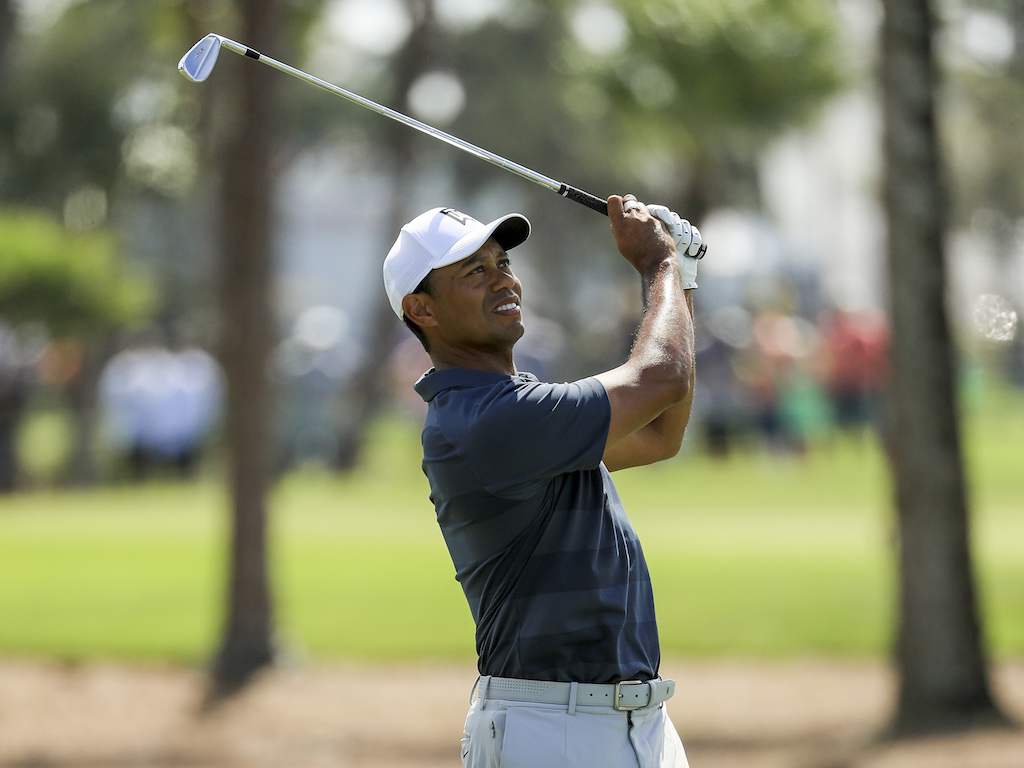
Much was made of Tiger Woods leading the field in Proximity to the Hole in this weekend’s Honda Classic. But what does this stat actually even mean?
Included in Proximity to the Hole are all approach shots, whether they hit the green or not. BUT, if the shot misses, and is not within 30 yards of the edge of the green, it does not count. Think about it: a shot missed just short of the flag but in a hazard counts. Tiger had two wet miscues this week that were included in his proximity calculation. One of those actually helped his average proximity as it was recorded as two feet closer than his average of 29 feet 3 inches. What does the Shotlink team do? Laser the exact distance of the splash? Finally, the fact that the big misses don’t count will dilute the average and cause compaction over multiple events.
I have found some misunderstanding of the importance of this stat among the players and coaches with whom I work. Specifically, there is a tendency to put top priority on hunting flags. I strongly believe that the most important aspect of the approach game is to HIT THE GREEN, and that proximity to the hole is by far secondary. Obviously, proximity is great when one has the right opportunities, but hitting greens should be the overriding goal at every level.
Let’s take the small sample of Tiger in this week’s Honda vs. Justin Thomas, the winner. Tiger’s proximity was exactly four feet closer than Justin’s. At that distance, with average Tour putting, it would take 40 greens to equal one stroke difference. By contrast, Tiger gave up FOUR strokes with the two doubles recorded on hole No. 15 following his approach shots in the water.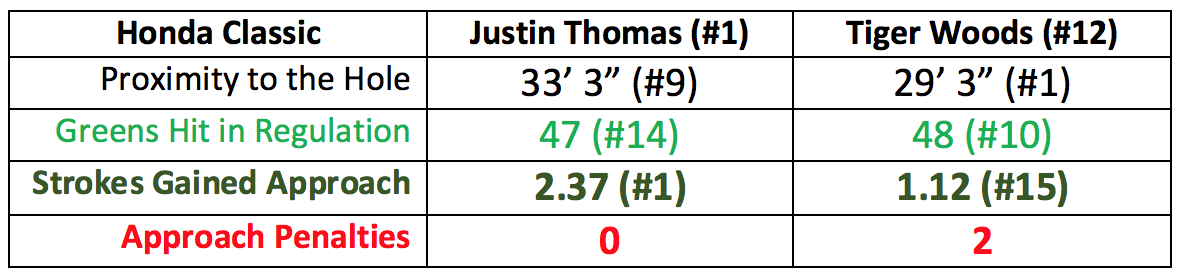 Additional perspective: In 2017, the average player on the Tour’s Scrambling was 57.9 percent (player makes par after missing GIR 57.9 percent of the time). We can therefore assume that each additional GIR would save him at least 0.42 Strokes (the reciprocal of his Scrambling Percentage).
The Tour average GIR’s in 2017 was 11.68 per round. In order to save that 0.42 strokes per round simply by hitting shots closer to the hole on these 11.68 greens, Mr. Average would need to improve his Proximity by 7 feet* (from 36 ft. to 29 ft.) on ALL 11.68 greens hit. I submit that ONE additional GIR is a much more attainable goal and that striving for the closer proximities may well lead to hitting fewer GIR’s.
Further, the No. 1 ranked player on the Tour for Proximity to the Hole in 2017 was Ryan Armour at 32 feet 8 inches. Even with that impressive number, his Approach Strokes Gained was only 0.121 (ranked 89th).
My suggestion: Only count the distances when the greens are hit. Then the combination of percentage of GIR’s and Proximity would really mean something.
For a complete analysis of your game, log on to www.ShotByShot.com
*The SG values were extracted from the ShotByShot.com Scratch, Strokes Gained model. It is slightly different from the Tour’s model but the relative values will be virtually identical.




This past Monday, I played in the U.S. Amateur local qualifier at Rock Creek Country Club in Portland, Oregon. A full tee sheet from 7:30 a.m. to 1:55 p.m., the top 11 scores would make it to the U.S. Amateur final qualifying.
I teed off at 10:48 a.m.. With the 7:30 am tee time, you can get a feel for the leaders’ pace, and they were off and running on the challenging setup at Rock Creek.
View this post on Instagram
Getting to the highlight of the round on the par five 17th, a drive up the left side and 212 yards left to the front hole location. I took out a 5-iron with plans of middle of the green. The ball ended up 8 feet left of the hole, pin high. A slight downhill putt dropped in for an eagle 3 on the 17th. With the cut line looking to be anywhere from -2 to even par. This was the boost I had been waiting for all day.
With making par from the trees on 18, it was time to wait for a potential playoff with a posted score of one under par 71.
Three hours later, it was playoff time. 8 players for 6 spots. I made par on the playoff hole, which was good enough to advance to the U.S. Amateur final qualifying in July. USGA qualifiers sure deliver on all of the emotions in golf!
Club Junkie
Building my 2026 gamer WITB: Ranking the contenders and new putter projects – Club Junkie Podcast

The annual What’s In The Bag build is underway, and on this episode of Club Junkie, Brian breaks down the clubs currently leading the race for a spot in his 2026 gamer setup. From drivers and fairway woods to irons, wedges, and shafts, he ranks the equipment that’s performing best and explains what’s separating the front runners from the rest of the field.
Brian also heads into the workshop to discuss several putter projects currently on the bench. From head options and shaft choices to build ideas and testing plans, he shares what he’s working on and which putters could become serious contenders for the bag this season.
If you’re a gear junkie who loves equipment testing, club building, and the never-ending pursuit of the perfect setup, this episode is for you.
Follow Club Junkie:
Instagram: @clubjunkiepod
TikTok: @clubjunkiepod
Threads: @clubjunkiepod
X: @ClubJunkiePod
Club Junkie
Tour Edge Exotics mini driver review + TaylorMade Spider ZT Max first look – Club Junkie

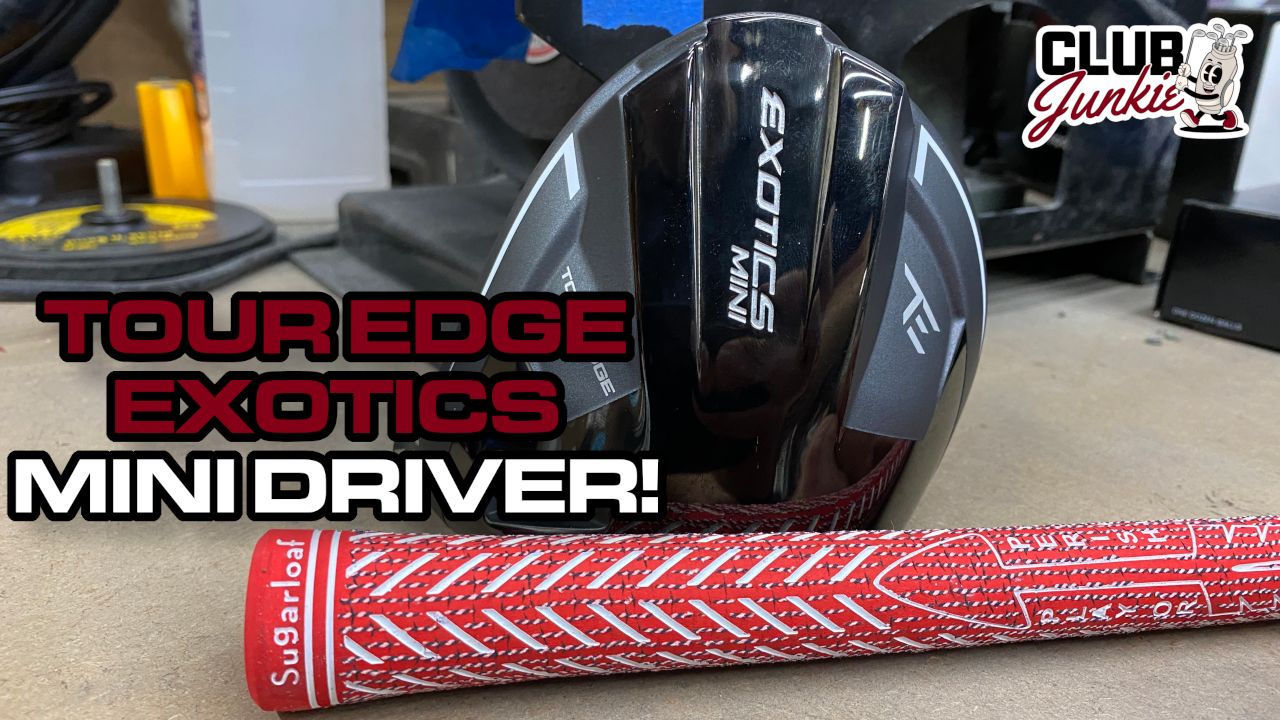
On this episode of Club Junkie, I put the new Tour Edge Exotics Mini Driver to the test and break down the performance, forgiveness, distance, and where it fits compared to a traditional driver or strong fairway wood. If you have been curious about adding a mini driver to the bag, this one is worth a look.
I also dive into the new TaylorMade Spider ZT Max putter that was recently spotted and discuss the growing zero torque putter trend. Plus, there is a closer look at the new Project X Titan Yellow shaft showing up on the PGA Tour and what makes it different from other profiles currently out there.

Justin Rose WITB 2026 (April): Full WITB breakdown with new McLaren irons

What’s the story behind Webb Simpson’s custom-stamped irons?

Memorial Tournament Tour Report: Rory McIlroy, Cameron Young switch up drivers, and more

Cadillac Championship Tour Report: Spieth’s sizable changes, McLaren Golf launches, and more

Russell Henley’s winning WITB: 2026 Charles Schwab Challenge

Kristoffer Reitan’s winning WITB: 2026 Truist Championship

Best irons 2026: Best irons overall, most forgiving irons, and more

J.T. Poston’s winning WITB: 2026 Memorial Tournament

Aaron Rai’s winning WITB: 2026 PGA Championship

Cameron Young’s winning WITB: 2026 Cadillac Championship


Bud Cauley WITB 2026 (June)
Bud Cauley had >14 clubs in his bag when photographed prior to the Memorial Tournament. Driver: Titleist GTS2 (8 degrees) Shaft: Fujikura...


Hannah Green WITB 2026 (June)
Driver: Titleist GTS3 (10 degrees, D4 SureFit setting) Shaft: Mitsubishi Chemical Diamana RB 53 S 3-wood: Titleist GT3 (15 degrees,...


Asterisk Talley WITB 2026 (June)
Driver: TaylorMade Qi4D (9 degrees) Shaft: Fujikura Ventus Blue 6 S 3-wood: TaylorMade Qi4D (16.5 degrees) Shaft: Fujikura Ventus Blue...

Brianna Do WITB 2026 (June)
Driver: Callaway Quantum Triple Diamond (9 degrees) Shaft: KBS PGW 3-wood: Callaway Elyte Titanium (15 degrees) Shaft: KBS PGW 5-wood:...
-
 Equipment6 days ago
Memorial Tournament Tour Report: Rory McIlroy, Cameron Young switch up drivers, and more
-
 News2 weeks ago
Russell Henley’s winning WITB: 2026 Charles Schwab Challenge
-
 Equipment3 days ago
Best irons 2026: Best irons overall, most forgiving irons, and more
-
 Whats in the Bag4 days ago
J.T. Poston’s winning WITB: 2026 Memorial Tournament
-

 Equipment1 week ago
Details on Jason Day’s latest prototype Avoda iron setup
-
 Equipment3 weeks ago
CJ Cup Byron Nelson Tour Report: Koepka and Kim’s newest putters finally get hot
-

 News2 weeks ago
Charles Schwab Challenge Tour Report: MacIntyre, Åberg and Spaun all switch putters, TaylorMade launches new Spider
-
 Equipment2 weeks ago
Details on J.J. Spaun’s surprise putter switch


JThunder
Feb 27, 2018 at 6:49 pm
All statistics are (essentially) meaningless without the story; but the corporate media and the defunded educational system have decreased our attention spans and intelligence, so stats are all we have the time or brains for. There’s an agenda here, if only we could see it. 17 more yards!
Tom
Feb 27, 2018 at 3:09 pm
Tiger has always led the “proximity to the ho” stat…….
David
Feb 27, 2018 at 11:17 am
Of course it’s not meaningless. It good information — just doesn’t tell the whole story. Your suggestion wouldn’t fully tell the story either. For instance, I would include in your improvement green (or fringe) in regulation, since there is virtually no difference between hitting the fringe and hitting the the green on tour courses. And ShotLink keeps fringe data now, I believe….
Peter Sanders
Feb 28, 2018 at 10:40 am
David,
Right you are! Fringe data is in ShotLink. I originally included it with my suggestion BUT the Tour GIR is a fairly sacred number and does not include balls on the fringe. I believe the Proximity stat could be 2 stats: 1 w/o fringe – strictly GIR’s and 2. w fringe.
Cory
Feb 27, 2018 at 9:43 am
Is it meaningless? No. And as you’ve pointed out it is flawed. But with that being said, it should give you an indication that he is starting to dial in his shots, and we could see glimpses of past Tiger. Only time will tell, but they made more of it than what it deserved given his 12th place finish.
Peter Sanders
Feb 28, 2018 at 10:36 am
Thanks Cory,
My point was not a shot against Tiger but the stat AND how even the people in the golf business do not understand it.
Jack
Feb 26, 2018 at 11:35 pm
Strokes gained is obviously much more important. It calculates how close you need to hit it versus the distance you are away. For Thomas and Woods their distances are not that different, so I think their proximity numbers are actually relevant.
As discussed by the author, the main difference here are the hazards that Tiger hit. The SG difference in approach was only 1.25 strokes over 4 rounds. Yeah ok that’s a lot for a pro, but hitting it in the water already is 1 stroke penalty plus the extra stroke needed to chip it onto the green. Pro’s can flag hunt when they need, or else they would never score enough birdies to win a tournament LOL. For amateurs just getting on the green consistently already is a huge win.
CB
Feb 27, 2018 at 2:51 am
Well, that, and the fact that he didn’t make many putts, so his Stroke Gained Putting (or lack of) is what should also be reflected here.
But lets not forget that as difficult as the course played, the overall score-to-Par for the whole field showed how hard it was, and that should also be reflected but is never really discussed enough. And we’re not talking about amateurs, so stop comparing it to how hackers don’t understand how to break down the stats or the course to be able to go low.
Mad-Mex
Feb 26, 2018 at 10:41 pm
The ONLY stat that matters is who gets the “W”
Ogo
Feb 26, 2018 at 9:57 pm
I would like to know how many steps-per-green Tiger takes before he holes out. I bet he takes fewer steps than any other tour pro. Udaman Tiger!!!
CB
Feb 27, 2018 at 2:52 am
What about spits-per-green as well
Ogo
Feb 27, 2018 at 11:47 am
Tiger not only reads the greens with his eyes, he feels the greens with his feet. Visual and tactile putting method.
GregNormansGreenJacket
Feb 26, 2018 at 9:50 pm
Its not how, its how many. Got to get in the hole.
Tyler Champ
Feb 26, 2018 at 8:33 pm
Or we could just look at strokes gained approach because that entails everything approach related. Notice how JT was number 1 in SGA, but one less green?
Read every stroke counts by Mark Broadie and you’ll understand traditional stats, in addition to Prox and feet of putt made don’t mean anything… strokes gained really tells the whole story week in and week out, and for the season.
Steve Wozeniak
Feb 26, 2018 at 6:34 pm
Gee…….after dumping the two let’s swing left clowns, he starts swinging toward the target and plays better……wow…..who would have thunk it!!!!!!
I always said he is an easy fix if he gets good information, looks like he’s figuring it out by himself. Still has a bit of a block in his swing but it’s WAY BETTER, keep it up Tig……
Steve Wozeniak PGA
James
Feb 27, 2018 at 2:06 am
But he’s exiting left through impact, as in in-square-in…so he has to swing left? Or am I misinterpreting what you said?
J
CB
Feb 27, 2018 at 2:54 am
Outside-in, hands pull left, under-cut twirl with clubhead
Realist
Feb 26, 2018 at 6:10 pm
I saw Tiger make a couple of mental mistakes and use a driver that has only made me miss worse on my misses. I think if he dumps the driver, the mental aspects will come to him with confidence. He’s closer than we’ve seen him in a long time. Great for the game
Matt A
Feb 26, 2018 at 5:44 pm
Closer doesn’t mean better.
Kaven
Feb 26, 2018 at 5:13 pm
Lollll he putt well with his scotty
He’s good with his nike iron
He chips well with his nike wedge
The only weakness is the taylormade metalwood
CB
Feb 27, 2018 at 2:55 am
I reckon the ball isn’t that good either, it’s not helping him make putts
juliette
Feb 26, 2018 at 5:03 pm
Well, I think it’s a good analysis and is well worth reading for understanding how this stat is compiled. Thank you for your good work. As to whether or not it is a telltale stat for the tour, and achieving #1 status means something significant, you’ve shown that there are other stats more meaningful than this one.
Still, it is a measure of how close your misses are and for that reason it shows mostly that the one with the closest proximity was likely the one whose shots went closer to where he intended than did other players’ shots to the greens. But in the end we all know that putting, more likely number of feet of putts made, is much more telling for a players’ final tournament position.
Tiger went for a few pins on Sat and Sunday that he thought he needed to go for in order to have a chance to win. He didn’t pull it off and paid a high price. Had he been leading I doubt he would have done that. So strategy is a hard one to figure in to this stat. That said, all these stats lose a bit of luster under close scrutiny.
Humble Golfer
Feb 26, 2018 at 4:31 pm
While I do agree with the fact that this stat can’t have a direct correlation to birdie opportunities or hazard less play, I do believe this shows how well players are hitting approach shots from a consistency perspective. This stat is also important from a round to round comparison to ones self showing improvements in ball striking. This piece is nothing but a “selective hearing” type of reaction to the obvious fact that PGA National is a VERY tough course, and it got to everyone over the course of 4 Days. Let’s not take away the fact that Tiger had lots of good looks at Birdie. It was a matter of who made more crucial puts.
Peter Sanders
Feb 27, 2018 at 8:30 am
Thanks Humble, if the Tour would adopt my idea of only counting Proximity when the green is hit, we would have a perfect answer as to who had the most and best birdie opportunities. My complaint now is that the inclusion of shots that miss the green seriously cloud this perspective.
James
Feb 27, 2018 at 3:09 pm
It does seem rather strange to include the proximity value when the green is missed or hit into a hazard. Perhaps they should include par 3s in driving distance because that would be equally unintuitive…
DaveyD
Feb 26, 2018 at 3:43 pm
Avoid shots that result in penalties, minimize #shots to the green, and avoid three-putting. More of a workflow than stats, but it works for me.