
Opinion & Analysis
Let’s Retire Old Man Par: A Modest Proposal

In 1729, Jonathan Swift wrote a satirical essay entitled “A modest proposal,” in which he suggested that the Irish eat their own children. As might be expected, the piece drew a great deal of discussion and controversy. He was of course not serious, but simply attempting to make a point. As you will read this piece contains “A Modest Proposal” as well, but it is not intended to be satirical. I am for the record dead serious.
The golf industry is wringing its hands, trying to find a way to bring new players into the game, while at the same time keeping those that are in the game from leaving. They have initiated any number of programs designed for this purpose. How successful have they been? I would venture that they have barely moved the needle.
Barriers to the game
What we do know is that today there are three major barriers that confront the industry. They are first, the time required to play the game; second the costs associated with playing the game; and third the difficulty of the game.
There are among those adults that start the game, three distinct different groups:
- Those who would like to start playing golf but for any number of reasons decided not to take up the game.
- Those who once played more frequently but have reduced the number of rounds that they play.
- Those who started to play the game but then after a short period decided to leave it.
Those who leave the game
Those in the golf industry, the hand-wringers, have developed any number of programs to bring new players to the game. I would ask the question, “What is the point, when almost an equal number of players that start playing the game each year, decide to give it up within a span of a few months.
Does it make any sense to continue to put water into a bucket when there is a hole in the bottom? Of course not, but that is effectively what is being done. The first question to be ask, why do these new players quit the playing after a short time? In my opinion, the number No. 1 reason is the method of scoring being used.
Were an exit poll to be conducted asking these people why they quit playing, I seriously doubt they would answer truthfully. Who would want to admit that they were discouraged by their inability to succeed at any endeavor? The two answers that would be given the most often would be 1) that golf is too expensive to play; or 2) that they simply didn’t have time. In this case both answers serve to preserve the individual’s dignity. And who could blame them?
The concept of par
Why did these individuals find the game difficult? The short answer is that while golf is a hard game to learn, there is a more compelling reason. I would venture, that the underlying reason they quit the game is that it ceased to be fun because of how they viewed their performance. And for one central reason… the concept of par. The idea that an amateur golfer, especially a beginner, should measure their level of success against an imaginary set of numbers that represents what an expert player would score on each hole is on the surface ridiculous.
You might imagine a beginning player scoring an eight on a par-four hole after hitting six good shots and then two putting for an eight. In the context of their ability, they should be ecstatic — but of course they are not (because as their playing partner reminds them) they were four-over par on that hole. The time has come for Old Man Par to retire. And retire permanently. He is killing the game.
Perceived failure
In another scenario, the beginning player scores sixty for nine holes, which is an excellent score given the short amount of time they might have spent playing the game. And yet their nine-hole score was 24-over par. How would that make you feel? Would you be encouraged or discouraged? You might imagine yourself back in school and regardless of the amount of work that you put into a given class you always receive an “F.” At some point, would you give up?
Why should every golfer be judged by the same standard when there is such inequality in their ability? The equivalent would be placing a high school freshman in a graduate-level college course, expecting that they could perform at the same level as the other graduate students. The disparity in knowledge, based on age and experience, is precisely the reason why there are different grades in school. The same disparity exists among golfers. In this case, the difference being the ability to perform on the golf course as opposed to the classroom.
What about the second group of players that now plays less than they did in the past? Could it be that they are no longer having fun playing the game?And then there is the third group, those that consider playing the game but abandon it for another sport. Could it be that they are intimidated by the scoring system, knowing that as a beginner par is an absolute impossibility?
Old man par
The legendary Bobby Jones was the first to coin, perhaps with the help of his friend O.B. Keillor, the phrase “Old Man Par.” Jones was, of course, the greatest amateur to have ever played the game. He won the Grand Slam in 1930, retiring then at the age of 28.
The time has come to retire “Old Man Par” and devise a new system for measuring a golfer’s progress in the game. I know that those in the USGA. would reject the concept immediately for fear of, and here is a $10 word used primarily by attorneys, “bifurcate” the game. What that word essentially means in this context in having more than one standard. The USGA is responsible for preserving the nature of the game, but at the same time it should be equally concerned with preserving the future of the game.
Personal par
What I would suggest is a system based on the principle of what might be termed “personal par.” This was essentially the system that was used to groom a young Tiger Woods. As a young child, he was not capable of reaching the longer holes in regulation, making par a virtual impossibility. Consequently, his coach wisely devised a system in which par was adjusted upward based on his ability at a given point in time. This served to keep the young child feeling good about his performance and subsequent progress.
This is the type of system that needs to be devised for the health of the game. The system would begin at a nine-hole level using a par of thirty-six as a basis. The actual numbers are not as important as the basic concept. There would be within the nine-hole and the eighteen-hole groups five different levels as follows with assigned par for each hole and eighteen holes roughly equal with the player’s ability.
As players improved, they would graduate from one level to another based on their total score. The handicap system would work in similar fashion as it does now with a single modification. The strokes give from one player to another would depend on the level in which they fall and the par assigned to that level.
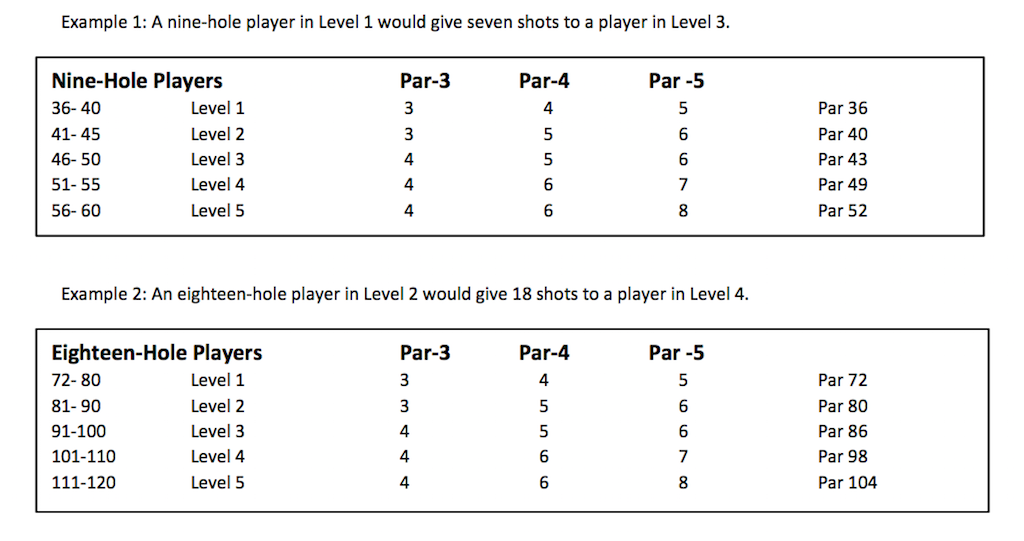
The personal par handicap system would not be as exacting as it is presently used, but it would be sufficient to allow players to be reasonable competitive without any significant sacrifice. There would then be two scoring systems then, allowing players to choose which one they wanted to use. Or a recommendation might be given that until they reach a given scoring threshold that they use the personal par scoring system.
There would, of course, be the usual concern with something new being injected into the system, but the proposed change would be no greater than when the system of equitable scoring was introduced or when courses were first assigned a course rating number.
A few years ago, when life-long teacher and educator Dr. Gary Wiren was inducted into the Golf Teacher’s Hall of Fame, he wanted to pass along a single piece of advice to those teachers in the room. “Gentleman,” he started and then paused for emphasis. “We must find a way to make the game more fun for our students.”
I’m in full agreement with Dr. Wiren. The question is, “What is the best way to accomplish that goal?” I believe that that the first step in that direction is to change the scoring system so that golfers experience more satisfaction and accomplishment. That is what makes learning fun.
And so, I would have you consider “The Modest Proposal” that I have put forward. And rather than attempting to find reasons why a revised scoring system couldn’t never work, for the benefit of the game, look for the same number of reason why it could work. The time has come for Old Man Par, as we know him, to retire. He has served us well, but he has become an anarchism. He is as obsolete as the horse and buggy. Let’s hand him his gold watch and let him enjoy his golden years in peace.
And at the same time, let’s welcome the “new kid on the block” who will pave the way for the next generation of golfers pioneering a scoring system that promises to make the game more “fun.”





This past Monday, I played in the U.S. Amateur local qualifier at Rock Creek Country Club in Portland, Oregon. A full tee sheet from 7:30 a.m. to 1:55 p.m., the top 11 scores would make it to the U.S. Amateur final qualifying.
I teed off at 10:48 a.m.. With the 7:30 am tee time, you can get a feel for the leaders’ pace, and they were off and running on the challenging setup at Rock Creek.
View this post on Instagram
Getting to the highlight of the round on the par five 17th, a drive up the left side and 212 yards left to the front hole location. I took out a 5-iron with plans of middle of the green. The ball ended up 8 feet left of the hole, pin high. A slight downhill putt dropped in for an eagle 3 on the 17th. With the cut line looking to be anywhere from -2 to even par. This was the boost I had been waiting for all day.
With making par from the trees on 18, it was time to wait for a potential playoff with a posted score of one under par 71.
Three hours later, it was playoff time. 8 players for 6 spots. I made par on the playoff hole, which was good enough to advance to the U.S. Amateur final qualifying in July. USGA qualifiers sure deliver on all of the emotions in golf!
Club Junkie
Building my 2026 gamer WITB: Ranking the contenders and new putter projects – Club Junkie Podcast

The annual What’s In The Bag build is underway, and on this episode of Club Junkie, Brian breaks down the clubs currently leading the race for a spot in his 2026 gamer setup. From drivers and fairway woods to irons, wedges, and shafts, he ranks the equipment that’s performing best and explains what’s separating the front runners from the rest of the field.
Brian also heads into the workshop to discuss several putter projects currently on the bench. From head options and shaft choices to build ideas and testing plans, he shares what he’s working on and which putters could become serious contenders for the bag this season.
If you’re a gear junkie who loves equipment testing, club building, and the never-ending pursuit of the perfect setup, this episode is for you.
Follow Club Junkie:
Instagram: @clubjunkiepod
TikTok: @clubjunkiepod
Threads: @clubjunkiepod
X: @ClubJunkiePod
Club Junkie
Tour Edge Exotics mini driver review + TaylorMade Spider ZT Max first look – Club Junkie

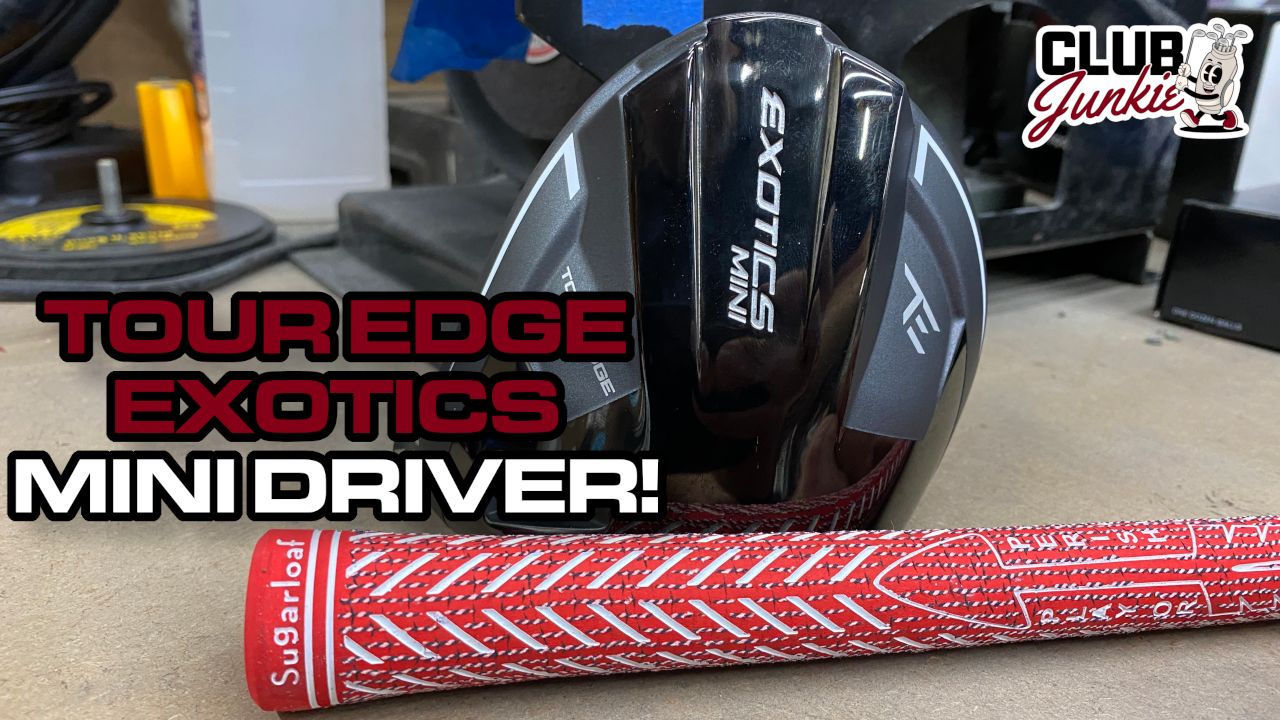
On this episode of Club Junkie, I put the new Tour Edge Exotics Mini Driver to the test and break down the performance, forgiveness, distance, and where it fits compared to a traditional driver or strong fairway wood. If you have been curious about adding a mini driver to the bag, this one is worth a look.
I also dive into the new TaylorMade Spider ZT Max putter that was recently spotted and discuss the growing zero torque putter trend. Plus, there is a closer look at the new Project X Titan Yellow shaft showing up on the PGA Tour and what makes it different from other profiles currently out there.

What’s the story behind Webb Simpson’s custom-stamped irons?

Memorial Tournament Tour Report: Rory McIlroy, Cameron Young switch up drivers, and more

Cadillac Championship Tour Report: Spieth’s sizable changes, McLaren Golf launches, and more

Russell Henley’s winning WITB: 2026 Charles Schwab Challenge

Kristoffer Reitan’s winning WITB: 2026 Truist Championship

Best irons 2026: Best irons overall, most forgiving irons, and more

J.T. Poston’s winning WITB: 2026 Memorial Tournament

Aaron Rai’s winning WITB: 2026 PGA Championship

Cameron Young’s winning WITB: 2026 Cadillac Championship

Details on Jason Day’s latest prototype Avoda iron setup


Ryan Palmer WITB 2026 (June)
Driver: Callaway Quantum Triple Diamond (9 degrees) Shaft: Project X HZRDUS Smoke Blue RDX 60 TX 3-wood: TaylorMade Qi10 (15 degrees) Shaft:...


Bud Cauley WITB 2026 (June)
Bud Cauley had >14 clubs in his bag when photographed prior to the Memorial Tournament. Driver: Titleist GTS2 (8 degrees) Shaft: Fujikura...


Hannah Green WITB 2026 (June)
Driver: Titleist GTS3 (10 degrees, D4 SureFit setting) Shaft: Mitsubishi Chemical Diamana RB 53 S 3-wood: Titleist GT3 (15 degrees,...


Asterisk Talley WITB 2026 (June)
Driver: TaylorMade Qi4D (9 degrees) Shaft: Fujikura Ventus Blue 6 S 3-wood: TaylorMade Qi4D (16.5 degrees) Shaft: Fujikura Ventus Blue...
-
 Equipment6 days ago
Memorial Tournament Tour Report: Rory McIlroy, Cameron Young switch up drivers, and more
-
 News2 weeks ago
Russell Henley’s winning WITB: 2026 Charles Schwab Challenge
-
 Equipment3 days ago
Best irons 2026: Best irons overall, most forgiving irons, and more
-
 Whats in the Bag4 days ago
J.T. Poston’s winning WITB: 2026 Memorial Tournament
-
 Equipment1 week ago
Details on Jason Day’s latest prototype Avoda iron setup
-

 Equipment3 weeks ago
CJ Cup Byron Nelson Tour Report: Koepka and Kim’s newest putters finally get hot
-

 News2 weeks ago
Charles Schwab Challenge Tour Report: MacIntyre, Åberg and Spaun all switch putters, TaylorMade launches new Spider
-
 Equipment2 weeks ago
Details on J.J. Spaun’s surprise putter switch


LC
Dec 29, 2018 at 8:30 am
Much ado about nothing. When I took up the game I already knew from my friends that played that par or scratch was an unattainable standard that most/all recreational golfers aspire to – and understand they won’t likely achieve. While we are chasing it we play matches with each other using the handicap system which works surprisingly well. I used to play with a regular group where I was the weakest golfer, yet using handicaps our matches almost always went down to the wire. I was always happy with a bogey.
This article is a solution in search of a problem,
T
Apr 24, 2018 at 11:09 am
Should change the article name to “Let’s Install Snowflake Par”
Jack
Apr 24, 2018 at 5:25 am
Yeah, it’s all perception and how golfers are educated, but also they need to play from closer tee boxes. There’s always the perception that the white tees are the men’s tees, and then you have golden for senior and red for womens. It should really be based on handicap. If you are over 30 handicap you should play from the reds. Over 20 should play from gold, then over 10 whites, and then you can play blues or whatever if you are single digit. It’s a guide only of course, but the perception that males will tee off the white tees doesn’t help new golfers when they are struggling to advance the ball.
Dave r
Apr 23, 2018 at 8:32 pm
JUST GO AWAY AND FIND SOMETHING ELSE TO WRITE ABOUT.
Robert Parsons
Apr 23, 2018 at 4:18 pm
BYW, when I started playing, my friend was already a good golfer. We never kept score.
We only wrote down birdies or better and number of lost balls. For my first few years, he said we need to focus on and improve on the number of balls I lost.
In our “scorekeeping”, only birdies or better counted. He would only win by at most a few strokes. Seemed much closer than it really was. Many times he wouldn’t manage a birdie and we’d tie! Tiebreakers came down to number of balls lost. Haha
And here I am many years later playing a round with the same golf ball. It’s rare I lose one, unless I attempt a big carry over water or whatever that most would play to a landing area.
Dennis Ritter
Apr 23, 2018 at 2:41 pm
Let’s make it like everyone gets a trophy – just like real life.
Robert Parsons
Apr 23, 2018 at 4:08 pm
That’s a great way to reward losers. Now there’s no desire to improve, we all win! Hugs all around…
~j~
Apr 23, 2018 at 2:04 pm
I declared every hole a par 8 and came in 64/under yesterday! My ego is sooooaaring now!
Brad
Apr 23, 2018 at 1:20 pm
Isn’t this just simply a different way to configure handicapping? And how does this system add more ‘fun’ to the game and ‘speed up’ the game? I applaud any thought given to growing this game that I love, but I don’t think this answers the issue, for there is still a “par” to each hole, it’s just adjusted. And the issue of how one attains a level higher with good play or is demoted to a level lower due to poor play is a sticky enough challenge (and maybe a dis-incentive to a mid-level player going through a slump) to render this whole thing un-workable.
Kevin
Apr 23, 2018 at 12:59 pm
Ridiculous article. If you want to argue that the current handicap system isn’t accessible enough (complicated for beginners to understand; often adds even MORE to golf’s overall cost) I’d agree. But basically ignoring that the system exists is mind-boggling. In fact, it’s such a glaring issue that I have to wonder if the author, despite his qualifications, doesn’t really understand the current system—which supports my previous point.
In my opinion, the first step to “fix” the handicap system is make it free (always). That’s just step one—some simplification is also in order but much more complex to simplify (ha).
The primary reasons people quit are cost and time, with cost being the greater factor.
Dave
Apr 23, 2018 at 12:20 pm
Stableford format has been around for a while and is a great equaliser. It is used to great effect for beginners and juniors alike.
http://www.wallaseygolfclub.com/club_history/dr_frank_stableford/
Nigel
Apr 23, 2018 at 12:10 pm
It’s not “old man Par,” it’s “old man Bogey,” and he plays every hole one over par and you’re supposed to beat him!
If you’re trying to drive players away from the game letting a beginner finish a hole if it takes him 20 strokes will surely do it.
Without par we have no way to tell someone when it’s time to quit this hole and move on, you’ve failed, miserably.
Slow play is the #1 reason people aren’t playing golf. People need to understand and respect Equitable Stroke Control. I can’t stand being on a golf course for 6 hours unless I’m playing 2 rounds. I’m most likely completely addicted to golf but I won’t play until super twilight when I can play in ~2.5 hours.
Also, South Koreans are not helping the game. In their culture making other people wait for you elevates your status, basically they like to make you wait. It’s a fact. Many will deny it but a few will tell you it’s true. How many times have you caught a SK group and said, “Did they slow down now that we’re behind them?” The answer is Yes, they did. Golf courses in China, CHINA, have banned SK golfers completely because of their slow play. That’s how bad it is.
Finally, the complete lack of true course marshalling is the cause. If a marshall could not keep the course moving, in the old days of it being a paid position, he’d be fired. That was his job. Now the marshall is a volunteer who usually makes thing worse by chatting with people or sleeping in the shade of a tree. They’re either afraid to do their job or they simply don’t know how.
How long would the line be if a course could guarantee a 3 hour round? Huge, right? I heard of a course charging by the hour …
Ron
Apr 23, 2018 at 12:34 pm
I agreed with your point that slow play is one of the reasons people stop playing. But once you said that China banned South Koreans from golfing, you lost all credibility.
Aesop
Apr 23, 2018 at 2:07 pm
“In their culture making other people wait for you elevates your status, basically they like to make you wait. It’s a fact.”
What?? What the heck are you talking about? Get your baloney out of here.
Ron
Apr 23, 2018 at 11:49 am
I think they should make the hole twice as big (8 inches). And at the end of every round you should get a trophy….and a hug.
Alistair Yates
Apr 23, 2018 at 11:43 am
Come to Europe. We have a system called stableford. It works.
Jeff Martin
Apr 23, 2018 at 11:22 am
Just play the hole shorter. Think junior golf. 7 year olds at US Kids Golf events play around 1700 yards for 9 holes. Par-5’s are around 225-250. Par-4’s are around 150-200. Par-3’s are around 75-125. Just go out to the fairway and tee it up.
This method is far, far, far simpler than anything else and builds confidence. Also can help with slow play issues.
Dave Tutelman
Apr 23, 2018 at 11:15 am
I think I understand why a golfing buddy quits the game. I know I understand why I quit the game (and I have, twice). Par was never a factor! Never! Not even vaguely!
The big three you cite at the beginning of the article are probably the big three worth talking about. I see people who make money from golf trying to downplay the notion that golf is too expensive. Sorry, you have to learn to live with it. It’s there and it’s real.
Nick
Apr 23, 2018 at 11:08 am
As a high school golf coach of girls, I give the same concept to my beginning players, Tell them not to focus on par, but bogey as their par . over 9 holes they are coming in as a 45. I think the concept of the article is that for beginners without any experience or a mind set of what is a handicap or setting your own score, they go with what is printed on a scorecard and that is what discourages the new golfer. there are a lot more recreational golfers than those of us have a serious interest in it.
Kevin McGarrahan
Apr 23, 2018 at 11:05 am
Try this on for size. A couple of decades ago, several of us used a technique from measuring driving accuracy to speed up our games and improve the fun. If your ball is not in the fairway, pick it up, count your steps to the center of the fairway, and then walk back toward the tee that number of steps. Drop your ball at that point and hit your next shot with a one-stroke penalty.
Scott
Apr 24, 2018 at 9:28 am
Huh? How is taking a bunch of penalty shots fun and how is chasing balls around then walking back 30 yards quicker? That sounds like it would add about an hour of time. Your game may be interesting for you and your friends, but keep that crazy to yourself.
Brian Rome
Apr 23, 2018 at 10:56 am
You have wasted my time with your proposal because it already exists: the handicap system was established by the St. Andrews Golf Club well over a hundred years ago.
Ron
Apr 23, 2018 at 11:51 am
This
Randy Wall
Apr 23, 2018 at 10:51 am
I think the author has a point, but being a 32 HCP, instead of trying to reach par, I look at how I did on a Net basis. If I score a 6 on the hardest par 5 on the course, I tell myself, I shot a net birdie, pat myself on the back and move on.
I don’t think we need a new system, but a different emphasis. I started in 2012, and even though I’m in my 50’s, I am getting better.
Joe
Apr 23, 2018 at 9:25 am
How does someone take 6 good shots to reach a par 4?
I’m a short hitter. 200-230. Two good shots and I’m almost there. 6? They’re hitting it 60 yards at a time??
Larry Sheffer
Apr 23, 2018 at 10:43 am
200-230 is not a short hitter. I’m sure there are stats out there to show you are in the upper echelon on the distance scale.
Top Amateur
Apr 23, 2018 at 8:19 am
What utter nonsense!
Just ignore par and play for enjoyment until you reach a standard that pars are a goal
joe
Apr 23, 2018 at 7:50 am
Ridiculous proposals and concept. Golf, like life, is hard. Toughen up. Some will love golf and play a lot, most will like it and play a few times a year, some will despise this crazy sport and never play again. Is what it is.
Duncan Marc
Apr 22, 2018 at 11:19 am
Judge Smails: How do you measure yourself against other men
Ty Webb: By height.
ski_co
Apr 23, 2018 at 1:27 pm
I knew I would find this as a response but it is:
“How do you measure yourself with other golfers?”
HappyDuffer
Apr 22, 2018 at 10:40 am
I have some great news for you! Personal par already exists.. it’s called the current handicap system. Just another proposal to fix something that isn’t broken.
Kurt
Apr 22, 2018 at 8:32 am
What a joke. !!!????????????????????????????????????
nyguy
Apr 22, 2018 at 8:18 am
why not just have everyone win a trophy next…. Mediocre is was people strive for now, and it’s boring.
BettiBoop
Apr 22, 2018 at 7:55 am
Love the idea. I’d be all for it.
Greg V
Apr 22, 2018 at 7:44 am
Here is another way to get around the issue of par – don’t bother keeping score. Just enjoy hitting the ball and trying to get it into the hole.
Steve Jesus
Apr 22, 2018 at 7:32 am
The best and easiest way to improve the experience is to allow tee’ing it up in the fairway. The hardest part of the game for a beginner is hitting the ball down, especially for women and older people.this would speed up the game and make it more fun to improve. Peter Kostis advocated this in an article a few years ago.
Greg V
Apr 22, 2018 at 7:42 am
excellent idea.
larrybud
Apr 22, 2018 at 6:54 am
Another solution to a problem which doesn’t exist. Look, I get it, people in the golf business have a job to increase sales. But the game isn’t broken, stop trying to change it.
People don’t play golf because it’s too slow for much of the tide pod eating society, and can be fairly expensive (only good thing about Michigan are our cheap rates).
DJ
Apr 22, 2018 at 3:58 am
Why are par 3s always thought of as easy. Requires good tee shot and if that goes bad a good short game.
Duncan Marc
Apr 22, 2018 at 11:22 am
I think the pga tour average on par 3’s is slightly over par…..LOL
TJ
Apr 22, 2018 at 1:34 am
Golf is hard which is one of the reasons golfers love it. Play the right tees, establish an handicap, practice, and spend your lifetime playing the best game ever invented.
Larry Sheffer
Apr 23, 2018 at 10:40 am
Play the right tees and have more shorter tee boxes. Quit calling the reds the women’s tee. Using that or a shorter tee will lower the scoring, increase the speed of play and make the sport more enjoyable for everyone on the course.
Hawkeye77
Apr 22, 2018 at 12:19 am
Par is intimidating, scary.
Mark
Apr 21, 2018 at 10:18 pm
Not a bad idea especially for kids and those just getting into the game, but I think that the main thing that keeps golf from growing is the cost, every year courses get more and more expensive, though you get nothing more for the increases.
Also clubs have once again sky rocketed in price and again for the average player the newer clubs do nothing to improve their game.
AP
Apr 21, 2018 at 10:11 pm
I just duffed a drive, hit a decent approach, and 4-putted for my “par”…….
JR
Apr 21, 2018 at 8:02 pm
I think what people are touching on is players need to be flexible when first starting out. If you try to play by the official rules as a beginner, you’re just going to get frustrated and quit. I’ve been playing for a year and my personal rules are if I lose a ball, I place one on the fairway about where I think it went out (stroke and distance on a muni course is a non starter), if I can’t hit the put in two I pick up and if I can’t get off the tee in two attempts I drop next to my buddy or far back on the fairway if playing alone. These rules help keep my pace of play up & does wonders for my enjoyment. I don’t play tournaments & I’m not going pro, so it’s all good. I keep a rough score just to track my progress. Golfs ruling bodies need to tell people it’s ok to make the game fun for you.
Ron
Apr 23, 2018 at 11:55 am
Agree with this but I don’t know anyone who DOESN’T do this. I don’t think we need the ruling bodies to come out and tell you to play by your own rules as a beginner. It just naturally happens. This whole concept is truly a non-issue IMO
DS
Apr 23, 2018 at 3:46 pm
I must know a lot more people than you do. In 1 foursome I have the guy who doesn’t allow gimmes, the other who will shoot 100 but won’t hit his ball in the rough without a witness and who must say ‘lifting to identify!’ in a clear voice prior to doing so, and the other guy who insists on walking back to the tee to retee for a lost ball (white stakes, not red). These are guys who feel ‘the rules are there for a reason!’ and there are many out there.
So you pick up after 2 putts on greens like the guy says he does? You drop your ball by a buddy after hitting 2 poor tee shots? I putt out, and I sometimes do drop near a buddy but usually would just pick up and steam.
GHIN anyone?
Apr 21, 2018 at 7:50 pm
If only there was a system in place that gives you strokes on every hole based on your past ability. Oh wait there is. Your concept of personal par is no different than the handicap index. You set personal par of 5 on a par 3? You more than likely are getting 2 strokes per GHIN anyways. I would love to see your idea put into place and watch the amount of golfers leave in droves. People aren’t playing because it takes too damn long and golf courses are greedy and raise their prices year after year for little return on value
The dude
Apr 21, 2018 at 6:59 pm
Everyone here has comments that are too long…..get to the point …
Sean Foster-Nolan
Apr 21, 2018 at 6:58 pm
When I first started playing the game, I made my own personal par. For example, some par 3’s were par 4’s, some par 4’s were par 5’s, and some par 5’s were par 6’s. I would use a sharpie to change the pars on the holes on the scorecard. I found it to be a useful exercise.
Andrew levy
Apr 21, 2018 at 6:47 pm
I do not disagree with argument. I disagree with the way you put out the levels.
First of all do the levels by handicap so it is understandable.
Secondly, a 5 on par 3 is fine. In fact I don’t know 98% of people would love to shoot under 100. 18 5s is 90. My wife started the game last year as a 24 and was frustrated by par. So I told her to try and make a 5 on every hole. She happened to be long enough where par 5s were not par 6s or 7s. It gave her a starting point.
Thirdly, that was a long way to go for something as simple as we should focus on the number you shoot not if you are over or under.
J Zilla
Apr 21, 2018 at 6:43 pm
Jesus the idea of par has to be so far down the list of reasons why people aren’t taking up the game.
Obviously the main reasons in no particular order are:
Cost of entry. Clubs, lessons, greens fees are expensive. Prohibitively for many people.
It can take forever to play a round on a weekend at a muni. Courses really to need to speed up pace of play, encourage 9 hole rounds and not try to cram so many tee times in.
And yes golf is hard. Unless you’re a complete natural, it takes hundreds of hours on the range just to get the ball in the air with some level of consistency.
No one’s not taking up the game because they’re 25 over. They’re not taking it up, because there so many cheaper, faster and easier options.
Golf is fun when you’re able to make solid contact with some level of proficiency while you’re outdoors on a warm sunny day. Unless you’re playing a tournament or on tour, par is mostly irrelevant to the recreational aspect of golf.
Seasider
Apr 21, 2018 at 4:47 pm
Terrible idea – golf is great because it’s hard. Scoring par or better feels good because it’s hard. Getting a personal par would just feel like cheating/bowling with the buffers up.
Harry Goss
Apr 21, 2018 at 4:05 pm
Golf has survived hundreds of years because it was difficult and aspirational.
Mower
Apr 21, 2018 at 5:01 pm
Hear hear!
Henkedejk
Apr 21, 2018 at 3:19 pm
Asking because im not sure, but dont you use the Stableford system in the US? This system in effect does ehat the article prescribes: Say you have an extra 39 strokes on a course, you the play to extra two strokes on all holes and have an additional stroke (so 3 extra strokes) on the 3 hardest rated holes on the course. If you make your “par”, ie 6 on a par 4 you get two points. A 7 on the hole would get you 1 point, whereas a real par (4) would get you 4 point. Note that you can only loose your two points so a disaster, ie a 12 on the hole, will only cost you two points that can be won back later. Objective is to play to or better than 36 stableford points. Play better and your handicap reduces (from 2020 onwards Europe and rest of world will change to the US system though).
Garb
Apr 21, 2018 at 2:24 pm
Lets bring the hoop down to 6 feet in basketball. Lets make the NFL play in 5-minute quarters, at half the size of the field. Lets get rid of helmets and pad in ice hockey and make the puck larger. Lets have the MLB hit with aluminum bats and use a rubber ball.
That’s how ridiculous it is to suggest this at all. It won’t be golf.
e
Apr 21, 2018 at 2:04 pm
Isn’t this just a more complicated version of the handicapping system stratified into five arbitrary buckets? What does this solve that couldn’t be solved by saying something like “a 36 handicapper should expect to shoot 108”?
Kevin
Apr 21, 2018 at 5:44 pm
This exactly what I came to comment, if you’re a 36 handicap, you effectively get two strokes per hole to “subtract” from your actual score.
Golf is expensive because OEM’s are happy with their profit margins, why should we care if they want more people spending their money on clubs. It’s pretty much been proven that if player A and player B want to start golfing and they each can spend $2000, if player A buys the newest technology for clubs, and player B buys used clubs and spends the rest on lessons that player B will have more fun.
Just put a scoring expectation for groupings of handicaps on the score card and you will have exactly what is described in this article.
Galted
Apr 21, 2018 at 1:48 pm
Agreed, the culture of masochism must go. Gross score is a useless, albeit purist scoring method. My suggested changes are quite simple. 1- No matter where your shot ends up, you have option to play next shot from fairway with a one stroke penalty. 2- The number of shots, incl penalties, to reach green is capped at hole’s par and number of putts are capped at 2, with designated green area for those that reached fairway cap. This would not require bifurcation and would change emphasis to how many good holes you can still play. This would also speed up play.
Ron
Apr 23, 2018 at 11:57 am
Putts capped at 2? You’re joking, right?
Woody
Apr 21, 2018 at 1:47 pm
“I know that those in the USGA. would reject the concept immediately for fear of, and here is a $10 word used primarily by attorneys, “bifurcate” the game. What that word essentially means in this context in having more than one standard. The USGA is responsible for preserving the nature of the game”.
Here’s the problem with the USGA, they could care less about improving the game for us peasants. If they cared about the integrity of the game and “one standard” the rule book would be half the size. Rules officials wouldn’t exist and spectators wouldn’t be able to call penalties on professional players let alone instant replay showing a Lexi Thompson touching a grain of sand using HD zoom. It’s ridiculous because we as non professionals cannot play the same game as the professionals. They “improved” the rule book last year by changing three rules. What a freaking joke..the USGA is litterally running people off from the game. If the USGA made the rule book a little more simple they’d prolly retain 25% of those who leave.
ogo
Apr 21, 2018 at 1:41 pm
You can better manage the golf course if you have a personal par…. on the fairways and on the greens.
Par on the greens is obviously 36. If you play below that you are very good or you are chipping a lot off the fringe which distorts personal par on the greens.
My personal par on the fairways from tee to green depends on the length of each hole. Generally, long par 3s are par 4… and long par 4s are par 5… and I play them accordingly. However par 5s are always par 5 unless there are obstacles that force you to lay up.
Attempting to play official par when you can’t control all your club is a fool’s game…. and you must play within yourself.. your abilities.