
Opinion & Analysis
Stats! What are they good for?


For years the world of golf has attempted to quantify the game with the idea that data will somehow improve the experience and provide information as to what and how to improve performance. The various professional tours have invested millions of dollars in order to gather the data that can be boiled down into about 600 statistical categories. Those of us not affiliated with professional tours are encouraged to gather, record and keep our own stats so that we too can improve our golfing experience and provide a basis for improving our games.
And now, many years later we have Greens in Regulation, Driving Distance, Driving Accuracy, Putts Made from every conceivable distance, Proximity to the Hole from every conceivable distance and a whole range of analysis based upon the advanced notion of “Shots Gained.” Some of these stats have added to the experience, but none of them have actually helped most of us improve our games.
And why is that?
For example, if a player had 27 putts in a round, what did he/she shoot? Meanwhile, Phil Michelson shot a 59 to win the 2004 PGA Grand Slam of Golf hitting only three fairways. And, how is missing a fairway by inches automatically a negative while hitting a green leaving a 90-foot putt a good thing?
Instead of beating up on all of the unnecessary and unproductive stats and all of the data points necessary to base averages and the like, I will share with you the one single most useful and helpful stat that I have used and tested — and it only requires a binary response. A simple “Yes” or “No” to the question: “Did the shot produce the result that I tried to produce?”
- For the beginning player, getting the ball off the ground and going generally in the right direction for some acceptable distance would be a “Yes” answer.
- For the high-handicap player, getting the ball off the ground and going generally in the right direction for some acceptable distance without going out of bounds or into a hazard would be a “Yes” answer.
- For the middle-handicap player, a shot that has the general appearance of correctness without going out of bounds or into a hazard would be a “Yes” answer.
For the low-handicap or professional player, more specific definitions or targets are necessary. Meaning, does the ball flight have the “General Appearance of Correctness” (GAC) and is the ball coming to rest within the intended target area. “GAC” refers to direction, trajectory, distance and curve. The better the player, the more exact would be the standard for GAC. For your general information, “targets” are stated objectives into which the player desires the ball to come to rest.
I define targets as:
- Large Target: a “box” being 40 yards wide and as deep as desired (a rectangle, a parallelogram or a square)
- Small Target: an area* having a radius of 10 yards or 30 feet
- Scoring Target: an area having a radius of 10 feet
- Short Game Scoring Target: an area having a radius of 3 feet
*Note: Areas are defined as having the shape of a circle, a semi-circle, a triangle or a fan
As a point of interest, it isn’t usually necessary or desirable to define targets in more definitive terms. You may have noticed that there wasn’t any references to the pin, the green, the fairway or the hole. They may or may not be considerations when targeting, and they may or may not be within the boundaries of the actual targets!
“Byron [Nelson] said that the secret to playing Augusta National was to play to the green, not the pins,” Ben Hogan said after his 1942 playoff loss to Nelson at the Masters.
I concede that there are a few major flaws to this system. First, the player is required to be honest. Second, the player is required to record all of the “No” answers onto a “scorecard” that then becomes a permanent record for that round. Third, the player must determine if the “No’s” were a result of bad decision making or substandard execution. Finally, the player must schedule and then do both the physical and mental practice that turns the “No’s” into “Yeses.”
So, what percentage of the time is a player in the right position for the shot about to be played, how is the right position determined, and how does being in the correct position actually effect scoring? A topic for another time.
Ready to get started? I will email you the scorecard I use by request. Contact me at [email protected].





This past Monday, I played in the U.S. Amateur local qualifier at Rock Creek Country Club in Portland, Oregon. A full tee sheet from 7:30 a.m. to 1:55 p.m., the top 11 scores would make it to the U.S. Amateur final qualifying.
I teed off at 10:48 a.m.. With the 7:30 am tee time, you can get a feel for the leaders’ pace, and they were off and running on the challenging setup at Rock Creek.
View this post on Instagram
Getting to the highlight of the round on the par five 17th, a drive up the left side and 212 yards left to the front hole location. I took out a 5-iron with plans of middle of the green. The ball ended up 8 feet left of the hole, pin high. A slight downhill putt dropped in for an eagle 3 on the 17th. With the cut line looking to be anywhere from -2 to even par. This was the boost I had been waiting for all day.
With making par from the trees on 18, it was time to wait for a potential playoff with a posted score of one under par 71.
Three hours later, it was playoff time. 8 players for 6 spots. I made par on the playoff hole, which was good enough to advance to the U.S. Amateur final qualifying in July. USGA qualifiers sure deliver on all of the emotions in golf!
Club Junkie
Building my 2026 gamer WITB: Ranking the contenders and new putter projects – Club Junkie Podcast

The annual What’s In The Bag build is underway, and on this episode of Club Junkie, Brian breaks down the clubs currently leading the race for a spot in his 2026 gamer setup. From drivers and fairway woods to irons, wedges, and shafts, he ranks the equipment that’s performing best and explains what’s separating the front runners from the rest of the field.
Brian also heads into the workshop to discuss several putter projects currently on the bench. From head options and shaft choices to build ideas and testing plans, he shares what he’s working on and which putters could become serious contenders for the bag this season.
If you’re a gear junkie who loves equipment testing, club building, and the never-ending pursuit of the perfect setup, this episode is for you.
Follow Club Junkie:
Instagram: @clubjunkiepod
TikTok: @clubjunkiepod
Threads: @clubjunkiepod
X: @ClubJunkiePod
Club Junkie
Tour Edge Exotics mini driver review + TaylorMade Spider ZT Max first look – Club Junkie

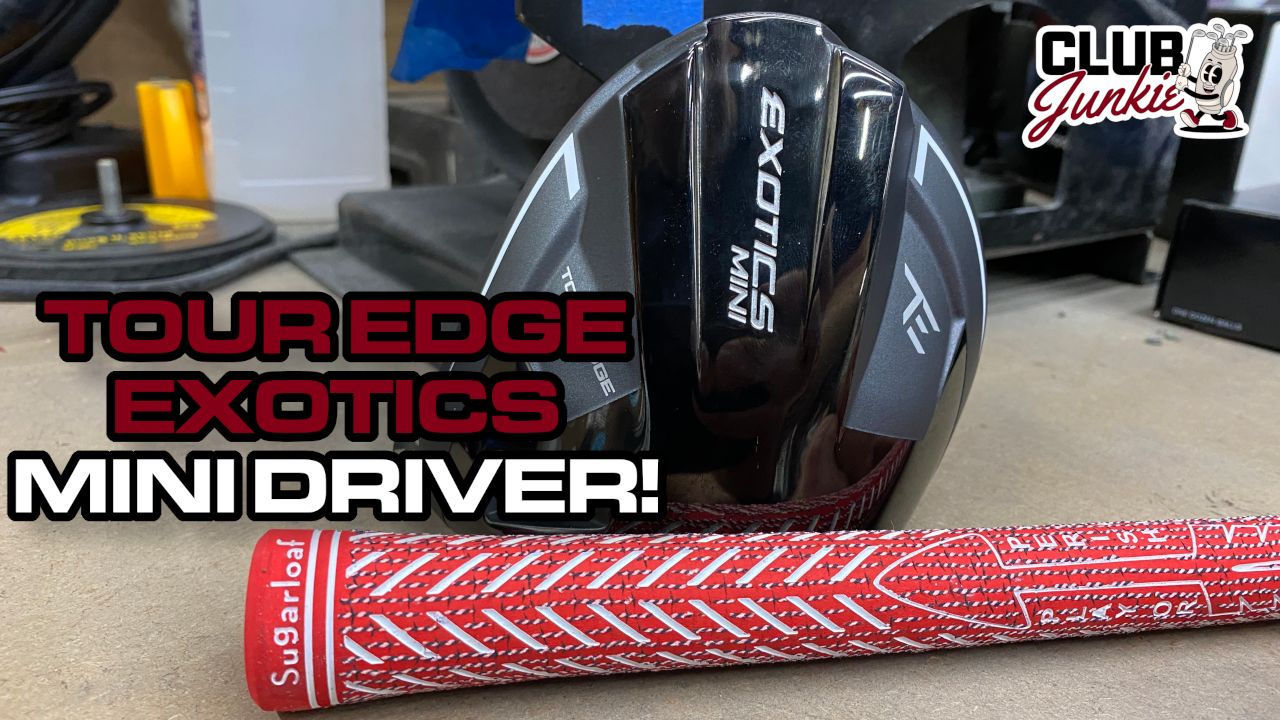
On this episode of Club Junkie, I put the new Tour Edge Exotics Mini Driver to the test and break down the performance, forgiveness, distance, and where it fits compared to a traditional driver or strong fairway wood. If you have been curious about adding a mini driver to the bag, this one is worth a look.
I also dive into the new TaylorMade Spider ZT Max putter that was recently spotted and discuss the growing zero torque putter trend. Plus, there is a closer look at the new Project X Titan Yellow shaft showing up on the PGA Tour and what makes it different from other profiles currently out there.

What’s the story behind Webb Simpson’s custom-stamped irons?

Memorial Tournament Tour Report: Rory McIlroy, Cameron Young switch up drivers, and more

Cadillac Championship Tour Report: Spieth’s sizable changes, McLaren Golf launches, and more

Russell Henley’s winning WITB: 2026 Charles Schwab Challenge

Kristoffer Reitan’s winning WITB: 2026 Truist Championship

Best irons 2026: Best irons overall, most forgiving irons, and more

J.T. Poston’s winning WITB: 2026 Memorial Tournament

Aaron Rai’s winning WITB: 2026 PGA Championship

Cameron Young’s winning WITB: 2026 Cadillac Championship

Details on Jason Day’s latest prototype Avoda iron setup


Ryan Palmer WITB 2026 (June)
Driver: Callaway Quantum Triple Diamond (9 degrees) Shaft: Project X HZRDUS Smoke Blue RDX 60 TX 3-wood: TaylorMade Qi10 (15 degrees) Shaft:...


Bud Cauley WITB 2026 (June)
Bud Cauley had >14 clubs in his bag when photographed prior to the Memorial Tournament. Driver: Titleist GTS2 (8 degrees) Shaft: Fujikura...


Hannah Green WITB 2026 (June)
Driver: Titleist GTS3 (10 degrees, D4 SureFit setting) Shaft: Mitsubishi Chemical Diamana RB 53 S 3-wood: Titleist GT3 (15 degrees,...


Asterisk Talley WITB 2026 (June)
Driver: TaylorMade Qi4D (9 degrees) Shaft: Fujikura Ventus Blue 6 S 3-wood: TaylorMade Qi4D (16.5 degrees) Shaft: Fujikura Ventus Blue...
-
 Equipment6 days ago
Memorial Tournament Tour Report: Rory McIlroy, Cameron Young switch up drivers, and more
-
 News2 weeks ago
Russell Henley’s winning WITB: 2026 Charles Schwab Challenge
-
 Equipment3 days ago
Best irons 2026: Best irons overall, most forgiving irons, and more
-
 Whats in the Bag4 days ago
J.T. Poston’s winning WITB: 2026 Memorial Tournament
-
 Equipment1 week ago
Details on Jason Day’s latest prototype Avoda iron setup
-
 Equipment3 weeks ago
CJ Cup Byron Nelson Tour Report: Koepka and Kim’s newest putters finally get hot
-

 News2 weeks ago
Charles Schwab Challenge Tour Report: MacIntyre, Åberg and Spaun all switch putters, TaylorMade launches new Spider
-
 Equipment2 weeks ago
Details on J.J. Spaun’s surprise putter switch


3puttPar
Jul 29, 2018 at 1:08 pm
Stats! What are they good for? CONFUSING THE AVERAGE GOLFER leading them to poor practice routines, if they even practice.
DaveyD
Jul 29, 2018 at 9:39 am
My goal to to make greens in regulation. This one stat means I’m staying out of trouble & avoiding penalty strokes. It’s giving me the best chance for a par or sub-par. I don’t track it, I simply know if I make it or I don’t and where the extra strokes came from.
CrashTestDummy
Jul 28, 2018 at 1:31 pm
It is good to keep track of putts, gir, fairways hit, and proximity to the hole. However, at the end of the day the score is what counts. Most tour pros know and high level golfers where they are losing strokes.
Adam
Jul 28, 2018 at 11:55 am
I agree with everything here but technically… turning “No’s into Yeses” requires some sort of stats, right? Maybe not actually tracking and analyzing numbers but to get better, you must eventually improve the areas of the game referred to as “stats.”
Mike
Jul 28, 2018 at 9:13 am
I used to keep tons of stats (I work w/ # so it’s a habit). I ditched all that except for 1 stat…what did I shoot. # of putts is a fairly useless stat. If u hit every green in regulation & 2-putted each, you have 36 putts & shoot par. If you missed every green but got up & down every time, you shoot par w/ 18 putts. Which is better? At some point, after playing for a few years, you should know your game, meaning, where you s/b focusing on for improvement.
Blaise
Jul 28, 2018 at 1:01 pm
Still pretty useful, isn’t it?
If you had 18 GIR and 36 putts you can be fairly sure that your game from the tee box is solid (hard to hit greens when behind the trees) and thus your wedge game and putting is where you should focus your efforts.
Conversely if you get up and down that often you know it’s the longer clubs.
But, I mostly agree. The stats aren’t always a perfect indicator as there is much nuance.
Frankie
Jul 28, 2018 at 6:07 pm
Why would you need to work on your wedge game if you are already hitting 18 GIR’s…? Strokes gained around the green offers the lowest strokes gained out of any strokes gained categories so therefore it is the most negligible part of the game to work on; not to mention the short game is so random on the course because they are a result of misses that there is no way to practice it off the course without making it block practice, which is the wrong way to practice such a random part of the game. Everyone is better off practicing from the driving range and putting green and then practice their short game creativity while playing on the course.
Prime21
Jul 27, 2018 at 11:54 pm
Thanks for saying it again, not sure what would have happened w/o your approval.
R k
Jul 27, 2018 at 6:50 pm
I will say it again.. Ed Myers produces the best golf improvement articles on this or any other golf outlet.
While I have not used his scorecard(s) specifically, I have heeded only some of his advice on and off course and have had my best rounds ever this year, multiple rounds not just one.