
Opinion & Analysis
The case for golf in the Paralympics

Last month golf made its first appearance in the Olympics since 1904. Whatever people feel about golf’s place in the Olympics — and despite a number of high-profile players pulling out — the men’s and ladies’ tournaments seemed to go well and there is a positive feeling looking ahead to Tokyo 2020. However, a few people may have noticed that golf is not represented in the Paralympics. Furthermore, it is not going to be part of the 2020 Paralympics, so 2024 marks the first realistic chance to see disabled golfers on a high-profile, worldwide stage. Adaptive golf is a small community right now, but I think there is real potential for golf to be a major Paralympic sport with large numbers of recreational players around the world if some of the right pieces fall into place.
I started to look into expanding Ping’s adaptive golf program in about 2007. I talked to a lot of people involved in the adaptive golf world including members of the blind golf, amputee golf and wheelchair golf communities, as well as great organizations like Saving Strokes, which uses golf as a form of rehabilitation for stroke survivors. What I found were a number of really good, but mostly disconnected organizations. In these past nine years, my belief has grown that if we could knit together some of these programs into a network, golf could be a much bigger sport for individuals with disabilities than it is now.
There are some huge benefits to golf over other sports:
- The existing handicap system allows people of vastly different abilities to play together and compete, which is not really possible in a sport like tennis or soccer.
- There are multiple tees for players who hit the ball different distances.
- It’s a self-timed sport, meaning the player hits the ball in his or her own time and does not have to react to an opponent.
- There is a medical benefit to the physical exercise associated with the game.
Steve Winter, a wheelchair golfer who has consulted for us, has told me many times that he loves golf because on the course he’s just a golfer like any other. When he plays wheelchair basketball, it is with a group of other wheelchair players. However, he can play golf with me and it’s the same game for both of us. We made him a set of clubs with extra-large putter grips and Velcro over the grips to allow him to swing one-handed, but other than sometimes taking a drop from a location he can’t access in his chair, the game is the same for him as it is for me. He can enjoy the same frustration over a missed 3-foot putt as I do.
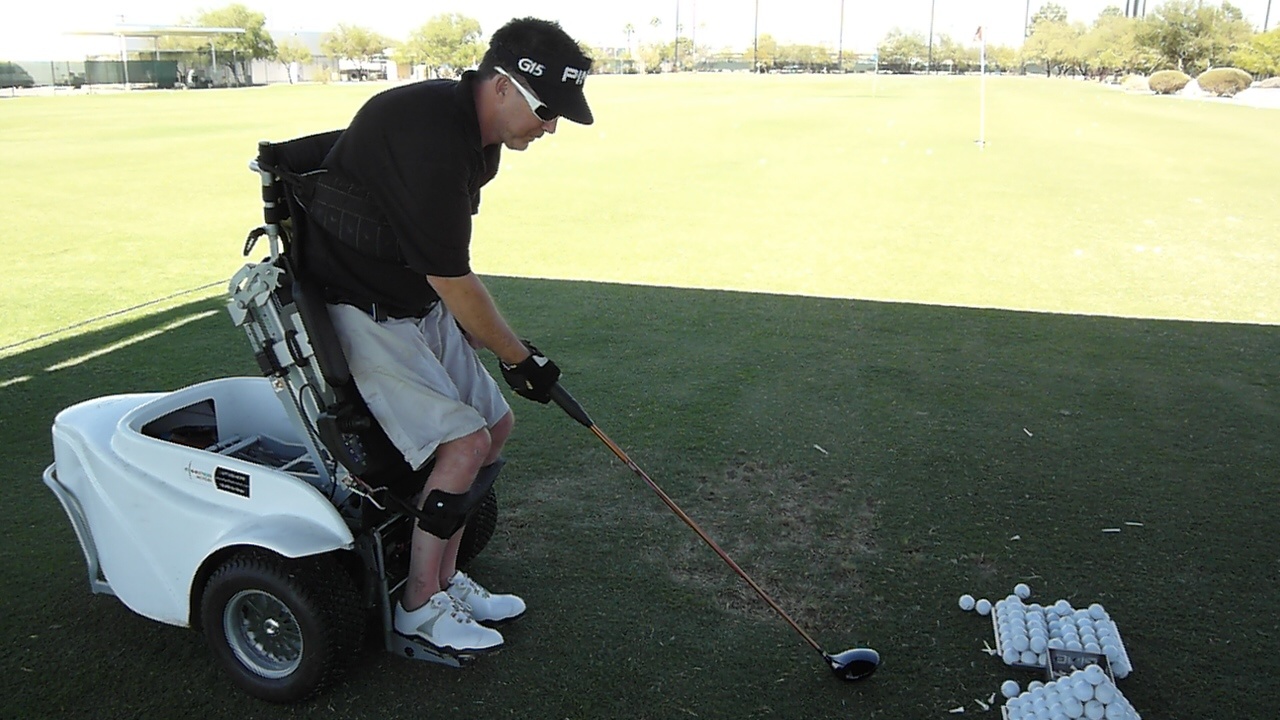
Figure 1: Steve Winter teeing up on the Ping driving range in 2010. The grip is the only major modification from our basic fitting options. He has a special electric wheelchair called the Paragolfer made by Ottobock.
We have tried to offer equipment modifications to better serve the adaptive golf community. Players who swing one-handed often use bigger grips or Velcro grips, and stroke survivors or arthritic golfers have benefitted from this, too. Leg amputee golfers often benefit from longer shafts to enable a more stable base for the swing. Players who hit from a chair or adapted golf cart usually need specific non-traditional lengths and lie angles. We have built clubs as short as 24 inches and as long as 60 inches, bent clubs 12 degrees flat, added or removed significant mass from the head, and created special grip solutions for those who need it.
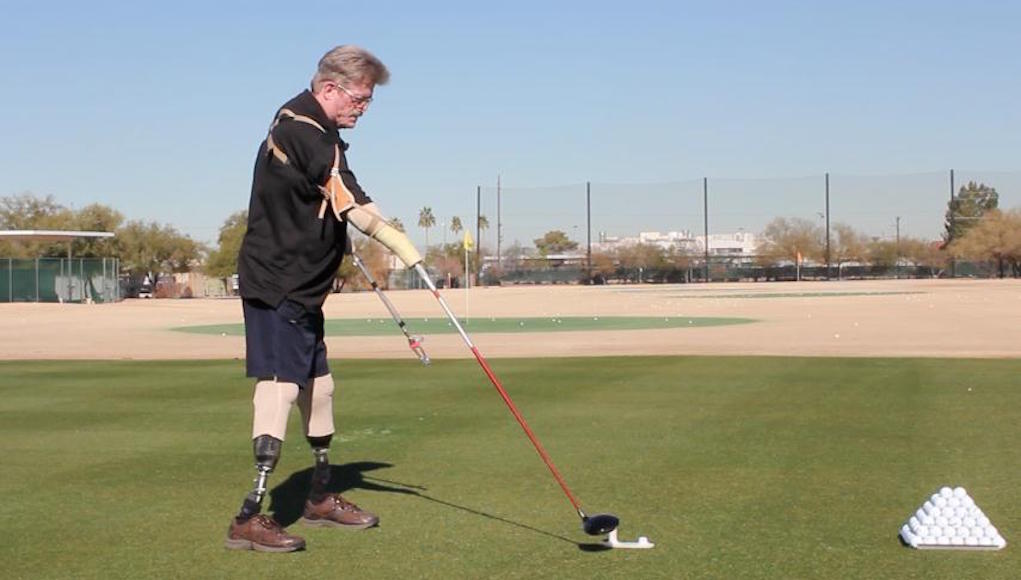
Every now and again we really have to flex our problem-solving muscles. Jeff Lewis, a local quadruple amputee golfer, contacted us to ask if we could help him. Figure 2 shows how we figured something out whereby the club fixes directly into his right prosthetic arm. There is a quick-change mechanism using springs that allows him to change clubs by pushing and twisting. We published this research in the Journal of Sports Engineering so the mechanism could be used in other applications.
Figure 2: Jeff Lewis on the PING range in 2011. He hits the driver about 170 yards, generally much straighter than I hit mine.
We have quite a few adaptive club-fitting centers now and we have created guidelines for fitters interested in conducting fittings for people with disabilities. A good problem-solver with the right tools can help almost anyone find the right head, shaft and grip to help them swing comfortably and maximize performance. It just takes a willingness to try some different options and see what works. I focus on helping the player feel comfortable swinging the club first, and then focus on performance optimization. Trial and error is very important and sometimes the least intuitive option is the one that works the best. There is not much in golf more satisfying than helping someone hit the ball farther and straighter than they ever have before.
The adaptive golf community is still very small, however. There are more than 50 million people in the Unites States with some kind of disability, but very few are involved in the sport. I’ve been to some really good adaptive golf tournaments, and everything indicates there are a lot of people interested in playing competitively or just for fun. The Paralympics would be a huge way to get visibility to the sport, reaching an enormous worldwide TV audience. What’s holding golf back from getting into the Paralympics is a lack of worldwide structure including world championships and international rankings, articulated well by Geoff Shackleford in his blog.
It seems like a catch-22 situation: the Paralympics would really help promote adaptive golf, but adaptive golf needs to reach a certain level of organization and profile before it would be considered for the Paralympics. Caroline Larsson, a former professional golfer in Europe, is backing a campaign for golf in the Paralympics. It will take more support to achieve that goal. Companies, organizing bodies and all interested parties will need to band together and put in the time to create the structure needed for a successful bid. I really think that a stronger adaptive golf community, with the pinnacle of the sport being Paralympic medals and/or adaptive golf majors, would benefit the whole golfing world.



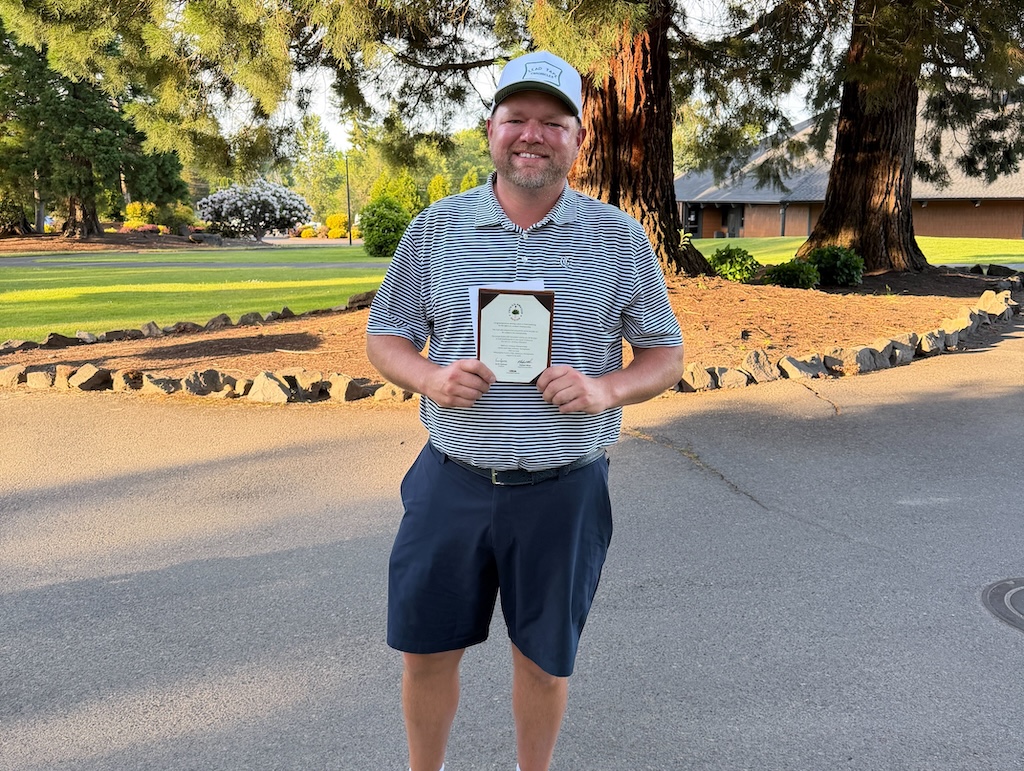
This past Monday, I played in the U.S. Amateur local qualifier at Rock Creek Country Club in Portland, Oregon. A full tee sheet from 7:30 a.m. to 1:55 p.m., the top 11 scores would make it to the U.S. Amateur final qualifying.
I teed off at 10:48 a.m.. With the 7:30 am tee time, you can get a feel for the leaders’ pace, and they were off and running on the challenging setup at Rock Creek.
View this post on Instagram
Getting to the highlight of the round on the par five 17th, a drive up the left side and 212 yards left to the front hole location. I took out a 5-iron with plans of middle of the green. The ball ended up 8 feet left of the hole, pin high. A slight downhill putt dropped in for an eagle 3 on the 17th. With the cut line looking to be anywhere from -2 to even par. This was the boost I had been waiting for all day.
With making par from the trees on 18, it was time to wait for a potential playoff with a posted score of one under par 71.
Three hours later, it was playoff time. 8 players for 6 spots. I made par on the playoff hole, which was good enough to advance to the U.S. Amateur final qualifying in July. USGA qualifiers sure deliver on all of the emotions in golf!
Club Junkie
Building my 2026 gamer WITB: Ranking the contenders and new putter projects – Club Junkie Podcast

The annual What’s In The Bag build is underway, and on this episode of Club Junkie, Brian breaks down the clubs currently leading the race for a spot in his 2026 gamer setup. From drivers and fairway woods to irons, wedges, and shafts, he ranks the equipment that’s performing best and explains what’s separating the front runners from the rest of the field.
Brian also heads into the workshop to discuss several putter projects currently on the bench. From head options and shaft choices to build ideas and testing plans, he shares what he’s working on and which putters could become serious contenders for the bag this season.
If you’re a gear junkie who loves equipment testing, club building, and the never-ending pursuit of the perfect setup, this episode is for you.
Follow Club Junkie:
Instagram: @clubjunkiepod
TikTok: @clubjunkiepod
Threads: @clubjunkiepod
X: @ClubJunkiePod
Club Junkie
Tour Edge Exotics mini driver review + TaylorMade Spider ZT Max first look – Club Junkie

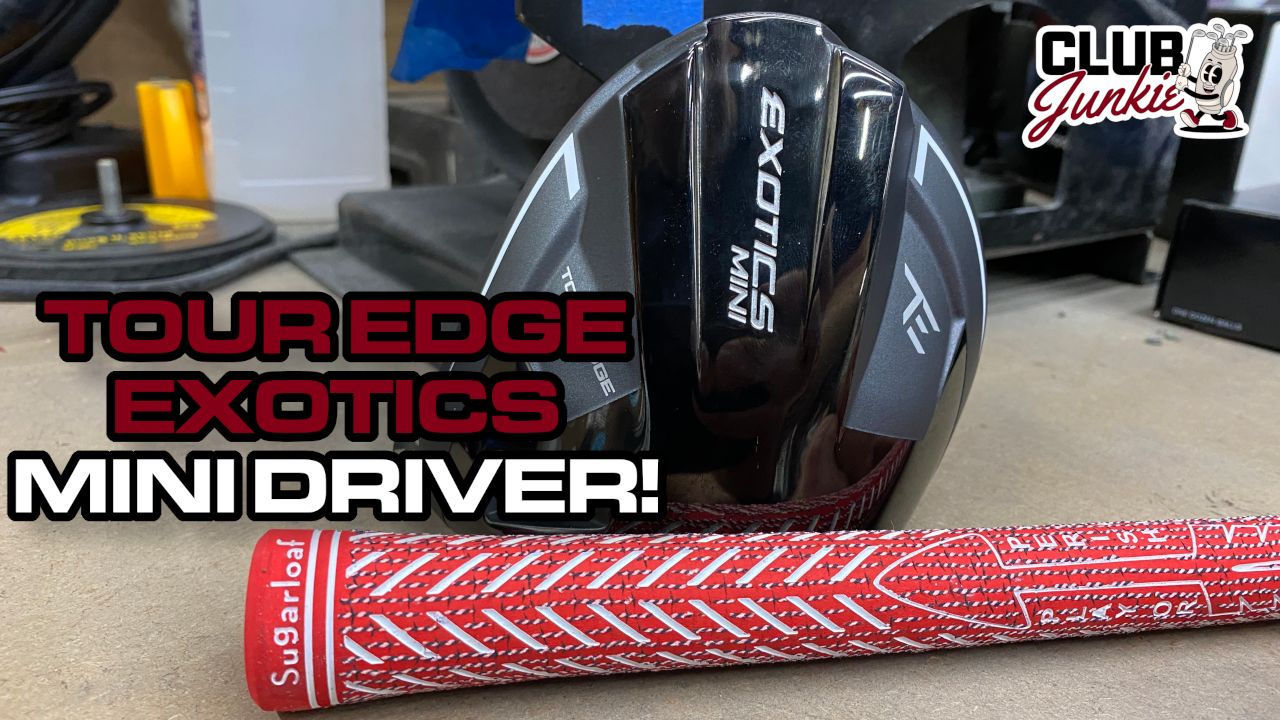
On this episode of Club Junkie, I put the new Tour Edge Exotics Mini Driver to the test and break down the performance, forgiveness, distance, and where it fits compared to a traditional driver or strong fairway wood. If you have been curious about adding a mini driver to the bag, this one is worth a look.
I also dive into the new TaylorMade Spider ZT Max putter that was recently spotted and discuss the growing zero torque putter trend. Plus, there is a closer look at the new Project X Titan Yellow shaft showing up on the PGA Tour and what makes it different from other profiles currently out there.

What’s the story behind Webb Simpson’s custom-stamped irons?

Memorial Tournament Tour Report: Rory McIlroy, Cameron Young switch up drivers, and more

Cadillac Championship Tour Report: Spieth’s sizable changes, McLaren Golf launches, and more

Russell Henley’s winning WITB: 2026 Charles Schwab Challenge

Kristoffer Reitan’s winning WITB: 2026 Truist Championship

Best irons 2026: Best irons overall, most forgiving irons, and more

J.T. Poston’s winning WITB: 2026 Memorial Tournament

Aaron Rai’s winning WITB: 2026 PGA Championship

Cameron Young’s winning WITB: 2026 Cadillac Championship

Details on Jason Day’s latest prototype Avoda iron setup


Ryan Palmer WITB 2026 (June)
Driver: Callaway Quantum Triple Diamond (9 degrees) Shaft: Project X HZRDUS Smoke Blue RDX 60 TX 3-wood: TaylorMade Qi10 (15 degrees) Shaft:...


Bud Cauley WITB 2026 (June)
Bud Cauley had >14 clubs in his bag when photographed prior to the Memorial Tournament. Driver: Titleist GTS2 (8 degrees) Shaft: Fujikura...


Hannah Green WITB 2026 (June)
Driver: Titleist GTS3 (10 degrees, D4 SureFit setting) Shaft: Mitsubishi Chemical Diamana RB 53 S 3-wood: Titleist GT3 (15 degrees,...


Asterisk Talley WITB 2026 (June)
Driver: TaylorMade Qi4D (9 degrees) Shaft: Fujikura Ventus Blue 6 S 3-wood: TaylorMade Qi4D (16.5 degrees) Shaft: Fujikura Ventus Blue...
-
 Equipment6 days ago
Memorial Tournament Tour Report: Rory McIlroy, Cameron Young switch up drivers, and more
-
 News2 weeks ago
Russell Henley’s winning WITB: 2026 Charles Schwab Challenge
-
 Equipment3 days ago
Best irons 2026: Best irons overall, most forgiving irons, and more
-
 Whats in the Bag4 days ago
J.T. Poston’s winning WITB: 2026 Memorial Tournament
-
 Equipment1 week ago
Details on Jason Day’s latest prototype Avoda iron setup
-
 Equipment3 weeks ago
CJ Cup Byron Nelson Tour Report: Koepka and Kim’s newest putters finally get hot
-

 News2 weeks ago
Charles Schwab Challenge Tour Report: MacIntyre, Åberg and Spaun all switch putters, TaylorMade launches new Spider
-
 Equipment2 weeks ago
Details on J.J. Spaun’s surprise putter switch


mat
Sep 19, 2016 at 5:39 am
Dear the truth, ED, and all of you talking (remarquably badly) about what you don’t know.
Facts only counts, well at list, they are more interesting than your opinion.
read this link: european disable golf championship results 2016.
http://www.edgagolf.com/downloads/2016-ranking/1607-gross.pdf
and guess what! almost all players have a full time jobs or studying in universities for the youngest.
And they all played from 6500yards tees , 18 holes under 4h30 times, for three days.
From what I know, best american amputee players play scratch and even played on web.com this year.
So yes we need to see disable golf in paralympics and we need it more than Stenson or Rose.
Golf is a fantastic way to get over your disability. and the best way to show it is by showing the best players on a worldwide scale competition. thats just my opinion.
but I hope these facts changed your little minded opinion.
Connard!
The Truth
Sep 19, 2016 at 9:00 am
Why do I have to pay for it through gun point? If this is a cause for the greater good, the money should be collected voluntarily via charity. Instead of the monopoly of Force ie taxation. How good they are at golf is not an argument. 85% of disabled people are living off of government subsidies, facts are not your friend my friend.
Y Drizzle
Sep 19, 2016 at 9:45 am
Gun point? Good grief, you are a drama queen.
I don’t care if 100% of disabled people are living off of government subsidies. I have no problem with my tax dollars helping people who really need it. Apparently, empathy is not your friend.
The Truth
Sep 19, 2016 at 9:53 am
Just because you believe this should be funded with tax dollars doesn’t mean anything. Somehow you have the moral high ground and know what is best for everything, thank you Mr. Authoritarian. If something is done for the greater good, and it truly is for the greater good, it will be solved without tax dollars via charity. Your obviously ignorant about about big Government going hand in hand with Cronyism.
mat
Sep 19, 2016 at 10:12 am
We’re talking about golf in the paralympics, not USA’s government way to handle and support disable people..
When you talk about subject like this, you don’t only place yourself in an American point of view, but try to see why disable golfers from all around the world should be playing this great sport in an international competition like the paralympics.
I won’t debate on if they should be helped in life , or if you should be taxed, that’s not the subject.
What’sure is when you see stupid comments out this good article, and not only your comment, gotta react friend!
ps: it is not a cause for the greater good, only best athletes that try to compete in the best international scale (the paralympics), and that’s right you need financial support for travel, training etc. … may you be on the PGA tour or an American disable golf tour :).
Take the Red Pill
Sep 19, 2016 at 11:58 am
Wow Mat, you really showed the Truth who is boss with your long winded Virtue Signaling. I never knew that training and traveling for an international sports competition is a God given Right. LOL
mat
Sep 19, 2016 at 2:15 pm
your point?
Par4
Sep 19, 2016 at 11:05 am
Obviously don’t have a member in the family or a close friend that is that situation. Put yourself in someone’s shoes that lives like that!!! People sometimes actually need help.
Par4
Sep 19, 2016 at 10:59 am
Very well put!!!
Joe Kearney
Sep 18, 2016 at 5:06 pm
Slow play and draining the system!!??? It’s idiots like these devoid of the milk of human kindness who give golfers a bad name. Shame on you. You may soon get the president you deserve… an equally forward-thinking visionary.
Tom
Sep 18, 2016 at 10:54 am
Tough crowd in here today.
The Truth
Sep 18, 2016 at 9:58 am
What a waste of time and money. Lets get a productive economy again so the disabled can have jobs and not drain the system via B.S Special/Paralympics.
Mark
Sep 18, 2016 at 4:54 am
No need for any type of Golf in the Olympics. Period.
Ed
Sep 17, 2016 at 10:36 pm
Cant imagine how slow these guys play. Talk about bad for the game. Oh well… Give em a hand.
Redx
Sep 18, 2016 at 2:04 am
Cant believe that’s the first thing that came to mind for you Ed.
Smokin'Gun
Sep 18, 2016 at 8:13 pm
What do you mean “these guys”? I have a handicap son who has Cerebral Palsy that plays to a 6 HNDCP. Crawl back under your rock!!!