
Opinion & Analysis
The key to putter fitting? Know your roll

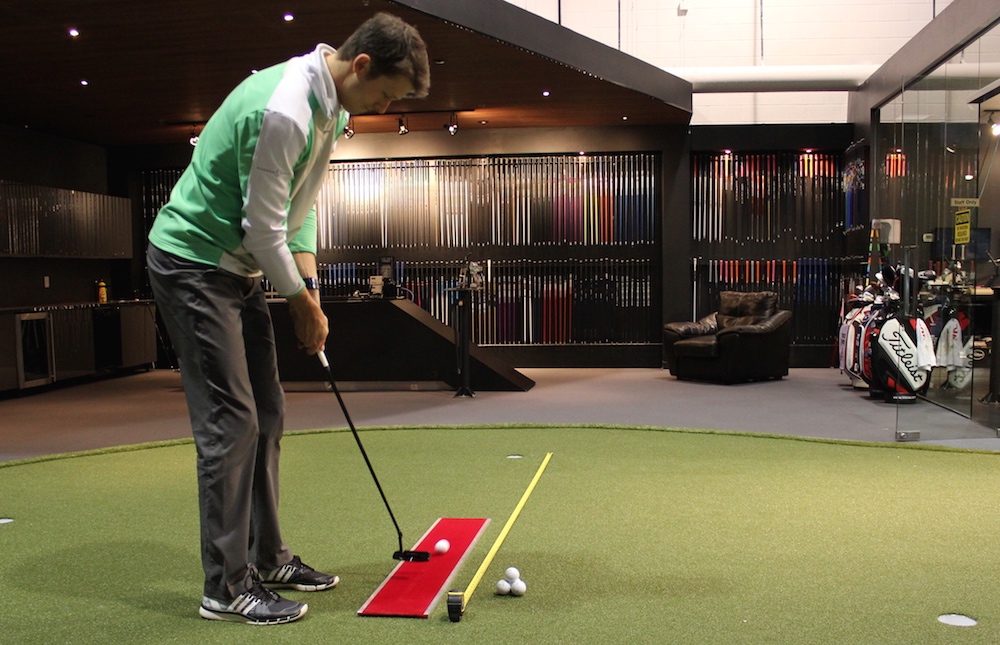
This is the second installment of a four-part series from Modern Golf on putter fitting and the Quintic System.
Find a busy practice putting green, and it’s almost guaranteed that you’ll see at least a few golfers obsessing over the motion of their putting stroke. They’re usually the ones who are using some kind of training aid to help them groove their stroke in a certain way.
For many golfer, it can be time well spent. But what they might not know is that the way their putter moves is only half the equation to good putting. Did you know that two putts with the same clubhead speed can travel significantly different distances? Did you also know that most golfers actually do a good job of consistently swinging the putter through at their desired speed? So why do so many golfers have problems with their distance control? The other half of the equation is controlling what is called their ball roll.
How do golfers control how their ball roll? How should the ball be rolling? It is a very difficult question to answer without using high-speed cameras and motion capturing. Using a system called Quintic, we provide golfers the knowledge and data they need to putt their best. Understanding this data will improve your game.
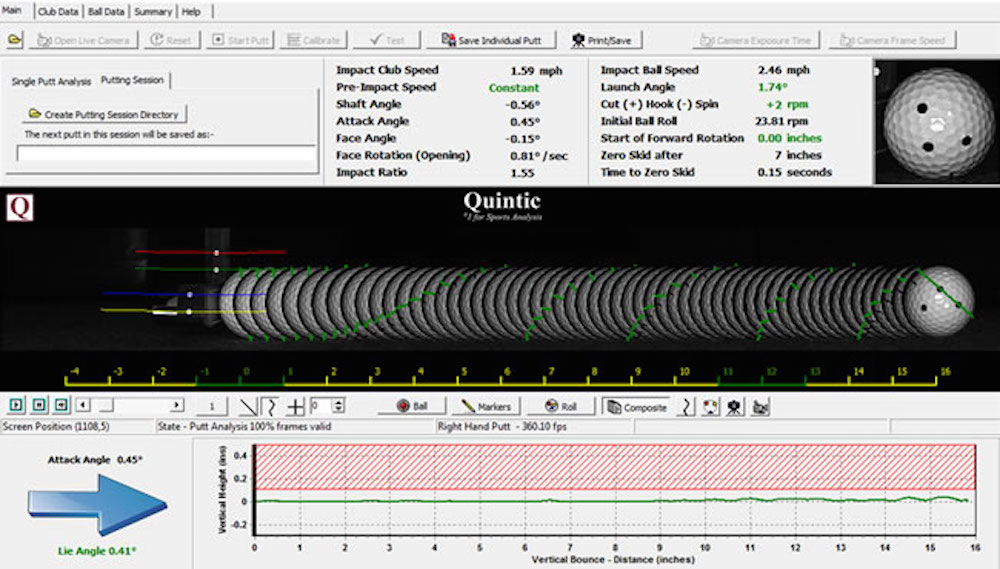
The image below shows what an ideal 8-foot putt looks like on our Quintic System.
Click the image to enlarge it.
Forward Rotation
As you can see, the ball instantly started to rotate forward off the putter face. A ball that has negative initial ball roll, or “backspin,” will lose speed and can deflect offline. Having the ball rotate forward off the face will give players better distance control with their putts because the ball will lose less energy and stay on its intended line longer. This will aid the ball in rolling over debris and other imperfections on the green such as ball marks, spike marks, etc.
Having anywhere from +25 rpm to +50 rpm initial ball roll is ideal. Any higher and the ball will roll out longer because it will be carrying more momentum. This can make downhill 5 footers scarier than they already are. With an rpm under +20 rpm, the ball doesn’t carry as much momentum to the hole.
Launch
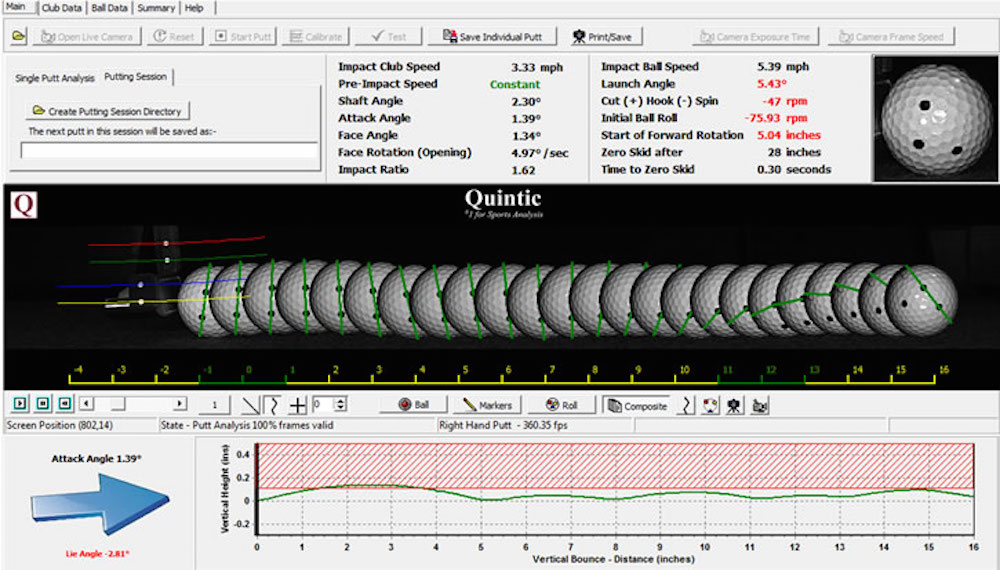
The ball was launched at about 1.75 degrees. An ideal launch angle on most greens is between 0.75 degrees and 2 degrees. Much like a driver, controlling launch has a big influence on how far the ball will travel. That is because on the green, a ball will sit in a small depression as a result of gravity. The ball needs to be launched out of this depression — and not too high or too low. Optimal launch should change depending on the blade length of the grass and the type of putting surface. On lush greens with a longer blade length, the ball will sit in a deeper depression. On firm greens with a short blade length, the ball will not sit in such a deep depression, and for that reason not as much launch is required.
The image below shows what happens to a putt that has a launch angle that is too high.
Click the image to enlarge it.
Zero Skid
Minimal skid is ideal. On a well struck putt, there should be less than 10 percent skid for the total distance the ball travels. So on an 8-foot putt, ideally there should be less than 10 inches of skid (see first image). Once “zero skid” occurs, the ball starts rolling on top of the grass smoothly. When there is too much skid, the result is a loss of distance and ball speed. Every time the ball bounces and strikes the putting surface it loses energy — energy that has been factored into your putt for speed and distance. These putts tend to come up short and offline, and this often happens with long putts or lag putts.
Below are images of a “dew board.” The board simulates putting through an early morning dew where it is easy to see launch and skid. There are two visible lines on the board. The putt that has a flat and consistent line has optimal launch and minimal skid. The putt that looks dotted or chattered has launched too high, increasing the zero skid parameter. The dots are where the ball has struck the putting surface and continues to hop until it reaches zero skid.
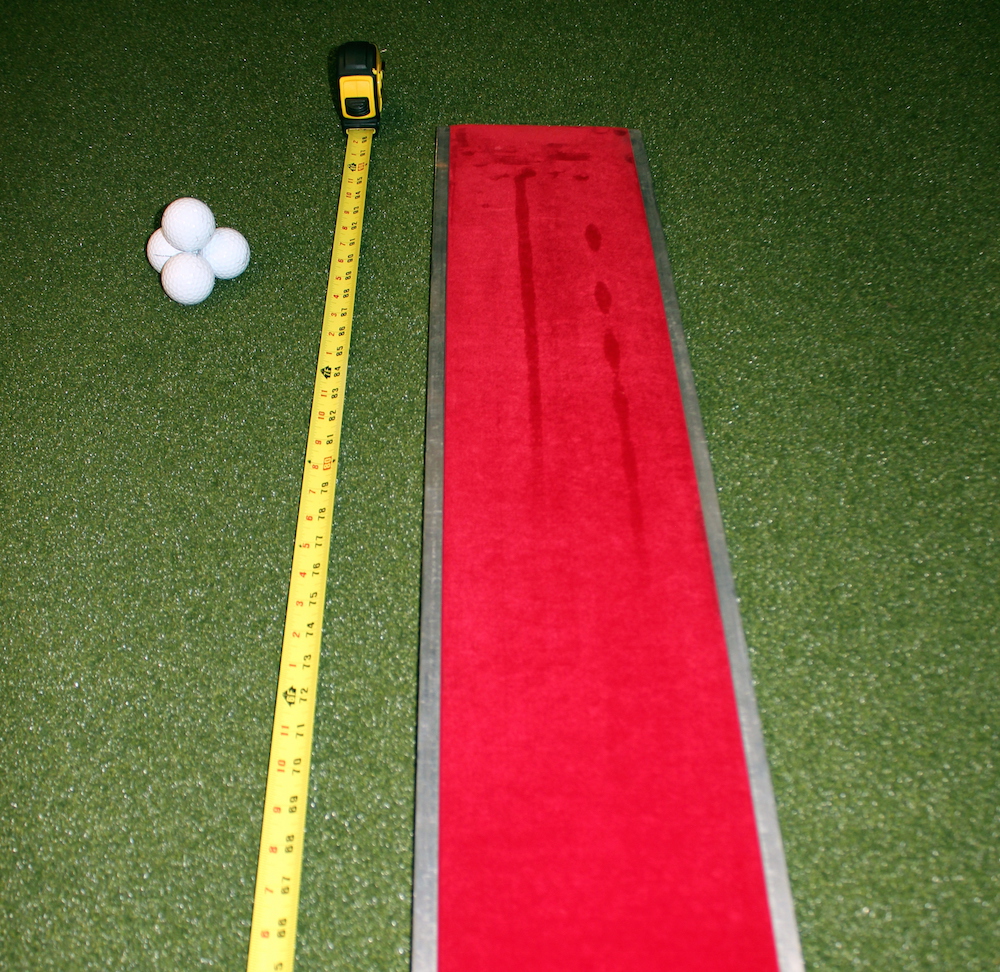
Every putt, at some point, reaches zero skid. Reducing the amount of time it takes for the ball to reach zero skid will ensure that the ball will lose minimal energy and carry more momentum to the hole.
Impact Ratio
This refers to how efficiently clubhead speed is converted into ball speed. For all of those Trackman users out there, this is the same as smash factor. It is a simple calculation: ball speed divided by clubhead speed. Controlling the speed that the ball comes off the face is crucial. This is achieved when the center mass of the club head makes contact with the center mass of the golf ball. Any off-center strike results in a loss of ball speed and face deflection, causing the ball to roll offline with less speed.
We’ve all hit full shots that weren’t solidly struck and they come up short of our target. The exact same thing happens when we don’t hit a putt solid, but it’s much harder to feel the mishit because the clubhead speed is much slower through impact with a putter. This is where most golfers struggle.
The face of the putter also needs to be square to the path of the club. Otherwise, you’ll see a glancing blow that also reduces ball speed. The type of putter a player uses also has an effect on ball speed. Putters with softer inserts reduce ball speed because of reduced energy transfer from the club head to the ball. To illustrate where you strike the ball on the clubface, spray the face of the putter with Doctor Scholl’s foot spray. It will show you where the ball is making contact with the face, and has minimal effect on ball speed and friction.
Certainly there are other parameters to consider, but this article should provide golfers with a general concept that they may not have considered in the past. Without knowing what the ball is doing, it is very difficult to teach someone proper putting mechanics. Players who have a better understanding of how the ball is rolling have a better chance of improving their game on the greens. Therefore, go get fit for a putter and KNOW YOUR ROLL.
Call or email to book your appointment today at Modern Golf.
Related












This past Monday, I played in the U.S. Amateur local qualifier at Rock Creek Country Club in Portland, Oregon. A full tee sheet from 7:30 a.m. to 1:55 p.m., the top 11 scores would make it to the U.S. Amateur final qualifying.
I teed off at 10:48 a.m.. With the 7:30 am tee time, you can get a feel for the leaders’ pace, and they were off and running on the challenging setup at Rock Creek.
View this post on Instagram
Getting to the highlight of the round on the par five 17th, a drive up the left side and 212 yards left to the front hole location. I took out a 5-iron with plans of middle of the green. The ball ended up 8 feet left of the hole, pin high. A slight downhill putt dropped in for an eagle 3 on the 17th. With the cut line looking to be anywhere from -2 to even par. This was the boost I had been waiting for all day.
With making par from the trees on 18, it was time to wait for a potential playoff with a posted score of one under par 71.
Three hours later, it was playoff time. 8 players for 6 spots. I made par on the playoff hole, which was good enough to advance to the U.S. Amateur final qualifying in July. USGA qualifiers sure deliver on all of the emotions in golf!
Club Junkie
Building my 2026 gamer WITB: Ranking the contenders and new putter projects – Club Junkie Podcast

The annual What’s In The Bag build is underway, and on this episode of Club Junkie, Brian breaks down the clubs currently leading the race for a spot in his 2026 gamer setup. From drivers and fairway woods to irons, wedges, and shafts, he ranks the equipment that’s performing best and explains what’s separating the front runners from the rest of the field.
Brian also heads into the workshop to discuss several putter projects currently on the bench. From head options and shaft choices to build ideas and testing plans, he shares what he’s working on and which putters could become serious contenders for the bag this season.
If you’re a gear junkie who loves equipment testing, club building, and the never-ending pursuit of the perfect setup, this episode is for you.
Follow Club Junkie:
Instagram: @clubjunkiepod
TikTok: @clubjunkiepod
Threads: @clubjunkiepod
X: @ClubJunkiePod
Club Junkie
Tour Edge Exotics mini driver review + TaylorMade Spider ZT Max first look – Club Junkie

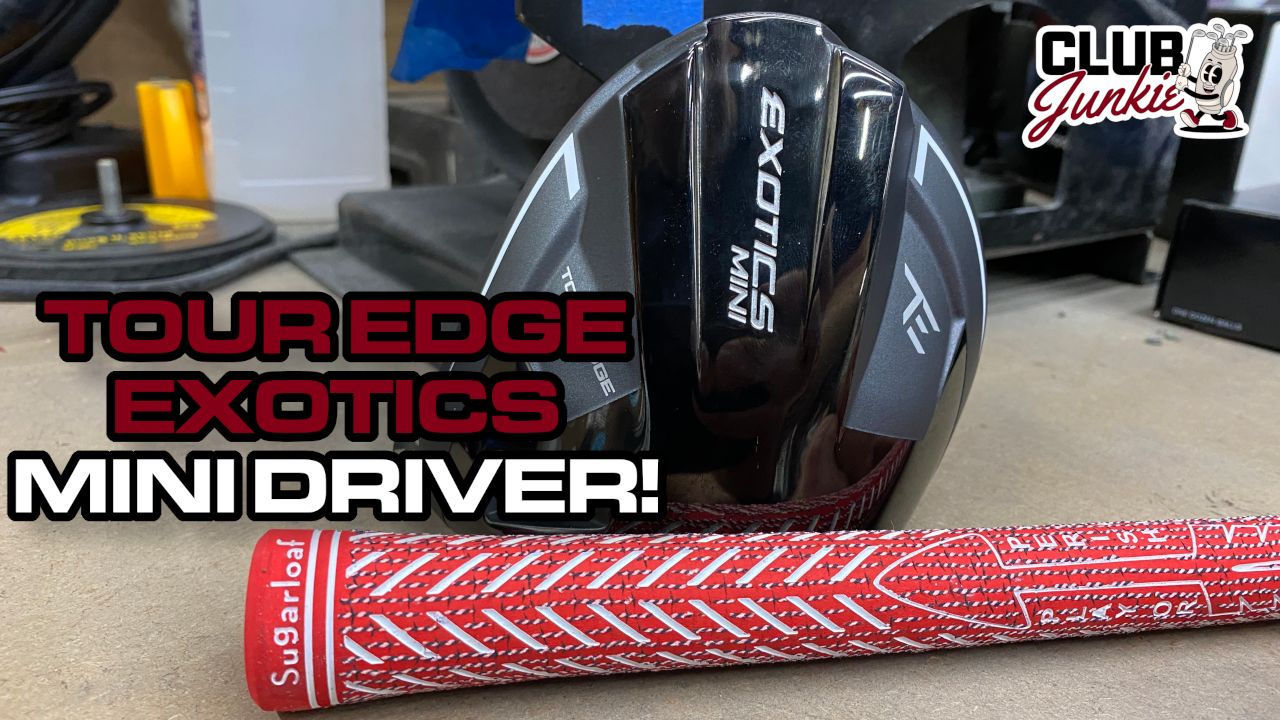
On this episode of Club Junkie, I put the new Tour Edge Exotics Mini Driver to the test and break down the performance, forgiveness, distance, and where it fits compared to a traditional driver or strong fairway wood. If you have been curious about adding a mini driver to the bag, this one is worth a look.
I also dive into the new TaylorMade Spider ZT Max putter that was recently spotted and discuss the growing zero torque putter trend. Plus, there is a closer look at the new Project X Titan Yellow shaft showing up on the PGA Tour and what makes it different from other profiles currently out there.

Justin Rose WITB 2026 (April): Full WITB breakdown with new McLaren irons

What’s the story behind Webb Simpson’s custom-stamped irons?

Memorial Tournament Tour Report: Rory McIlroy, Cameron Young switch up drivers, and more

Cadillac Championship Tour Report: Spieth’s sizable changes, McLaren Golf launches, and more

Russell Henley’s winning WITB: 2026 Charles Schwab Challenge

Kristoffer Reitan’s winning WITB: 2026 Truist Championship

Best irons 2026: Best irons overall, most forgiving irons, and more

J.T. Poston’s winning WITB: 2026 Memorial Tournament

Aaron Rai’s winning WITB: 2026 PGA Championship

Cameron Young’s winning WITB: 2026 Cadillac Championship


Ryan Palmer WITB 2026 (June)
Driver: Callaway Quantum Triple Diamond (9 degrees) Shaft: Project X HZRDUS Smoke Blue RDX 60 TX 3-wood: TaylorMade Qi10 (15 degrees) Shaft:...


Bud Cauley WITB 2026 (June)
Bud Cauley had >14 clubs in his bag when photographed prior to the Memorial Tournament. Driver: Titleist GTS2 (8 degrees) Shaft: Fujikura...


Hannah Green WITB 2026 (June)
Driver: Titleist GTS3 (10 degrees, D4 SureFit setting) Shaft: Mitsubishi Chemical Diamana RB 53 S 3-wood: Titleist GT3 (15 degrees,...


Asterisk Talley WITB 2026 (June)
Driver: TaylorMade Qi4D (9 degrees) Shaft: Fujikura Ventus Blue 6 S 3-wood: TaylorMade Qi4D (16.5 degrees) Shaft: Fujikura Ventus Blue...
-
 Equipment6 days ago
Memorial Tournament Tour Report: Rory McIlroy, Cameron Young switch up drivers, and more
-
 News2 weeks ago
Russell Henley’s winning WITB: 2026 Charles Schwab Challenge
-
 Equipment3 days ago
Best irons 2026: Best irons overall, most forgiving irons, and more
-
 Whats in the Bag4 days ago
J.T. Poston’s winning WITB: 2026 Memorial Tournament
-

 Equipment1 week ago
Details on Jason Day’s latest prototype Avoda iron setup
-
 Equipment3 weeks ago
CJ Cup Byron Nelson Tour Report: Koepka and Kim’s newest putters finally get hot
-

 News2 weeks ago
Charles Schwab Challenge Tour Report: MacIntyre, Åberg and Spaun all switch putters, TaylorMade launches new Spider
-
 Equipment2 weeks ago
Details on J.J. Spaun’s surprise putter switch


Scooter McGavin
Feb 27, 2015 at 11:20 am
There is some good info on this article. I also agree that people can tend to overlook putter roll. I’d be curious for a little more info that goes into greater depth about its role in the fitting process with respect to different models’ grooves, inserts, centers of gravity, etc. and how it would directly affect one’s putter choice. Cheers!