
Opinion & Analysis
Are you a swing junkie?


Recreational golfers are unlike any other recreational sportsman. I know of no other sport where the recreational participants are as wrapped up in the technique as golfers. Visit any driving range and you are certain to see the majority of the golfers fiddling with their swing.
My guess is that technique preoccupies the minds of golfers more so than technique does in all other recreational sports combined. Visit a basketball court and watch a player miss a shot. Does that player stop and look at his feet or check the angle of his shoulders? Go to a baseball batting cage… Do you see anyone look behind themselves to check the position of the bat? Go fishing and ask your buddy if he has ever checked his wrist angle in order to improve his casting. Be careful with that one, you may get thrown out of the boat!
Modern golf has produced a recreational participant that is too often more involved in the golf swing than they are in watching the golf shot. Watch how seldom golfers hit their shot and watch it fly, land and come to a stop. More times than not, golfers will be seen checking a position or making a practice swing while their golf shot is still in the air. I refer to this type of golfer as a “swing junkie.”
The origins of the swing junkie can be traced back to a wonderful and historic book, Ben Hogan’s “Five Lessons: The Modern Fundamentals of Golf.” This book and the Hogan myth that grew out of this book have done more to create a modern recreational golfer that thinks more about how to swing the golf club than he does about how to play the game. The swing junkie defends his approach to golf by believing that Hogan himself was a swing junkie.
While Hogan continues to be the hero and go-to swing for most swing junkies, others too have caught the attention of the swing junkie. The 1970s brought into popularity Homer Kelley’s book “The Golfing Machine.” The first authorized instructor of the Golfing Machine was Ben Doyle, and his passion for teaching the system was a perfect match for the swing junkies. Golfing Machine swing junkies were seldom seen without their stack of graphs to check sequence photos. For you youngsters, the graph check sequence photos camera took eight still photographs and could be timed for the length of a golf swing. The Polaroid film used with the graph check allowed instant review of the swing. The result was that swing junkies could now spend more time analyzing their swing than watching the ball fly through the air.
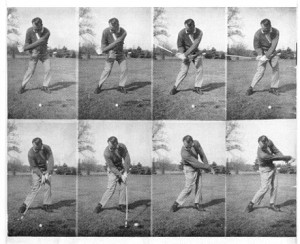
In the 1980s, Jimmy Ballard caught the imagination of the swing junkies. Commonly known as the “Pioneer of Connection,” Ballard had success with golfers as different as Gary Player and Sandy Lyle. Connection resonated well with the swing junkies. After all, on page 82 of Hogan’s “Five Lessons,” Hogan states that “the elbows remain tightly glued to the sides.” Unfortunately for Ballard, swing junkies have a short attention span and the age of connection was short lived.
David Leadbetter’s student Nick Faldo was the perfect golfer for the swing junkie to copy. Faldo seemed to have an endless number of swing drills. In Faldo, the swing junkies found their hero, a golfer who made more practice swings than he hit balls. While the swing junkie was busy trying to keep up with all of Faldo’s drills, the golf swing theory landscape was changing.
The success and popularity of Leadbetter brought into fashion the swing guru, and with that the swing junkie would now and for ever more enjoy technique and method overload. Leadbetter’s “Distance Through Resistance” would soon share the stage with Hank Haney’s concept of swinging the club on plane.
Jim McLean’s X-Factor had swing junkies twisting their torsos to the max. The No. 1 golf instructor was Butch Harmon Jr., but he was never a favorite of the swing junkie. Too much of his instruction was on how to hit golf shots and the swing junkies focus was always to make a better swing.
Today, entirely new ways of dissecting the golf swing are being developed to spark the imagination of the swing junkies. FlightScope and Trackman systems work with 3D Doppler radar tracking technology. Up to 26 individual data points are collected from every golf swing and shot. Data speak like “if you zero the swing plane with that degree of downward angle you will hit a draw” is now replacing the age old image of Ben Hogan’s downswing plane being a little under the backswing plane.
Will 3D radar data be the next step in the long evolution of swing junkie? Like something out of the movie The Matrix, will swing junkies become so focused on the data stream that they don’t even know what their swing looks like? Or will there be a split among the swing junkies? What will happen to the old guard that depends and protects the “good old way, the tried and true” use of video and pictures in their quest to find the perfect swing. What about the new breed of “techno swing junkie” who is always searching for new data points in order to build their perfect swing?
Whatever the future, swing junkies have their own special passion for the game and their own philosophy as to how to get the most enjoyment out of the game. Truth be known, every golfer who enjoys the game has some degree of swing junkie inside. Just keep in mind that the goal of this game is to get the ball in the hole as fast as possible.




This past Monday, I played in the U.S. Amateur local qualifier at Rock Creek Country Club in Portland, Oregon. A full tee sheet from 7:30 a.m. to 1:55 p.m., the top 11 scores would make it to the U.S. Amateur final qualifying.
I teed off at 10:48 a.m.. With the 7:30 am tee time, you can get a feel for the leaders’ pace, and they were off and running on the challenging setup at Rock Creek.
View this post on Instagram
Getting to the highlight of the round on the par five 17th, a drive up the left side and 212 yards left to the front hole location. I took out a 5-iron with plans of middle of the green. The ball ended up 8 feet left of the hole, pin high. A slight downhill putt dropped in for an eagle 3 on the 17th. With the cut line looking to be anywhere from -2 to even par. This was the boost I had been waiting for all day.
With making par from the trees on 18, it was time to wait for a potential playoff with a posted score of one under par 71.
Three hours later, it was playoff time. 8 players for 6 spots. I made par on the playoff hole, which was good enough to advance to the U.S. Amateur final qualifying in July. USGA qualifiers sure deliver on all of the emotions in golf!
Club Junkie
Building my 2026 gamer WITB: Ranking the contenders and new putter projects – Club Junkie Podcast

The annual What’s In The Bag build is underway, and on this episode of Club Junkie, Brian breaks down the clubs currently leading the race for a spot in his 2026 gamer setup. From drivers and fairway woods to irons, wedges, and shafts, he ranks the equipment that’s performing best and explains what’s separating the front runners from the rest of the field.
Brian also heads into the workshop to discuss several putter projects currently on the bench. From head options and shaft choices to build ideas and testing plans, he shares what he’s working on and which putters could become serious contenders for the bag this season.
If you’re a gear junkie who loves equipment testing, club building, and the never-ending pursuit of the perfect setup, this episode is for you.
Follow Club Junkie:
Instagram: @clubjunkiepod
TikTok: @clubjunkiepod
Threads: @clubjunkiepod
X: @ClubJunkiePod
Club Junkie
Tour Edge Exotics mini driver review + TaylorMade Spider ZT Max first look – Club Junkie

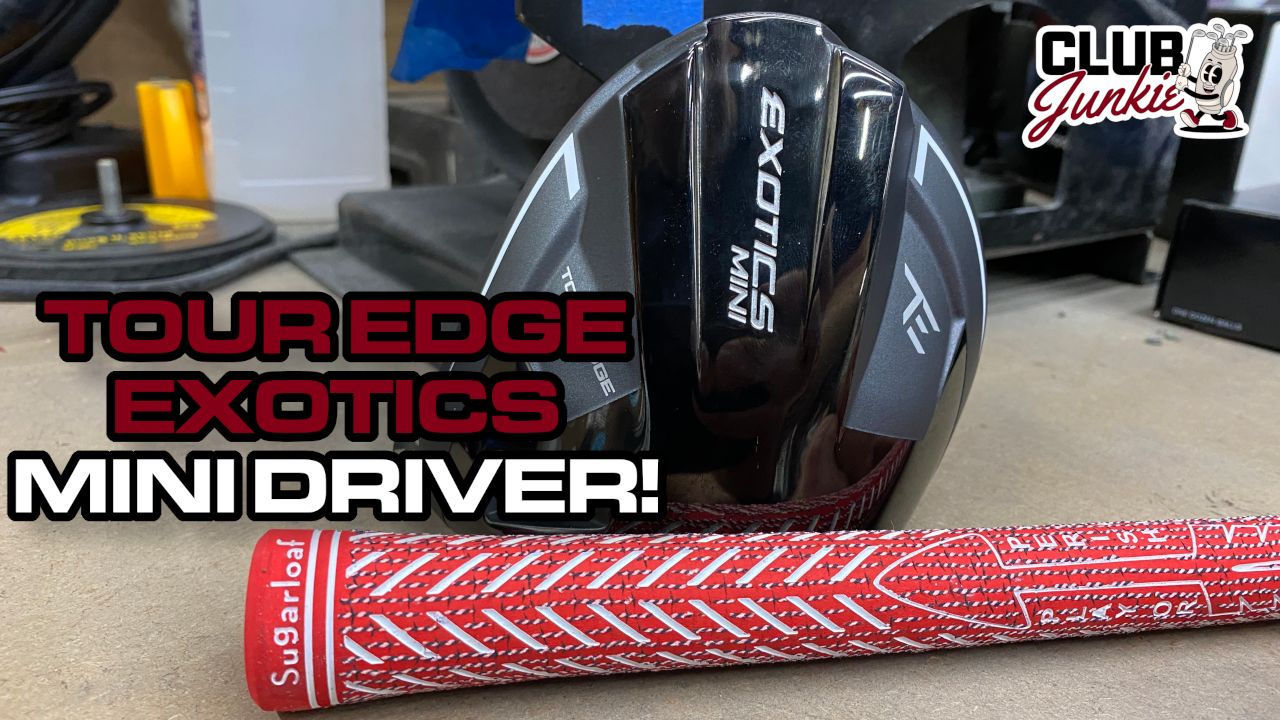
On this episode of Club Junkie, I put the new Tour Edge Exotics Mini Driver to the test and break down the performance, forgiveness, distance, and where it fits compared to a traditional driver or strong fairway wood. If you have been curious about adding a mini driver to the bag, this one is worth a look.
I also dive into the new TaylorMade Spider ZT Max putter that was recently spotted and discuss the growing zero torque putter trend. Plus, there is a closer look at the new Project X Titan Yellow shaft showing up on the PGA Tour and what makes it different from other profiles currently out there.

Justin Rose WITB 2026 (April): Full WITB breakdown with new McLaren irons

What’s the story behind Webb Simpson’s custom-stamped irons?

Memorial Tournament Tour Report: Rory McIlroy, Cameron Young switch up drivers, and more

Cadillac Championship Tour Report: Spieth’s sizable changes, McLaren Golf launches, and more

Russell Henley’s winning WITB: 2026 Charles Schwab Challenge

Kristoffer Reitan’s winning WITB: 2026 Truist Championship

J.T. Poston’s winning WITB: 2026 Memorial Tournament

Best irons 2026: Best irons overall, most forgiving irons, and more

Aaron Rai’s winning WITB: 2026 PGA Championship

Cameron Young’s winning WITB: 2026 Cadillac Championship


Bud Cauley WITB 2026 (June)
Bud Cauley had >14 clubs in his bag when photographed prior to the Memorial Tournament. Driver: Titleist GTS2 (8 degrees) Shaft: Fujikura...


Hannah Green WITB 2026 (June)
Driver: Titleist GTS3 (10 degrees, D4 SureFit setting) Shaft: Mitsubishi Chemical Diamana RB 53 S 3-wood: Titleist GT3 (15 degrees,...


Asterisk Talley WITB 2026 (June)
Driver: TaylorMade Qi4D (9 degrees) Shaft: Fujikura Ventus Blue 6 S 3-wood: TaylorMade Qi4D (16.5 degrees) Shaft: Fujikura Ventus Blue...


Brianna Do WITB 2026 (June)
Driver: Callaway Quantum Triple Diamond (9 degrees) Shaft: KBS PGW 3-wood: Callaway Elyte Titanium (15 degrees) Shaft: KBS PGW 5-wood:...
-
 Equipment6 days ago
Memorial Tournament Tour Report: Rory McIlroy, Cameron Young switch up drivers, and more
-
 News2 weeks ago
Russell Henley’s winning WITB: 2026 Charles Schwab Challenge
-
 Whats in the Bag4 days ago
J.T. Poston’s winning WITB: 2026 Memorial Tournament
-
 Equipment3 days ago
Best irons 2026: Best irons overall, most forgiving irons, and more
-

 Equipment1 week ago
Details on Jason Day’s latest prototype Avoda iron setup
-

 Equipment3 weeks ago
CJ Cup Byron Nelson Tour Report: Koepka and Kim’s newest putters finally get hot
-

 News2 weeks ago
Charles Schwab Challenge Tour Report: MacIntyre, Åberg and Spaun all switch putters, TaylorMade launches new Spider
-

 Equipment2 weeks ago
Details on J.J. Spaun’s surprise putter switch


Jim Benjamin
May 21, 2014 at 12:02 pm
A friend of mine learned the Golfing Machine swing from Ben Doyle in the 70’s and is an excellent player. He tried teaching me and I improved to a point. I learned a lot about the Golfing Machine theory and can recognize the swing aspects present or missing in any player. The biggest problem I had was I couldn’t do it well enough. I’m a big thick guy and at 66 can’t turn fast enough to get any resulting swing speed. I was trying some new clubs at a Van’s Golf Shop and the pro asked me to release the club more. I knew what he meant and started more of an arm swing, releasing the club through impact instead of holding on trying to release the club with my body. I started hitting the club much longer. Since then I have referenced books by Jim Flick and have been working on a swing that allows me to swing the arms and let the body react. It works much better for me going from a 15 to a 9 hdcp. Pro swings are not for everybody.
jmichael204
May 21, 2014 at 10:41 am
I think in golf we get soo caught up in teaching people the proper swing instead of focusing on pitching, chipping and putting where they will make up most of there strokes.. No matter how good your swing is your going to miss the green at some point or need to get up and down from 50 yards etc.. I used to be someone who was always focused on my Driver and full swings.. This year I have spent half the time on the range and more time around the chipping and putting green and have seen dramatic improvement in my game where if I am hitting the ball like garbage I can still “save my round” with the short game.
1 Junk
May 20, 2014 at 9:55 pm
Gimme gimme gimme more more more! Swing it swing it swing it yeah yeah yeah that’s it that’s it that’s it
tom stickney
May 20, 2014 at 12:18 pm
As a teacher whom has taught on both sides of the coin- with and without technology…I can tell you that when video came out it caused us to become too “position” focused and guided us into trying to make robotic swings until we learned that everyone had their “own” swing. Thus some things that looked good on camera didn’t translate into great scores…so finally we were ok with different looking moves as long as they “worked” for the player.
With the advent of Trackman (I have one and love it!) we are seeing the same thing- most teachers trying to push players into “robotic swings” with low face to path relationships with a tight spin axis for less curvature. Trying to eliminate all the variables. This too will pass in time….
Therefore in the end I believe that Trackman will help golfers go BACK to swings that work for them- ones that are NOT position or aesthetic based- but FUNCTIONAL for the golfer whom uses them because the Trackman is not video based. It’s not about what you look like it’s about what works best for you!!!!! Personally I could care less about the numbers you produce (to a point) as long as they fit what you want your ball flight to look like in your own mind.
New technology always elicits the same learning curve until instructors truly learn how to best teach with the new systems…it happened with video, 3D motion analysis, and now Trackman.