
Opinion & Analysis
Overrated? That’s not what the stats say about Rickie Fowler

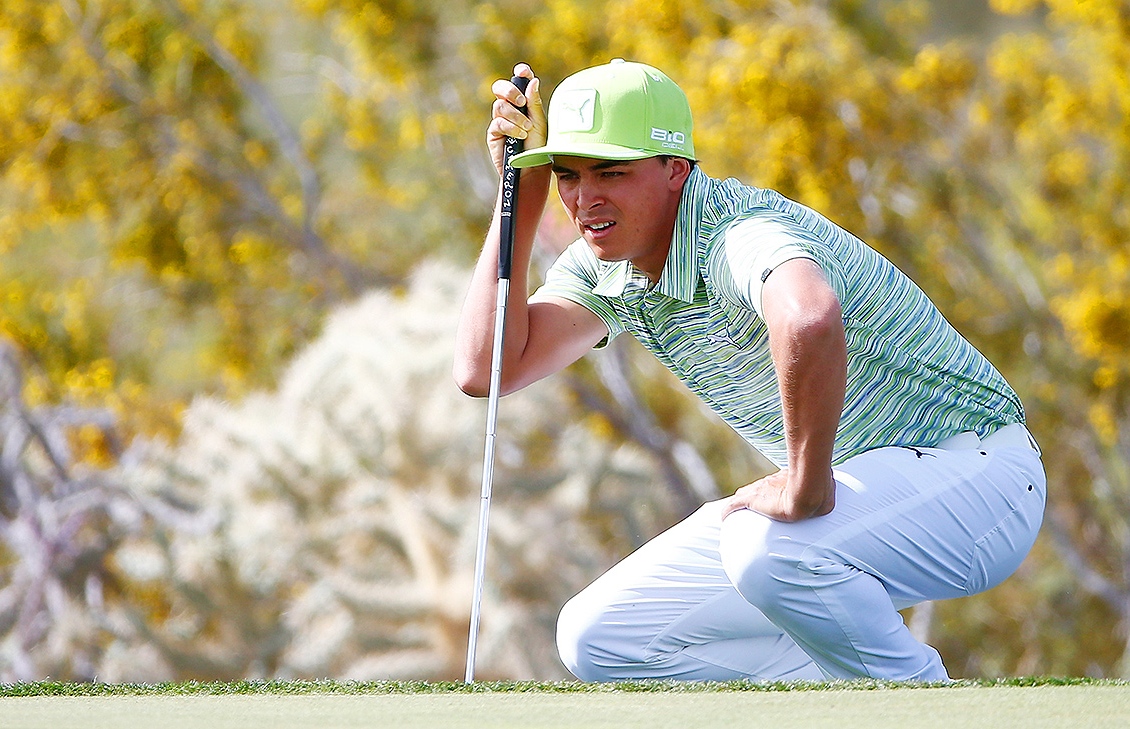
One of the most publicized swing changes this season has been Rickie Fowler’s decision to alter some of his swing mechanics with instructor Butch Harmon.
Fowler had his first career victory in 2012 and finished 40th on the 2013 Money List. Since he began making swing changes with Harmon in December, however, he has missed the cut in three of five events. But Fowler played terrific in his most recent tournament, the WGC-Accenture Match Play Championship, where he finished third. And when I look at Fowler’s metrics, the projections show him playing more like he did at the Accenture Match play than in his previous four events.
First, let’s take a look at Fowler’s rankings in the key scoring metrics in 2013. These rankings are based out of 180 players.
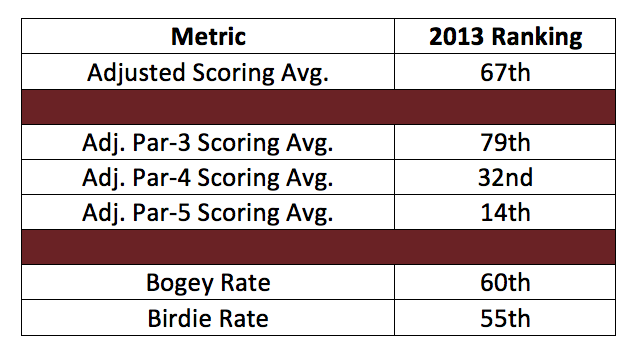
Typically, the ranking in Adjusted Scoring Average and Money List ranking tend to be very similar. If they are a bit off, then the Money List Ranking tends to eventually match the Adjusted Scoring Average ranking. In this case, Fowler’s Adjusted Scoring Average ranking is noticeably worse (67th) than his Money List ranking (40th). This is because Fowler ranked 20th in purse size per event. He was playing in more lucrative events and that allowed him to rank higher in earnings than his Adjusted Scoring Average indicated. However, Fowler had good reason to be concerned since his play in 2013 ran the risk of not being good enough to qualify him for the more lucrative events he was able to play in 2013.
With that said, Fowler’s rankings are pretty solid. Par-4 play is the most important metric, and he performed well on par-4’s in 2013. He also was in the top-10th percentile on the par-5’s. Even his Bogey Rate and Birdie Rate are pretty good. However, he was one of the leaders in double bogeys last year, which is what the bogey rate metric does not quite show. So every time he made a double bogey, he now had to make two birdies in order to break even. Lastly, if he wants to get to an elite status as a golfer, he needs to get into the top-10th percentile in par-4 play and Bogey Rate.
Here are Fowler’s rankings in the key performance metrics in 2013
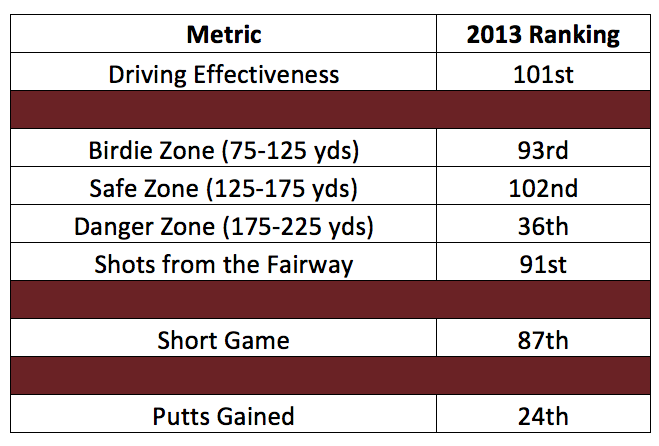
These metrics are not overly impressive, but not poor either. And he was very good at the two parts of the game that correlate most to success on Tour: Danger Zone play and Putts Gained.
When we consider his trouble with double bogeys, I normally take a look at his driving and some key precision metrics:
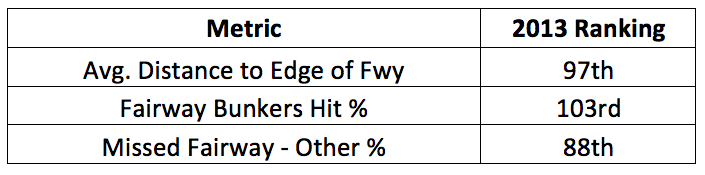
Again, Fowler was not great at these metrics, but he was not poor by Tour standards either. The Missed Fairway – Other % is essentially any tee shot that finds a hazard, O.B. or results in a rescue shot, and he was still better than the Tour average there. However, I did find something very peculiar about his driving with his radar metrics.
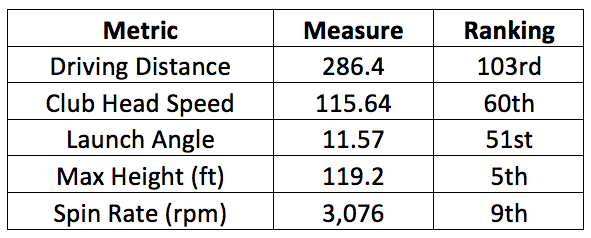
Generally, a golfer’s driving distance ranking and club head speed ranking should come close to matching. If there is a large discrepancy, it is usually due to the golfer hitting upward or downward on the ball. In Fowler’s case, his driving distance is far less than his club head speed ranking. This would indicate that he is hitting down on the ball too much. However, his launch angle and Max Height indicate that he likes to hit up on the ball. Meanwhile, his high spin rate is more indicative a downward attack angle.
So, which is it?
Fowler ranked 55th in Ball Speed and given his ranking in club head speed it indicates that he was making quality strikes with his driver as his smash factor was rather high. I think he probably was hitting up a little on the driver and he was ill-fitted from an equipment standpoint. This would cause the ball to balloon, which would explain his high Max Height and it would come down with a lot of spin so he was not getting any roll. And this was causing Fowler to lose one of his strengths, in his ability to hit the ball far.
Still, I do not see the driving as the major culprit for his double bogey woes. He simply did not miss big off the tee frequently. Instead, I think he had a major problem from the Safe Zone (125-to-175 yards) as he was putting himself in pretty good position off the tee, but only ranked 102nd from that distance. Most of the high birdie makers that are not ‘Bubba-long’ tend to play very well from the Safe Zone and Fowler’s below average play also cost him some birdies. In the end, I could see why Fowler was looking for a new perspective. His game was slipping a little and he probably did not want to have to change too much when it was too late.
Here are his key performance metrics for the 2013-2014 season (out of 174 players):
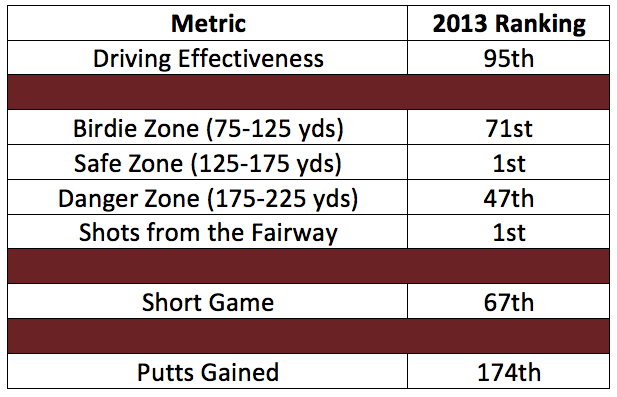
Fowler’s iron play has improved quite dramatically. While he is slightly worse from the Danger Zone, the important metric to keep in mind is shots from the fairway as that is the greatest indicator of a Tour player’s pure iron skill. Fowler ranked 91st in the metric in 2013 and is now the best from the fairway on Tour. So if his Danger Zone play has dropped slightly, it is more due to him hitting a few more shots from the rough.
And while the driving effectiveness is roughly the same, the key radar metrics indicate that it will get better.
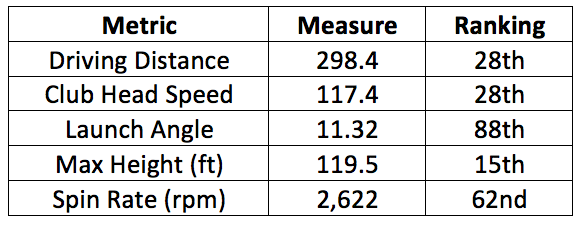
Fowler is not only hitting the ball farther, but he is generating more club head speed. And his driving distance ranking and club head speed ranking match. The other radar metrics are virtually the same except that his spin rate has lowered by about 450 rpm. He has regained his advantage of hitting the ball a long ways and his iron play has greatly improved.
The only thing that has hampered Fowler is his putting, as he currently ranks last in Putts Gained. Here are his rankings in Putts Gained each year since turning pro:
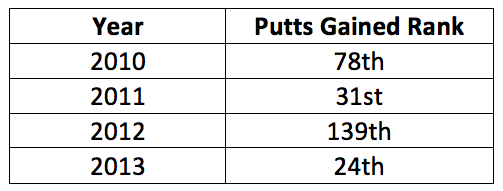
Fowler has been a pretty good putter on Tour throughout his career. I feel that he is on the right path with his ball striking to get to that next level of winning a major. He has regained his power with his driving and has been striking his irons at an elite level. His short game has been sound and the only thing lacking has been his putting, which has probably suffered due to him focusing more of his attention on his swing.
I have my doubts about him contending in the majors this year. But, if he can continue to improve at this rate with his irons, fine tune his driving and get his putting back, Fowler could have a breakout year in 2015.





This past Monday, I played in the U.S. Amateur local qualifier at Rock Creek Country Club in Portland, Oregon. A full tee sheet from 7:30 a.m. to 1:55 p.m., the top 11 scores would make it to the U.S. Amateur final qualifying.
I teed off at 10:48 a.m.. With the 7:30 am tee time, you can get a feel for the leaders’ pace, and they were off and running on the challenging setup at Rock Creek.
View this post on Instagram
Getting to the highlight of the round on the par five 17th, a drive up the left side and 212 yards left to the front hole location. I took out a 5-iron with plans of middle of the green. The ball ended up 8 feet left of the hole, pin high. A slight downhill putt dropped in for an eagle 3 on the 17th. With the cut line looking to be anywhere from -2 to even par. This was the boost I had been waiting for all day.
With making par from the trees on 18, it was time to wait for a potential playoff with a posted score of one under par 71.
Three hours later, it was playoff time. 8 players for 6 spots. I made par on the playoff hole, which was good enough to advance to the U.S. Amateur final qualifying in July. USGA qualifiers sure deliver on all of the emotions in golf!
Club Junkie
Building my 2026 gamer WITB: Ranking the contenders and new putter projects – Club Junkie Podcast

The annual What’s In The Bag build is underway, and on this episode of Club Junkie, Brian breaks down the clubs currently leading the race for a spot in his 2026 gamer setup. From drivers and fairway woods to irons, wedges, and shafts, he ranks the equipment that’s performing best and explains what’s separating the front runners from the rest of the field.
Brian also heads into the workshop to discuss several putter projects currently on the bench. From head options and shaft choices to build ideas and testing plans, he shares what he’s working on and which putters could become serious contenders for the bag this season.
If you’re a gear junkie who loves equipment testing, club building, and the never-ending pursuit of the perfect setup, this episode is for you.
Follow Club Junkie:
Instagram: @clubjunkiepod
TikTok: @clubjunkiepod
Threads: @clubjunkiepod
X: @ClubJunkiePod
Club Junkie
Tour Edge Exotics mini driver review + TaylorMade Spider ZT Max first look – Club Junkie

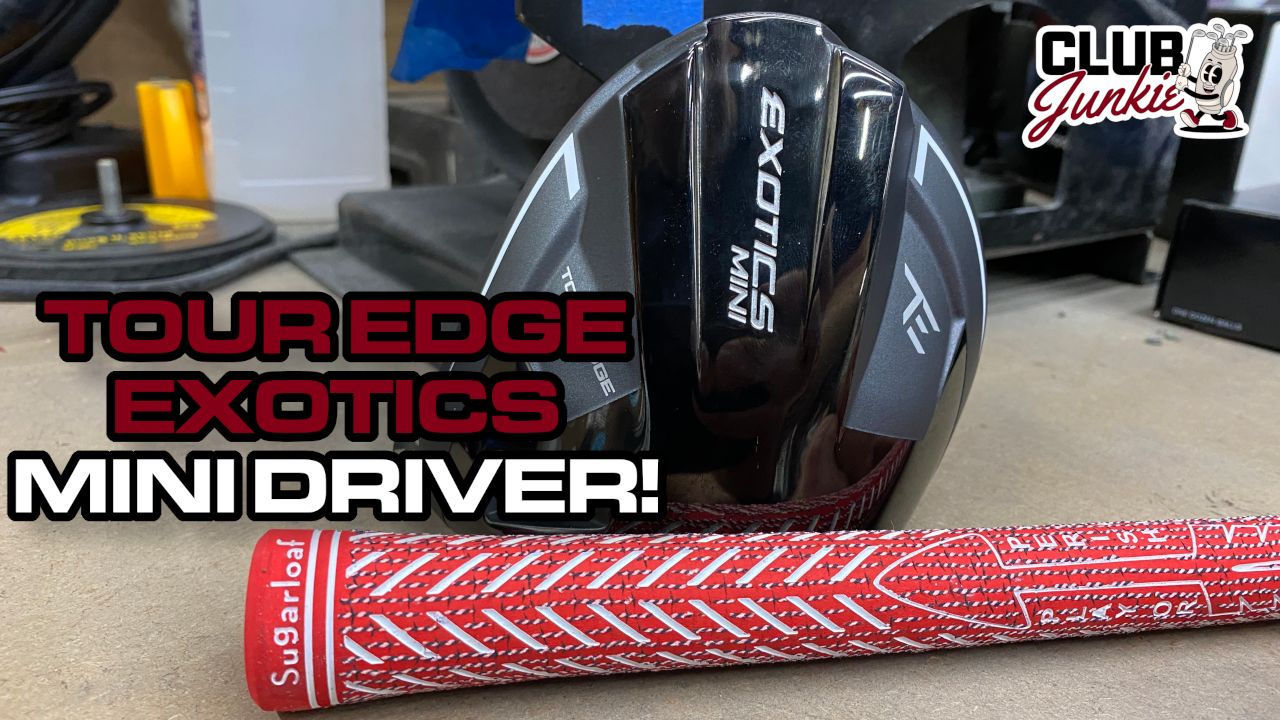
On this episode of Club Junkie, I put the new Tour Edge Exotics Mini Driver to the test and break down the performance, forgiveness, distance, and where it fits compared to a traditional driver or strong fairway wood. If you have been curious about adding a mini driver to the bag, this one is worth a look.
I also dive into the new TaylorMade Spider ZT Max putter that was recently spotted and discuss the growing zero torque putter trend. Plus, there is a closer look at the new Project X Titan Yellow shaft showing up on the PGA Tour and what makes it different from other profiles currently out there.

Justin Rose WITB 2026 (April): Full WITB breakdown with new McLaren irons

What’s the story behind Webb Simpson’s custom-stamped irons?

Memorial Tournament Tour Report: Rory McIlroy, Cameron Young switch up drivers, and more

Cadillac Championship Tour Report: Spieth’s sizable changes, McLaren Golf launches, and more

Russell Henley’s winning WITB: 2026 Charles Schwab Challenge

Kristoffer Reitan’s winning WITB: 2026 Truist Championship

Best irons 2026: Best irons overall, most forgiving irons, and more

J.T. Poston’s winning WITB: 2026 Memorial Tournament

Aaron Rai’s winning WITB: 2026 PGA Championship

Cameron Young’s winning WITB: 2026 Cadillac Championship


Ryan Palmer WITB 2026 (June)
Driver: Callaway Quantum Triple Diamond (9 degrees) Shaft: Project X HZRDUS Smoke Blue RDX 60 TX 3-wood: TaylorMade Qi10 (15 degrees) Shaft:...


Bud Cauley WITB 2026 (June)
Bud Cauley had >14 clubs in his bag when photographed prior to the Memorial Tournament. Driver: Titleist GTS2 (8 degrees) Shaft: Fujikura...


Hannah Green WITB 2026 (June)
Driver: Titleist GTS3 (10 degrees, D4 SureFit setting) Shaft: Mitsubishi Chemical Diamana RB 53 S 3-wood: Titleist GT3 (15 degrees,...


Asterisk Talley WITB 2026 (June)
Driver: TaylorMade Qi4D (9 degrees) Shaft: Fujikura Ventus Blue 6 S 3-wood: TaylorMade Qi4D (16.5 degrees) Shaft: Fujikura Ventus Blue...
-
 Equipment6 days ago
Memorial Tournament Tour Report: Rory McIlroy, Cameron Young switch up drivers, and more
-
 News2 weeks ago
Russell Henley’s winning WITB: 2026 Charles Schwab Challenge
-
 Equipment3 days ago
Best irons 2026: Best irons overall, most forgiving irons, and more
-
 Whats in the Bag4 days ago
J.T. Poston’s winning WITB: 2026 Memorial Tournament
-
 Equipment1 week ago
Details on Jason Day’s latest prototype Avoda iron setup
-
 Equipment3 weeks ago
CJ Cup Byron Nelson Tour Report: Koepka and Kim’s newest putters finally get hot
-

 News2 weeks ago
Charles Schwab Challenge Tour Report: MacIntyre, Åberg and Spaun all switch putters, TaylorMade launches new Spider
-
 Equipment2 weeks ago
Details on J.J. Spaun’s surprise putter switch

