
Opinion & Analysis
The myth behind the “one-way miss”

We often hear from professional golfers how important it is to have a “one way miss’”and to be able to “take one side of the golf course out of play” in order to drive the ball more effectively. However, statistical evidence indicates that this is not quite an accurate depiction of how the best golfers in the world effectively drive the ball.
A metric that I have explored quite frequently is “miss bias.” This is the percentage of time a player misses a fairway right or left. What I have found is that there is no direction that is better to miss the fairway. Having a right miss bias is equal to having a left miss bias. Typically, what is more important is the ratio of the miss bias.
I feel the best indicator of driving success is to look at the top players in my “Driving Effectiveness” ranking. Driving Effectiveness is based on algorithm that considers the following metrics:
- Driving distance
- Fairway percentage
- Average distance from the edge of fairway (on drives that miss the fairway)
- Percentage of fairway bunkers hit
- Missed fairways and other (shots that end up in the trees, water, O.B, etc.)
Here is a table with the current top-20 players in Driving Effectiveness and their Miss Bias.
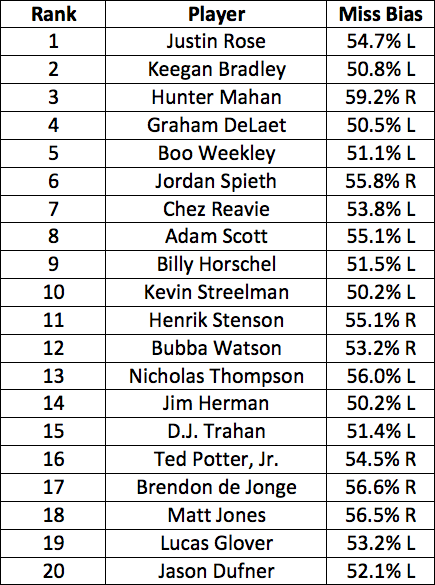
As the chart shows, 13 of the top-20 ranked players have a miss bias that is no more than 55 percent either way.
Now, let’s look at this year’s players with miss biases that are greater than 60 percent and their rankings in Driving Effectiveness.
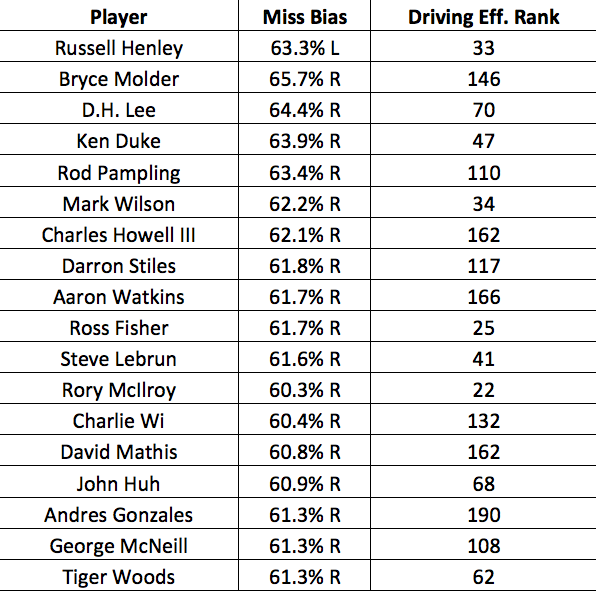
Tour golfers can strike the ball well off the tee with a large miss bias, however, not one of these players on the list is ranked in the top 20 in Driving Effectiveness. Furthermore, let’s take a look at the players on that list that played last on the Tour last season.
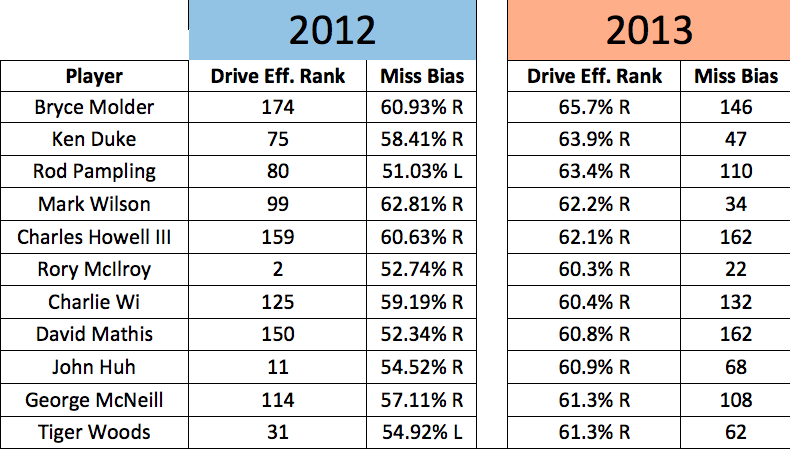
The chart shows that if the player’s miss bias in 2012 was less than 60 percent, they were typically more effective off the tee. Rod Pampling, Rory McIlroy, John Huh and Tiger Woods are examples of golfers that had a miss bias less than 60 percent in 2012 and also drove the ball much more effectively as well.
What the data tells me is that trying to taking one side “out of play” is not great advice if you wish to be an effective driver of the ball. There are likely too many holes where the golfer has to favor the right side or the left side.
What I’ve seen from my tour players is that having a “one-way miss” is actually more about having a “one-way curve.” If a golfer tend to hit a draw with their stock swing, they’ll be best served to continue to hit draws or straight balls off the tee. When many golfers try to alternate between draws and fades, however, they often risk getting into trouble and being less effective off the tee.
If a player has a more extreme miss bias, that tends to indicate a common “big miss” that they cannot rid themselves of. And that miss may cost them down the line.
I recommend that amateur golfers forget about having a “one-way miss.” They need to concern themselves with getting the ball to curve one way, and identify that common “big miss” and work to make it a smaller one.





This past Monday, I played in the U.S. Amateur local qualifier at Rock Creek Country Club in Portland, Oregon. A full tee sheet from 7:30 a.m. to 1:55 p.m., the top 11 scores would make it to the U.S. Amateur final qualifying.
I teed off at 10:48 a.m.. With the 7:30 am tee time, you can get a feel for the leaders’ pace, and they were off and running on the challenging setup at Rock Creek.
View this post on Instagram
Getting to the highlight of the round on the par five 17th, a drive up the left side and 212 yards left to the front hole location. I took out a 5-iron with plans of middle of the green. The ball ended up 8 feet left of the hole, pin high. A slight downhill putt dropped in for an eagle 3 on the 17th. With the cut line looking to be anywhere from -2 to even par. This was the boost I had been waiting for all day.
With making par from the trees on 18, it was time to wait for a potential playoff with a posted score of one under par 71.
Three hours later, it was playoff time. 8 players for 6 spots. I made par on the playoff hole, which was good enough to advance to the U.S. Amateur final qualifying in July. USGA qualifiers sure deliver on all of the emotions in golf!
Club Junkie
Building my 2026 gamer WITB: Ranking the contenders and new putter projects – Club Junkie Podcast

The annual What’s In The Bag build is underway, and on this episode of Club Junkie, Brian breaks down the clubs currently leading the race for a spot in his 2026 gamer setup. From drivers and fairway woods to irons, wedges, and shafts, he ranks the equipment that’s performing best and explains what’s separating the front runners from the rest of the field.
Brian also heads into the workshop to discuss several putter projects currently on the bench. From head options and shaft choices to build ideas and testing plans, he shares what he’s working on and which putters could become serious contenders for the bag this season.
If you’re a gear junkie who loves equipment testing, club building, and the never-ending pursuit of the perfect setup, this episode is for you.
Follow Club Junkie:
Instagram: @clubjunkiepod
TikTok: @clubjunkiepod
Threads: @clubjunkiepod
X: @ClubJunkiePod
Club Junkie
Tour Edge Exotics mini driver review + TaylorMade Spider ZT Max first look – Club Junkie

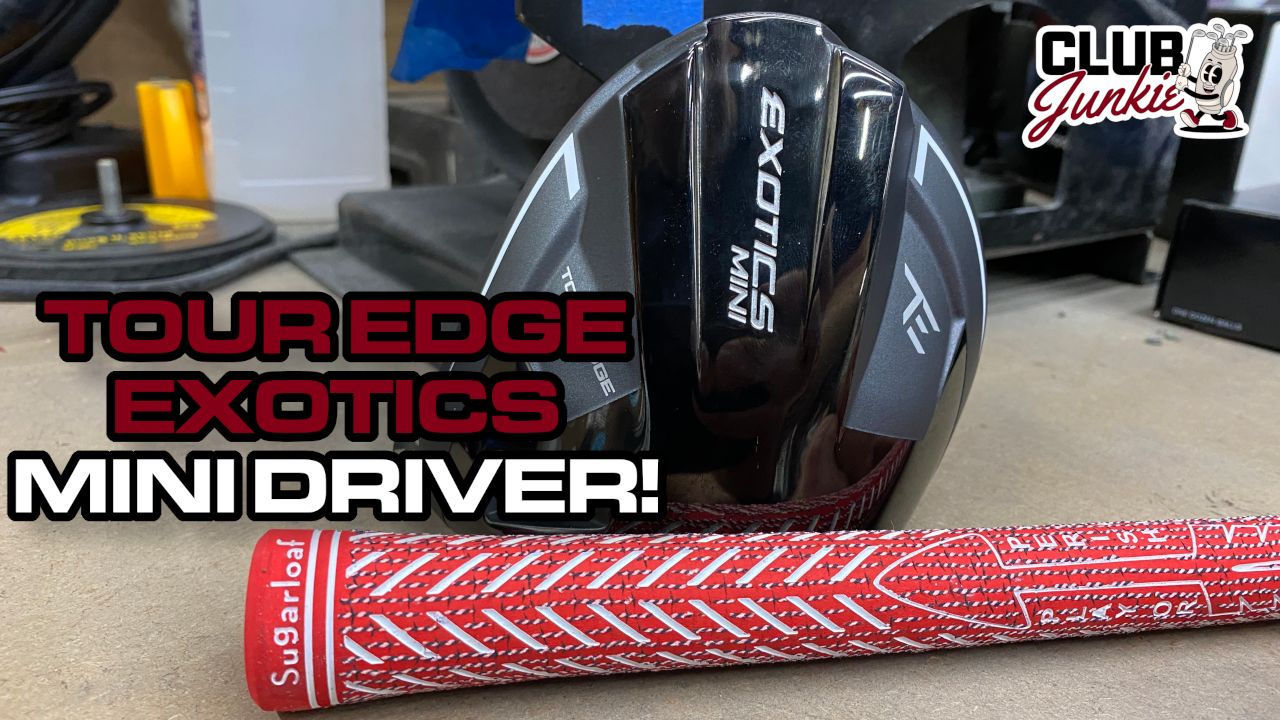
On this episode of Club Junkie, I put the new Tour Edge Exotics Mini Driver to the test and break down the performance, forgiveness, distance, and where it fits compared to a traditional driver or strong fairway wood. If you have been curious about adding a mini driver to the bag, this one is worth a look.
I also dive into the new TaylorMade Spider ZT Max putter that was recently spotted and discuss the growing zero torque putter trend. Plus, there is a closer look at the new Project X Titan Yellow shaft showing up on the PGA Tour and what makes it different from other profiles currently out there.

Justin Rose WITB 2026 (April): Full WITB breakdown with new McLaren irons

What’s the story behind Webb Simpson’s custom-stamped irons?

Memorial Tournament Tour Report: Rory McIlroy, Cameron Young switch up drivers, and more

Cadillac Championship Tour Report: Spieth’s sizable changes, McLaren Golf launches, and more

Russell Henley’s winning WITB: 2026 Charles Schwab Challenge

Kristoffer Reitan’s winning WITB: 2026 Truist Championship

Aaron Rai’s winning WITB: 2026 PGA Championship

Cameron Young’s winning WITB: 2026 Cadillac Championship

J.T. Poston’s winning WITB: 2026 Memorial Tournament

Best irons 2026: Best irons overall, most forgiving irons, and more


Bud Cauley WITB 2026 (June)
Bud Cauley had >14 clubs in his bag when photographed prior to the Memorial Tournament. Driver: Titleist GTS2 (8 degrees) Shaft: Fujikura...


Hannah Green WITB 2026 (June)
Driver: Titleist GTS3 (10 degrees, D4 SureFit setting) Shaft: Mitsubishi Chemical Diamana RB 53 S 3-wood: Titleist GT3 (15 degrees,...


Asterisk Talley WITB 2026 (June)
Driver: TaylorMade Qi4D (9 degrees) Shaft: Fujikura Ventus Blue 6 S 3-wood: TaylorMade Qi4D (16.5 degrees) Shaft: Fujikura Ventus Blue...

Brianna Do WITB 2026 (June)
Driver: Callaway Quantum Triple Diamond (9 degrees) Shaft: KBS PGW 3-wood: Callaway Elyte Titanium (15 degrees) Shaft: KBS PGW 5-wood:...
-
 Equipment5 days ago
Memorial Tournament Tour Report: Rory McIlroy, Cameron Young switch up drivers, and more
-
 News1 week ago
Russell Henley’s winning WITB: 2026 Charles Schwab Challenge
-
 Whats in the Bag3 days ago
J.T. Poston’s winning WITB: 2026 Memorial Tournament
-
 Equipment3 days ago
Best irons 2026: Best irons overall, most forgiving irons, and more
-

 Equipment1 week ago
Details on Jason Day’s latest prototype Avoda iron setup
-
 Equipment3 weeks ago
CJ Cup Byron Nelson Tour Report: Koepka and Kim’s newest putters finally get hot
-

 News2 weeks ago
Charles Schwab Challenge Tour Report: MacIntyre, Åberg and Spaun all switch putters, TaylorMade launches new Spider
-
 Equipment2 weeks ago
Details on J.J. Spaun’s surprise putter switch


Pingback: Tips in Beating a Pro Golfer – Aymerich Golf Club
TheFightingEdFioris
Sep 4, 2014 at 1:28 pm
Cool article by the way. Always enjoy your writing.
TheFightingEdFioris
Sep 4, 2014 at 1:28 pm
No look into what they actually scored on the hole and/or the actual distance they missed the fairway by? Were Tiger’s driving stats better in 2012 when he missed it left more than right? Apparently… But did the left miss cost him a shot in a few tournaments? Absolutely (see 2012 PGA when Rory missed left off the tee basically zero times)
I am not disagreeing, you’ve clearly done a lot more homework on this than I have. But would you agree Rich that the biggest advantage to feeling that you have a one way miss is mental? To stand on a tee box and know you can swing as hard as you want and not even sniff the OB left, or not worry about blocking it high and right.
Jtriscott
Aug 7, 2013 at 12:06 pm
I think this is pretty simple…
There is usually a side on the hole that is a much better miss (ie, hazard, OB, etc).
For the RH golfer:
If the good miss is RIGHT, I just weaken my grip and make sure I am not going to HOOK the ball.
If the good miss is LEFT, I strengthen my grip and make sure I am not going to SLICE the ball.
It works all the time, 60% of the time!
Geoffrey
Apr 9, 2014 at 12:09 pm
Is there any way to interpret a players extreme left vs right miss tendency to determine if a player’s primary shot is a draw vs a fade?
Mike
Jul 31, 2013 at 9:01 pm
This article could not be more on point! The best players know which direction their ball will curve on less than perfect shots. When they talk about eliminating one side of the course, what they mean is eliminating one direction the ball will curve on their poor shots. And Matteo, as a club fitter you should know that tour players have their own clubs built with exactly this in mind. Nice article.
CT
Jul 31, 2013 at 11:22 am
“What I’ve seen from my tour players is that having a “one-way miss” is actually more about having a “one-way curve.” ”
You should make that the title of the article, and the first sentence summary to set the writing, because this information is great stuff. Because that what it is – it’s all about the favored curve.
Richie Hunt
Jul 31, 2013 at 2:22 pm
Thanks for the kind words. I had a little difficulty coming up with a good title.
Dustin
Jul 30, 2013 at 8:52 pm
The one way miss is a draw or fade. I can miss a fade down the left and a draw down the right. Point is I want a shot that I know will fade or draw.
Steve
Jul 30, 2013 at 5:53 pm
Good article…working with tour players it makes perfect sense. Keep sharing 🙂
Brian
Jul 30, 2013 at 12:09 pm
While the data is interesting, I think the conclusion you are drawing from it is a bit heavy. Just because a player misses in one direction more often off the tee, doesn’t mean they are neccesarily trying to miss in that direction. And, in my opinion, a player, especially a pro, who is truly trying to “miss” in one direction would see something more like 70/30 at the worst, not 60/40. With that said, from the pro golf that I’ve watched in person, most pros are paying no attention to the old addage and just hitting towering bombs right down the pipe. With the low spin driver and ball technology available, and the caliber of swings, it just seems to be the norm. Perhaps the approach data is more rellevant?
Also, the math behind what you consider a “myth” is that if you can eliminate one side of the course, your bigger misses are less threatening. Think about it. If you have a 20 yard wide fairway, and you know you won’t miss left, you can aim at the left side of the fairway and afford a 0-20 yard miss to the right side of the fairway. If you have no bias, then you aim down the middle, and you can afford a 0-10 yard miss in either direction.
And let’s be honest, nobody, not even the pros, can truly eliminate one side of the course. If a RH golfer has a trusty fade, at some point they are going to double cross and yank one left. That’s the true definition of a miss, otherwise it’s just a shot shape.
Richie Hunt
Jul 31, 2013 at 9:08 am
Brian,
I agree with what you are saying about the player ‘not trying to miss in that direction.’ I think those with a larger miss bias are likely struggling with a shot that does not prevent them from missing towards that bias.
Dixie Flatline
Jul 30, 2013 at 9:58 am
I think the author is taking the phrase “one way miss” and “taking one side of the golf course out of play” too literally. Those phrases are used in a discussion of ball flight off the tee, not where the ball actually lands.
Richie Hunt
Jul 30, 2013 at 10:05 am
Perhaps that is the case and I can respect your opinion on that. I know that when discussing this with some golfers, even some of my Tour clients, they think of it in very literal terms.
The main point I was trying to convey is that the miss biases on Tour are not as pronounced as some people tend to think it is and those with more pronounced miss biases tend to not hit it as well off the tee.
steff
Jul 30, 2013 at 9:23 am
A one way miss has nothing to do with the fairway! It depends on were you aim and the knowlage the if you miss it wont go left or right.
Example: You have OB left but you open up the hole the more left you aim.
This is were a “one way miss” comes in handy. You can aim close to the OB and you feel confident that if you hit it good it will go were you aim. But a miss will never go OB! A bad shot will allways go to the right and not OB.
Jokke
Jul 30, 2013 at 3:38 am
I totally agree with the above comments that the data used in this article has nothing to do with one-way misses. None whatsoever.
stephenf
Jul 30, 2013 at 3:33 am
It may be that the secondary goal of “taking one side out of play” isn’t particularly valid, but the primary reason to establish a go-to consistent curve is simply that you’ll have the whole width of a fairway to miss (or something close to it) rather than only half the fairway (as happens if you don’t know which way you’re likely to curve it, and you have to hit it down the middle and hope for the best).
Mateo
Jul 30, 2013 at 1:33 am
Wow. utterly pointless article.
This dude must be a 25 handicap.
Eliminating a side of the golf course has nothing to do with what side of the fairway you miss. It has to do with the 15 of variables he obviously will never understand.
As a teacher, a club fitter, a golf nut, and a scratch player with years of tourney experience……………. I advise everyone to disregard this article.
Richie Hunt
Jul 30, 2013 at 10:01 am
I fully stand behind what I have written.
The article is discussing about missing either left or right. The ‘one way miss’ is often described as if you miss, you miss one direction or the other (left or right).
As we can see, once the ratio is greater than 55/45 the player tends to become less effective off the tee. Particularly as the ratio gets to 60/40 or even a greater discrepancy.
I even stated in this very article that there is no difference in somebody who tends to miss left versus misses right. It’s the size of the ratio that matters more.
Why?
I know the obvious variables that can come into play with the way a hole is designed. But the *point* that has been missed is that in general, Tour players do not have very pronounced miss biases and the ones that do; generally do not drive the ball as well.
And I do not think it’s fair to assume that I’m a 25 handicapper just like it would not be fair for me to assume that you are a poor instructor because you were unable to comprehend my obvious points.
Nick
Jul 30, 2013 at 4:35 pm
Haha, you must be trolling dude. Either that or you like to run your mouth about people you don’t know.
Nick
Jul 30, 2013 at 4:36 pm
My previous comment was directed at Mateo if that wasn’t clear.
Mat
Jul 29, 2013 at 7:03 pm
Very low correlation here.
Imagine a hole that goes water-rough-fw-rough. Player aims centre-right to ensure that only a left miss would be a strong left miss to get wet. Whether the player hits the fairway or not is almost irrelevant; it’s that the ball isn’t wet.
If you’re not sure why, flip the hole; rough-fw-rough-water. It’s effectively even.
If you want to study misses like this, correlate the number of penalising hazards a player hits vs their average fairways hit. In other words, do they put it in the water more because they ignore the one-way miss. Or, an even stronger cause-effect is to see how often players miss to the opposite side of water in the rough.
Bryce Molder, at 66%, simply means he misses right more often when he misses at a rate of not quite 1 in 3. Assuming he hits 8 of 14 in a round, that means that he’s going to miss 4 right, 2 left. Just one shot per round would flip that, and he’s the worst there is.
I’m not buying this one as-is.
Richie Hunt
Jul 30, 2013 at 10:10 am
Mat,
I think you’re missing the point that players with more pronounced miss biases tend to be less effective off the tee. I also point out players like Tiger, Rory, John Huh and Rod Pampling as players whose miss biases became much more pronounced this year and they are now less effective off the tee.
My Driving Effectiveness algorithm takes into consideration shots that go in hazards (i.e. Missed Fairway – Other %) and fairway bunkers hit % as well as Avg. Distance from Edge of Fairway. I could certainly look at the correlation just between miss bias and Missed Fairway Other and fairway bunker %, but the big picture here is that when it comes to all of the main factors that relate to effectiveness off the tee; the bigger miss biases tend to make golfers less effective off the tee.
Brian
Jul 29, 2013 at 5:40 pm
I think you missed the point of having a one way miss. It’s not so much which side you miss it on, it’s that is usually the same side that you miss it on.
The point is to always miss right, or always miss left. The side doesn’t matter, just that you aren’t missing left half the time and right half the time. These stats have absolutely nothing to do with the point of a one way miss.
Nick
Jul 30, 2013 at 4:29 pm
Did you read his article? He’s saying that while people say exactly what you said, a statistical review of the best drivers shows most have no more than a five percent favoritism towards missing on one side as opposed to the the other, which many who have a much stronger statistical favoratism for one side (i.e. the guys who seem to be the best able to take one side or the other out of play) are not ranking high on driving effectiveness.
I think the issue is that a one sided driver of the ball will simply accrue less penalties, not necessarily find the fairway the best. You can find more fairways but I’ll take multiple shots out of the rough over a rinsed tee shot or god forbid OB or LB and a retee. Obviously the goal would be to find the fairway, but you can drastically improve your scoring by cutting out penalties if your game features a penality drive or two a round. You could esily be shaving upwards of two – four strokes on eliminating two bad swings that find water and force a drop way back or land OB.
Andy
Aug 8, 2013 at 7:57 pm
You didn’t even read the article dude.
Jeff
Jul 29, 2013 at 5:21 pm
on most golf holes, there is a side that is a worse miss than others. i think in general you see that professional golfers play the odds more than anything else. if there is OB left and lateral hazard right, a right miss is better, but that could just as easily be switched. therefore, having a “one side out” that ignores the particular hole seems worse to me than trying to hit a shot for the hole. i play (and i think most pros play) to a spot that is safe and then work the ball away from the worst trouble. whether it’s right or left, stay away from the worst trouble.